Contents
Make sure to check out Ballot Box Scotland’s Holyrood Hub page for polling, analysis and updates ahead of the 2026 Scottish Parliament election.
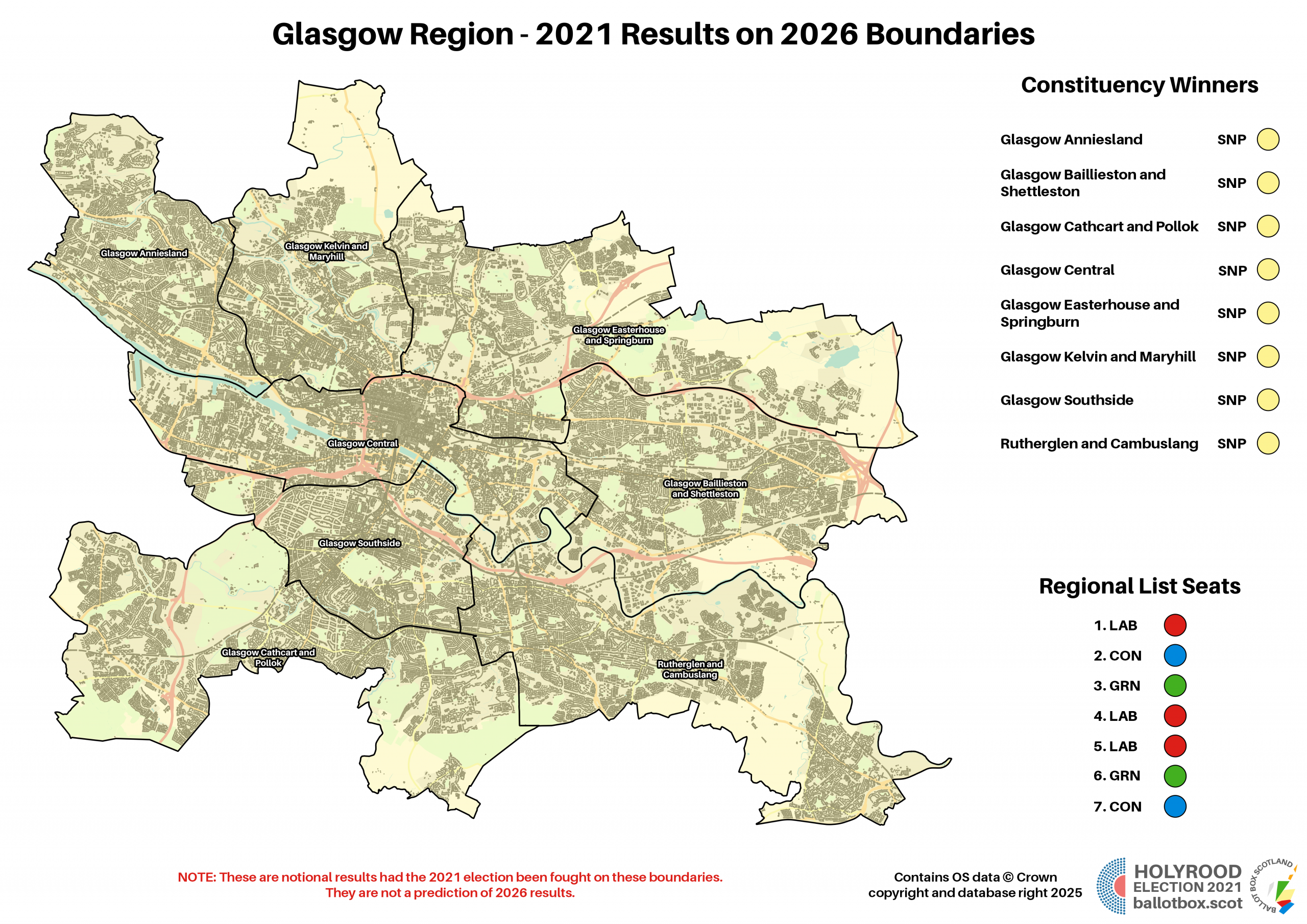
Region Map
Region Description
This is one of the most significantly redrawn regions under the new boundaries, reflecting the fact that the balance of Scotland’s population has been moving eastwards. Glasgow City Council has never been a whole region by itself, with the Rutherglen, Cambuslang and Blantyre areas of South Lanarkshire Council bolted on to this and the 2011 version. When created in 1999 however, it didn’t have Blantyre and the boundaries matched the pre-1995 Glasgow City Council, so it wasn’t completely nonsensical.
Things have shifted so much in the past few years though that the existing region found itself in the awkward situation of having too few voters to justify 9 constituencies, as far as Boundaries Scotland were concerned, but too many for 8. The solution? As at Westminster, Cardonald is part of a Renfrewshire constituency and thus sits within the West region. So now, we’ve got a Glasgow region that only covers 95% of the actual city, but does have a whole constituency outside it. First Past the Post, everybody!
What to Watch For in 2026
Although Glasgow was one of the few parts of Scotland to vote Yes to Independence in 2014, it’s actually very similar to lots of northern English cities. That means Labour being historically dominant, the Conservatives and Lib Dems gradually fading, but also the Greens becoming increasingly strong in the new millennium. Ultimately Labour’s dominance would be replaced by the SNP’s, which means that following the former’s resurgence at Westminster, there are opposing clean sweeps here: the SNP holding every Holyrood constituency, and Labour every Westminster seat.
Labour’s stumbles since taking up residence at 10 Downing Street have significantly reduced the chances of them repeating the feat this time around. There’s one seat that’s a comparatively easy pickup (the non-Glasgow one, funnily enough), and then the rest are 20% or higher SNP majorities. Hard as that may be for Labour to overcome, it does mean that like Westminster, they all fall like dominos if they can do so. Neither party will proportionally deserve to win them all though, and will distort the outcome significantly if they do.
Having come third in the city but not the region in 2021, the Greens will be hoping to solidify their status as the third force following the Conservative collapse. Narrowly missing out on a second seat on the 2021 boundaries, they are notionally defending even more narrowly having won it on the new boundaries. I could explain at length why that is, or I could send you to the Cardonald results at the 2022 election and let that speak for why it’s bad for Labour and good for the Greens that’s been shunted into West.
On the right of the political spectrum, in this region more than any other the Conservatives are in extreme danger of being completely supplanted by Reform UK. In 2024 they didn’t even win 5% across the region, and a similar performance at Holyrood would mean failing to win a single MSP here for the first time ever. For their part, Reform won’t do as well here as elsewhere in the country, but particularly on the periphery of Glasgow itself they will do very well and could therefore still win a couple of MSPs.
Last and certainly least of the big parties in this region, the Lib Dems were wiped out of Glasgow in 2011 and there’s very little indication they have any realistic prospect of mounting a comeback.
Notional 2021 Constituency Vote
Notional 2021 Regional Vote
Notional 2021 Seat Winners
Constituency
Glasgow Anniesland: SNP
Glasgow Baillieston and Shettleston: SNP
Glasgow Cathcart and Pollok: SNP
Glasgow Central: SNP
Glasgow Easterhouse and Springburn: SNP
Glasgow Kelvin and Maryhill: SNP
Glasgow Southside: SNP
Rutherglen and Cambuslang: SNP
Regional List
1: Labour
2: Conservative
3: Green
4: Labour
5: Labour
6: Conservative
7: Green
Glasgow: 2021 Notional Results (Regional Vote)
Glasgow: 2021 Notional Results (Constituency Vote)
1999 to 2011 Boundaries
Elections in 1999, 2003 and 2007 for Glasgow were fought on boundaries that covered the whole of Glasgow and part of South Lanarkshire around Rutherglen and Cambuslang.
Labour unsurprisingly won every constituency in the region at the first election, though they weren’t proportionally due such a result. Most of the list seats went to the SNP, plus one each for the Conservatives and Lib Dems. The SSP also unexpectedly saw success for Tommy Sheridan, who’d made a name for himself in the anti-Poll Tax campaign. The particular system of PR that was selected for Holyrood was expected to be proportional amongst the existing four big parties, not to let upstarts in.
In 2003’s “Rainbow Parliament” Labour were even less due their clean sweep of constituencies, whilst the SSP were nipping at the SNP’s heels with both parties winning two MSPs but, proportionally, due three. Future Green Co-Leader Patrick Harvie was also first elected at this outing, alongside the continuing Conservative and Lib Dem MSPs.
2007 saw the SNP strike at the first chink in Labour’s armour, as Nicola Sturgeon managed to prise the Glasgow Govan seat from their grasp. With Tommy Sheridan having blown the SSP to smithereens and failing to be re-elected under his new Solidarity banner, the SNP effectively picked up both SSP seats, leaving the Lib Dems, Conservatives and Greens unchanged.
2011 to 2026 Boundaries
Elections in 2011, 2016 and 2021 for Glasgow were fought on boundaries that covered the whole of Glasgow and part of South Lanarkshire around Rutherglen, Cambuslang and Blantyre.
Although it may not look as dramatic in hindsight given 2015 and beyond, the shock of the SNP’s win in Glasgow in 2011 cannot be overstated. Not only holding the redrawn Southside seat but gaining Anniesland, Cathcart, Kelvin, and Shettleston, leaving Labour with just Maryhill and Springburn, Pollok, Provan, and Rutherglen was a huge moment. Apart from anything else, it ensured proportionality across all seats for the first time, but with the Lib Dems in freefall the smaller party delegation was reduced to just one each for the Greens and soon-to-be Conservative leader Ruth Davidson.
The SNP swept the constituency board in 2016, but unlike when Labour used to do that, they proportionally deserved to do so. That cut Labour down to just four MSPs overall, as resurgent Conservatives easily beat the Greens to a double.
There were no changes in 2021, though the Greens came extremely close to a second MSP and were proportionally due it, missing out as the SNP this time did exceed their fair share of seats.
Candidates in both this section and individual constituencies are marked if they are an incumbent MSP:
- (*C): Incumbent for that constituency, or equivalent if significantly impacted by boundary changes
- (*OC): Incumbent for another constituency
- (*L): Incumbent on the list
2026 Total Candidate Numbers
Glasgow: 2026 Regional List Candidates
The six parties expected to win seats in the Scottish Parliament in 2026 are listed in order of national support in 2021. Remaining parties are in alphabetical order, and Independents listed last.
Candidates that are contesting both the List and Constituency ballot have their constituency noted after their name on the list.
- Alison Thewliss (Glasgow Central)
- Ivan McKee (*C, Glasgow Easterhouse and Springburn)
- Kaukab Stewart (*C, Glasgow Southside)
- David Linden (Glasgow Baillieston and Shettleston)
- Graham Campbell
- Colm Merrick (Glasgow Anniesland)
- Declan Blench
- Zen Ghani (Glasgow Cathcart and Pollok)
- Annette Christie
- Abdul Bostani
- Adekemi Giwa
- Qasim Hanif
- Annie Wells (*L, Rutherglen and Cambuslang)
- Sandesh Gulhane (*L, Glasgow Anniesland)
- Ross Hutton (Glasgow Southside)
- Kyle Park (Glasgow Cathcart and Pollok)
- John Murray (Glasgow Baillieston and Shettleston)
- Josephine Macleod (Glasgow Easterhouse and Springburn)
- Daniel Bowman (Glasgow Kelvin and Maryhill)
- Anas Sarwar (*L, Glasgow Cathcart and Pollok)
- Pauline McNeill (*L, Glasgow Baillieston and Shettleston)
- Paul Sweeney (*L, Glasgow Easterhouse and Springburn)
- Monica Lennon (*L, Rutherglen and Cambuslang)
- James Adams (Glasgow Kelvin and Maryhill)
- Vonnie Sandlan (Glasgow Central)
- Eunis Jassemi (Glasgow Anniesland)
- Patrick Harvie (*L)
- Holly Bruce (Glasgow Southside)
- Iris Duane (Glasgow Kelvin and Maryhill)
- Rana Noor Mohamed
- Kit Renard
- Isabel Ruffel
- Daniel Khan-O’Malley (Glasgow Kelvin and Maryhill)
- Paul Kennedy (Glasgow Central)
- James Speirs (Glasgow Anniesland)
- Rachel Park (Glasgow Southside)
- Peter McLaughlin (Glasgow Cathcart and Pollok)
- Amy Carman (Glasgow Baillieston and Shettleston)
- Verity Wooley
- Thomas Kerr (Glasgow Baillieston and Shettleston)
- Kim Schmullian (Glasgow Cathcart and Pollok)
- Audrey Dempsey (Glasgow Easterhouse and Springburn)
- Allan Lyons (Rutherglen and Cambuslang)
- Paul Bennie (Glasgow Central)
- Aimee Alexander (Glasgow Kelvin and Maryhill)
- Sean O Hagan (Glasgow Anniesland)
- Gordon Millar (Glasgow Southside)
- Tommy Sheridan
- Dhruva Kumar
- Gail Sheridan
- Hilda McMahon
- John Cormack
- Kamran Butt (Glasgow Southside)
- Adnan Rafiq (Glasgow Cathcart and Pollok)
- Thomas Adkins (Glasgow Kelvin and Maryhill)
- Kenneth Nwosu (Glasgow Easterhouse and Springburn)
- Andrew Brady
- John McArthur
- Michael O’Hara
- Agnes Gallagher
- Paul Steele
- Alistair McConnachie
Note: Independent Green Voice are a front group for a bunch of Glasgow bampots, led by someone (this candidate) who was expelled from UKIP for alleged Holocaust denial. They are standing purely as a spoiler party in this election, targeting the legitimate Scottish Green Party, and their simple one candidate per region slate is further evidence of this dodgy dealing.
- Liam McLaughlan
- Olivia Murphy
- Bill Bonnar
- Donald MacKay
- Ian Garbutt
- Lynda Davis
- Laurence Keeley
- Yvonne Ridley (Glasgow Southside)
- George Galloway
- Catherine McKernan
- Laura Jones
- Craig Houston
- Elspeth Kerr
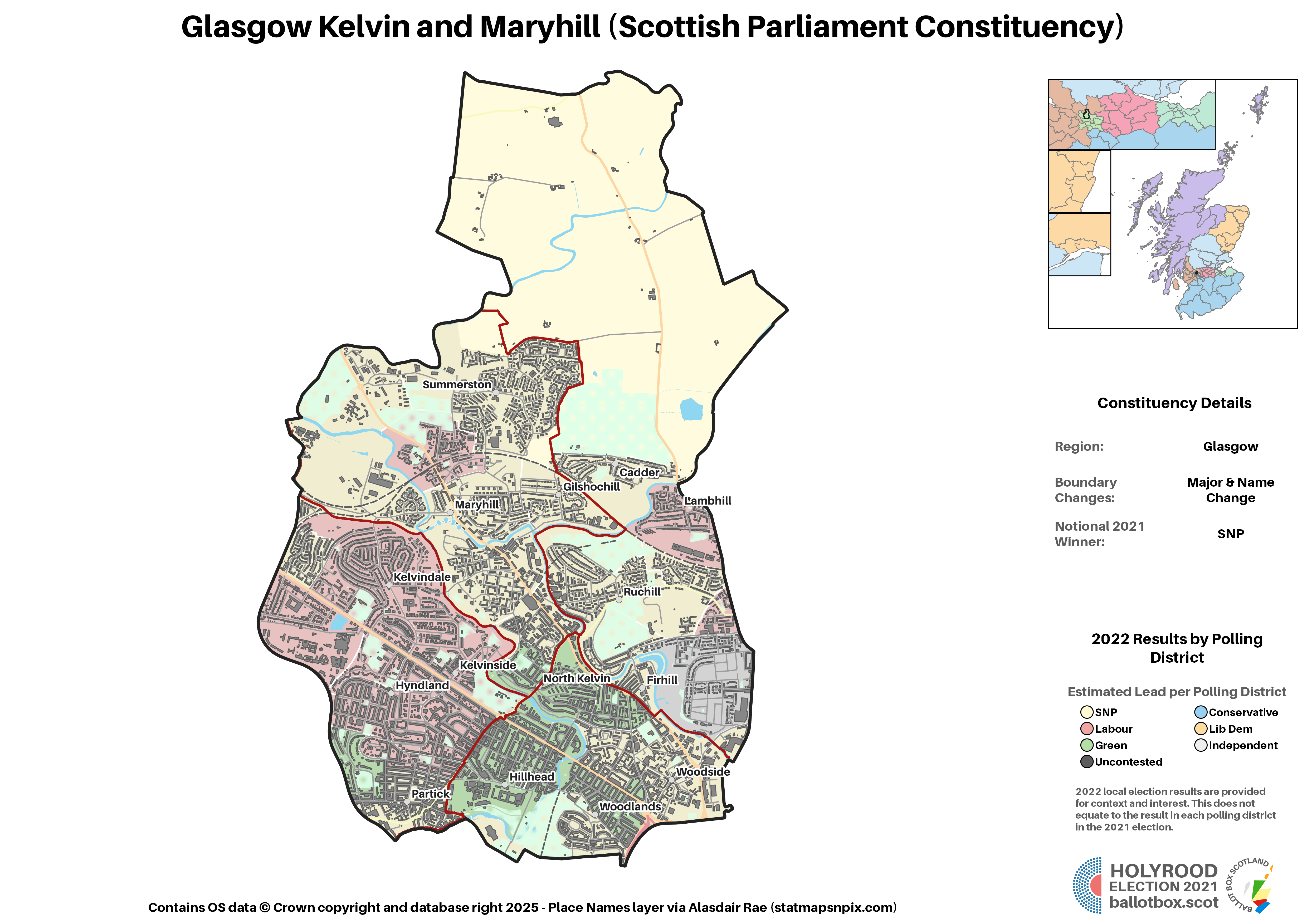
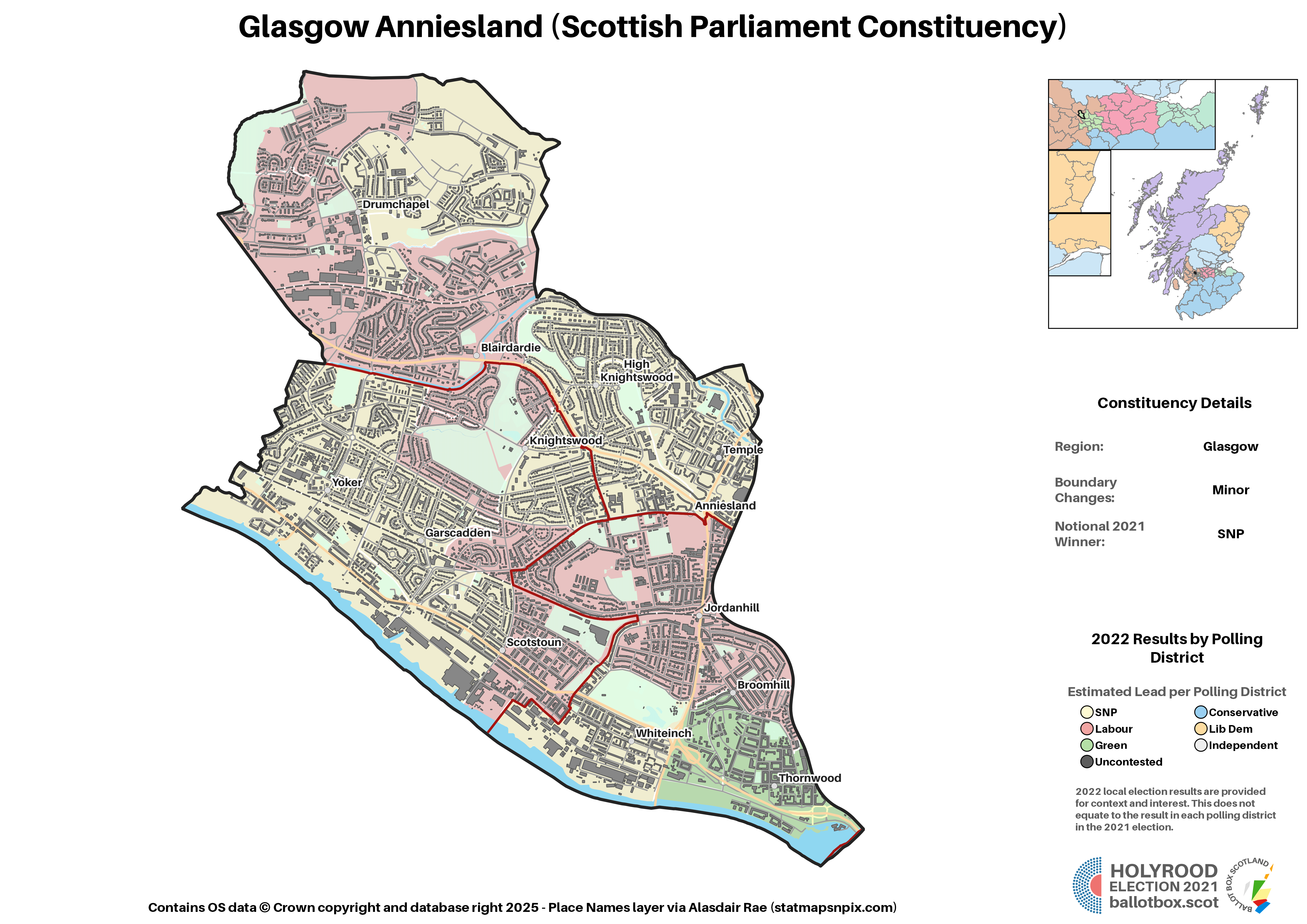
Constituency Map
Key Information
Notional 2021 Winner: SNP
Majority: 7375 (20.3%)
Boundary Changes: Gains area around Thornwood from old Glasgow Kelvin; loses area around Claythorn to new Glasgow Kelvin and Maryhill
2026 Candidates
SNP: Colm Merrick, L6
Conservative: Sandesh Gulhane (*L), L2
Labour: Eunis Jassemi, L7
Lib Dem: James Speirs, L3
Reform UK: Sean O Hagan, L7
Constituency Description
Sitting entirely within the Glasgow City Council area, Glasgow Anniesland is the least changed of any in the city, being tweaked to fit current ward boundaries by removing Claythorn but adding Thornwood. The continuing area is perhaps best defined in relation to major roads. Drumchapel, Blairdardie, Knightswood, Temple and Anniesland lie along Great Western Road; Jordanhill and Broomhill by Crow Road; and Whiteinch, Scotstoun, Garscadden and Yoker off Dumbarton Road.
When the SNP gained the prior version from Labour in 2011, they did so by a nail-biting 7 votes. The original 1999 version of the constituency was the seat of Donald Dewar, the inaugural First Minister and “Father of the Nation”. Tragically, Dewar didn’t even make it 18 months beyond the establishment of the Parliament he helped create, dying of a brain haemorrhage in October 2000 aged just 63.
Notional 2021 Constituency Vote
Note: the Green vote is based solely on where they stood in 2021 and does not reflect a “true” share for this constituency.
Notional 2021 Regional Vote
Constituency Map
Key Information
Notional 2021 Winner: SNP
Majority: 8812 (25.4%)
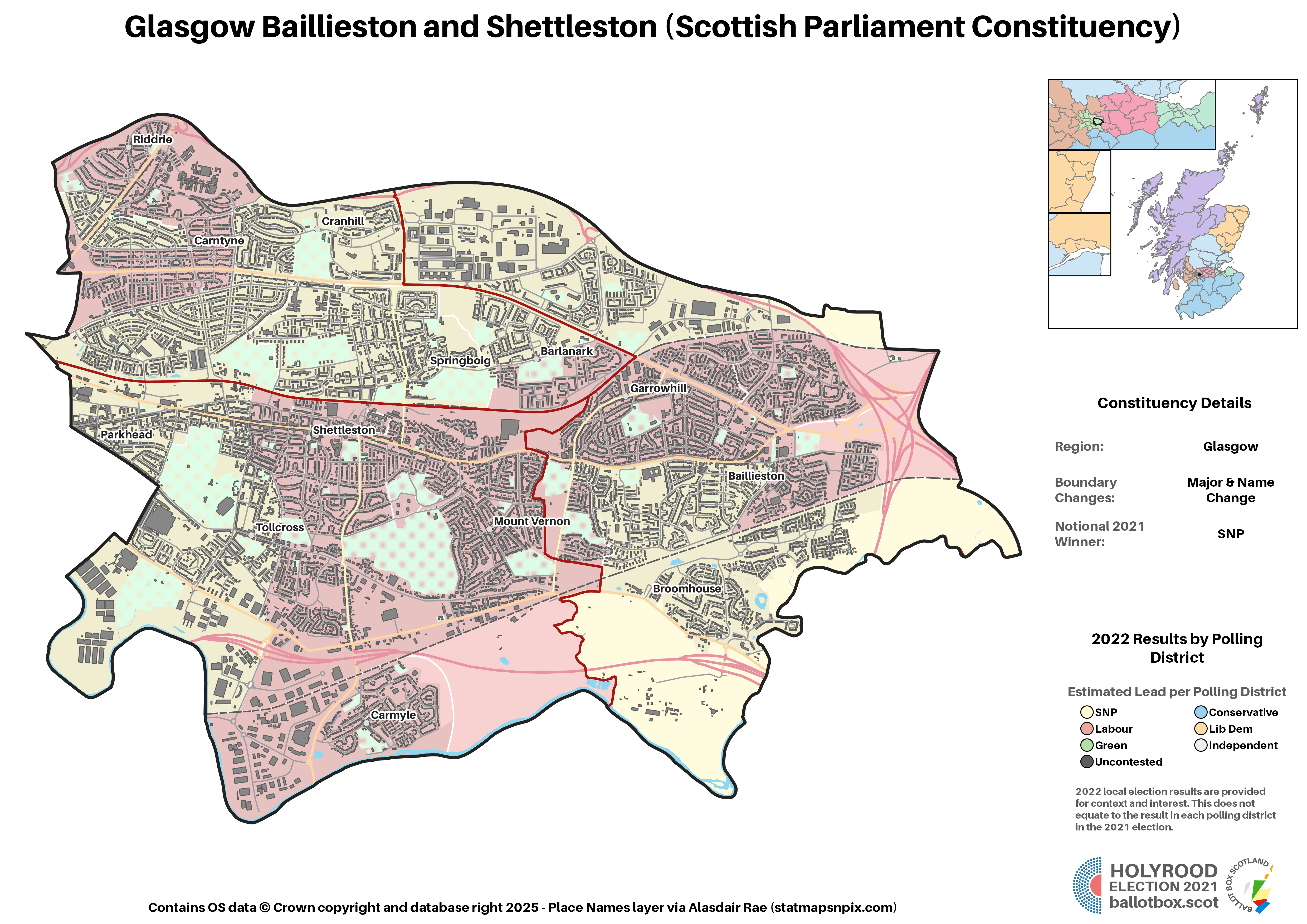
Boundary Changes: Takes area of Shettleston, most of Baillieston and the Barlanark portion of East Centre wards from old Glasgow Shettleston; remainder of Baillieston and East Centre wards from old Glasgow Provan
2026 Candidates
SNP: David Linden, L4
Conservative: John Murray, L5
Labour: Pauline McNeill (*L), L2
Lib Dem: Amy Carman, L6
Reform UK: Thomas Kerr, L1
Constituency Description
Sitting entirely within the Glasgow City Council area, Glasgow Baillieston and Shettleston is a very substantial redrawing of the bulk of the city’s East End. It’s almost bounded by the M8 and M74 motorways, with only Carmyle lying outwith them. In between we have, in addition to Shettleston and Baillieston themselves, areas including Tolcross, Parkhead, Mount Vernon, Broomhouse, Garrowhill, Barlanark, Springboig, Carnhill and Carnytne.
If we take the prior Shettleston seat as a comparator, that’s one the SNP gained from Labour in 2011, though it’s also very similar to the original Baillieston seat which disappeared that year. Although the SNP have a very healthy majority here, I’m inclined to feel that given 2022 local election results, this one will swing harder to Labour than the average. It’ll still be a challenge for them to gain, mind you, but it’s one of their better shots in a region that, on paper, has a lot of huge majorities to overcome.
Notional 2021 Constituency Vote
Note: the Green vote is based solely on where they stood in 2021 and does not reflect a “true” share for this constituency.
Notional 2021 Regional Vote
Constituency Map
Key Information
Notional 2021 Winner: SNP
Majority: 8400 (22.2%)
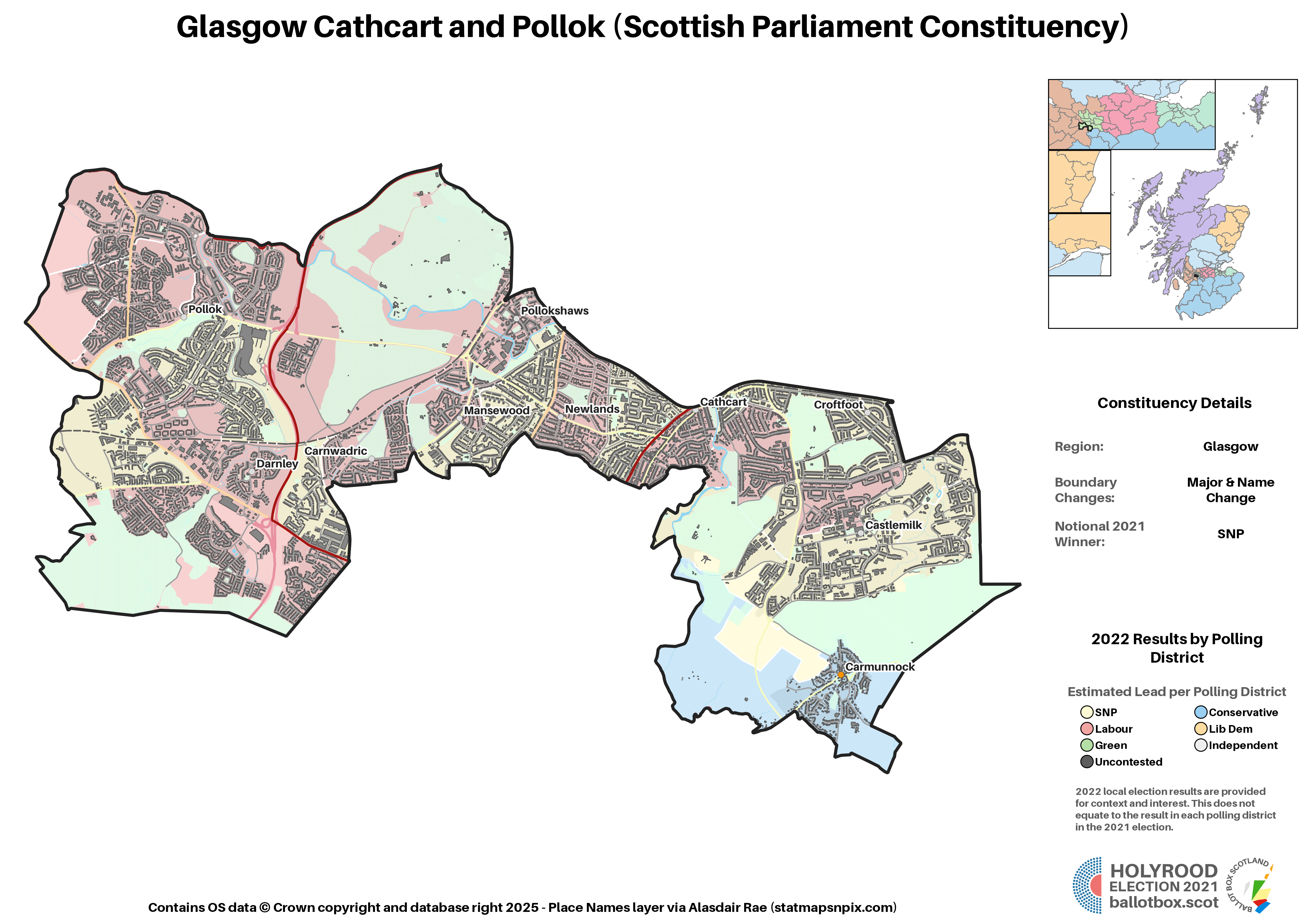
Boundary Changes: Takes area of Greater Pollok ward from old Glasgow Pollok; area of Newlands and Auldburn and the Linn wards from old Glasgow Cathcart
2026 Candidates
SNP: Zen Ghani, L8
Conservative: Kyle Park, L4
Labour: Anas Sarwar (*L), L1
Lib Dem: Peter McLaughlin, L5
Reform UK: Kim Schmullian, L2
Common: Adnan Rafiq, L2
Worker’s Party: Yvonne Ridley, L1
Constituency Description
Sitting entirely within the Glasgow City Council area, Glasgow Cathcart and Pollok covers the entire east-west stretch of the city’s southern periphery. When you account for Pollok Country Park, this is sort of two big lobes joined by a relatively narrow band. The western portion is dominated by Pollok itself, but also covers Darnley and Carnwadric. The eastern lobe is a lot of C’s: Castlemilk, Croftfoot, much of Cathcart itself, and the oddly disconnected village of Carmunnock. The two lobes are thus joined by Newlands, Pollokshaws and Mansewood.
Of the seats this succeeds, Cathcart was an SNP gain in 2011 whilst Pollok was won by them in 2016, when future – brief – First Minister Humza Yousaf shifted over from being a list MSP. One of the candidates for this new seat also has First Ministerial ambitions: Labour leader Anas Sarwar. This seat bears no relation to the Southside constituency he contested in 2021, but it is a somewhat easier one for Labour to win.
Notional 2021 Constituency Vote
Note: the Green vote is based solely on where they stood in 2021 and does not reflect a “true” share for this constituency.
Notional 2021 Regional Vote
Constituency Map
Key Information
Notional 2021 Winner: SNP
Majority: 11015 (26.7%)
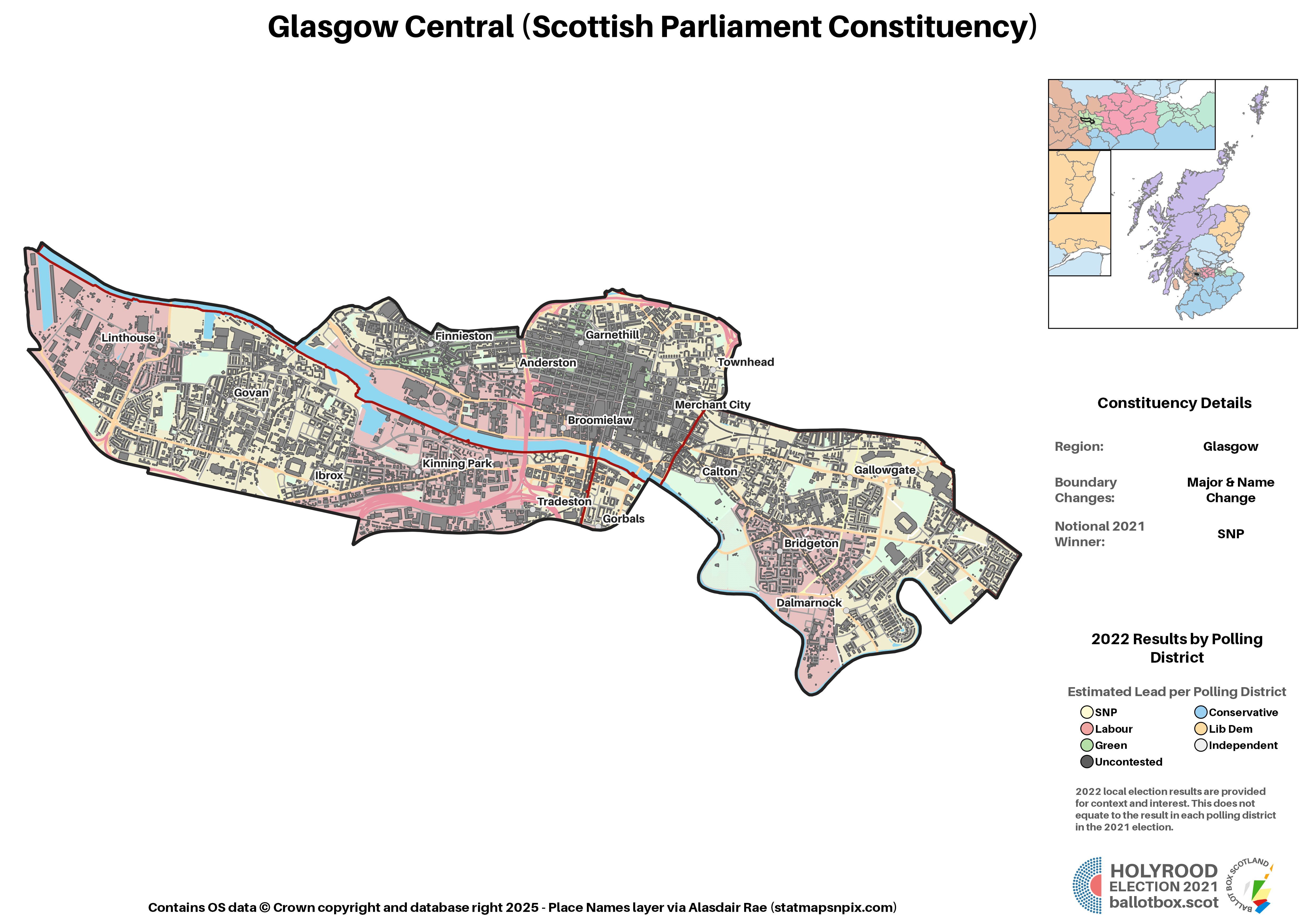
Boundary Changes: Takes area of Anderston, City and Yorkhill ward from old Glasgow Kelvin; Calton ward from old Glasgow Shettleston; eastern half of Govan ward from old Glasgow Southside; western half of Govan ward from old Glasgow Pollok
2026 Candidates
SNP: Alison Thewliss, L1
Conservative: Naveed Asghar
Labour: Vonnie Sandlan, L6
Lib Dem: Paul Kennedy, L2
Reform UK: Paul Bennie, L5
Constituency Description
Sitting entirely within the Glasgow City Council area, Glasgow Central is an apt descriptor for this one. Whereas the previous set of boundaries had been able to use the river as a natural marker, now we have a cross-Clyde seat. South of the river, it stretches from Linthouse through Govan, Ibrox, Kinning Park, Tradeston to a portion of the Gorbals. North of the river, it’s got Finnieston, Anderston, Garnethill, Townhead, and the core of the city centre, before turning eastward to incorporate Calton, Gallowgate, Bridgeton and Dalmarnock.
This really isn’t the direct successor to any existing seat, so there’s no history to traipse back through here. The rule of thumb in recent Glasgow elections however has been that the “inner” parts of the city have been more favourable to the SNP and Greens, and the “outer” to Labour and the Conservatives. That’s partly how this has such a big SNP majority, and why it’ll be one of the hardest for Labour to pick up, as well as one where a Green presence could make most difference to the SNP’s chances.
Notional 2021 Constituency Vote
Note: the Green vote is based solely on where they stood in 2021 and does not reflect a “true” share for this constituency
Notional 2021 Regional Vote
Constituency Map
Key Information
Notional 2021 Winner: SNP
Majority: 6365 (22.3%)
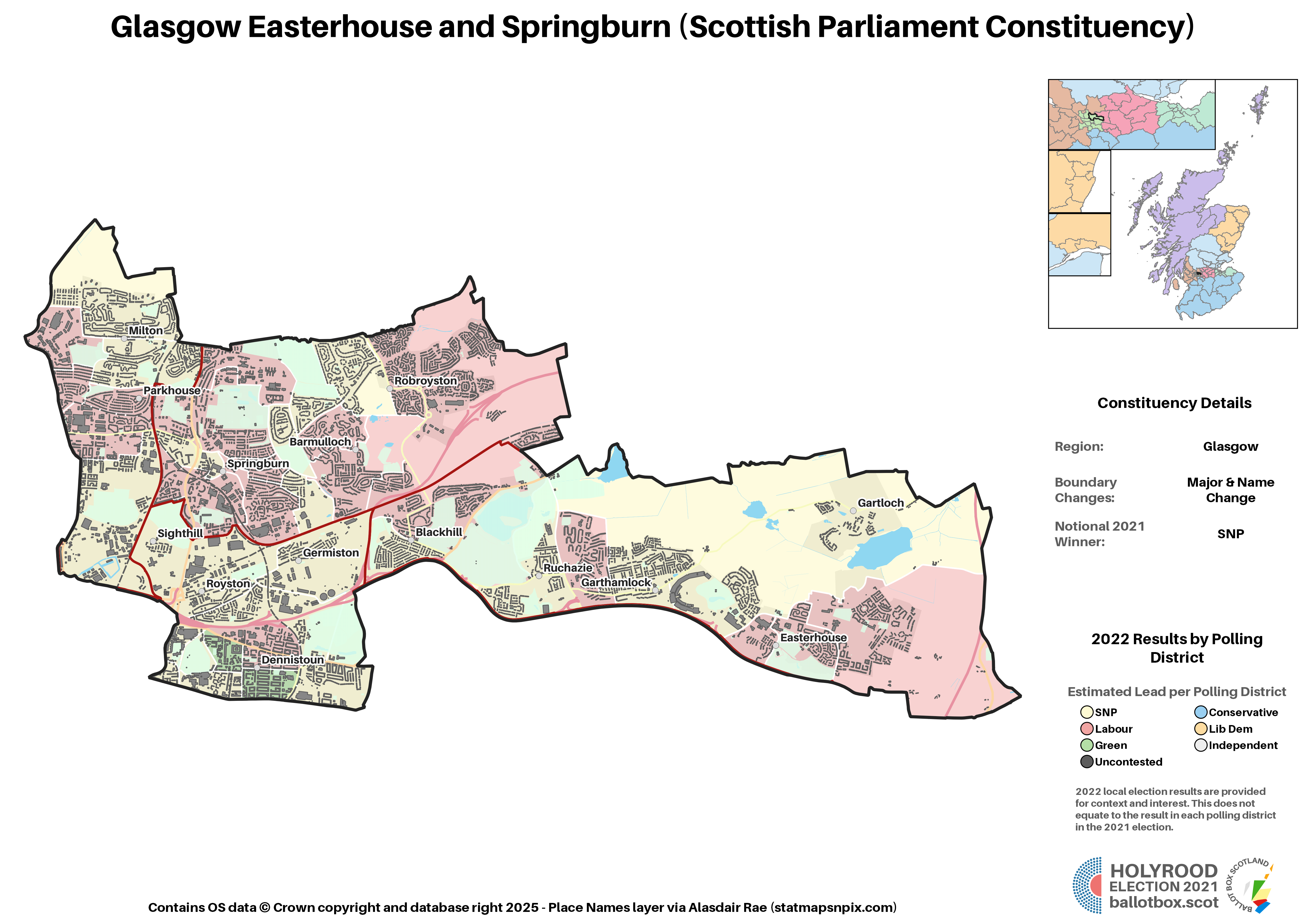
Boundary Changes: Takes areas around Germiston, Springburn, Sighthill, Possilpark, Parkhouse and Milton from old Glasgow Maryhill and Springburn; area of North East ward plus areas around Barmulloch, Robroyston and Dennistoun from old Glasgow Provan; area around Drygate from old Glasgow Kelvin
2026 Candidates
SNP: Ivan McKee (*C), L2
Conservative: Josephine Macleod, L6
Labour: Paul Sweeney (*L), L3
Lib Dem: Nicholas Moohan
Reform UK: Audrey Dempsey, L3
Common: Kenneth Nwosu, L4
Constituency Description
Sitting entirely within the Glasgow City Council area, although Glasgow Easterhouse and Springburn has shifted a fair bit to the north and west, it is somewhat recognisable as a successor to the Glasgow Provan seat. From that seat this carries over the area to the north of the M8 spanning from Blackhill through Ruchazie, Garthamlock and out to Easterhouse, as well as a more dense portion going north from Dennistoun to the likes of Royston, Germiston, Barmulloch, Robroyston and of course Springburn. The new additions include Milton and Parkhouse.
The SNP gained the preceding Provan seat from Labour in 2016, who had held the not too dissimilar Springburn seat that existed from 1999 to 2011. A solid SNP majority here may nonetheless be a little softer than it appears on the surface given the demographics of the area. What may really count against Labour however is if Reform UK stand, as you can expect this to be one of their brighter spots in the city.
Notional 2021 Constituency Vote
Note: the Green vote is based solely on where they stood in 2021 and does not reflect a “true” share for this constituency.
Notional 2021 Regional Vote
Constituency Map
Key Information
Notional 2021 Winner: SNP
Majority: 8110 (20.4%)
Boundary Changes: Takes area around Claythorn from old Glasgow Anniesland; Hillhead ward and area around Hyndland, Dowanhill and Partick from old Glasgow Kelvin; area around Kelvindale, Maryhill, Ruchill, Lambhill and Summerston from old Glasgow Maryhill and Springburn
2026 Candidates
SNP: Bob Doris (*C)
Conservative: Daniel Bowman, L7
Labour: James Adams, L5
Green: Iris Duane, L3
Lib Dem: Daniel Khan-O’Malley, L1
Reform UK: Aimee Alexander, L6
Common: Thomas Adkins, L3
Constituency Description
Sitting entirely within the Glasgow City Council area, don’t let the name fool you: Glasgow Kelvin and Maryhill is much more Maryhill than it is Kelvin, relative to the prior seats. Kelvin is very much an ex-seat, it has ceased to be, with the bits carved out of it into this one including Woodside, Woodlands, Hillhead, North Kelvin, Partick and Hyndland. The Maryhill further includes Summerston, Cadder, Gilshochill, Lambhill, Ruchill, Firhill; a lot of hills, basically.
The Maryhill and Springburn seat this primarily replaces was an SNP gain from Labour in 2016, though they’d gained the now dissolved Kelvin earlier in 2011. Labour had, as you’d expect, held the original Maryhill-only seat from creation in 1999. The Greens gave Kelvin a strong run in both 2016 and 2021, though placed a rather distant second both times. Although this remains a good constituency for them, I don’t see it as being one that could be in their grasp the way Kelvin could have. Instead, Labour would seem more likely to relieve the SNP of this seat.
Note: The originally selected Conservative candidate for this seat, Faten Hameed, defected to Reform UK in August 2025.
The originally selected Labour candidate for this seat, sitting regional MSP Pam Duncan-Glancy, announced in December 2025 she would no longer be standing for re-election after aspects of her personal life made national news.
Notional 2021 Constituency Vote
Note: the Green vote is based solely on where they stood in 2021 and does not reflect a “true” share for this constituency.
Notional 2021 Regional Vote
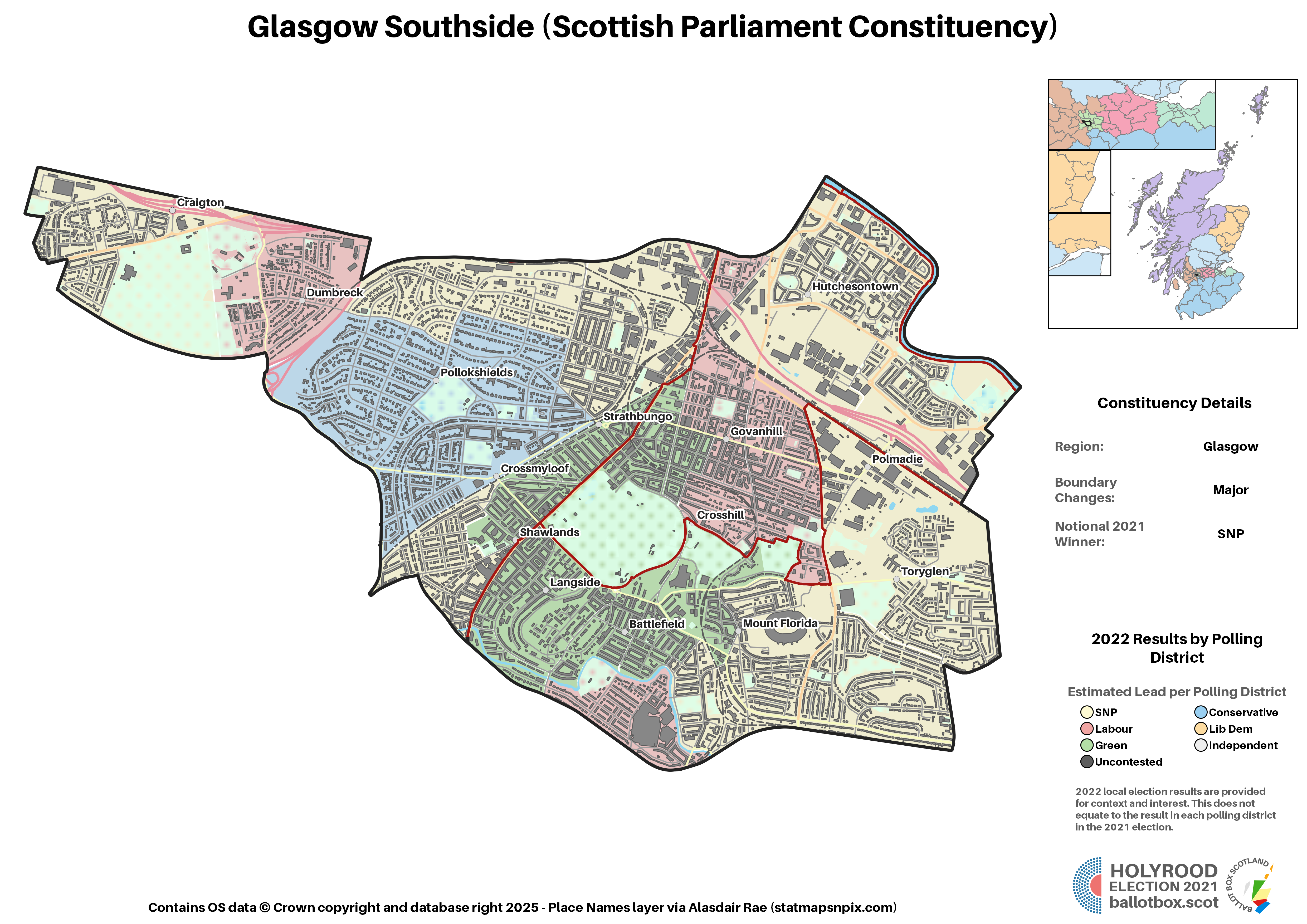
Constituency Map
Key Information
Notional 2021 Winner: SNP
Majority: 12705 (30.0%)
Boundary Changes: Loses eastern portion of Govan ward to new Glasgow Central; gains Craigton area from old Glasgow Pollok; gains remaining area of Langside ward from old Glasgow Cathcart
2026 Candidates
SNP: Kaukab Stewart (*OC), L3
Conservative: Ross Hutton, L3
Labour: Rashid Hussain
Green: Holly Bruce, L2
Lib Dem: Rachel Park, L4
Reform UK: Gordon Millar, L8
Common: Kamran Butt, L1
Independent: Arzoo Waqqar Abdhullah
Constituency Description
Sitting entirely within the Glasgow City Council area, comparatively mild changes shift Glasgow Southside that little bit further South. Whilst it previously had a long border along the Clyde, it no longer has Govan and so it only touches the river at Hutchesontown. Likewise preserved are Govanhill, Strathbungo, Pollokshields and the western side of Shawlands. Newly added are eastern Shawlands, plus Battlefield, Mount Florida and Toryglen.
Even on these new boundaries, the SNP were an ultimately dominant force here in 2021, reflecting the fact that this was the seat of then-First Minister Nicola Sturgeon, who’d first gained it as the old Govan constituency in 2007. Look at that regional vote though: the Greens only a hair behind Labour. If Kelvin has been snatched from the Greens’ grasp, this is the possible replacement.
I’d still be highly doubtful of them taking it in this election, but via the Langside ward this has shifted onto very strong Green territory. That may also be why this is easier for Labour to gain than the massive 30% gap suggests. A Green candidacy is going to eat more into the SNP than Labour support, and Reform aren’t really going to register here which will help reduce Labour’s own losses of support.
Note: The originally selected Labour candidate for this seat, Mo Ameen, was deselected the day nominations closed after being charged with fraud.
Notional 2021 Constituency Vote
Note: the Green vote is based solely on where they stood in 2021 and does not reflect a “true” share for this constituency.
Notional 2021 Regional Vote
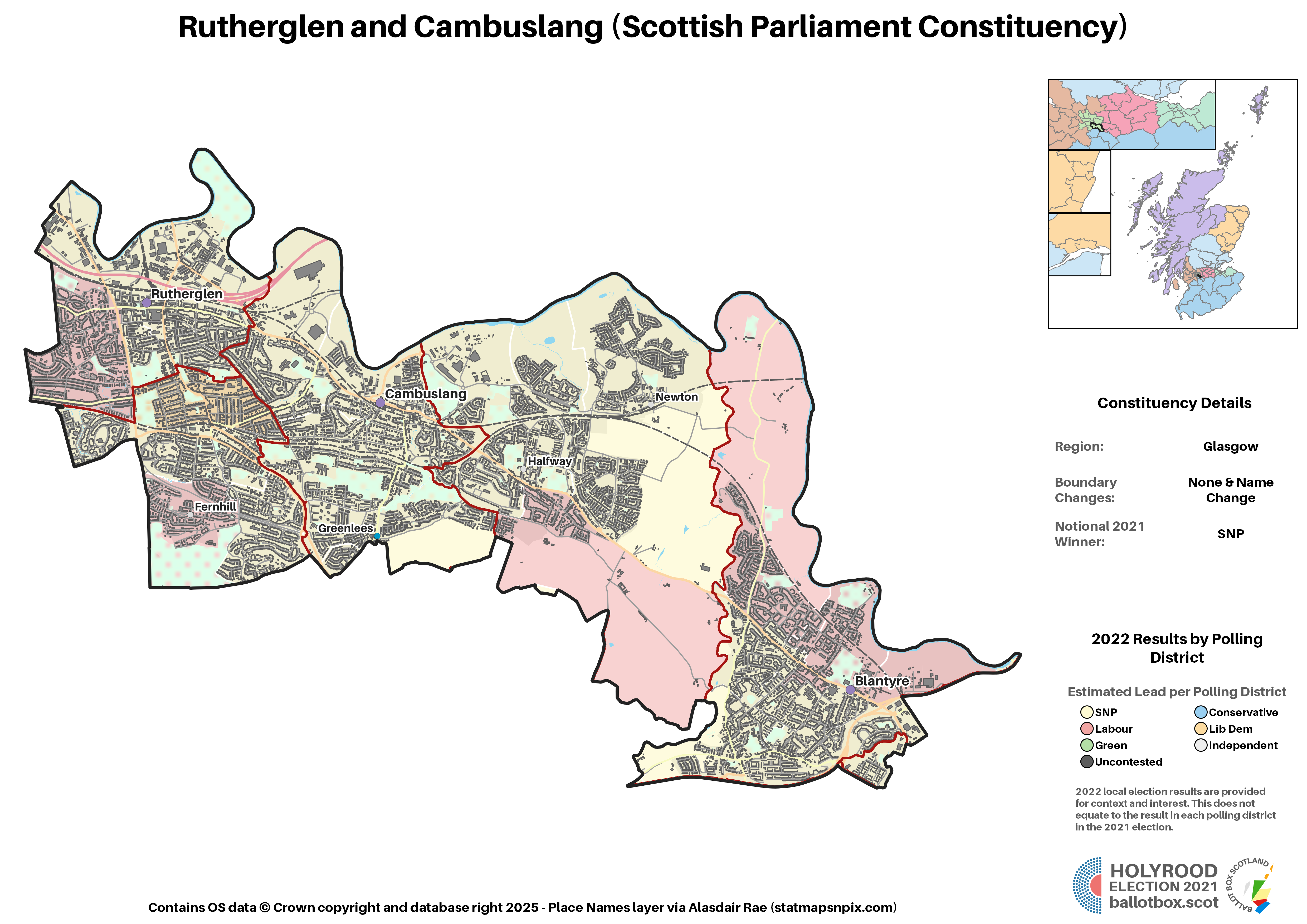
Constituency Map
Key Information
Notional 2021 Winner: SNP
Majority: 1702 (12.9%)
Boundary Changes: No meaningful boundary changes, but name expanded from simply “Rutherglen”
2026 Candidates
SNP: Clare Haughey (*C)
Conservative: Annie Wells (*L), L1
Labour: Monica Lennon (*L), L4
Lib Dem: Patrick Logue
Reform UK: Allan Lyons, L4
TUSC: Chris Sermanni
Constituency Description
Sitting entirely within the South Lanarkshire Council, Rutherglen and Cambuslang has a new name. That’s it. It used to just be Rutherglen, now it’s added Cambuslang to the title to differentiate it from the UK Parliament seat. Blantyre is also still in this seat.
The prior Rutherglen seat was one of the Labour holdouts in 2011, but finally fell to the SNP in 2016. It’s nonetheless still easily Labour’s strongest seat in the region and the one they are most likely to pick back up. Don’t expect an outcome as dramatic as 2023’s Rutherglen and Hamilton West by-election for the UK Parliament, but do expect this to flip even if Labour don’t make much progress on 2021. If they do that’ll secure the spot of current Central Scotland MSP Monica Lennon, who was in a very odd position.
Not only had her natural constituency (which she contested in 2021) of Hamilton, Larkhall and Stonehouse been moved into the South region, it was also of course won by a different Labour candidate in the by-election following Christina McKelvie’s death. That could have put Lennon in a tight spot, and as something of a thorn in the side of the current leadership, risked her being sunk beyond a winnable spot on the list and without a winnable constituency. The SNP majority here however is functionally identical however, which means regardless of where she ranks on the Glasgow list she’s in a much better place than she could have been.
2021 Constituency Vote
2021 Regional Vote
To allocate list seats using the D’Hondt method, each party’s share of the vote is divided by one more than the number of seats they’ve won so far in the process. This is an important part of how the list seats then more fairly represent the diversity of views amongst voters. List votes cast for a party that has won lots of constituency seats are not “wasted”, they just aren’t needed to give their voters fair representation.
Starting Point
When allocating the first list seat, this starts with the number of constituencies won by each party:
- The SNP won 8 constituencies, so their vote is divided by 8.
- No one else won any constituencies, so their vote is not divided.
Seat 1
Since Labour have the highest total here, they receive the first regional seat. We add that to their total, giving them 1 seat overall so far, and therefore for the next round of allocation their share is divided by 2.
Seat 2
Since the Conservatives have the highest total here, they receive the second regional seat. We add that to their total, giving them 1 seat overall so far, and therefore for the next round of allocation their share is divided by 2.
Seat 3
Since the Greens have the highest total here, they receive the third regional seat. We add that to their total, giving them 1 seat overall so far, and therefore for the next round of allocation their share is divided by 2.
Seat 4
Since Labour have the highest total here, they receive the fourth regional seat. We add that to their total, giving them 2 seats overall so far, and therefore for the next round of allocation their share is divided by 3.
Seat 5
Since Labour have the highest total here, they receive the fifth regional seat. We add that to their total, giving them 3 seats overall so far, and therefore for the next round of allocation their share is divided by 4.
Seat 6
Since the Conservatives have the highest total here, they receive the sixth regional seat. We add that to their total, giving them 2 seats overall so far, and therefore for the next round of allocation their share is divided by 3.
Seat 7
Since the Greens have the highest total here, they receive the seventh and final regional seat. We add that to their total, giving them 2 seats overall. This completes the list seat allocation process.
If you find this or other Ballot Box Scotland output useful and/or interesting, and you can afford to do so, please consider donating to support my work. I love doing this, but it’s a one-man project and takes a lot of time and effort. All donations, no matter how small, are greatly appreciated and extremely helpful.
(About Donations)