Contents
Make sure to check out Ballot Box Scotland’s Holyrood Hub page for polling, analysis and updates ahead of the 2026 Scottish Parliament election.
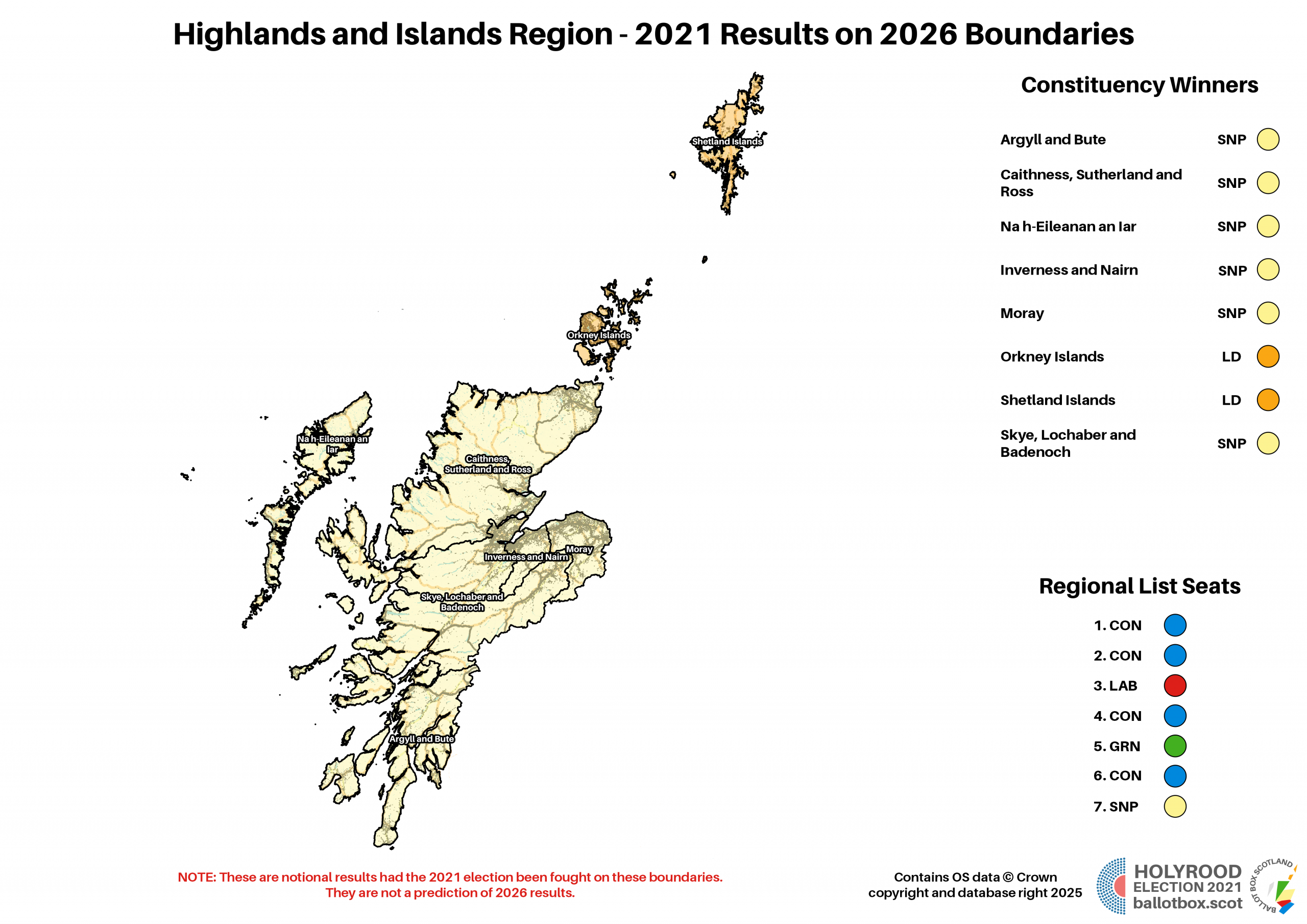
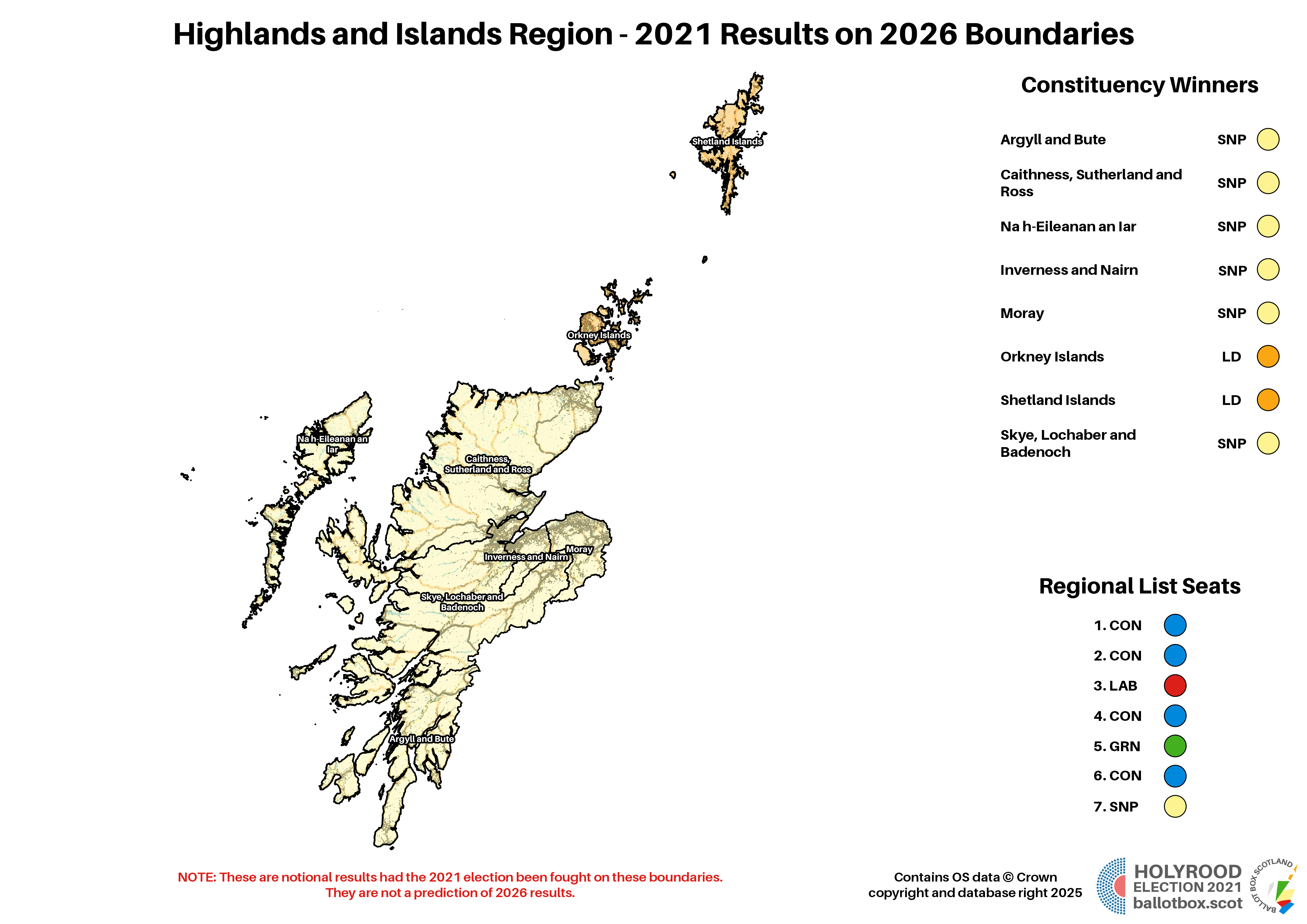
Region Map
Region Description
Highlands and Islands was almost entirely untouched by the boundary review process. The external boundaries of the region have not been modified, and the only internal changes were a relatively minor tweak between on pair of constituencies. That means this continues to cover the entirety of the three islands councils (Na h-Eileanan an Iar, Orkney, and Shetland), Highland Council, and most of the Moray (excluding Buckie and Cullen) and Argyll and Bute (excluding Helensburgh and Lomond) Council areas.
That amounts to roughly half of Scotland’s total land area, making this by far the biggest region in geographic terms. However, as the Islands constituencies are protected and substantially below the electorate size of mainland seats, it’s by far the smallest by number of voters. It also used to be the only 8 constituency region, until Glasgow joined its ranks for this election.
What to Watch For in 2026
The Highlands and Islands have long been a relatively politically diverse region, and in the early days of the Scottish Parliament this was the only region where the Lib Dems won the most seats, albeit that was from winning an oversized share of constituencies rather than justified by their overall vote. Although the Lib Dems were chased off the mainland section in 2011, they are on the hunt for a comeback this time, and should easily gain at least one further constituency here.
It’s not just the Lib Dems that will be challenging the SNP though, as Labour will be keen to replicate their Westminster result by picking up Na h-Eileanan an Iar. Time was the Conservatives would also have been making a solid go at Moray, but that feels like it’ll be out of reach this year, particularly given we might expect Reform UK to do well there.
The Greens will also be seeking to pick up a second seat here, though their best patch is probably Shetland which has relatively few votes on offer. Previously this was their best bet at a second MSP of any region outside the two big cities. As of 2021 it’s no longer their third best vote share, though former Green MSP Andy Wightman’s Independent run perhaps artificially deflated their support. A second seat will perhaps be a toughie for them, but they might be helped on their way by the reduced likelihood of the SNP exceeding their fair allocation of seats… so long as the Lib Dems don’t return to doing so themselves.
2021 Constituency Vote
2021 Regional Vote
Notional 2021 Seat Winners
Constituency
Argyll and Bute: SNP
Caithness, Sutherland and Ross: SNP
Na h-Eileanan an Iar: SNP
Inverness and Nairn: SNP
Moray: SNP
Orkney Islands: Lib Dem
Shetland Islands: Lib Dem
Skye, Lochaber and Badenoch: SNP
Regional List
1: Conservative
2: Conservative
3: Labour
4: Conservative
5: Green
6: Conservative
7: SNP
Highlands and Islands: 2021 Notional Results (Regional Vote)
Highlands and Islands: 2021 Notional Results (Constituency Vote)
1999 to 2011 Boundaries
Elections in 1999, 2003 and 2007 for the Highlands and Islands were fought on boundaries that covered the entirety of the three islands councils (Na h-Eileanan an Iar, Orkney, and Shetland), Highland Council, and most of the Moray (excluding Keith) and Argyll and Bute (excluding Helensburgh and Lomond) Council areas.
At the first election the Lib Dems won both of the Northern Isles constituencies as well as the three mainland constituencies that have west coasts, whilst the SNP won the Inverness and Moray centred seats, and Labour what was then referred to in the Beurla as the Western Isles. Given the Lib Dems placed third in the list vote but won the most constituencies, they weren’t due any list seats, which split almost evenly between the SNP, Labour and Conservatives. One of those went to the SNP’s Winnie Ewing who, as the oldest member elected, convened the very first meeting of the new parliament.
Although generally more diverse than other regions, Highlands and Islands didn’t really contribute all that much to the “Rainbow Parliament”: effectively, Labour lost one of their seats to the Greens, and that was that. Note that the Lib Dems’ further slide on the list vote now meant their five constituency seats was two in excess of their due share. Had that not happened, the SSP would have won a list seat, adding their darker red hue to the seat spectrum.
The SNP’s first victory in 2007 had strong roots in this region, seeing them pick up both Argyll and Bute and the Western Isles, whilst still retaining their two list MSPs. The net loss was taken by the Greens and the Lib Dems who, for the first time, actually ended up with their correct total allocation in this region.
2011 to 2026 Boundaries
Elections in 2011, 2016 and 2021 for the Highlands and Islands were fought on boundaries that covered the entirety of the three islands councils (Na h-Eileanan an Iar, Orkney, and Shetland), Highland Council, and most of the Moray (excluding Buckie and Cullen) and Argyll and Bute (excluding Helensburgh and Lomond) Council areas.
Their shock 2011 majority saw extreme SNP success in this region, picking up both the Caithness, Sutherland and Ross and the Skye, Lochaber and Badenoch seats, as well as an additional list MSP. Let me emphasise that: an additional list MSP. They already had two. That gave them three.
If you’re just eyeballing the charts above you might think the SNP were doing what the Lib Dems used to and winning an excessive number, but nope! You can’t get list seats unless you’re due them! That was just the way the AMS cookie crumbled this time, though the Greens were only about 0.2% away from snatching one of those list seats away from them… which they would ultimately do during the term anyway, when John Finnie quit the SNP and then later joined the Greens.
2016 is where we start to see a massive realignment in the SNP vote, something a lot of people have still failed to come to terms with. They lost two list seats here, one apiece to the Conservatives and the Greens. That came from losing about 8% of their list vote, whereas the Greens only went up about 2%. Previously one of the party’s main strongholds, the referendum saw SNP support move away from north of the country and into the Central Belt.
The only substantial change in 2021 was that Labour lost one of their list seats to the Conservatives, the first time they had ever been reduced to a single MSP in any region.
Candidates in both this section and individual constituencies are marked if they are an incumbent MSP:
- (*C): Incumbent for that constituency, or equivalent if significantly impacted by boundary changes
- (*OC): Incumbent for another constituency
- (*L): Incumbent on the list
2026 Total Candidate Numbers
Highlands and Islands: 2026 Regional List Candidates
The six parties expected to win seats in the Scottish Parliament in 2026 are listed in order of national support in 2021. Remaining parties are in alphabetical order, and Independents listed last.
Candidates that are contesting both the List and Constituency ballot have their constituency noted after their name on the list.
- Maree Todd (*C, Caithness, Sutherland and Ross)
- Robert Leslie (Orkney Islands)
- Emma Roddick (*L, Inverness and Nairn)
- Hannah Mary Goodlad (Shetland Islands)
- Eilidh Munro (Skye, Lochaber and Badenoch)
- Jérémie Fernandes
- Tim Eagle (*L, Moray)
- Jamie Halcro Johnston (*L, Orkney Islands)
- Helen Crawford (Skye, Lochaber and Badenoch)
- Ruraidh Stewart (Inverness and Nairn)
- George MacPherson (Na h-Eileanan an Iar)
- Peter Wallace (Argyll and Bute)
- Donald MacKenzie (Caithness, Sutherland and Ross)
- Douglas Barnett (Shetland Islands)
Note: Elaine Kirby, the 6th placed list candidate, stood down a few days before the election.
- Islay McCay (Skye, Lochaber and Badenoch)
- Donald McKinnon (Na h-Eileanan an Iar)
- Eva Kestner (Caithness, Sutherland and Ross)
- John Erskine (Shetland Islands)
- Mike Macleod (Orkney Islands)
- Callum George (Argyll and Bute)
- Shaun Fraser (Inverness and Nairn)
- David Blair (Moray)
- Ariane Burgess (*L)
- Kristopher Leask
- Kate Willis
- Draeyk Van der Horn
- Alex Armitage (Shetland Islands)
- Anne Thomas
- Julie Christie
- Morven May McCallum (Moray)
- Alan Reid (Argyll and Bute)
- Declan Gallacher
- Angela MacLean
- Robert Rixson
- Guy Grieve
- Fiona Bennett
- Vic Currie (Shetland Islands)
- Max Bannerman (Moray)
- Amanda Hampsey (Argyll and Bute)
- Fred Campbell (Inverness and Nairn)
- Malcolm McTaggart (Na h-Eileanan an Iar)
- John Whitton (Skye, Lochaber and Badenoch)
- John Coupland (Orkney Islands)
- Matt Sheppard (Caithness, Sutherland and Ross)
- Steve Skerrett (Inverness and Nairn)
- Brian Nugent (Shetland Islands)
- Andrew MacDonald (Caithness, Sutherland and Ross)
- Kenny MacKenzie (Na h-Eileanan an Iar)
- Laura Hansler (Skye, Lochaber and Badenoch)
- Allan Duffy (Moray)
- Flora Badger
- Donald Boyd
- Kenny Stone
- Allan MacEachen
- Rachel Gibson
- Eva Morrice
- Harriet Woolmore
- Fiona Nelson
- Nicola Siddall
Note: Independent Green Voice are a front group for a bunch of Glasgow bampots, led by someone who was expelled from UKIP for alleged Holocaust denial. They are standing purely as a spoiler party in this election, targeting the legitimate Scottish Green Party, and their simple one candidate per region slate is further evidence of this dodgy dealing.
- Nathan Lumb
- Alasdair Fletcher
- Ruraidh Ormiston
- Willie Hamilton
- Brenda Nicholson
- Syed Hussain
- Duncan MacPherson
- Mick Rice (Argyll and Bute)
Constituency Map
Key Information
Notional 2021 Winner: SNP
Majority: 8963 (26.7%)
Boundary Changes: None
2026 Candidates
SNP: Jenni Minto (*C)
Conservative: Peter Wallace, L6
Labour: Callum George, L6
Lib Dem: Alan Reid, L2
Reform UK: Amanda Hampsey, L3
Independent: Tommy MacPherson
Independent: Mick Rice, L1
Constituency Description
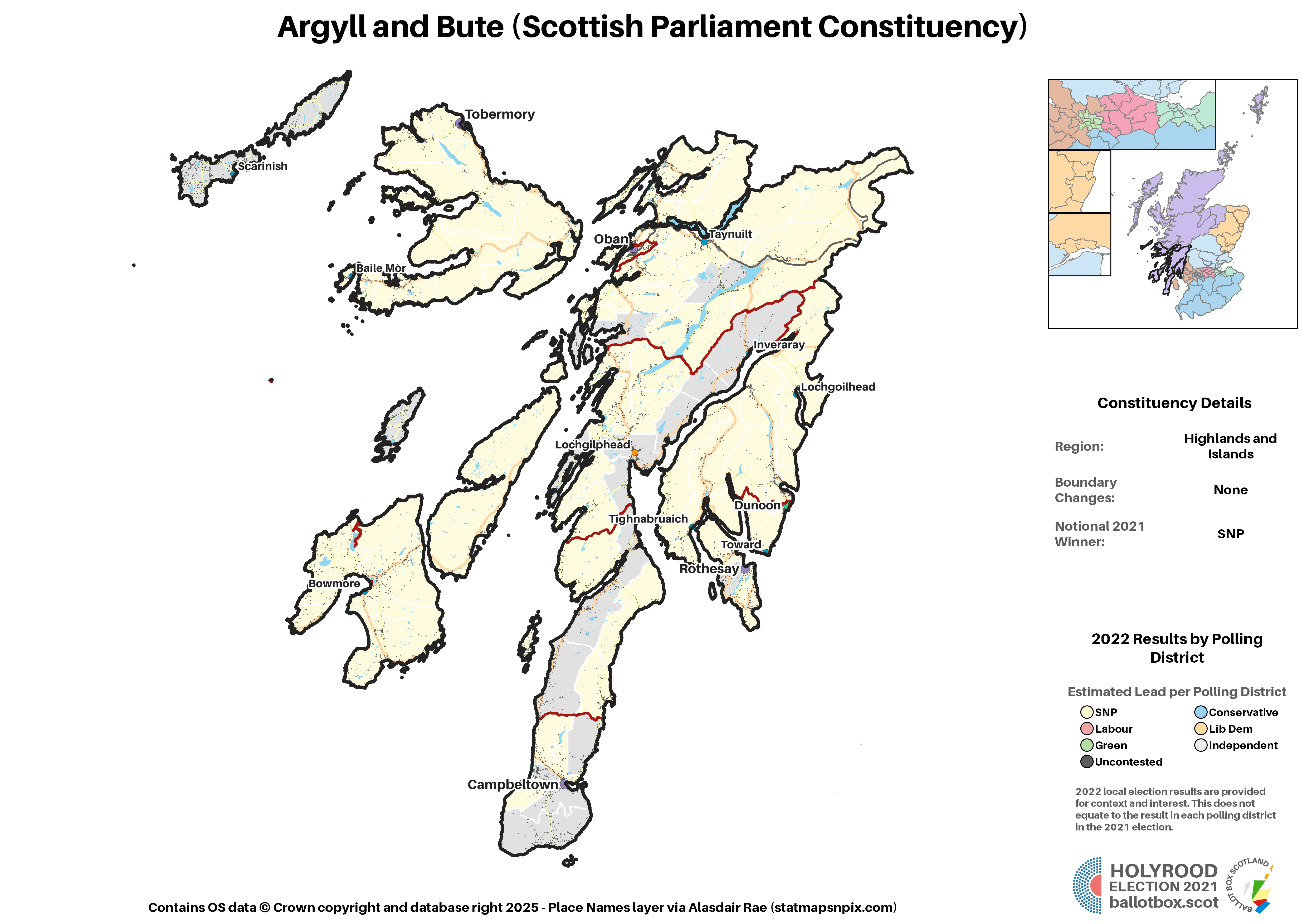
Sitting entirely within, but not covering the whole of the council area of the same name, Argyll and Bute hasn’t been meaningfully changed since it was created in 1999, with only a tiny, nearly cosmetic change with the Dumbarton border in 2011. That also means it’s got the smallest electorate of any (mostly) mainland constituency. Boundaries Scotland did suggest expanding it, but that went down like a lead balloon and the idea was ditched in the name of Special Geographic Considerations. In addition to the mainland components of Cowal, Kintyre and Lorn, several major islands are also included, most obviously Bute but also the likes of Islay and Mull.
What’s missing here from the council (and the region) is thus the Helensburgh and Lomond area. That’s historically in Dunbartonshire and indeed when I was born in Dumbarton District it was part of it. The snobs over the hill in Helensburgh decided they were too good to stick with us when West Dunbartonshire added Clydebank, but the constituency map has preserved that old relic. Long-nursed local rivalries aside, the SNP gained this seat in 2011, and I’d be dubious about the Lib Dems chances of regaining it: this hasn’t been where their efforts to regrow in the region have been concentrated, and it might spread them too thin to really, really try.
Note: The initially selected Conservative candidate, Amanda Hampsey, defected to Reform and was subsequently selected as that party’s candidate.
2021 Constituency Vote
2021 Regional Vote
Constituency Map
Key Information
Notional 2021 Winner: SNP
Majority: 2591 (7.0%)
Boundary Changes: None
2026 Candidates
SNP: Maree Todd (*C), L1
Conservative: Donald MacKenzie, L7
Labour: Eva Kestner, L3
Lib Dem: David Green
Reform UK: Steve Welsh
Advance UK: Matt Sheppard, L1
Alliance to Liberate Scotland: Andrew MacDonald, L2
Constituency Description
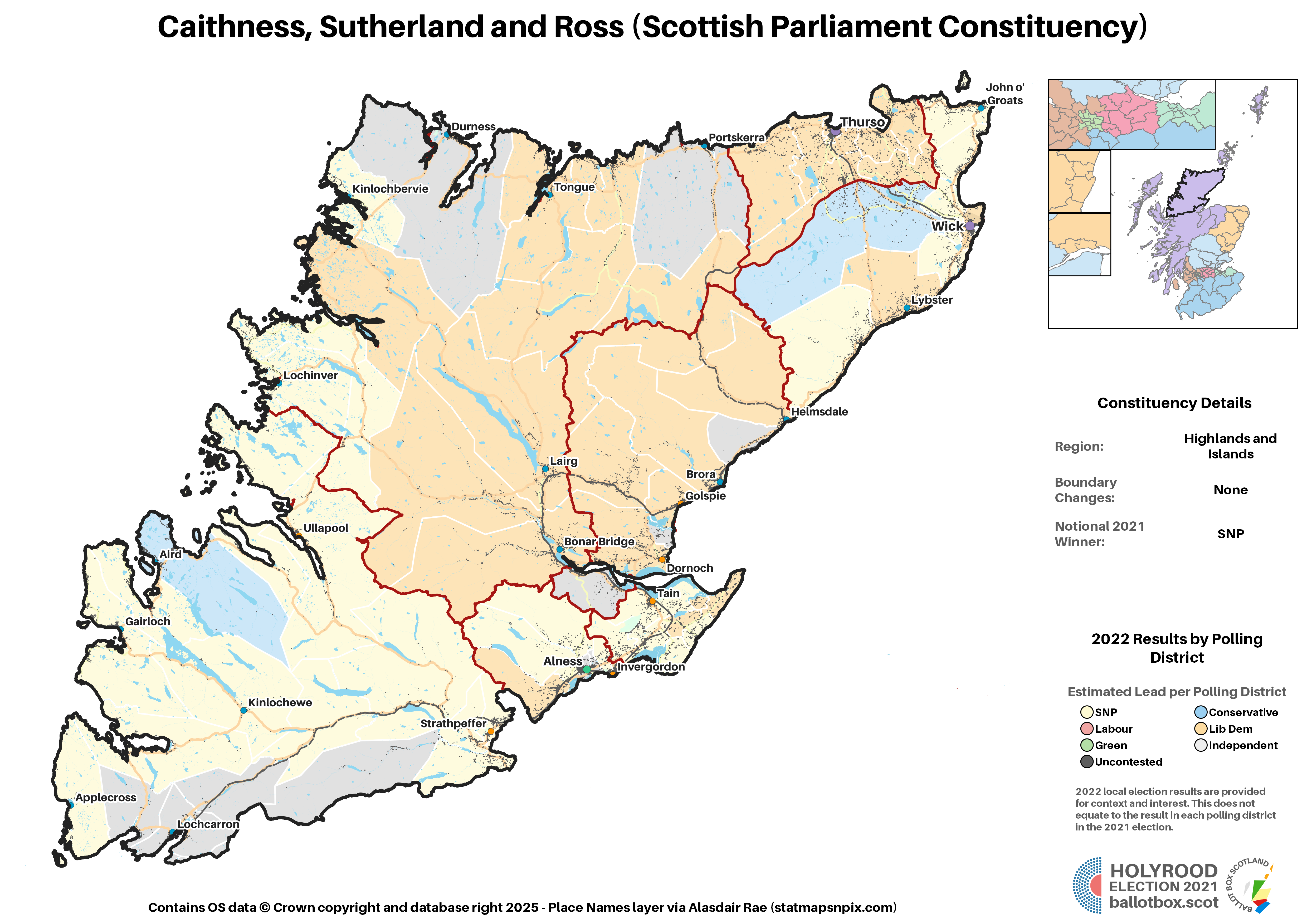
Sitting entirely within the Highland Council area, Caithness, Sutherland and Ross is a truly gargantuan constituency, the largest in the country. Despite the name it doesn’t quite cover all of historic Ross-shire, as it’s not got Dingwall, but it’s got the rest, stretching from Applecross and Ullapool on the west coast over to Alness and Tain on the east. Caithness, centred on Thurso and Wick, and Sutherland, running from Dornoch to Cape Wrath, similarly span from coast to coast.
The SNP gained the somewhat expanded seat from the Lib Dems in 2011, and now the Lib Dems want it back. Their victory in the corresponding Westminster seat in 2017 and 2019 didn’t translate to Holyrood in 2021, but they ran it pretty close. Had they won it then they’d have been back to their old habit of winning more seats than they fairly should have. I reckon they are a shoo-in this time but given they are also in line to increase their regional vote, a third seat may be proportionally earned anyway.
Note: The initially selected Conservative candidate, Elaine Kirby, stood down as a candidate a couple of days before the close of nominations.
2021 Constituency Vote
2021 Regional Vote
Constituency Map
Key Information
Notional 2021 Winner: SNP
Majority: 3441 (23.7%)
Boundary Changes: None
2026 Candidates
SNP: Alasdair Allan (*C)
Conservative: George MacPherson, L5
Labour: Donald McKinnon, L2
Lib Dem: Jamie Dobson
Reform UK: Malcolm McTaggart, L5
Alliance to Liberate Scotland: Kenny MacKenzie, L3
Constituency Description
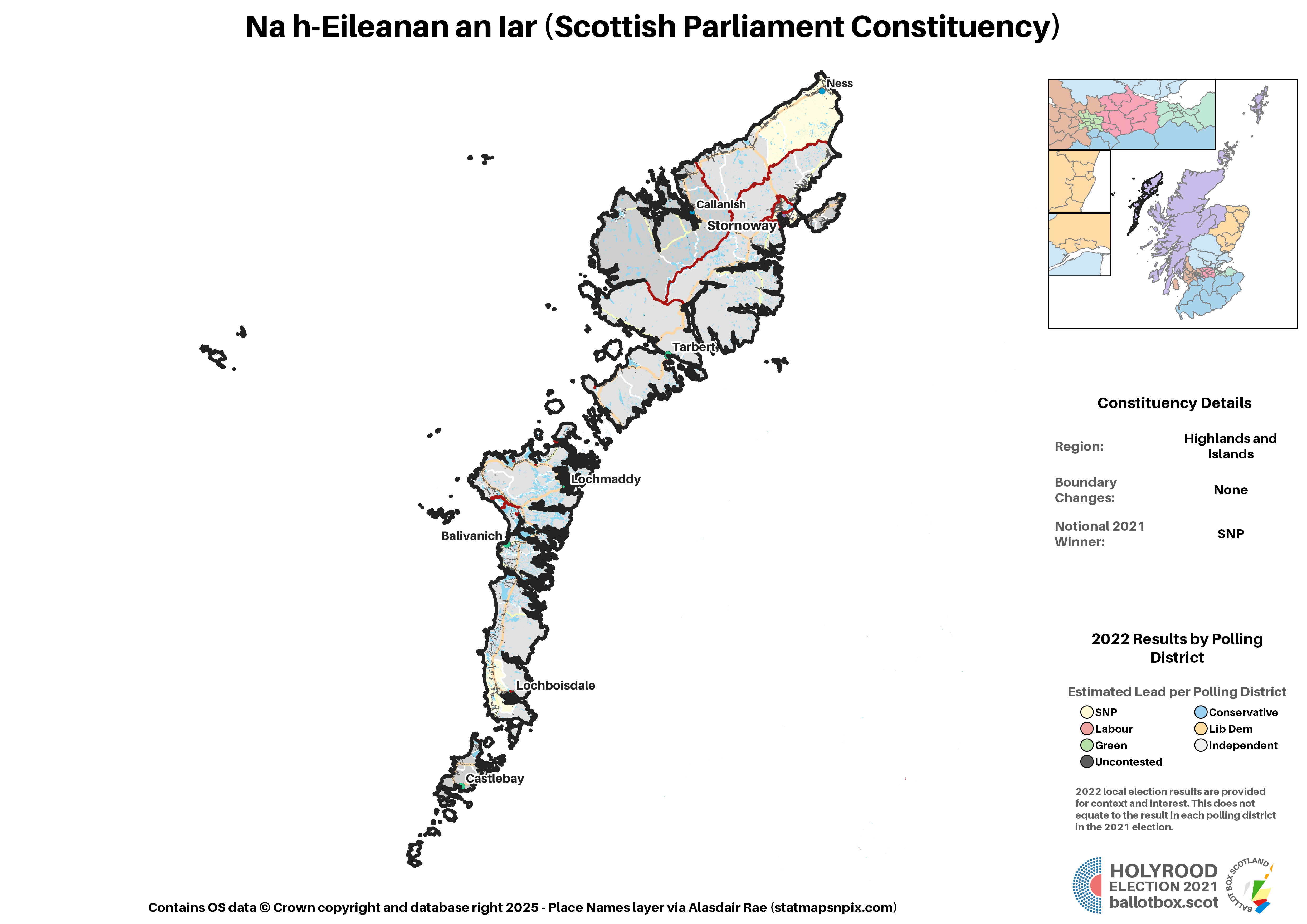
Completely encompassing Comhairle nan Eilean Siar, Na h-Eileanan an Iar obviously covers what in English can be referred to as the Western Isles or the Outer Hebrides. That the official name uses Gaelic reflects the islands’ status as the last big stronghold of that language, though there are still a fair few Gaelic speakers found across the Inner Hebrides and the mainland Highlands, as well as Glasgow and Edinburgh.
In any case, this long chain of islands goes from Leòdhas agus Na Hearadh (Lewis and Harris, the next largest island in our archipelago after Great Britain and Ireland), through Uibhist a Tuath (North Uist), Beinn na Faoghla (Benbecula), Èirisgeigh (Eriskay), Uibhist a Deas (South Uist), Barraigh (Barra) and ultimately tiny Bhatarsaigh (Vatersay). As an Islands constituency it is protected from boundary changes and thus remains as it was in 1999.
The SNP gained this from Labour in 2007, which may surprise Central Belters mostly used to the idea of the Highlands and Islands as the lands of the Liberals. In actual fact, this has long been an SNP-Labour battleground in both parliaments. You have to go back to 1931 to find the last time it elected a Liberal, and in 1970 it became the first seat the SNP ever won at a UK General Election. Although the SNP have a seemingly comfortable lead, the small size of the electorate can make it very swingy if locals like the candidate from the non-incumbent party. Given that the SNP have already lost about 14% support locally across a run of elections they gained about 2% nationally, Labour likely have a good shot at this.
2021 Constituency Vote
2021 Regional Vote
Constituency Map
Key Information
Notional 2021 Winner: SNP
Majority: 11015 (21.5%)
Boundary Changes: Loses area around Grantown on Spey to new Skye, Lochaber and Badenoch
2026 Candidates
SNP: Emma Roddick (*L), L3
Conservative: Ruraidh Stewart, L4
Labour: Shaun Fraser, L7
Lib Dem: Neil Alexander
Reform UK: Fred Campbell, L4
Independent: Fergus Ewing (*C)
Advance UK: Steve Skerrett, L2
Constituency Description
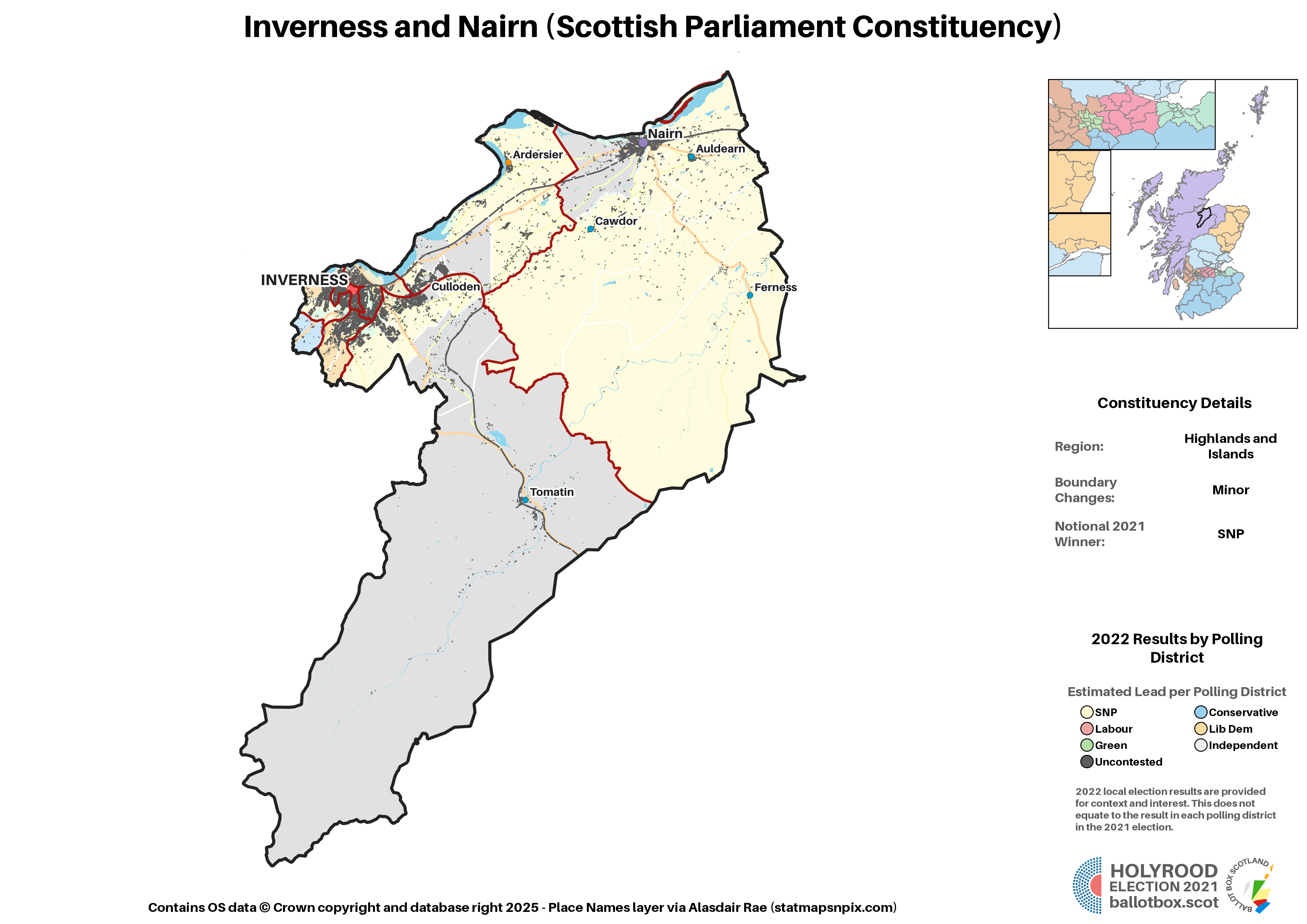
Sitting entirely within the Highland Council area, Inverness and Nairn is another one of those seats where the name is pretty clear. Yep, this does indeed cover the Highland capital of Inverness plus the historic county of Nairn. That includes Inverness suburbs around Culloden, and intervening villages like Ardersier and Cawdor, plus Auldearn, Ferness and Tomatin off in various other directions. In a region that is predominantly rural, this is the only seat that’s primarily and truly urban.
The SNP have held this seat, including in the prior Inverness East, Nairn and Lochaber form, since the Scottish Parliament’s inception. Fergus Ewing, son of the much more famous Winnie, has been the MSP for that whole time, but in recent years had become a particularly bitter critic of the party. That’s culminated in him standing as an Independent, which complicates this election somewhat. I feel that Ewing is in many respects emblematic of the shift in the SNP’s position over the decades: from one rooted in the rural north and east of the country to one rooted in the urban central belt, and with a shift in attitude to match. Ewing, quite simply, didn’t fit in an avowedly social democratic SNP anymore.
This constituency has followed a very similar path. The original version had a huge rural component, but became much more urban in 2011. Although changes this time are much more minor, combined with ongoing growth in Inverness, this is a vastly more urban and youthful seat than anywhere else in the region. Are those the kind of voters that are going to vote for Ewing? I’m not convinced. There’s also a question of how the rest of the right wing vote splits: does it coalesce behind him to give the SNP a poke in the eye, or does he simply split it further? Some might fancy the Lib Dems’ chances here too, but they’ve got a real mountain to climb from not being far off losing their deposit, so I’d be pretty dubious.
If Roddick loses this seat, chances are very high she loses her seat entirely. She’s third on the list, behind two candidates less likely to win their constituencies, so even if the SNP lose so many constituencies they are due list seats, they’re unlikely to get to Roddick.
Notional 2021 Constituency Vote
Notional 2021 Regional Vote
Constituency Map
Key Information
Notional 2021 Winner: SNP
Majority: 3164 (7.7%)
Boundary Changes: None
2026 Candidates
SNP: Laura Mitchell
Conservative: Tim Eagle (*L), L1
Labour: David Blair, 8
Lib Dem: Morven-May McCallum, L1
Reform UK: Max Bannerman, L2
Advance UK: Les Durance
Alliance to Liberate Scotland: Allan Duffy, L5
Constituency Description
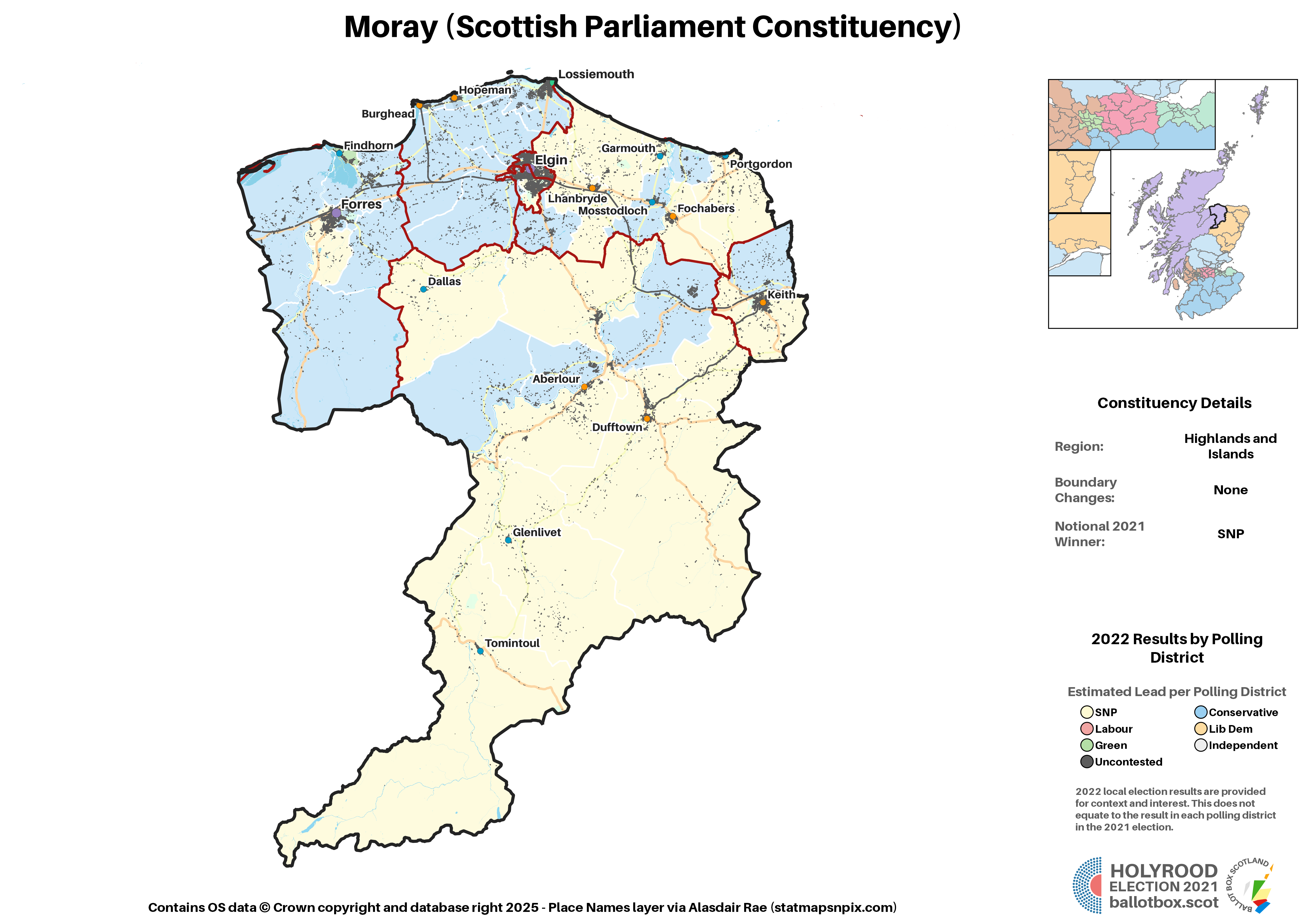
Sitting entirely within, but not covering the whole of the council area of the same name, Moray could at least get away with pointing out that it does contain almost all of actual, historic Moray. Centred on Elgin, that includes coastal towns and villages at Lossiemouth, Hopeman, Burghead and Findhorn, plus more inland settlements at Forres, Dallas, Lhanbryde, Mosstodloch and Fochabers. The rest of the area comes from the old Banffshire county, including Portgordon, Keith, Aberdour, Dufftown, and then the spike into the Cairngorms that includes Glenlivet and Tomintoul. The coastal stretch missing (from the region as well) between Buckie and Cullen is likewise Banffshire.
An SNP constituency since the very outset in 1999, the Conservatives have been trying to gain this one for the past few elections. They achieved that at Westminster in 2017, but it eluded them at Holyrood. I expect it will continue to do so given the party’s collapse in support, and that this is likely to be one of the more Reform-friendly constituencies, which will come primarily at the their expense.
2021 Constituency Vote
2021 Regional Vote
Constituency Map
Key Information
Notional 2021 Winner: Lib Dem
Majority: 3869 (33.4%)
Boundary Changes: None
2026 Candidates
SNP: Robert Leslie, L2
Conservative: Jamie Halcro-Johnston (*L), L2
Labour: Mike Macleod, L5
Lib Dem: Liam McArthur (*C)
Reform UK: John Coupland, L7
Constituency Description
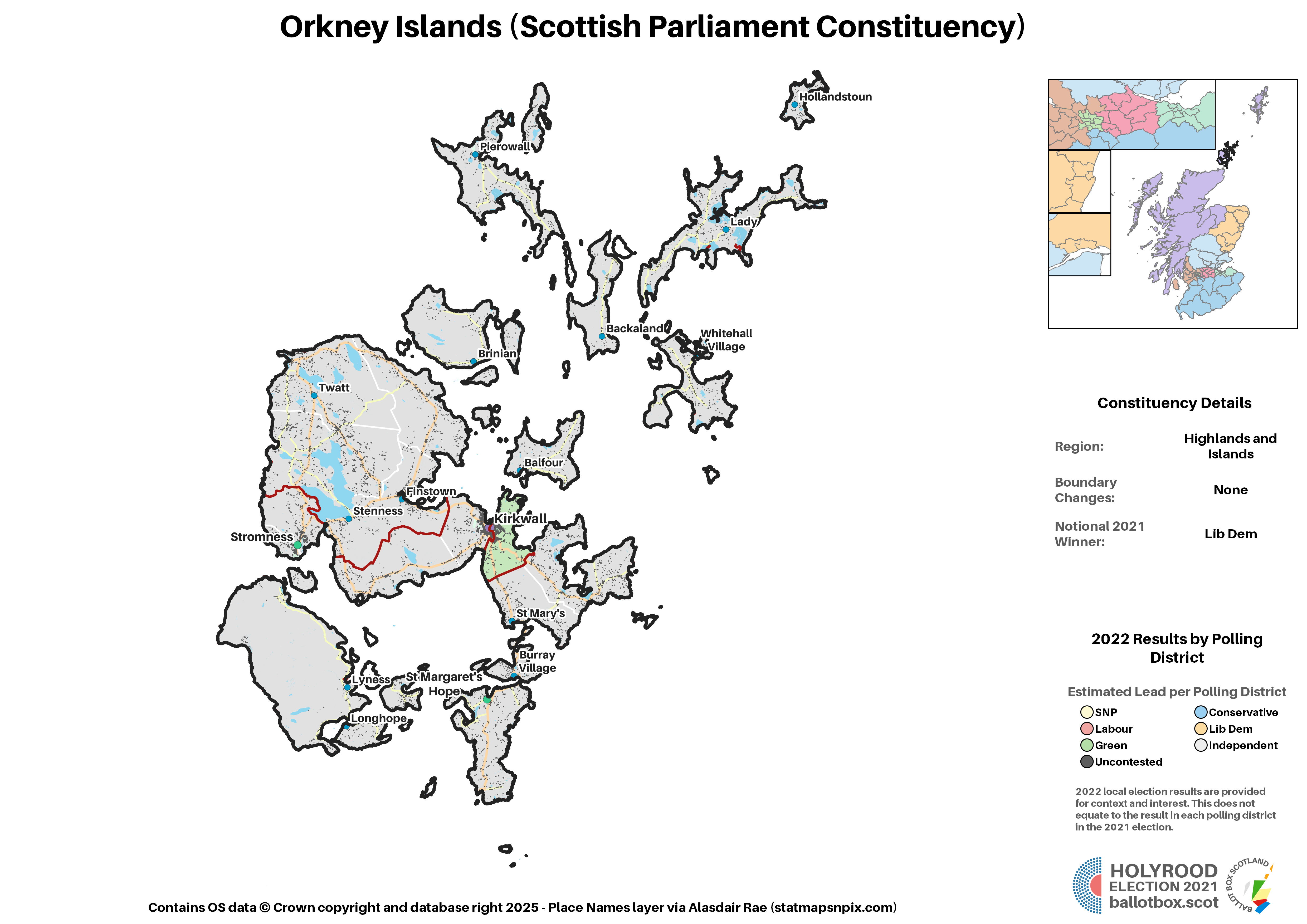
The Orkney Islands seat is coterminous with the Council, and when the Scottish Parliament was established in 1999 this was the one difference to the existing UK Parliament constituencies, where Orkney and Shetland have long been paired. As a protected Islands seat, this has never had any boundary changes.
The overwhelming majority of the population reside on the Orkney Mainland, particularly in Kirkwall and Stromness. The South Isles are then broadly more likely to be populous, with hundreds of residents on South Ronaldsay, Burray and Hoy, and smaller groups on Flotta and Graemsay. The North Isles are more sparse, though there are still hundreds of folk on Westray, Sanday, Stronsay, Shapinsay, and Rousay, and dozens on Eday, Papa Westray andNorth Ronaldsay.
The Lib Dems have always held this seat, and it’ll be a cold day in hell if another party ever wins it.
2021 Constituency Vote
2021 Regional Vote
Constituency Map
Key Information
Notional 2021 Winner: Lib Dem
Majority: 806 (6.8%)
Boundary Changes: None
2026 Candidates
SNP: Hannah Goodlad, L4
Conservative: Douglas Barnett, L8
Labour: John Erskine, L4
Green: Alex Armitage, L5
Lib Dem: Emma Macdonald
Reform UK: Vic Currie, L1
Alliance to Liberate Scotland: Brian Nugent, L1
Independent: Peter Tait
Constituency Description
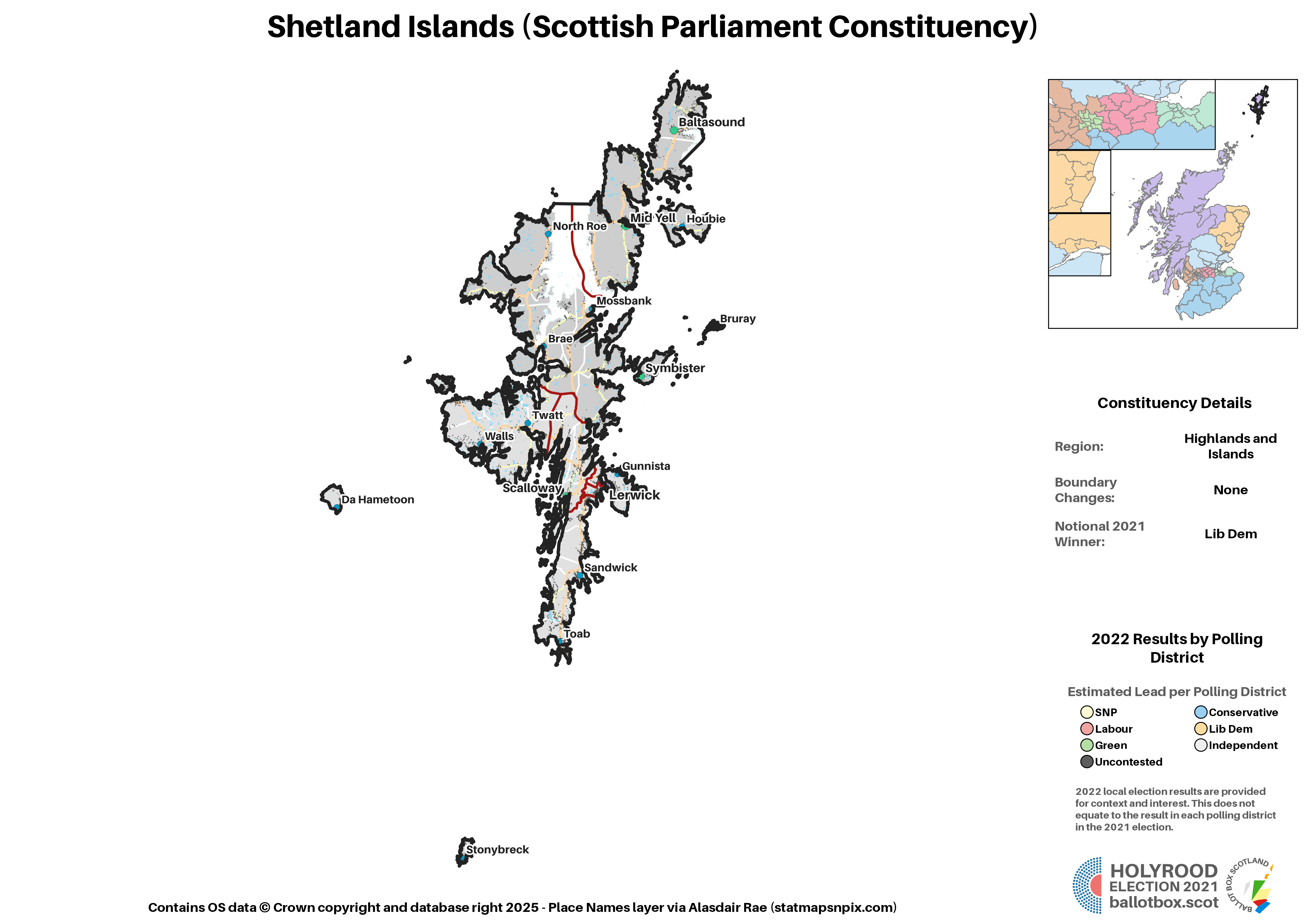
The Shetland Islands seat is coterminous with the Council, and when the Scottish Parliament was established in 1999 this was the one difference to the existing UK Parliament constituencies, where Orkney and Shetland have long been paired. As a protected Islands seat, this has never had any boundary changes. Note one thing on the map above: the red line in the sea between the Mainland and Yell. The actual constituency boundary includes the sea there, lending the constituency an odd look on many maps. Fortunately my use of polling districts as my lower layer avoids that in this case, but Shetlanders get surprisingly furious about this in my experience.
The overwhelming majority of the population reside on the Shetland Mainland, particularly in Lerwick and Scalloway. Other islands with populations in the hundreds are Whalsay and Bressay to the east of the mainland, Yell and Unst to the north, and West Burra, Trondra, Muckle Roe and East Burra to the west. There are lots of smaller islands too, most notably at Foula to the west and the Fair Isle to the far south.
The Lib Dems have always held this seat, but of the Northern Isles duo it’s been the one they’ve come closest to be being beaten in. The SNP managed to push this into marginality in 2021, and by this point relatively ancient scuttlebutt has it that in the 2015 UK election, the SNP led in Shetland and it was the Lib Dem dominance of Orkney wot won it. Regardless, I highly doubt that this will remain marginal after this election, as I reckon the SNP’s window of opportunity to win has passed.
2021 Constituency Vote
2021 Regional Vote
Constituency Map
Key Information
Notional 2021 Winner: SNP
Majority: 1702 (34.3%)
Boundary Changes: Gains area around Grantown on Spey from old Inverness and Nairn
2026 Candidates
SNP: Eilidh Munro, L5
Conservative: Helen Crawford, L3
Labour: Isla McCay, L1
Lib Dem: Andrew Baxter
Reform UK: John Whitton, L6
Alliance to Liberate Scotland: Laura Hansler, L4
Constituency Description
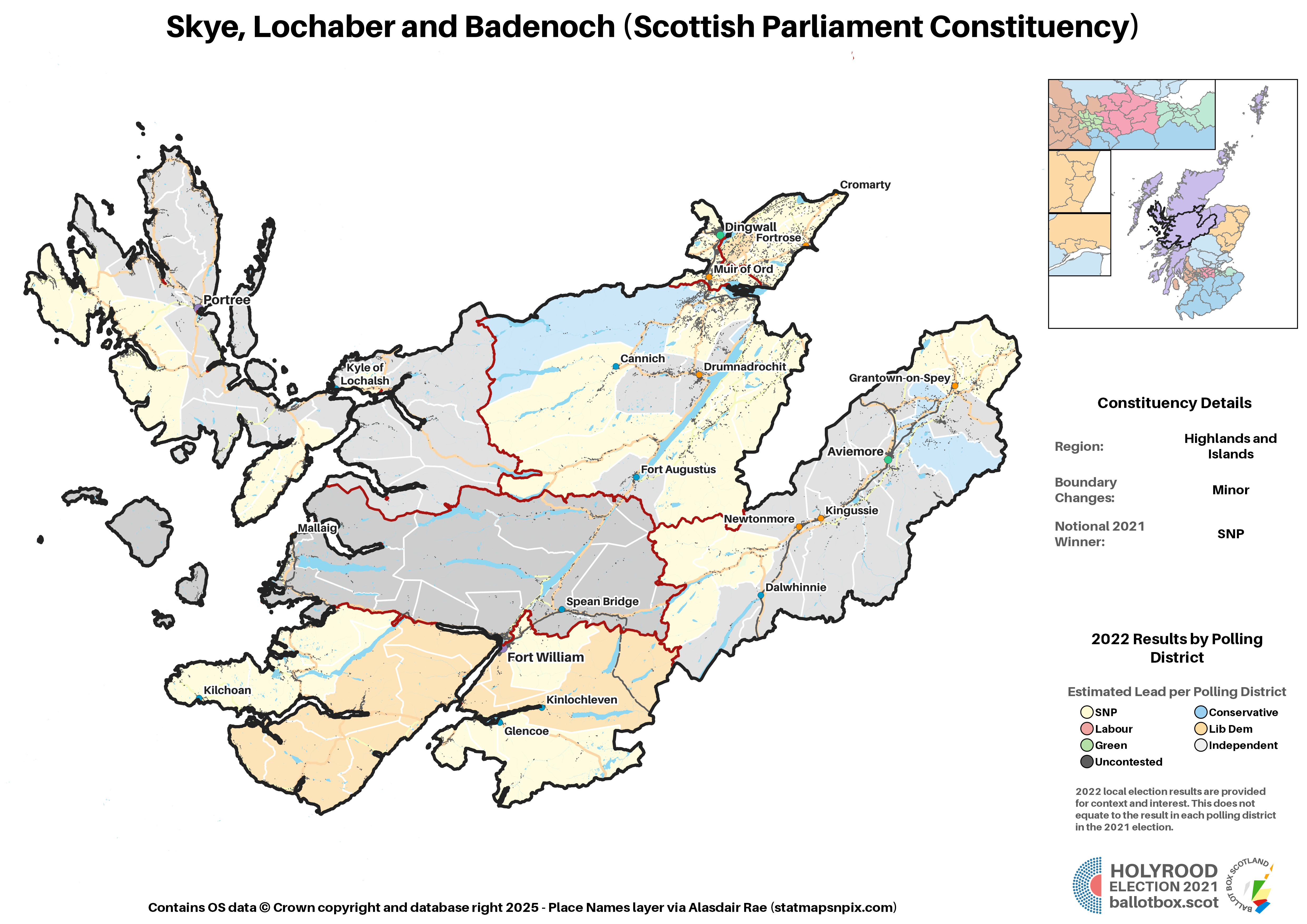
Sitting entirely within the Highland Council area, Skye, Lochaber and Badenoch is perhaps best described through compass points. The Isle of Skye sits in the west, just across from the Kyle of Lochalsh on the mainland. Lochaber, centred on the sizeable town of Fort William, covers off the south. Badenoch (and Strathspey) is the easternmost component, running from Dalwhinnie up through Aviemore and into, newly added in the boundary changes, Grantown-on-Spey. Finally, western Inverness-shire around Drumnadrochit and southern Ross-shire around Dingwall compose the northern chunk.
The SNP have held this seat since 2011 when it was created out of parts of the Ross, Skye and Inverness West and Inverness East, Nairn and Lochaber seats. Of these, the former was previously Lib Dem held and the latter consistently SNP. Especially given their win in the partly corresponding Westminster seat in 2024, the Lib Dems are definitely gunning for a win here too. The fact that Deputy First Minister Kate Forbes is standing down may boost their chances, as I reckon she may have been a rare recipient of a genuine and substantial personal vote. That is still a staggering 40% gap to close, however.
Note: The originally selected SNP candidate for this seat, Kate Forbes, announced she was not standing for re-election in August 2025, citing a desire to spend more time with her family.
Notional 2021 Constituency Vote
Note: the Green vote is based solely on where they stood in 2021 and does not reflect a “true” share for this constituency.
Notional 2021 Regional Vote
To allocate list seats using the D’Hondt method, each party’s share of the vote is divided by one more than the number of seats they’ve won so far in the process. This is an important part of how the list seats then more fairly represent the diversity of views amongst voters. List votes cast for a party that has won lots of constituency seats are not “wasted”, they just aren’t needed to give their voters fair representation.
Starting Point
When allocating the first list seat, this starts with the number of constituencies won by each party:
- The SNP won 6 constituencies, so their vote is divided by 7.
- The Lib Dems won 2 constituencies, so their vote share is divided by 3.
Seat 1
Since the Conservatives have the highest total here, they receive the first regional seat. We add that to their total, giving them 1 seat overall so far, and therefore for the next round of allocation their share is divided by 2.
Seat 2
Since the Conservatives have the highest total here, they receive the second regional seat. We add that to their total, giving them 2 seats overall so far, and therefore for the next round of allocation their share is divided by 3.
Seat 3
Since Labour have the highest total here, they receive the third regional seat. We add that to their total, giving them 1 seat overall so far, and therefore for the next round of allocation their share is divided by 2.
Seat 4
Since the Conservatives have the highest total here, they receive the fourth regional seat. We add that to their total, giving them 3 seats overall so far, and therefore for the next round of allocation their share is divided by 4.
Seat 5
Since the Greens have the highest total here, they receive the fifth regional seat. We add that to their total, giving them 1 seat overall so far, and therefore for the next round of allocation their share is divided by 2.
Seat 6
Since the Conservatives have the highest total here, they receive the sixth regional seat. We add that to their total, giving them 4 seats overall so far, and therefore for the next round of allocation their share is divided by 5.
Seat 7
Since the SNP have the highest total here, they receive the seventh and final regional seat. We add that to their total, giving them 7 seats overall. This completes the list seat allocation process.
If you find this or other Ballot Box Scotland output useful and/or interesting, and you can afford to do so, please consider donating to support my work. I love doing this, but it’s a one-man project and takes a lot of time and effort. All donations, no matter how small, are greatly appreciated and extremely helpful.
(About Donations)