Posted in

SP26: Mid Scotland and Fife Region Preview

Region Overview

Region Map

Note: due to an error on my part, the above graphic has the 4th and 5th list seats the wrong way round. The correct sequence is that the Greens won the 4th seat and the Conservatives the 5th.

Region Description

Mid Scotland and Fife almost entirely avoided the Boundaries Scotland scalpel, as the only change is a small tweak between two constituencies. Everything else remains as it was previously. That means this continues to cover the whole of the Clackmannanshire, Fife, Perth and Kinross, and Stirling Council areas. It also therefore continues to be the only region not to cross any local authority boundaries.

That doesn’t mean it’s without its own odd combinations. Southern Fife, Clackmannanshire, and the eastern part of Stirling (the city itself) are highly urbanised areas with industrial heritage and a substantial working class vote. On the other hand, Perth and Kinross, northern Fife, and western Stirling are broadly more rural and/or affluent patches of the country. 

What to Watch For in 2026

At the 2024 UK General Election, the equivalent seats to this region put on something of a 1997 tribute act: Perthshire was SNP, North East Fife Lib Dem, and all the rest Labour. Yet at Holyrood, the SNP’s starting position is still so far ahead of Labour in most seats that it’s going to take a lot to shift that. Their chances are best in the southern Fife seats, especially those that used to be Gordon Brown’s patch.

On paper, it’s actually Perthshire that’s under more threat, especially the southern end which did briefly go Conservative at UK level in 2017. In reality, the Conservative collapse should mean the SNP are pretty safe in those seats. Indeed, with the combination of a crashing vote, Reform’s rise, and the risk of the SNP increasing their excess constituency seats, the Conservatives could be headed for a halving of their local numbers.

Similarly, it’s possible SNP constituency dominance could pose a risk to the Greens. Relative to the notional 2021 results, this is in vote share terms their best starting position to aim for an 11th seat nationwide, via a second regional MSP. You would generally expect that repeating the 2.2% vote share gain they got from 2016 to 2021 would do the trick. However if the SNP aren’t dislodged from any constituencies, it wouldn’t. Finally, though facing the same challenge as the Greens, the Lib Dems could also pick up a second seat by building on their concentrations of support in the north east and Dunfermline.

2021 Constituency Vote
2021 Regional Vote
Notional 2021 Seat Winners

Constituency

Clackmannanshire and Dunblane: 🟡SNP
Cowdenbeath: 🟡SNP
Dunfermline: 🟡SNP
Fife North East: 🟠Lib Dem
Kirkcaldy: 🟡SNP
Mid Fife and Glenrothes: 🟡SNP
Perthshire North: 🟡SNP
Perthshire South and Kinross-shire: 🟡SNP
Stirling: 🟡SNP

Regional List

1: 🔵Conservative
2: 🔵Conservative
3: 🔴Labour
4: 🟢Green
5: 🔵Conservative

6: 🔴Labour
7: 🔵Conservative

Mid Scotland and Fife: 2021 Notional Results (Regional Vote)
Mid Scotland and Fife: 2021 Notional Results (Constituency Vote)

Region History

1999 to 2011 Boundaries

Elections in 1999, 2003 and 2007 for Mid Scotland and Fife were fought on boundaries that covered the whole of Clackmannanshire, Fife, Stirling, Perth and Kinross and part of Angus (Kirriemuir, Forfar, Brechin and the Glens).

The first election gave a relatively tidy geographic split to the constituency distribution, with Labour taking the six seats covering Stirling, Clackmannanshire and south Fife, the SNP both Perthshire seats, and the Lib Dems Fife North East. The SNP also picked up three list MSPs, as did the Conservatives, plus one for the Lib Dems.

2003’s “Rainbow Parliament” saw a Green functionally replace one of the SNP list seats, which the SNP had made up anyway by gaining the Ochil constituency from Labour, though the (recently late) George Reid would immediately go on to become Presiding Officer.

The SNP managed to add Fife Central and Stirling to their constituency haul here, whilst also effectively taking the Greens’ list seat off them. The Lib Dems also made a constituency gain in the form of Dunfermline West. Labour won their first list seats in the region as a consequence of these losses, leaving their total unchanged.

2011 to 2026 Boundaries

Elections in 2011, 2016 and 2021 for Mid Scotland and Fife were fought on boundaries that covered the whole of Clackmannanshire, Fife, Stirling, and Perth and Kinross.

The SNP’s stunning 2011 majority included winning almost every constituency in the region, with Labour only holding onto Cowdenbeath, and yet still electing an additional MSP via the list. I have it on good authority that when informed the SNP had won North East Fife,  then-First Minister Alex Salmond was heard to exclaim “ROD F***ING CAMPBELL?” I assume this was less to do with the quality of Mr Campbell as a candidate, but rather that he was just the usual face they put up in that no-hope seat! That left three-quarters of Labour’s representation as List MSPs, cut one off the Conservative tally, and saw the Lib Dems narrowly elect soon-to-be leader Willie Rennie.

The SNP still came up one constituency short in 2016, but that was a trade where they picked up Kirkcaldy from Labour but lost North East Fife back to the Lib Dems. Not only were they not due a list seat this time, but this was the one region they exceeded their fair seat share, which cost Labour a list seat; given they were already down one, that halved their delegation. Big gains (in relative terms) for the Conservatives and Greens meant the former doubled their seats and the latter regained one.

In 2021 nothing meaningful changed here, with each party winning the same number of seats as previously.

Candidates

Candidates in both this section and individual constituencies are marked if they are an incumbent MSP:

  • (*C): Incumbent for that constituency, or equivalent if significantly impacted by boundary changes
  • (*OC): Incumbent for another constituency
  • (*L): Incumbent on the list
  • (*OL): Incumbent on the list in another region
2026 Total Candidate Numbers
Mid Scotland and Fife: 2026 Regional List Candidates

The six parties expected to win seats in the Scottish Parliament in 2026 are listed in order of national support in 2021. Remaining parties are in alphabetical order, and Independents listed last.

Candidates that are contesting both the List and Constituency ballot have their constituency noted after their name on the list.

  1. John Swinney (*C, Perthshire North)
  2. Shirley-Anne Somerville (*C, Dunfermline)
  3. Fiona Law
  4. Alyn Smith (Stirling)
  5. Jim Fairlie (Perthshire South and Kinross-shire)
  6. David Torrance (Kirkcaldy)
  7. Susan McGill
  8. John Beare
  9. David Mitchell
  1. Murdo Fraser (*L, Perthshire North)
  2. Stephen Kerr (*OL, Stirling)
  3. Roz McCall (*L, Perthshire South and Kinross-shire)
  4. Alexander Stewart (*L, Clackmannanshire and Dunblane)
  5. Edward Sheasby (Fife North East)
  6. Thomas Heald (Dunfermline)
  7. Darren Watt (Cowdenbeath)
  8. Heather Greig (Kirkcaldy)
  9. Niamh Heald (Mid Fife and Glenrothes)
  1. Claire Baker (*L, Kirkcaldy)
  2. Joe Long (Dunfermline)
  3. Fiona Sword (Cowdenbeath)
  4. Kainde Manji (Stirling)
  5. Suzanne Grahame (Clackmannanshire and Dunblane)
  6. Angela Bailey (Perthshire North)
  7. Afifa Khanam (Mid Fife and Glenrothes)
  8. Luke Thomson (Perthshire South and Kinross-shire)
  1. Mark Ruskell (*L)
  2. Mags Hall
  3. Caitlin Ripley
  4. Ryan Blackadder
  5. Marie Stadtler
  6. Clare Andrews
  7. Andrew Adam
  8. Paul Vallot
  1. Claire McLaren (Perthshire North)
  2. Sally Pattle (Clackmannanshire and Dunblane)
  3. Ed Scotcher (Mid Fife and Glenrothes)
  4. Amanda Clark (Perthshire South and Kinross-shire)
  5. Lauren Buchanan-Quigley (Dunfermline)
  6. Jane Liston
  7. Fraser Graham (Kirkcaldy)
  1. Helen McDade (Perthshire South and Kinross-shire)
  2. Julie MacDougall (Kirkcaldy)
  3. Rachel Wright (Stirling)
  4. Mark Davies (Cowdenbeath)
  5. Mike Collier (Clackmannanshire and Dunblane)
  6. Kenneth Morton (Perthshire North)
  7. Otto Inglis (Dunfermline)
  1. Hilary Wheater
  2. Reece Lauder
  1. Eva Comrie (Clackmannanshire and Dunblane)
  2. Laurie Moffat (Cowdenbeath)
  3. John Penman
  4. Donal Hurley
  5. Frank Armstrong
  1. Richard Lucas
  2. Daniel Smith
  3. Alan Brown
  4. Marc Surtees
  1. Alexandra Hardie

Note: Independent Green Voice are a front group for a bunch of Glasgow bampots, led by someone who was expelled from UKIP for alleged Holocaust denial. They are standing purely as a spoiler party in this election, targeting the legitimate Scottish Green Party, and their simple one candidate per region slate is further evidence of this dodgy dealing.

  1. Paolo Caserta
  2. Jack Reekie

Clackmannanshire and Dunblane

Constituency Map
Key Information

Notional 2021 Winner: 🟡SNP
Majority: 8101 (21.2%)
Boundary Changes:  Gains area around Cornton, Causewayhead and Cambuskenneth from old Stirling

2026 Candidates

🟡SNP: Keith Brown (*C)
🔵Conservative: Alexander Stewart (*L), L4
đź”´Labour: Suzanne Grahame, L5
đźź Lib Dem
: Sally Pattle, L2
🟣Reform UK
: Mike Collier, L5
⚪Independent
: Luca Scacchi
🟤Alliance to Liberate Scotland
: Eva Comrie, L1

Constituency Description

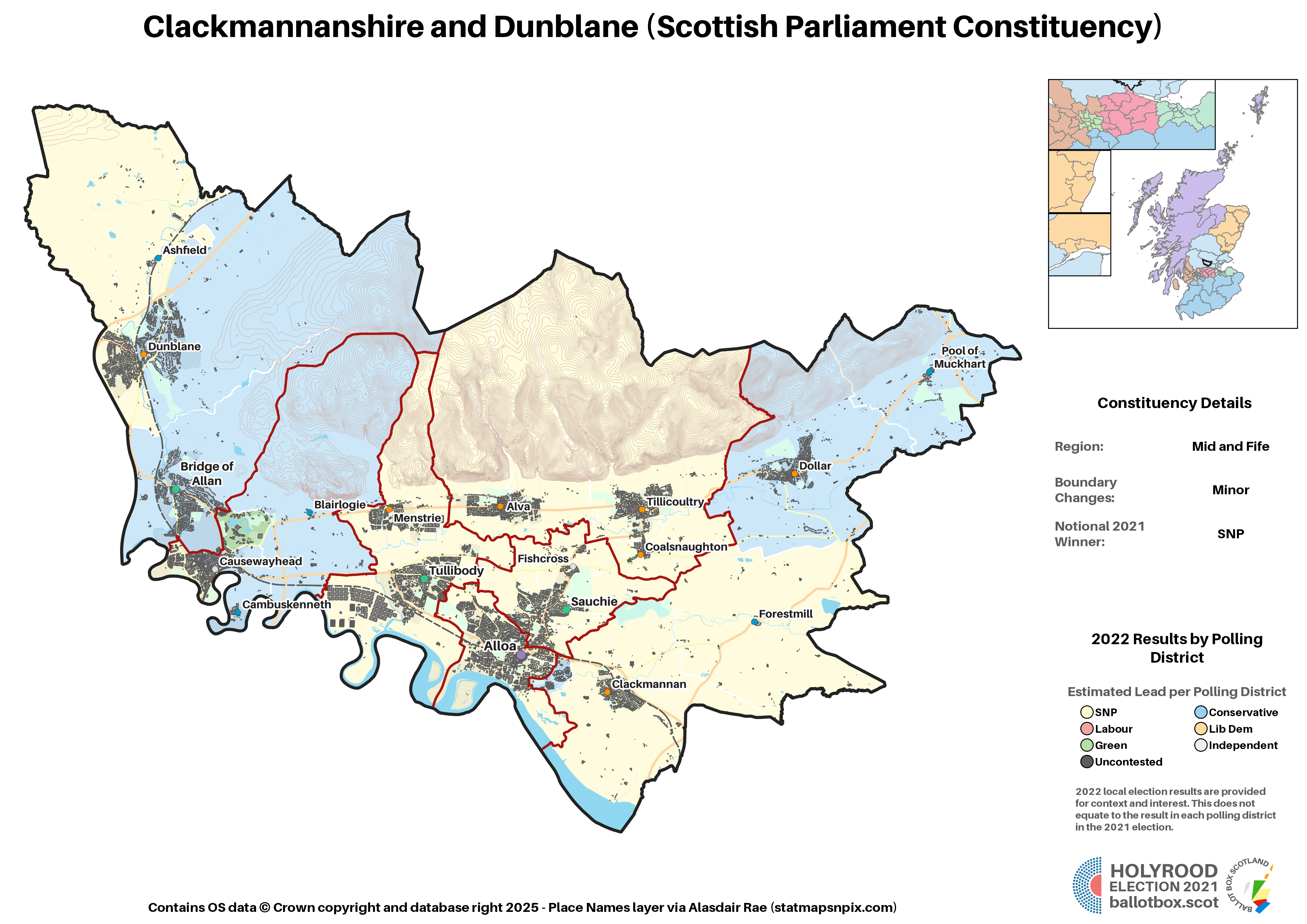
Covering the entirety of Clackmannanshire and a portion of Stirling council areas, Clackmannanshire and Dunblane sits nestled in between the River Forth and the Ochil Hills. The Clackmannanshire end includes Alloa, Tullibody and Clackmannan on or within sight of the river, plus the Hillfoots Villages of Menstrie, Alva, Tillicoultry, Dollar and Muckhart. The Stirling portion originally consisted of Dunblane and Bridge of Allan. This is one half of the only constituency boundary change in the region, nibbling a wee bit on Stirling City itself, namely Causewayhead and Cornton, as the southern boundary was fully aligned with the Forth.

The SNP have held this seat since it was created in 2011. They’d also gained the previous Ochil constituency from Labour in 2003, but you could argue that didn’t really matter until 2007 as 2003’s MSP, George Reid, took up office as the Presiding Officer. The Conservatives overtook Labour in 2021, though not by much, meaning the latter have a marginally higher SNP majority to overcome if they want to gain this. That puts it at the less likely end of the regional scale of Labour gain potential.

Notional 2021 Constituency Vote
Notional 2021 Regional Vote

Cowdenbeath

Constituency Map
Key Information

Notional 2021 Winner: 🟡SNP
Majority: 6013 (17.6%)
Boundary Changes: None

2026 Candidates

🟡SNP: David Barratt
🔵Conservative: Darren Watt, L7
đź”´Labour: Fiona Sword, L3
đźź Lib Dem
: James Calder
🟣Reform UK
: Mark Davies, L4
🟤Alliance to Liberate Scotland
: Laurie Moffat, L2

Constituency Description

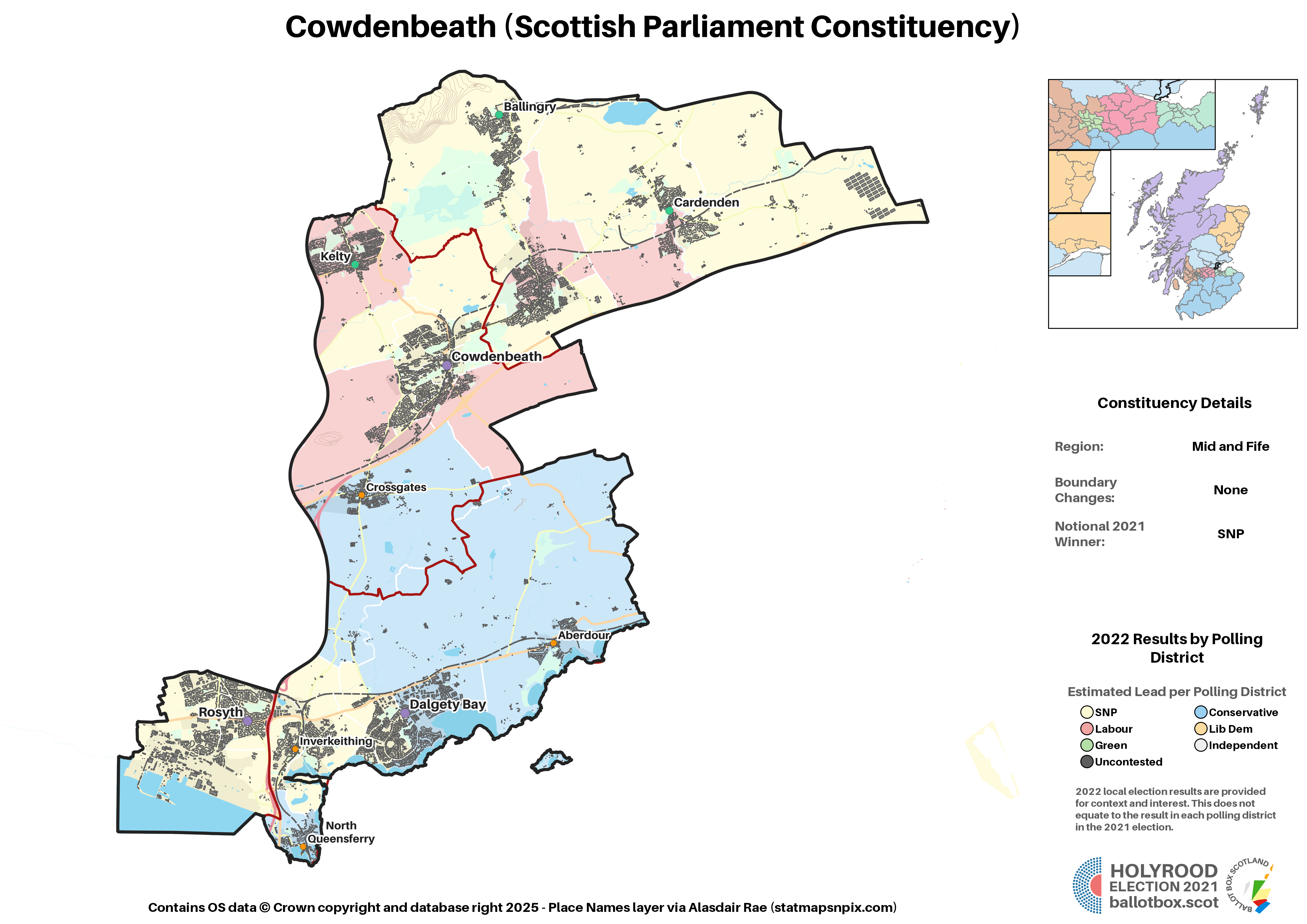
Sitting entirely within the Fife Council area, Cowdenbeath itself is actually a relatively small area to lend its name to a constituency. It’s nonetheless the anchor for the inland portion of this constituency, with the likes of Crossgates, Lochgelly, Kelty, Ballingry and Cardenden in orbit around it. The coastal section runs from Rosyth through North Queensferry, Inverkeithing, Dalgety Bay and as far as Aberdour.

This was Labour’s longest holdout in the region, having held the prior Dunfermline East seat originally, taking until 2016 for the SNP to nab it from them. Although he sat in a different parliament, remember that this is former Prime Minister Gordon Brown’s patch, and I believe he’s still a resident of North Queensferry. That may go partway to explaining why this is still Labour’s strongest prospect for a constituency gain in this region.

2021 Constituency Vote
2021 Regional Vote

Dunfermline

Constituency Map
Key Information

Notional 2021 Winner: 🟡SNP
Majority: 8664 (21.2%)
Boundary Changes: None

2026 Candidates

🟡SNP: Shirley-Anne Somerville (*C), L2
🔵Conservative: Thomas Heald, L6
đź”´Labour: Joe Long, L2
đźź Lib Dem
: Lauren Buchanan-Quigley, L5
🟣Reform UK
: Otto Inglis, L7

Constituency Description

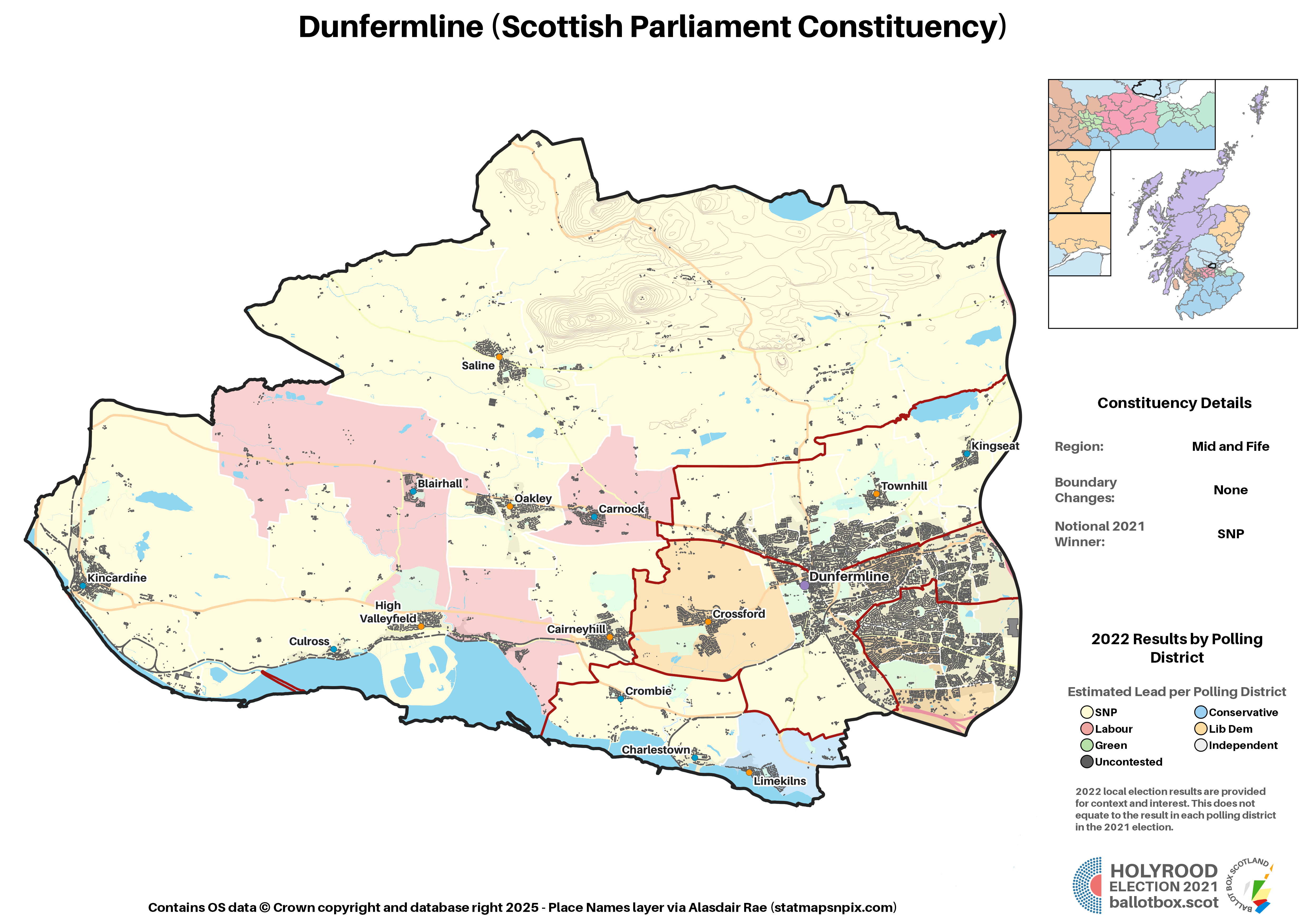
Sitting entirely within the Fife Council area, Dunfermline is centred on an ancient town that is simultaneously our newest city, having been granted that functionally meaningless title in 2022. It also includes a truly dizzying number of villages that dot western Fife, the largest being Kincardine, Oakley, Saline, High Valleyfield, Cairneyhill, Crossford, Limekilns and Townhill.

This seat has had a somewhat complex history, with the Lib Dems gaining the prior Dunfermline West seat from Labour in 2007. Although the SNP gained this redrawn version in 2011, new MSP Bill Walker was ultimately expelled from the party after domestic abuse charges, resigning from the parliament after his conviction in 2013. Labour won the resulting by-election in 2013 (incidentally, the first time I ever went doorknocking for an election – not for them, mind!), before the SNP regained it in 2016.

On the easier end of Labour gains in Fife, they still have a substantial majority to overcome. A complicating factor for them might be how well the Lib Dems do. Although their 2021 support wasn’t enormous, it was still their second best constituency in the region, they do well here at local elections, and their residual strength may be enough to draw away any scunnered Labour voters. Keep an eye on their regional vote here too, as that’ll be key to them getting a second MSP via the list.

2021 Constituency Vote
2021 Regional Vote

Fife North East

Constituency Map
Key Information

Notional 2021 Winner: đźź Lib Dem
Majority: 7448 (18.5%)
Boundary Changes: None, but order of name reversed from North East Fife

2026 Candidates

🟡SNP: John Beare, L8
🔵Conservative: Edward Sheasby, L5
đź”´Labour: Elizabeth Carr-Ellis, L7
đźź Lib Dem
: Willie Rennie (*C)
🟣Reform UK
: William Docherty

Constituency Description

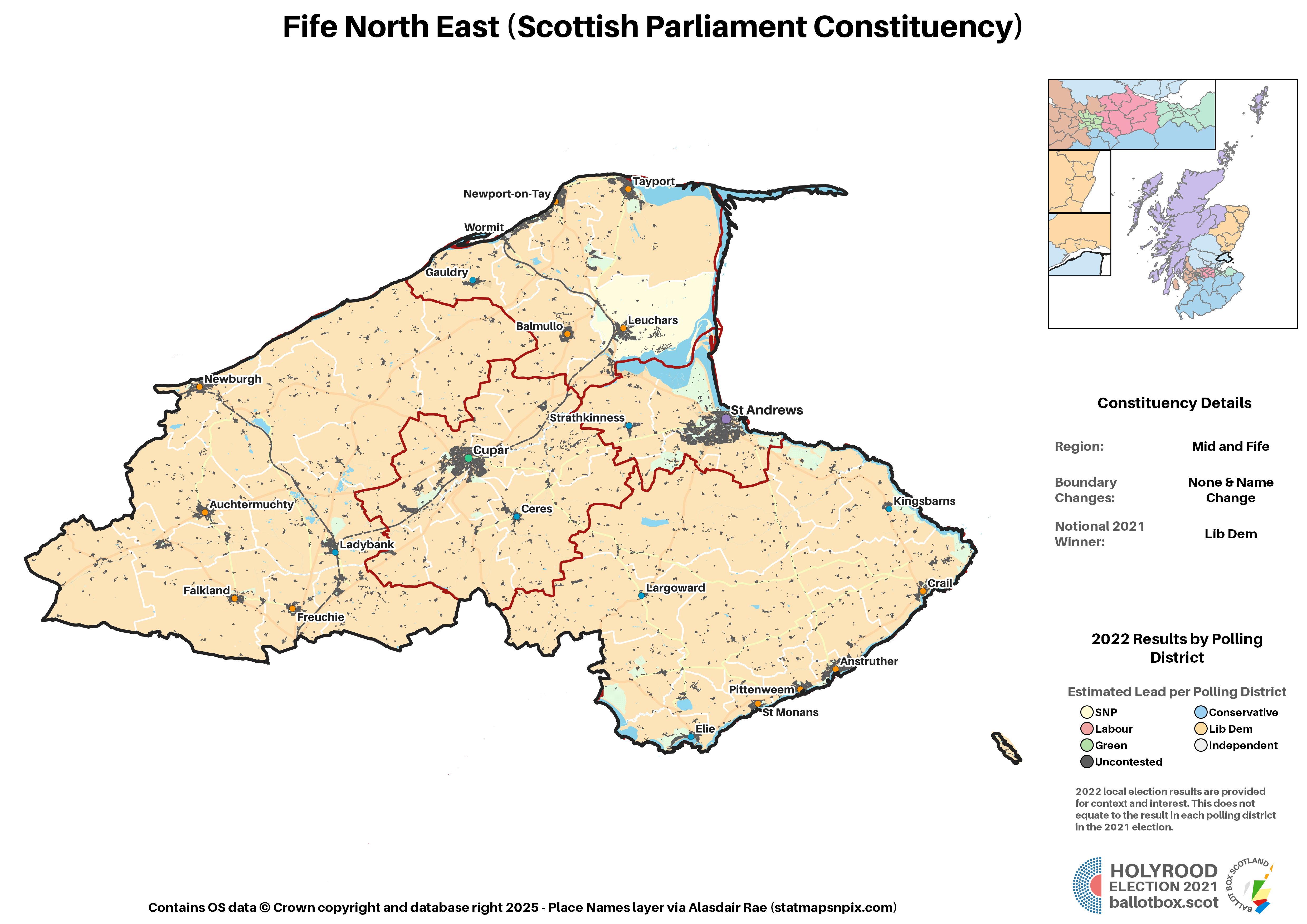
Sitting entirely within the Fife Council area, Fife North East is the closest thing Fife has to a rural constituency, covering about half of the total area. The clear centre here is the university town of St Andrews, though it also includes the historic country town of Cupar. The Tay-facing portion of the remainder stretches from Newburgh out to Tayport via Wormit and Newport-on-Tay, with the military base at Leuchars a bit further inland. On the Forth side is the famed East Neuk of Fife, and the picturesque historic fishing villages of St Monans, Pittenweem, Anstruther and Crail.

This has long been a very distinct part of Fife, in that it’s never once elected a Labour parliamentarian at any level. At Holyrood this is die-hard Lib Dem territory, only slipping from their grasp once when they suffered a mainland wipeout in 2011 (see “ROD F***ING CAMPBELL!” anecdote earlier). Former Lib Dem leader Willie Rennie has a nice, snug seat here by this point which he certainly won’t be losing again.

If he wants a regional party colleague though, work will need to go into pulling their list vote closer to their constituency share; note that in 2021 the SNP actually had a slender lead on that side of the ballot. Given that the Conservative list vote was almost four times the size of the constituency, this likely reflects a degree of bidirectional tactical voting: many Conservatives going Lib Dem in the constituency, and a few Lib Dems going Conservative on the list.

Note: The originally selected SNP candidate for this seat, Stefan Hoggan-Radu, resigned as candidate and from the party citing mental health pressures. It was also reported that he had been subject to a misconduct complaint.

The originally selected Reform UK candidate for this seat, Linda Holt, resigned as a candidate shortly after being selected. She was under scrutiny for her conduct on social media.

2021 Constituency Vote
2021 Regional Vote

Kirkcaldy

Constituency Map
Key Information

Notional 2021 Winner: 🟡SNP
Majority: 7831 (22.3%)
Boundary Changes: None

2026 Candidates

🟡SNP: David Torrance (*C), L6
🔵Conservative: Heather Greig, L8
đź”´Labour: Claire Baker (*L), L1
đźź Lib Dem
: Fraser Graham, L7
🟣Reform UK
: Julie MacDougall, L2

Constituency Description

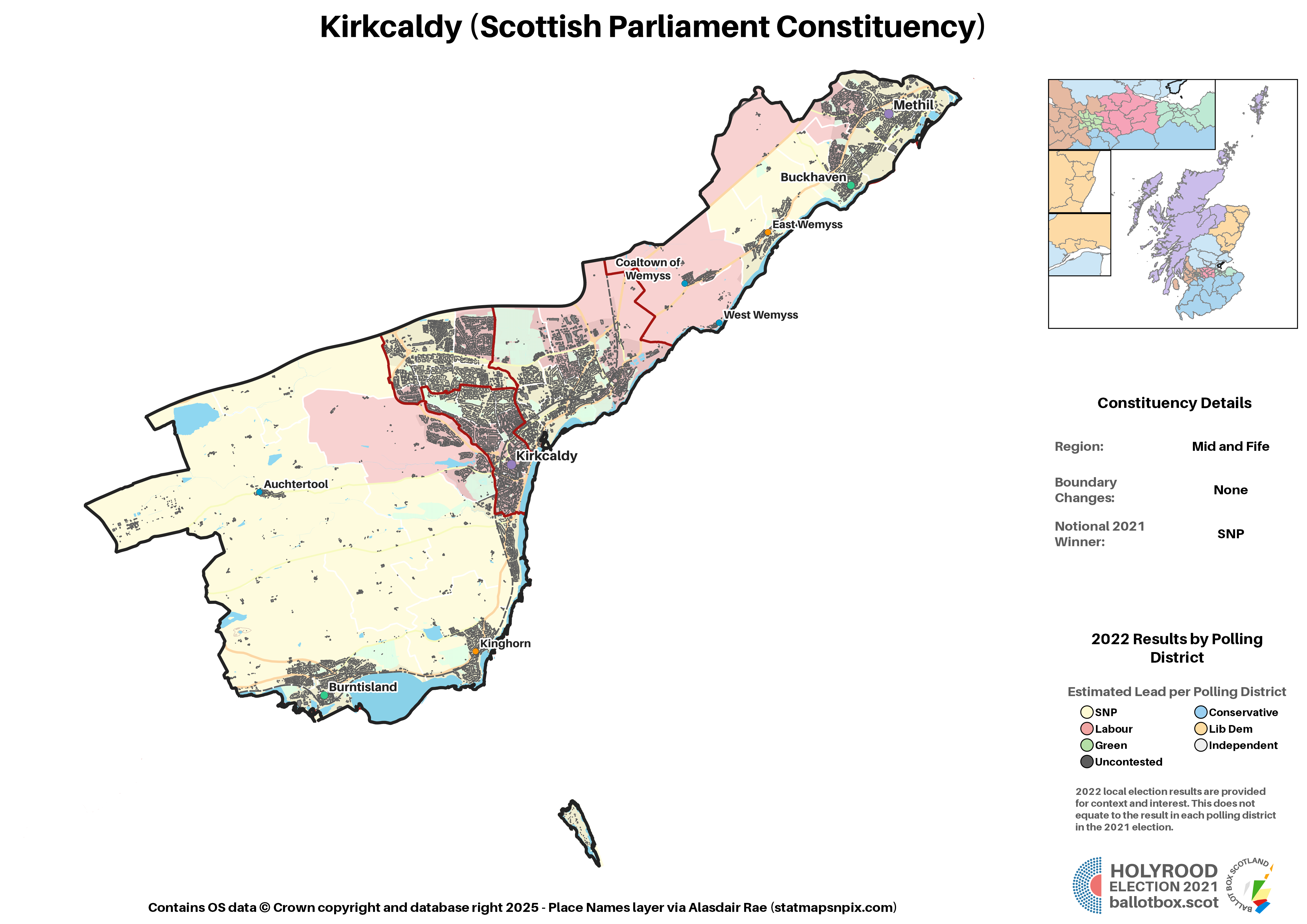
Sitting entirely within the Fife Council area, Kirkcaldy itself sits at the midpoint of this coastal constituency. To the south and west this also covers Burntisland and Kinghorn, whilst stretching to the Wemyss Villages, Buckhaven and Methil to the north and east. These latter two form part of the substantial Levenmouth area which is split along the River Leven at Holyrood.

The SNP gained this from Labour in 2011 and have since managed to bed quite strongly in despite Kirkcaldy’s spell back in Labour hands at UK level in 2017. This sits right in the middle of the table for the region in terms of how easy it’ll be for Labour to pick up.

2021 Constituency Vote
2021 Regional Vote

Mid Fife and Glenrothes

Constituency Map
Key Information

Notional 2021 Winner: 🟡SNP
Majority: 10234 (31.3%)
Boundary Changes: None

2026 Candidates

🟡SNP: Jenny Gilruth (*C)
🔵Conservative: Niamh Heald, L9
đź”´Labour: Afifa Khanam, L8
đźź Lib Dem
: Ed Scotcher, L3
🟣Reform UK
: Sacha Haworth

Constituency Description

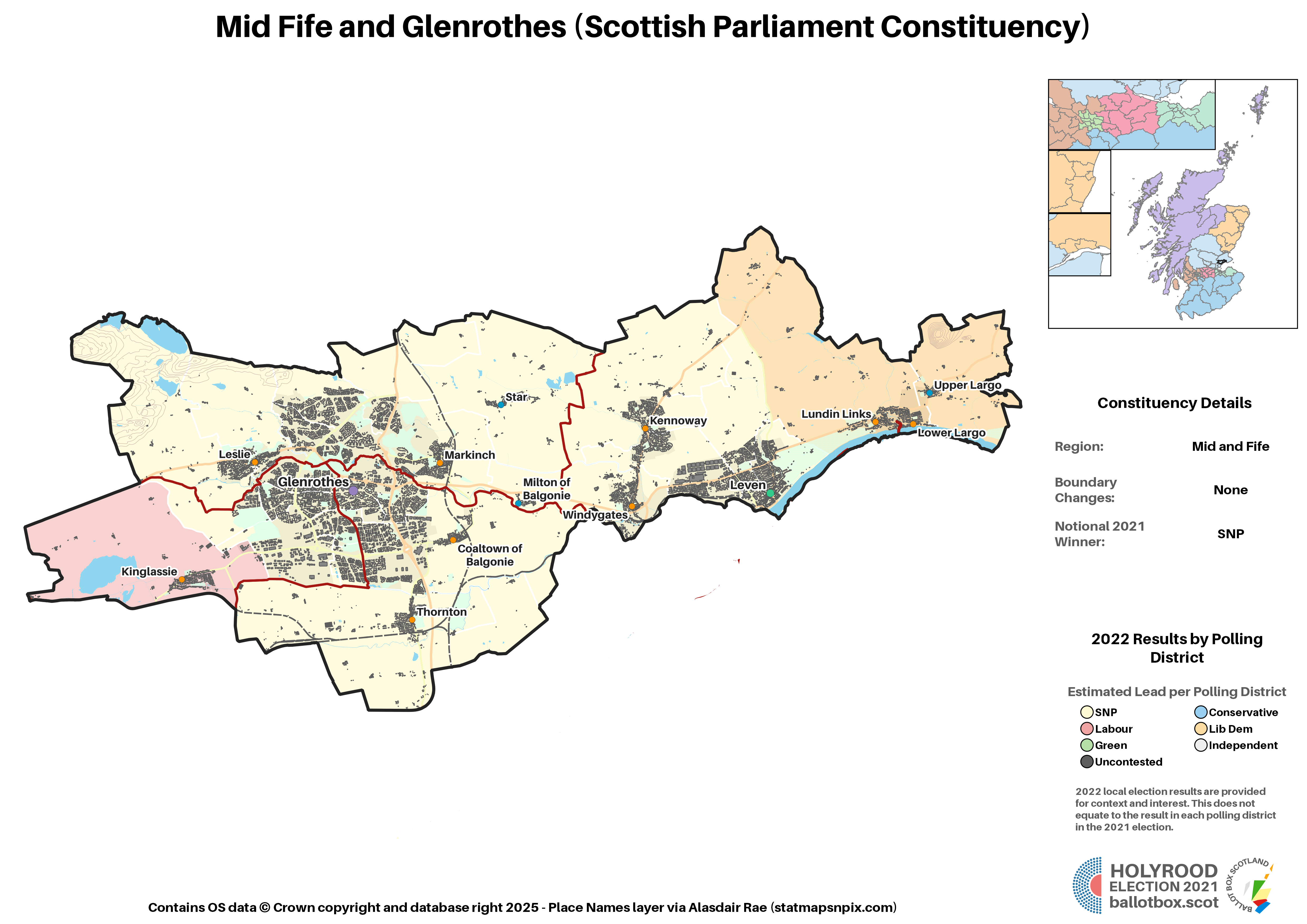
Sitting entirely within the Fife Council area, Mid Fife and Glenrothes is clearly centred on Glenrothes itself, a New Town which serves as the administrative centre for modern Fife. Glenrothes is surrounded by various smaller villages, including Thornton, Kinglassie, Leslie and Markinch. The constituency then passes through Windygates and Kennoway out to Leven, the northern component of the wider Levenmouth area, and thence to Lundin Links and the Largos (Upper and Lower).

The SNP gained this in its prior guise as Central Fife in 2007, and it has since become easily their strongest constituency in the region and one of their safest in the country. That didn’t stop Labour gaining the oppositely titled UK version in 2024, but they’ll be extremely hard pressed to repeat the feat at Holyrood unless polling changes dramatically.

Note: The originally selected Reform UK candidate for this seat, Roland Jackson, resigned shortly after being selected. He claimed he had withdrawn at the last minute but an administrative error led to him still being announced.

2021 Constituency Vote
2021 Regional Vote

Perthshire North

Constituency Map
Key Information

Notional 2021 Winner: 🟡SNP
Majority: 4053 (10.1%)
Boundary Changes: None

2026 Candidates

🟡SNP: John Swinney (*C), L1
🔵Conservative: Murdo Fraser (*L), L1
đź”´Labour: Angela Bailey, L6
đźź Lib Dem
: Claire McLaren, L1
🟣Reform UK
: Kenneth Morton, L6

Constituency Description

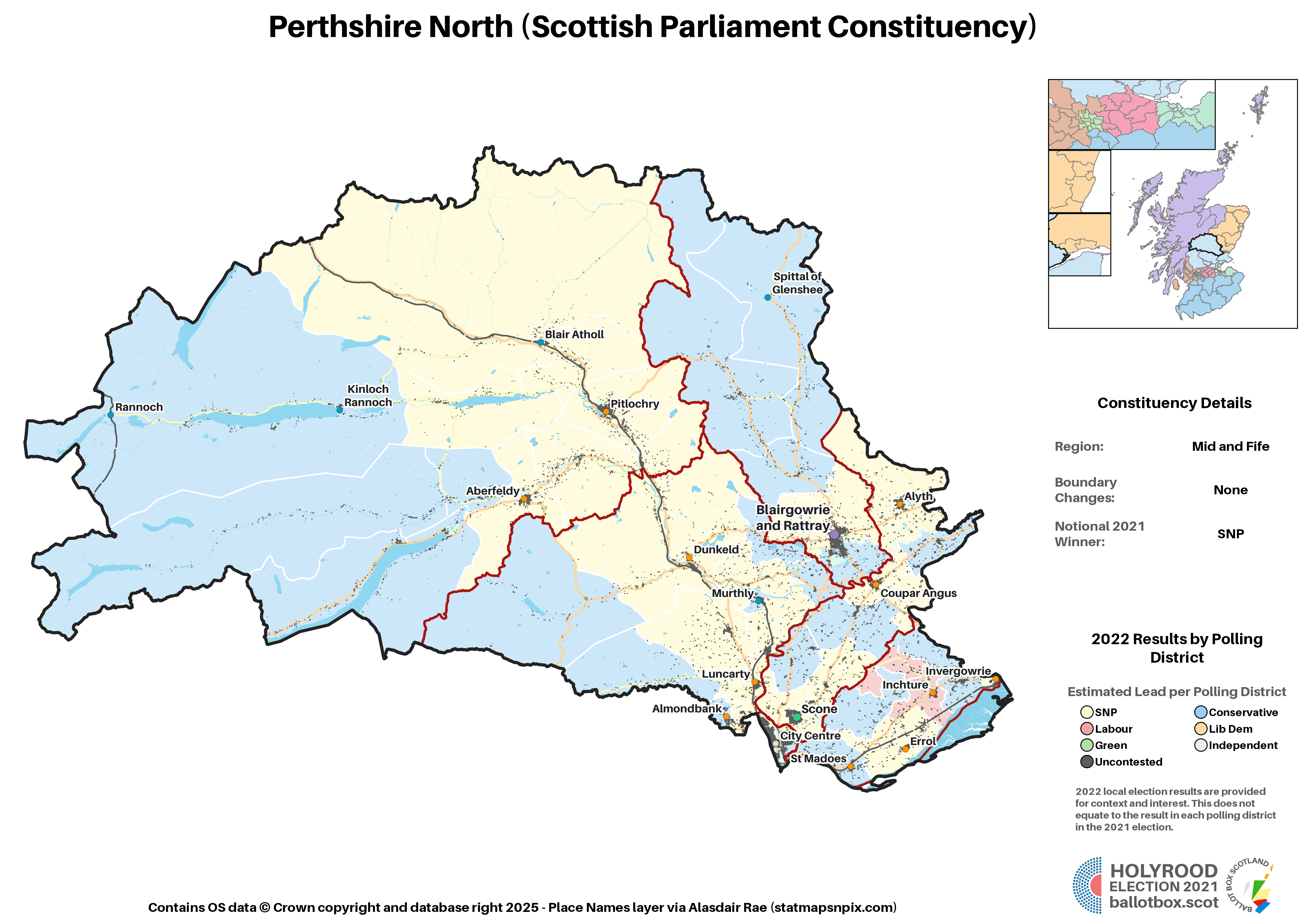
Sitting entirely within the Perth and Kinross Council area, Perthshire North stretches all the way from the Firth of Tay into the highlands. Perth city is split in two at Holyrood, this seat containing the city centre and eastern portions. Also in the flatter end of the constituency is the stretch between Perth and Dundee, which goes from Scone to Invergowrie, plus a cluster to the north of the city at Blairgowrie and Rattray, Alyth and Coupar Angus. Further inland the seat is defined by several rivers: the Tay, flowing from its source at Loch Tay through Aberfeldy; the Garry, which passes by Blair Atholl; and the Tummel, where Pitlochry is sited.

Not only have the SNP held this seat since the 1999 incarnation of North Tayside, current First Minister John Swinney’s victory in the identical UK Parliament seat in 1997 makes him Scotland’s longest serving current parliamentarian. Wise money would have been on him retiring this election had Humza Yousaf’s government not gone so terribly that Swinney had to return as a unifying figure. The Conservatives may have run this one to the verge of marginality in 2021, but I struggle to see them making a better show of it now their support has collapsed.

2021 Constituency Vote
2021 Regional Vote

Perthshire South and Kinross-shire

Constituency Map
Key Information

Notional 2021 Winner: 🟡SNP
Majority: 1948 (4.4%)
Boundary Changes: None

2026 Candidates

🟡SNP: Jim Fairlie (*C), L5
🔵Conservative: Roz McCall (*L), L3
đź”´Labour: Luke Thomson, L9
đźź Lib Dem
: Amanda Clark, L4
🟣Reform UK
: Helen McDade, L1

Constituency Description

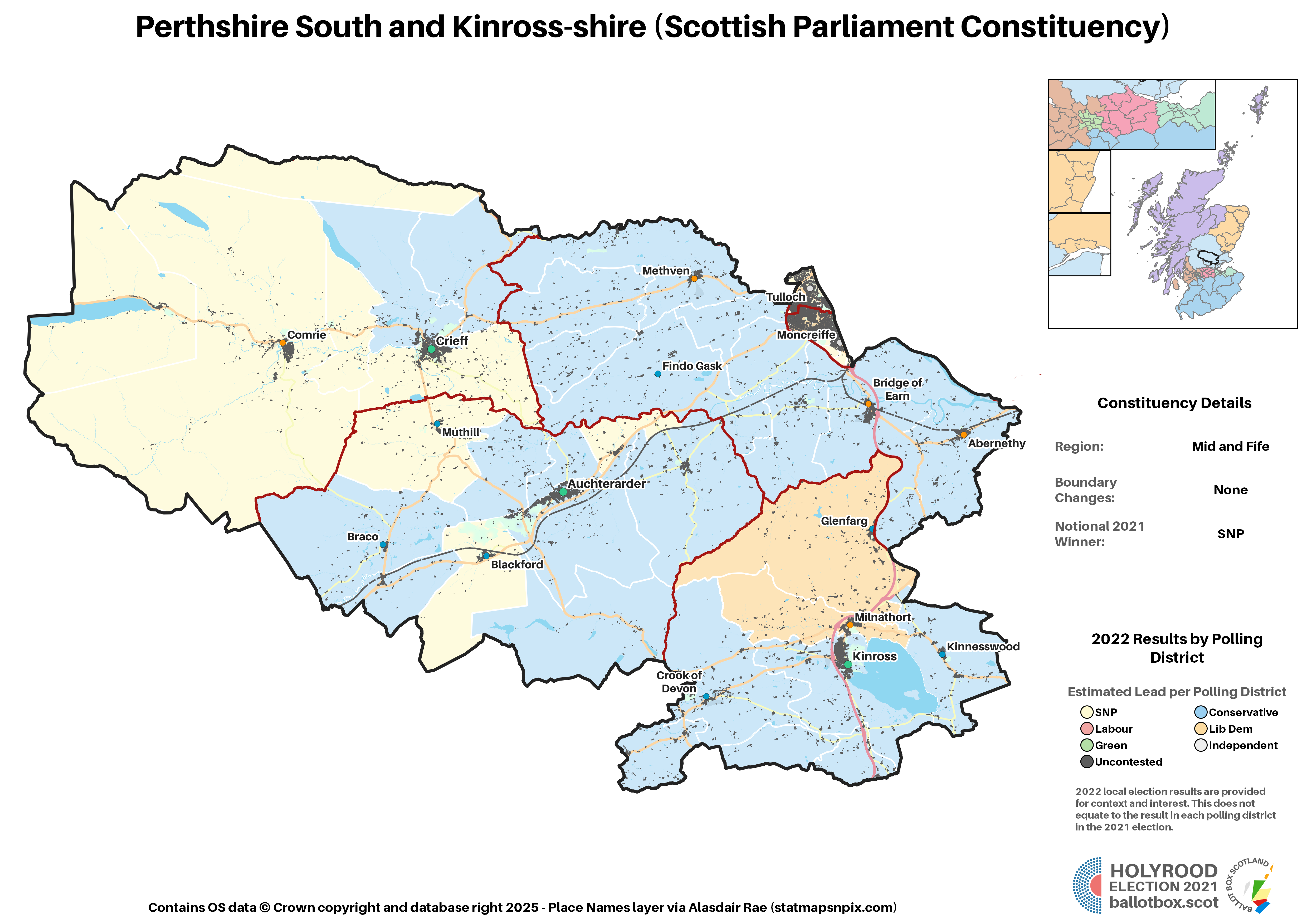
Sitting entirely within the Perth and Kinross Council area, Perthshire North stretches all the way from the Firth of Tay into the highlands. Perth city is split in two at Holyrood, this seat containing the western part. The other three major components to the seat are the tiny historic county of Kinross-shire, Strathallan (centred on Auchterarder) and Strathearn (on Crieff).

The SNP have held this the entire time the Scottish Parliament has existed, the prior version being simply “Perth”. They were however run incredibly close by the Conservatives last time, to the extent that on the regional ballot the Conservatives very narrowly pipped them for first place. This would be one of the very first seats we’d expect the Conservatives to pick up from a flagging SNP, but since their own support has gone up in smoke it doesn’t seem likely this time around.

2021 Constituency Vote
2021 Regional Vote

Stirling

Constituency Map
Key Information

Notional 2021 Winner: 🟡SNP
Majority: 6345 (16.9%)
Boundary Changes: Loses area around Cornton, Causewayhead and Cambuskenneth to new Clackmannanshire and Dunblane

2026 Candidates

🟡SNP: Alyn Smith, L4
🔵Conservative: Stephen Kerr (*OL), L2
đź”´Labour: Kainde Maji, L4
đźź Lib Dem
: Jill Reilly
🟣Reform UK
: Rachael Wright, L3

Constituency Description

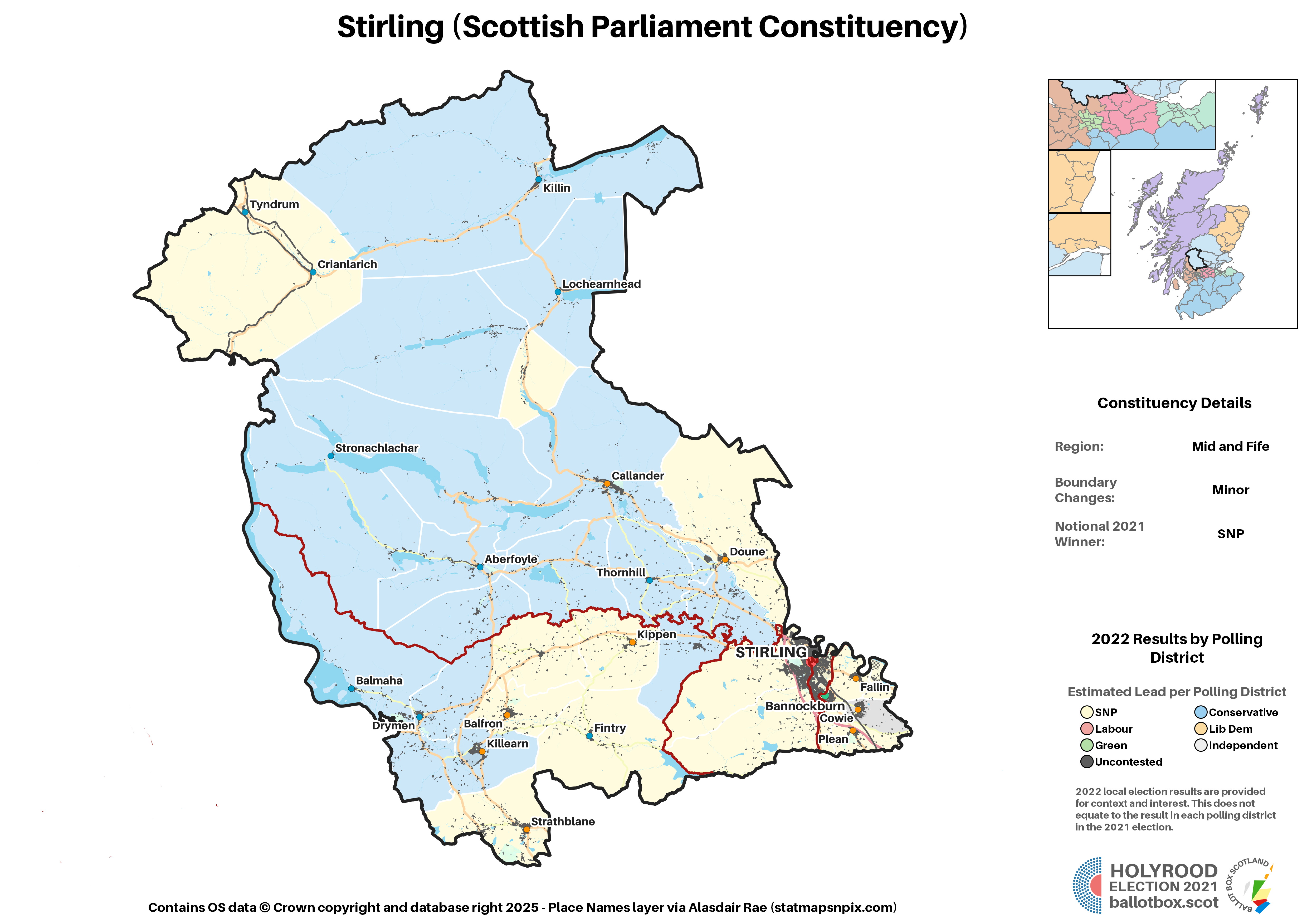
Covering the bulk but not the whole of the council area of the same name, Stirling pairs a chunky urban area with a huge rural expanse. On the urban side of things, this no longer has the whole of Stirling city as the portion north of the Forth has been taken out, but it’s still got Bannockburn and the other old mining villages to the east. On the rural end, the flatter southern portion stretches all the way to Loch Lomond by way of Kippen, Balfron, Killearn and Drymen, with Fintry and Strathblane nestled either side of the Campsies. The expansive northern reaches cover the Trossachs and settlements including Aberfoyle, Callander and Tyndrum.

The SNP gained this seat from Labour in 2007 and have held it pretty comfortably since, with the Conservatives managing to win and then lose the Westminster equivalent in between the 2016 and 2021 Holyrood elections with no ill effect on the SNP in the latter parliament. Funnily enough, in one respect this is a direct rematch of the 2019 UK election, with former SNP MP and MEP Alyn Smith looking to complete his set of titles, going up against Conservative former MP and currently MSP for Central Scotland Stephen Kerr.

This time however Kerr and the Conservatives’ chances would seem pretty slim, given how badly they’ve been doing in polling. Instead, it’s possible that Labour are the party that will prove the SNP’s primary challengers. They only won the Westminster seat very narrowly in 2024 however, and they are facing a shortfall of about 33% versus the SNP, a margin that may be impossible to overcome.

Notional 2021 Constituency Vote
Notional 2021 Regional Vote

List Seat Allocation Process

To allocate list seats using the D’Hondt method, each party’s share of the vote is divided by one more than the number of seats they’ve won so far in the process. This is an important part of how the list seats then more fairly represent the diversity of views amongst voters. List votes cast for a party that has won lots of constituency seats are not “wasted”, they just aren’t needed to give their voters fair representation.

Starting Point

When allocating the first list seat, this starts with the number of constituencies won by each party:

  • The SNP won 8 constituencies, so their vote is divided by 9.
  • The Lib Dems won 1 constituency, so their vote is divided by 2.
Seat 1

Since the Conservatives have the highest total here, they receive the first regional seat. We add that to their total, giving them 1 seat overall so far, and therefore for the next round of allocation their share is divided by 2.

Seat 2

Since Labour have the highest total here, they receive the second regional seat. We add that to their total, giving them 1 seat overall so far, and therefore for the next round of allocation their share is divided by 2.

Seat 3

Since the Conservatives have the highest total here, they receive the third regional seat. We add that to their total, giving them 2 seats overall so far, and therefore for the next round of allocation their share is divided by 3.

Seat 4

Since the Greens have the highest total here, they receive the fourth regional seat. We add that to their total, giving them 1 seat overall so far, and therefore for the next round of allocation their share is divided by 2.

Seat 5

Since the Conservatives have the highest total here, they receive the fifth regional seat. We add that to their total, giving them 3 seats overall so far, and therefore for the next round of allocation their share is divided by 4.

Seat 6

Since Labour have the highest total here, they receive the sixth regional seat. We add that to their total, giving them 2 seats overall so far, and therefore for the next round of allocation their share is divided by 3.

Seat 7

Since the Conservatives have the highest total here, they receive the seventh and final regional seat. We add that to their total, giving them 4 seats overall. This completes the list seat allocation process.

If you find this or other Ballot Box Scotland output useful and/or interesting, and you can afford to do so, please consider donating to support my work. I love doing this, but it’s a one-man project and takes a lot of time and effort. All donations, no matter how small, are greatly appreciated and extremely helpful.
(About Donations)