Contents
Region History
2026 Candidates
Ayr
Carrick, Cumnock and Doon Valley
Clydesdale
Dumfriesshire
East Kilbride
Ettrick, Roxburgh and Berwickshire
Galloway and West Dumfries
Hamilton, Larkhall and Stonehouse
Kilmarnock and Irvine Valley
Midlothian South, Tweeddale and Lauderdale
List Seat Allocation Process
Make sure to check out Ballot Box Scotland’s Holyrood Hub page for polling, analysis and updates ahead of the 2026 Scottish Parliament election.
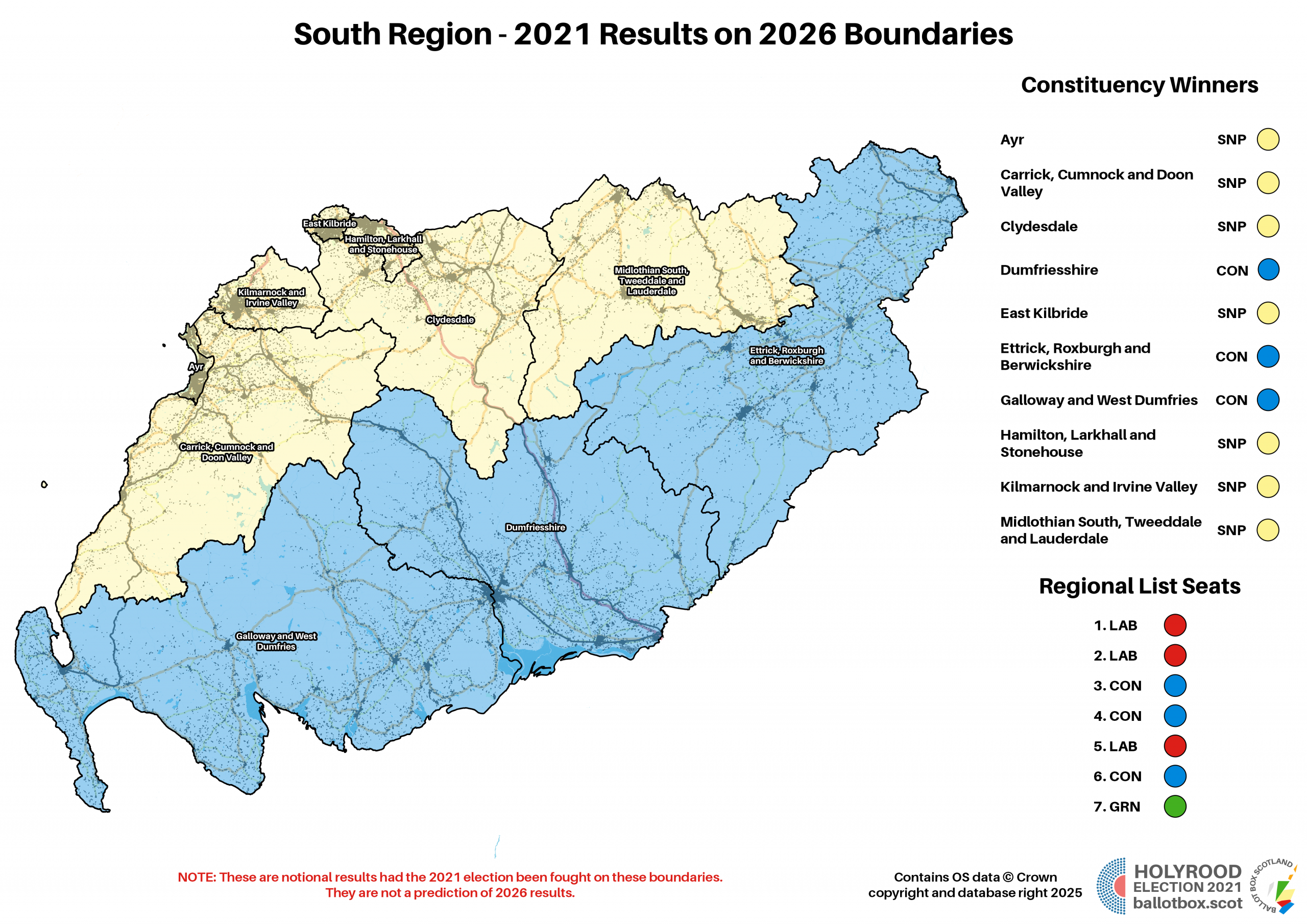
Region Map
Region Description
South Scotland pairs some of the mildest constituency changes in the country with one of the most dramatic regional redrawings. The previous version of South had been a largely rural region, and what large towns there were (Ayr, Kilmarnock and Dumfries) effectively served as their own urban centres rather than being in the orbit of a larger city. The new version however builds on the existing South Lanarkshire inclusion of Clydesdale by adding East Kilbride and Hamilton, larger than any of the existing towns in the region, and clearly in the immediate Glasgow commuter belt.
That’s a massive change to the character of this region, introducing a much more urban element to it. That’s not the only major shift though. After it was confusingly not in the Lothian(s) region in the previous two arrangements, East Lothian has finally been removed from South’s purview. That hasn’t completely rectified the confusing Lothian situation as this region still contains southern Midlothian, though Newtongrange has been carved off that seat.
The final change in the region’s shape comes from the area around Stewarton and Dunlop in East Ayrshire being moved into a West region constituency. It otherwise continues to contain most of East Ayrshire and all of South Ayrshire, Dumfries and Galloway, and the Scottish Borders.
What to Watch For in 2026
The rebalancing of the region with a slightly more urban element can be seen in the widening of the SNP’s lead over the Conservatives in the regional vote from about 4% in the old region to about 7% in the new. Labour don’t actually gain vastly more ground, because East Lothian had been one of their best areas. However, at the 2024 UK General Election every seat in the region was won by Labour (the Lanarkshire, Ayrshire and Lothian seats) or the Conservatives (the three border seats). Labour also won the Hamilton, Larkhall and Stonehouse Holyrood by-election in June. That seat was however their easiest pickup in the redrawn region, and winning it by a mere 2% at a by-election hardly points towards Labour successes anywhere else in the region.
There’s also the question of what happens with the Conservative seats. The SNP would be pressed to gain any of their seats whilst both are suffering roughly equally, and could still be at risk of losing the extremely marginal Ayr constituency. As with other regions, there’s a fine balance to be struck in this one if voters are to be fairly and accurately represented. If opponents can’t knock a few SNP constituencies off, they’ll have too many and wreck proportionality, but if they get few or none, then that just warps results in the other direction.
Given the historic strength of the Conservatives in much of this region, we might expect Reform UK to do well here, and indeed in 2024 they did better than their national average in every single constituency that overlaps. On the other end of the scale, one consequence of the boundary changes is that the Greens are notionally defending a seat, when the old version was the only region they missed out. That was only by 115 votes, and whilst shifting their best constituency out of the region chips away at their vote share, the overall increase of the size of the region by one seat means they get that “new” seat.
The Lib Dems lost their last seat in this region at the 2016 election, but it remains one of their best prospects for regrowth. The difficulty they’ll face is that whilst they’ve retained residual support in the Borders, the Ayrshire and Lanarkshire seats are absolutely dire for them. They’ll either need to really recover in those old strongholds, or hope that the rising national tide still adds a couple of percent in their weak seats.
Notional 2021 Constituency Vote
Notional 2021 Regional Vote
Notional 2021 Seat Winners
Constituency
Ayr: SNP
Carrick, Cumnock and Doon Valley: SNP
Clydesdale: SNP
Dumfriesshire: Conservative
East Kilbride: SNP
Ettrick, Roxburgh and Berwickshire: Conservative
Galloway and West Dumfries: Conservative
Hamilton, Larkhall and Stonehouse: SNP
Kilmarnock and Irvine Valley: SNP
Midlothian South, Tweeddale and Lauderdale: SNP
Regional List
1: Labour
2: Labour
3: Conservative
4: Conservative
5: Labour
6: Conservative
7: Green
South Scotland: 2021 Notional Results (Regional Vote)
South Scotland: 2021 Notional Results (Constituency Vote)
1999 to 2011 Boundaries
Elections in 1999, 2003 and 2007 for the South of Scotland were fought on really very sloppy boundaries. The only council areas included in full were Dumfries and Galloway, the Scottish Borders, and South Ayrshire. It also included most of East Lothian (excluding central and western Musselburgh), large parts of East Ayrshire (the Cumnock and Doon Valley sections) and North Ayrshire (Irvine, Kilwinning and Stevenston), and smaller portions of South Lanarkshire (much of Clydesdale and Larkhall) and Midlothian (Penicuik).
The first election saw the SNP win the Galloway seat, the Lib Dems the Borders, and Labour everything else. That then meant the list seats went three to the SNP and four to the Conservatives, equalising their totals. However this would be short lived, as the first by-election in Holyrood’s history was held within a year, leading to the Conservatives gaining the Ayr seat.
In 2003’s “Rainbow Parliament”, the Conservatives held onto their by-election gain in Ayr and relieved the SNP of the Galloway seat, but all other constituencies remained with their 1999 winners. The SNP were thus reduced to three MSPs, all on the list, and the first and only time they placed behind the Conservatives in any region. South offered a solid contribution to the rainbow, with both a Green and SSP MSP elected.
Conservative constituency gains continued into 2007 when they won the Roxburgh and Berwickshire seat from the Lib Dems. They did however slip back behind the SNP in votes and seats, who through their five list MSPs tied with Labour for the first time. This was also the only region where the SNP failed to win a constituency this election. The Lib Dems didn’t suffer for the loss of one of theirs though, as they made the seat back up on the list.
2011 to 2026 Boundaries
Elections in 2011, 2016 and 2021 for South Scotland were fought on boundaries that covered the whole of Dumfries and Galloway, Scottish Borders, South Ayrshire and East Ayrshire, most of East Lothian (excluding Musselburgh), and large parts of South Lanarkshire (Clydesdale and Strathaven) and Midlothian (Penicuik, Gorebridge and Newtongrange).
South was the region that proved most resistant to the SNP’s 2011 landslide. Although they ended up with half of the seats overall, as those were split evenly between the list and their four constituencies (Carrick, Cumnock and Doon Valley; Clydesdale; Kilmarnock and Irvine Valley; and Midlothian South, Tweeddale and Lauderdale), this was the only region they didn’t win a majority of constituency seats. The Conservatives held all three of their constituencies but missed out on a list seat, leaving Labour with just Dumfriesshire and East Lothian and two list seats, and the Lib Dems on just one seat.
Surging Conservatives in 2016 gained Dumfriesshire and two list seats, though the SNP would remain ahead with their three on the list. Labour were reduced to only East Lothian plus the two remaining list seats, as the Lib Dems crashed out and Greens failed to pick up a seat.
At the last election the SNP finally picked up some more constituencies, but in the place where that mattered the least. Snatching Ayr from the Conservatives and East Lothian from Labour simply led to trading places on the list, preserving the same 7:6:3 pattern as the prior election. The Greens meanwhile would have every right to be aggrieved with far right cosplayers “Independent Green Voice” confusing enough of their voters; if just one in fourteen such votes had gone Green, they’d have pipped Labour for the final list seat.
Candidates in both this section and individual constituencies are marked if they are an incumbent MSP:
- (*C): Incumbent for that constituency, or equivalent if significantly impacted by boundary changes
- (*OC): Incumbent for another constituency
- (*L): Incumbent on the list
2026 Total Candidate Numbers
South Scotland: 2026 Regional List Candidates
The six parties expected to win seats in the Scottish Parliament in 2026 are listed in order of national support in 2021. Remaining parties are in alphabetical order, and Independents listed last.
Candidates that are contesting both the List and Constituency ballot have their constituency noted after their name on the list.
- Máiri McAllan (*C, Clydesdale)
- Alan Brown (Kilmarnock and Irvine Valley)
- Emma Harper (*L, Galloway and West Dumfries)
- Siobhian Brown (*C, Ayr)
- Katie Hagman (Carrick, Cumnock and Doon Valley)
- John Redpath (Ettrick, Roxburgh and Berwickshire)
- Collette Stevenson (*C, East Kilbride)
- Stephen Thompson (Dumfriesshire)
- Alex Kerr (Hamilton, Larkhall and Stonehouse)
- Allan Dorans
- Kirsty Campbell
- Ross Clark
- Rachael Hamilton (*C, Ettrick, Roxburgh and Berwickshire)
- Craig Hoy (*L, Dumfriesshire)
- Finlay Carson (*C, Galloway and West Dumfries)
- Sharon Dowey (*L, Ayr)
- Brian Whittle (*L, East Kilbride)
- Keith Cockburn (Midlothian South, Tweeddale and Lauderdale)
- Julie Pirone (Clydesdale)
- James Adams (Kilmarnock and Irvine Valley)
- Tracey Clark (Carrick, Cumnock and Doon Valley)
- Carol Mochan (*L, Carrick, Cumnock and Doon Valley)
- Joe Fagan (East Kilbride)
- Linda Dorward (Dumfriesshire)
- Ewan McPhee (Kilmarnock and Irvine Valley)
- Lynsey Hamilton (Clydesdale)
- Daniel Coleman (Midlothian South, Tweeddale and Lauderdale)
- Kaymarie Hughes (Ettrick, Roxburgh and Berwickshire)
- Davy Russell (*C, Hamilton, Larkhall and Stonehouse)
- Brian McGinlay (Ayr)
- Jack McConnel (Galloway and West Dumfries)
- Laura Moodie
- Ann McGuinness
- Dominic Ashmole
- Neil MacKinnon
- Barbra Harvie
- Cameron Garrett
- Tim Clancey
- Tom Kerr
- Korin Matthew Vallance
- Duncan Dunlop (Midlothian South, Tweeddale and Lauderdale)
- Ray Georgeson (Ettrick, Roxburgh and Berwickshire)
- Aisha Mir
- Richard Brodie (Clydesdale)
- Charlotte Olcay
- Michael Gregori (Kilmarnock and Irvine Valley)
- Tracey Warman (Galloway and West Dumfries)
- Jamie Langan (Ettrick, Roxburgh and Berwickshire)
- David Kirkwood (Dumfriesshire)
- Senga Beresford (Galloway and West Dumfries)
- Tim Kelly (East Kilbride)
- Carolyn Grant (Midlothian South, Tweeddale and Lauderdale)
- Daniel Clarke (Clydesdale)
- John McNamee (Hamilton, Larkhall and Stonehouse)
- Andrew Russell (Ayr)
- Andrew Scott (Carrick, Cumnock and Doon Valley)
- Anne Millar (Kilmarnock and Irvine Valley)
Note: The Reform candidate for this seat, Tim Kelly, quit the party a few days before the election. As this was well after the close of nominations, he remains on the ballot paper as a Reform candidate.
- David Ballantine (Hamilton, Larkhall and Stonehouse)
- Glen Maney
- Terry Howson (Ettrick, Roxburgh and Berwickshire)
- Garry McClay (Kilmarnock and Irvine Valley)
- Yvonne Lazenbury
- Maureen Johnston
- Marjorie Thompson
- Paul Adkins (Dumfriesshire)
- Muhammad Tufail (Ayr)
- Gareth Kirk
- Hamish Goldie-Scot
- Laura Shell
- Josh-Lee Witherspoon
- David Griffiths
- Gisele Skinner
- Elspeth Griffiths
- Charles McEwan
- Maxwell Dunbar
Note: Independent Green Voice are a front group for a bunch of Glasgow bampots, led by someone who was expelled from UKIP for alleged Holocaust denial. They are standing purely as a spoiler party in this election, targeting the legitimate Scottish Green Party, and their simple one candidate per region slate is further evidence of this dodgy dealing.
- Daniel Fraser
- Mark Sands
- Zoe Greenan
- Alex Creel
- Janice MacKay
- Laurie Steele
- Robert Bilcliff
- Gail Bilcliff
- Colin Sullivan
- Sean Davis (Carrick, Cumnock and Doon Valley)
- Denise Sommervile (Ayr)
Constituency Map
Key Information
Notional 2021 Winner: SNP
Majority: 170 (0.4%)
Boundary Changes: None
2026 Candidates
SNP: Siobhian Brown (*C), L4
Conservative: Sharon Dowey (*L), L4
Labour: Brian McGinley, L9
Lib Dem: Desmond Buchanan
Reform UK: Andrew Russell, L8
Common Party: Muhammad Tufail, L2
Independent: Denise Sommerville, L1
Constituency Description
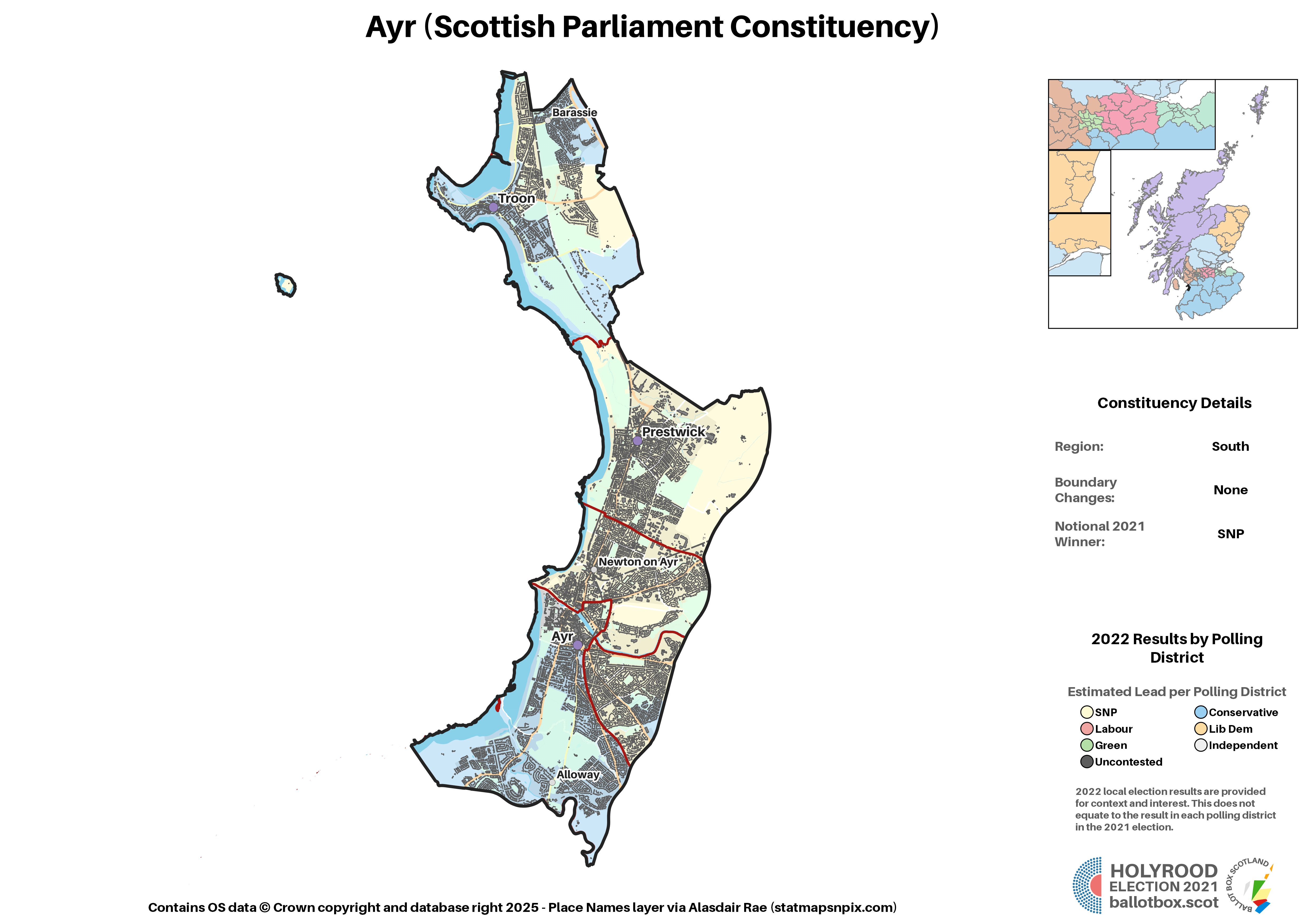
Sitting entirely within the South Ayrshire Council area, Ayr covers three towns along the coast. Ayr itself is the biggest of these, and obviously the historic centre of the wider Ayrshire area. To the north, it passes through the neighbouring town of Prestwick and then further on to Troon. Southern Ayr, northern Prestwick and much of Troon are pretty affluent areas, whereas northern Ayr in particular is much more working class.
The relative affluence of this constituency may explain why the Conservatives held it from a 2000 by-election where they gained it from Labour right up until the SNP narrowly won it in 2021. Although the boundaries are somewhat different compared to the original version, there’s a symmetry: when Labour won it in 1999, it was the most marginal seat in the country, as it was when the SNP won in 2021. Even with the Conservatives in freefall again, this could be one they pick back up just from the SNP falling even a tiny bit harder. I’d certainly not put money on either outcome.
2021 Constituency Vote
2021 Regional Vote
Constituency Map
Key Information
Notional 2021 Winner: SNP
Majority: 4337 (12.2%)
Boundary Changes: None
2026 Candidates
SNP: Katie Hagman, L5
Conservative: Tracey Clark, L9
Labour: Carol Mochan (*L), L1
Lib Dem: Jack Clark
Reform UK: Andrew Scott, L9
Independent: Sean Davis, L1
Independent: Alison Hewett
Constituency Description
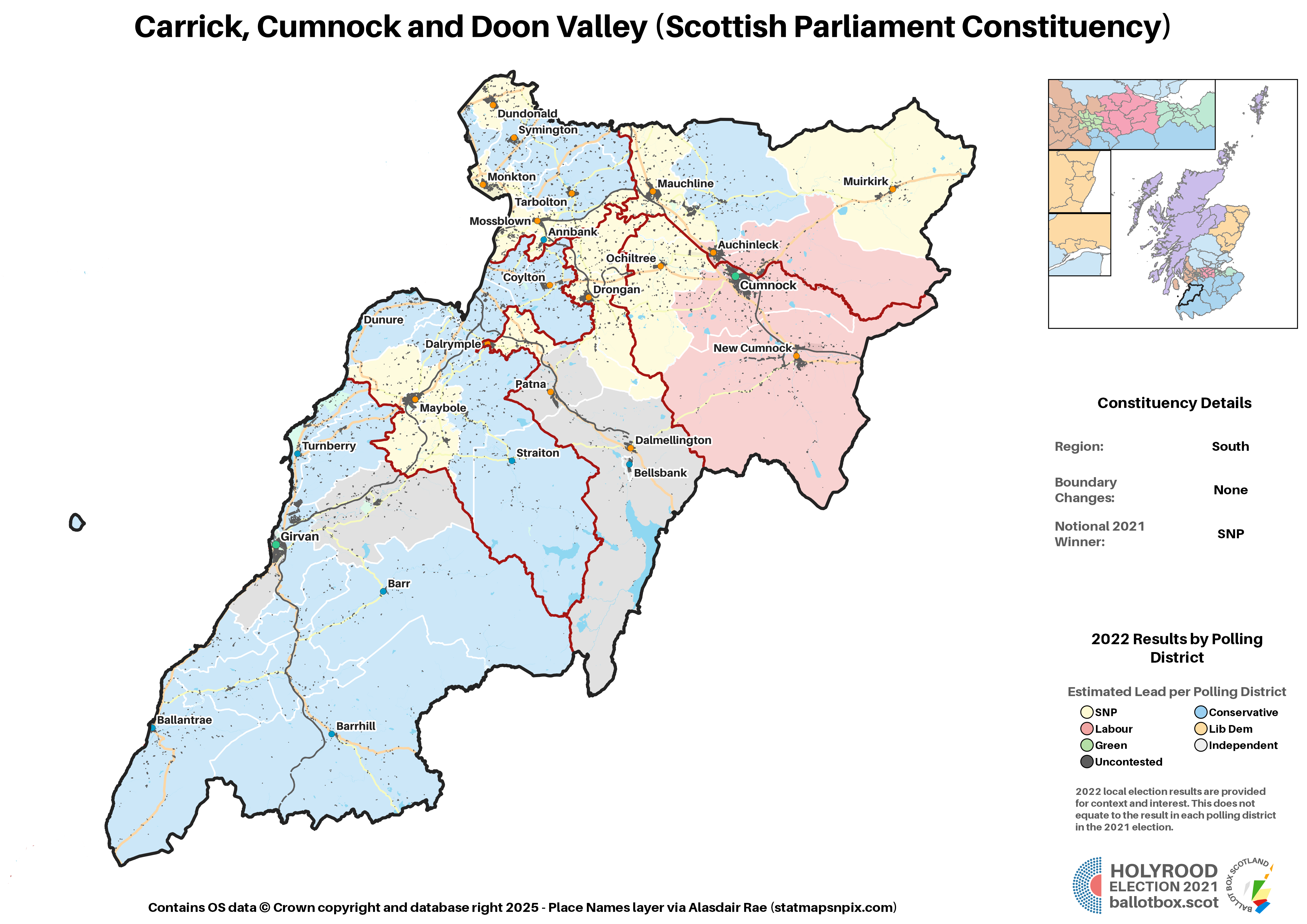
Split between the East and South Ayrshire Council areas, Carrick, Cumnock and Doon Valley covers the bulk of rural Ayrshire. If you think about it in terms of modern councils, the East Ayrshire section is clearly centred on Cumnock, with other notable settlements at the likes of New Cumnock, Dalmellington, Mauchline and Drongan. The South Ayrshire portion includes villages in the Ayr orbit like Dundonald, Monkton and Coylton, plus the more southerly towns of Girvan and Maybole and their surrounds. In historic terms, you might think of the areas around Cumnock and by Ayr as being much of Kyle, whilst traditional Carrick includes the Doon Valley as well as the area from Maybole south.
The SNP have held this seat since gaining it from Labour in 2011. Although the Conservatives have since become the primary challengers, Labour weren’t all that far behind them in 2021. That actually makes this the second easiest seat for Labour to gain in this region, and the only other one with an SNP lead over them of less than 20%.
Note: The originally selected SNP candidate for this seat (and former MP for the Westminster equivalent), Allan Dorans, was de-listed as a candidate in September. At this stage, there is no public information as to why.
2021 Constituency Vote
2021 Regional Vote
Constituency Map
Key Information
Notional 2021 Winner: SNP
Majority: 4578 (11.2%)
Boundary Changes: None
2026 Candidates
SNP: Máiri McAllan (*C), L1
Conservative: Julie Pirone, L7
Labour: Lynsey Hamilton, L5
Lib Dem: Richard Brodie, L4
Reform UK: Daniel Clarke, L6
Constituency Description
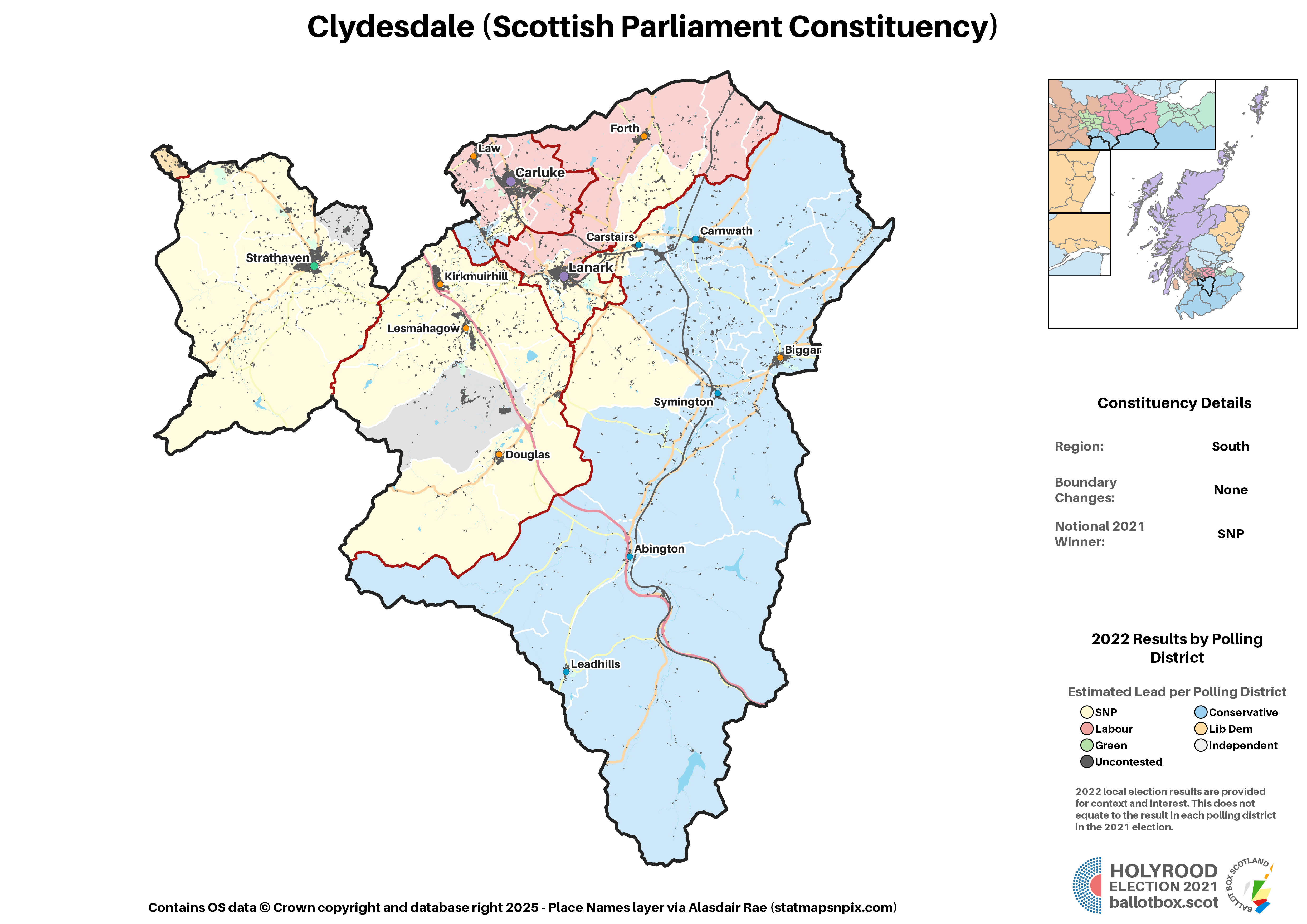
Sitting entirely within the South Lanarkshire Council area, Clydesdale accounts for the majority of historic Lanarkshire’s area but only a small portion of the population. A largely rural constituency, it does include Lanark itself, as well as other sizeable towns at Carluke and Strathaven. Everything else is much, much smaller, with villages like Biggar, Leadhills, Douglas, Lesmahagow, Law and Forth scattered around.
The SNP have held this since they gained it from Labour in 2011. As a primarily rural seat, the Conservatives have turned themselves into the main opposition here. Labour haven’t been completely displaced though, and at 10% behind the Conservatives could reasonably expect to overtake them this time. Winning will be more of a challenge though, as this one sits somewhere in the middle of possible Labour gains for this region.
Notional 2021 Constituency Vote
Notional 2021 Regional Vote
Constituency Map
Key Information
Notional 2021 Winner: Conservative
Majority: 4066 (9.9%)
Boundary Changes: None
2026 Candidates
SNP: Stephen Thompson, L8
Conservative: Craig Hoy (*L), L2
Labour: Linda Dorward, L3
Lib Dem: Ian McDonald
Reform UK: David Kirkwood, L2
Common Party: Paul Adkins, L1
Constituency Description
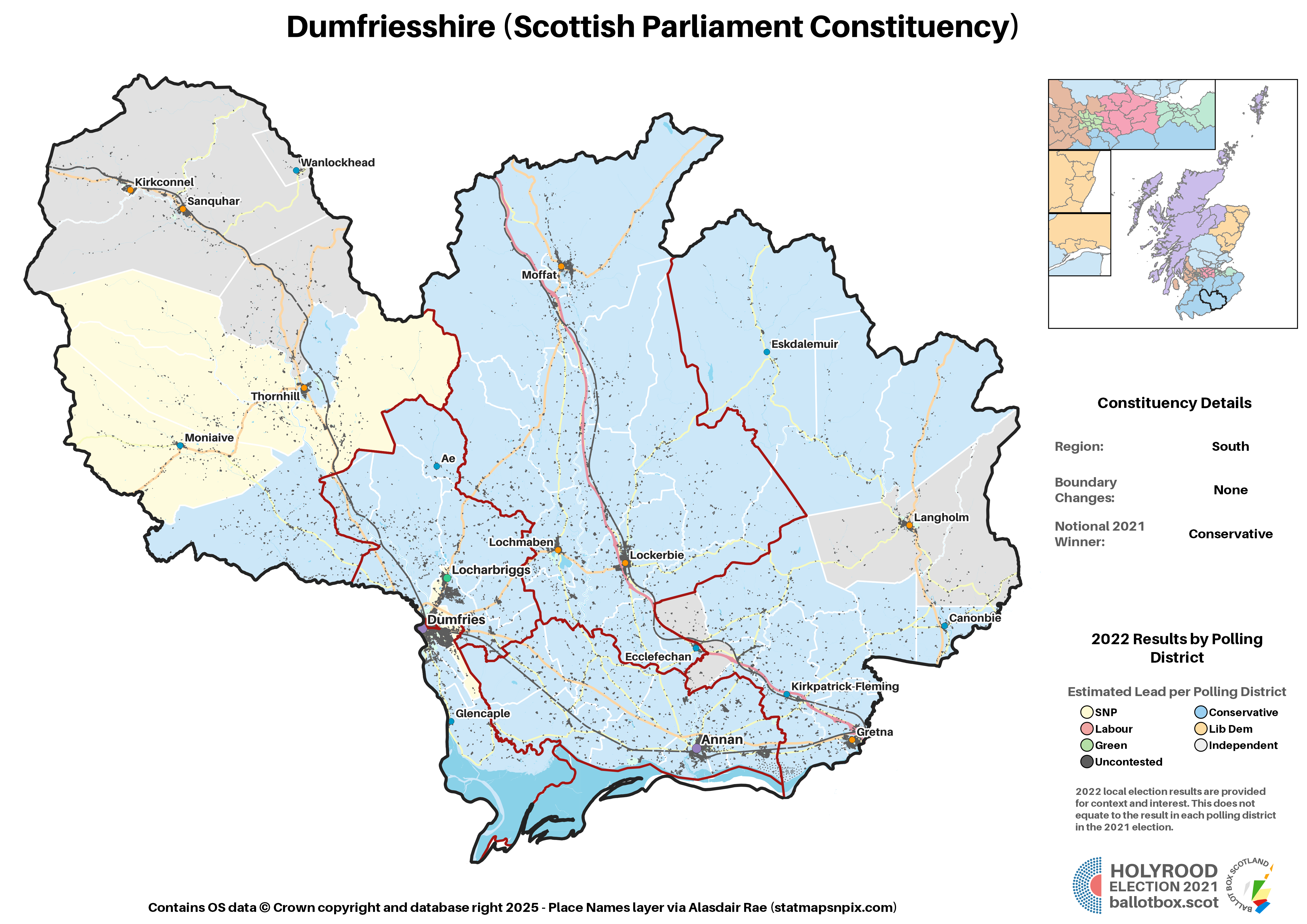
Sitting entirely within the Dumfries and Galloway Council area, Dumfriesshire incorporates most but not all of that historic county. Dumfries itself is only half-included, with the Nith being the dividing line, though the boundary stops following it to bring in the remainder of Nithsdale out through Thornhill to Kirkconnel. The other two divisions of Dumfriesshire, namely Annandale with major centres at Annan, Lockerbie and Moffat, and Eskdale centred on Langholm, are likewise entirely within the seat.
The Conservatives first won this from Labour in 2016, Labour having held it since it was originally created as Dumfries. They’ve since completely withered away here to a degree that it’s extremely hard to imagine them being able to mount a comeback; part of the issue for them is that their strongest part of Dumfries is in the other constituency. The Conservatives may therefore hold this one by default, given their lead over the SNP, though they may be impacted by the fact the junior Mundell is stepping back from the family business of representing the area.
Note: The originally selected Labour candidate for this seat, Colin Smyth, was arrested and charged with possession of indecent images in August 2025; legal proceedings are ongoing. He’d been an MSP for the Lothian region since 2016, but was subsequently suspended from the party.
2021 Constituency Vote
2021 Regional Vote
Constituency Map
Key Information
Notional 2021 Winner: SNP
Majority: 3390 (21.3%)
Boundary Changes: None
2026 Candidates
SNP: Collette Stevenson (*C), L5
Conservative: Brian Whittle (*L), L5
Labour: Joe Fagan, L2
Lib Dem: Leigh Butler
Reform UK: Tim Kelly, L4
Independent: Kristofer Keane
Constituency Description
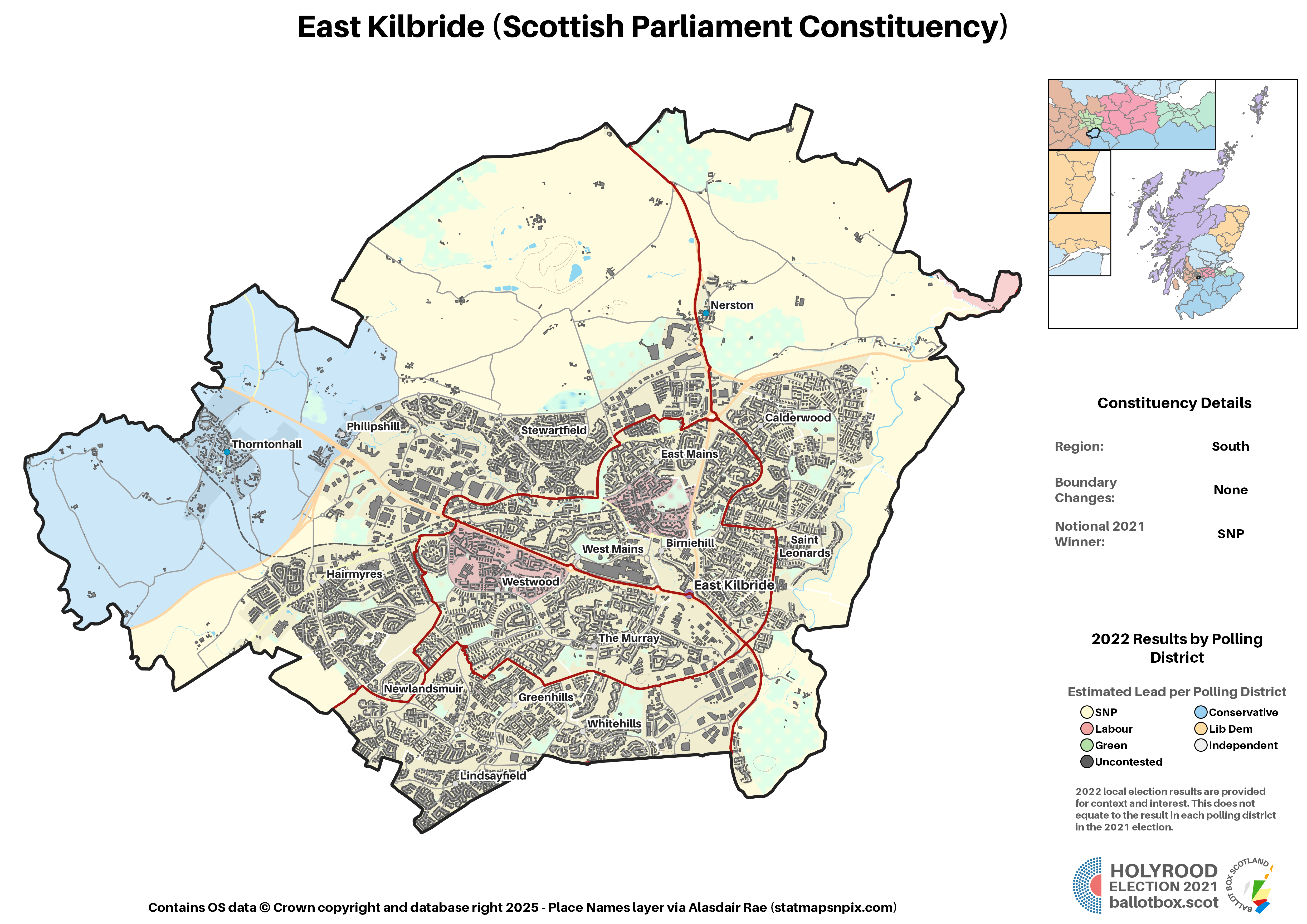
Sitting entirely within the South Lanarkshire Council area, East Kilbride is… well, it’s East Kilbride. It’s also got the tiny neighbouring village of Thorntonhall, but otherwise, this is just East Kilbride. One oddity here that Boundaries Scotland were initially going to fix, but for some reason decided not to, is that new housebuilding along Newhouse Road is not in the constituency. Previously in Central Scotland along with most of the rest of urban Lanarkshire, this constituency is an odd addition to the new South.
The SNP gained this from Labour in 2011 and it’s one of their strongest seats in the region in terms of vote share. However, it’s only in the middle when considering their margin over Labour. The challenge of flipping this seat shouldn’t be underestimated, but it certainly wouldn’t be the last to fall within South.
Note: The Reform candidate for this seat, Tim Kelly, quit the party a few days before the election. As this was well after the close of nominations, he remains on the ballot paper as a Reform candidate.
2021 Constituency Vote
2021 Regional Vote
Constituency Map
Key Information
Notional 2021 Winner: Conservative
Majority: 6863 (19.0%)
Boundary Changes: None
2026 Candidates
SNP: John Redpath, L6
Conservative: Rachael Hamilton (*C), L1
Labour: Kaymarie Hughes, L7
Lib Dem: Ray Georgeson, L2
Reform UK: Jamie Langan, L1
Alliance to Liberate Scotland: Terry Howson, L1
Independent: James Anderson
Constituency Description
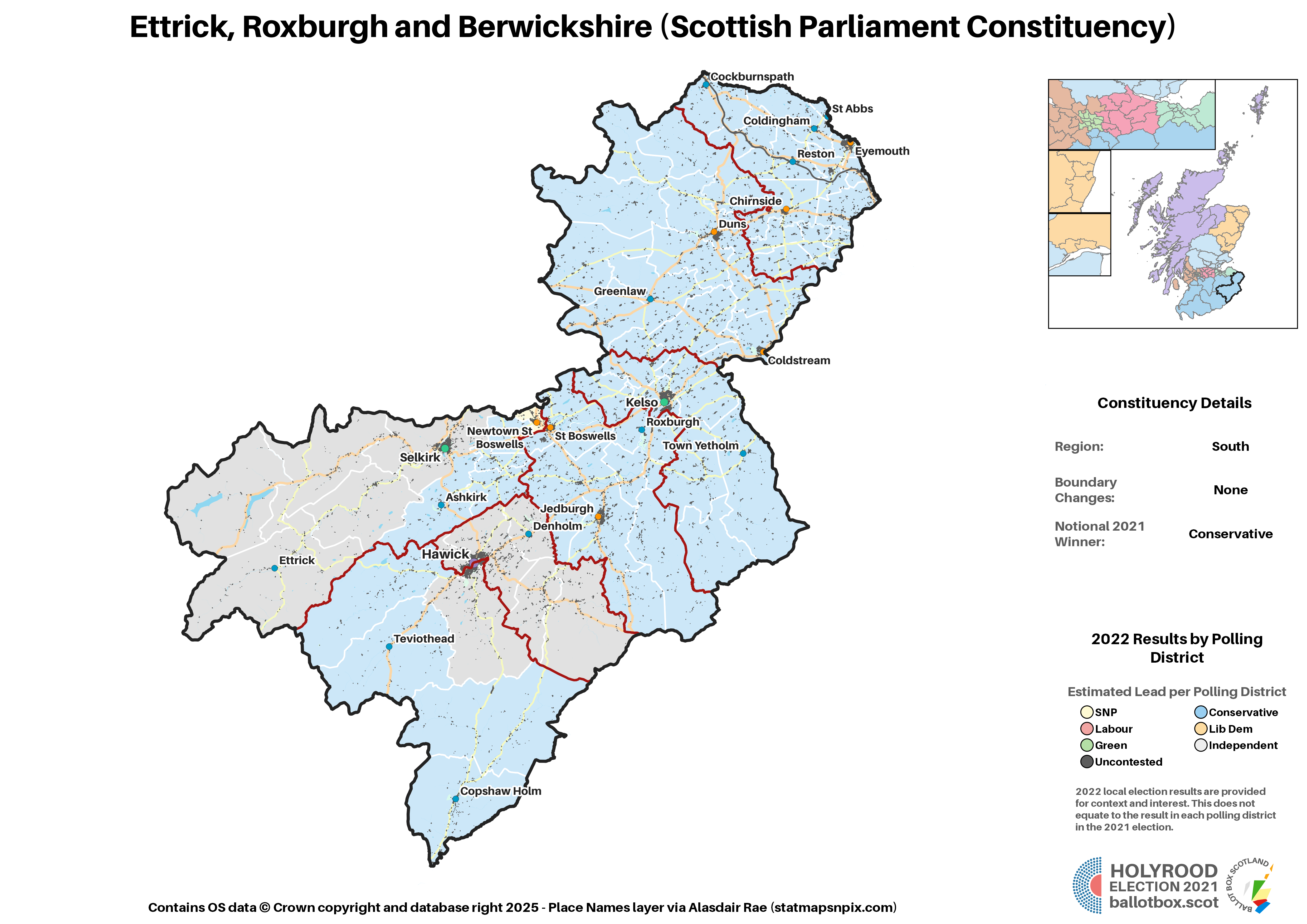
Sitting entirely within the Scottish Borders Council area, Ettrick, Roxburgh and Berwickshire covers the whole of two historic Borders counties and much of a third. The two fully covered are named for towns which have long since ceased to act as their hubs. Ancient Roxburgh is nothing more than some mounds of dirt and stone now, with the modern county rooted in Hawick and with other major settlements at Kelso and Jedburgh. Berwick-upon-Tweed on the other hand is still a healthy town, it’s just in England, meaning Berwickshire is a very rural county with small settlements at Coldstream, Duns and Eyemouth. The partial county is Selkirkshire, most of the geographic area of which is included, as is the town itself.
The Conservatives have held this seat since gaining the previous Roxburgh and Berwickshire version from the Lib Dems in 2007. They’ve since turned it into an impenetrable stronghold of their revival, driving the Lib Dems nearly to extinction. Despite a plummeting national vote, I’d be absolutely astonished if they failed to hold this seat
2021 Constituency Vote
2021 Regional Vote
Constituency Map
Key Information
Notional 2021 Winner: Conservative
Majority: 2635 (7.1%)
Boundary Changes: None
2026 Candidates
SNP: Emma Harper (*L), L3
Conservative: Finlay Carson (*C), L3
Labour: Jack McConnel (not that one), L10
Lib Dem: Tracey Warman, L7
Reform UK: Senga Beresford, L3
Constituency Description
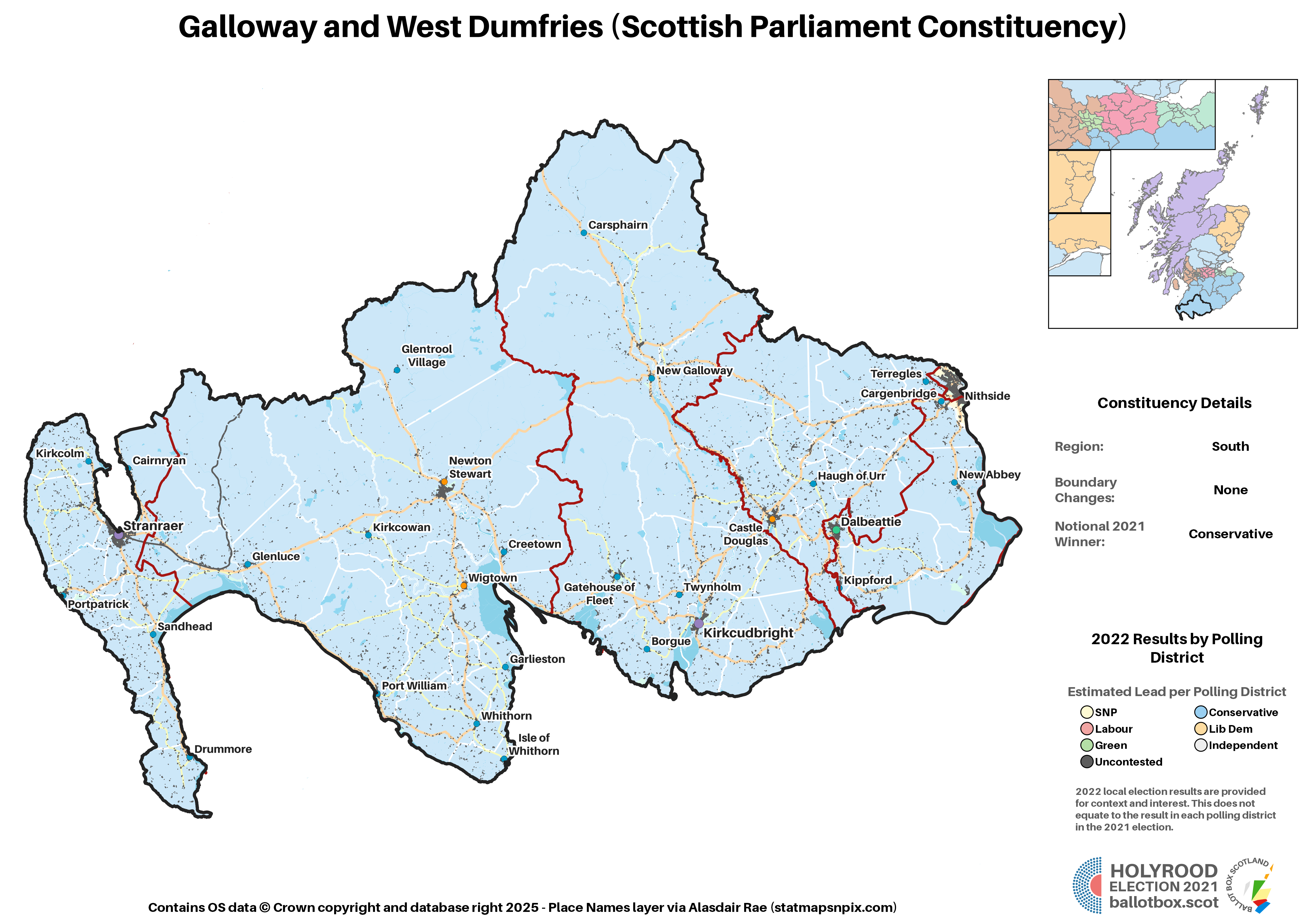
Sitting entirely within the Dumfries and Galloway Council area, Galloway and West Dumfries covers the two historic Galloway counties plus the portion of Dumfries west of the Nith. Moving westwards, the first half of Galloway is the Stewartry or Kirkcudbrightshire. Beyond Kirkcudbright itself, this includes Castle Douglas, Dalbeattie, New Galloway and Gatehouse of Fleet. The other Galloway county, with a view to Ireland on a good day, is Wigtownshire. The central town there these days is Stranraer rather than Wigtown, with Newton Stewart the second largest settlement.
The Conservatives first won the previous Galloway and Upper Nithsdale seat from the SNP in 2003. It may look odd with today’s eyes to imagine the SNP winning this constituency, but they’d won it in the 1997 UK election too. This is a real “people contain multitudes” area, and it’s the most marginal of the Conservatives’ remaining border seats. I’d be inclined towards them holding it, but I wouldn’t write off the SNP’s chances of regaining one of their very early constituencies. If the Greens don’t re-contest it, that’s a small additional boost for them too.
2021 Constituency Vote
2021 Regional Vote
Constituency Map
Key Information
Notional 2021 Winner: SNP
Majority: 4582 (12.6%)
Boundary Changes: None
2026 Candidates
SNP: Alex Kerr, L9
Conservative: Alexandra Herdman
Labour: Davy Russell (*C), L8
Lib Dem: Michael Weatherhead
Reform UK: John McNamee, L7
Alliance for Democracy and Freedom: David Ballantine, L1
Constituency Description
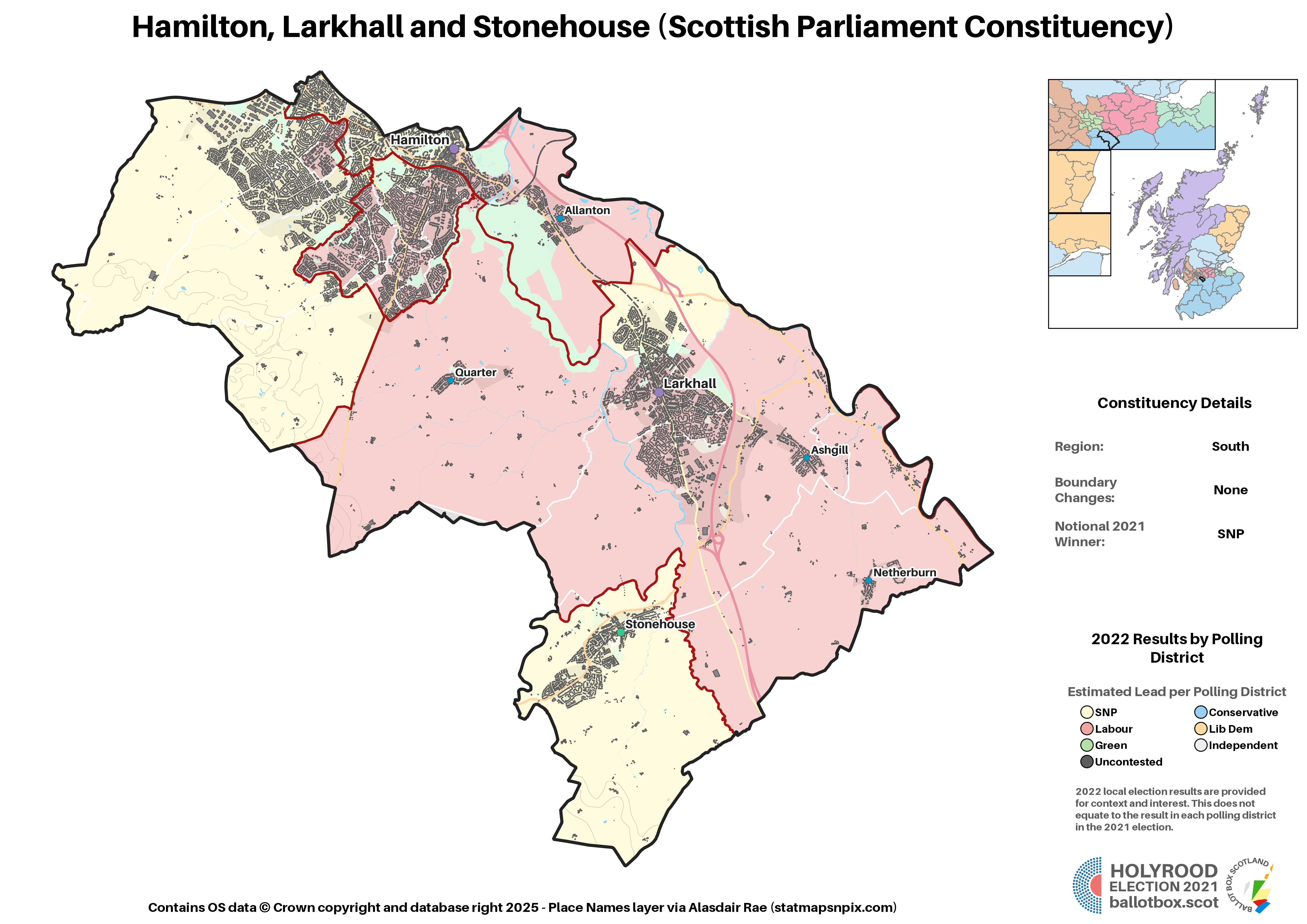
Sitting entirely within the South Lanarkshire Council area, Hamilton, Larkhall and Stonehouse hits upon the key areas pretty neatly in the name. Hamilton is by far the dominant component here, though it is missing its Blantyre suburbs. Larkhall is also a sizeable town, whereas Stonehouse is an aborted New Town. Alongside these big beasts this constituency includes smaller villages at Quarter, Allanton, Ashgill and Netherburn.
The SNP have won this at every full election since gaining it from Labour in 2011 – they’d held the previous Hamilton South and Hamilton North and Bellshill seats. Note the difference in wording there: not “held since”, but “have won”. Tragically, SNP MSP Christina McKelvie passed away in early 2025 from breast cancer. Labour won the resulting by-election, but only by about 2% of the vote. Given this was already the easiest seat in the region, and one of the easiest in the country, to pick up, that did not suggest they were about to romp home to a great national victory. Expect this to be one of the most closely fought contests of the whole election unless Labour really recover.
2021 Constituency Vote
2021 Regional Vote
Constituency Map
Key Information
Notional 2021 Winner: SNP
Majority: 9710 (27.9%)
Boundary Changes: Loses area around Stewarton and Dunlop to new Cunninghame South
2026 Candidates
SNP: Alan Brown
Conservative: James Adams, L8
Labour: Ewan McPhee, L4
Lib Dem: Michael Gregori, L6
Reform UK: Anne Millar, L10
Alliance to Liberate Scotland: Garry McClay, L2
Constituency Description
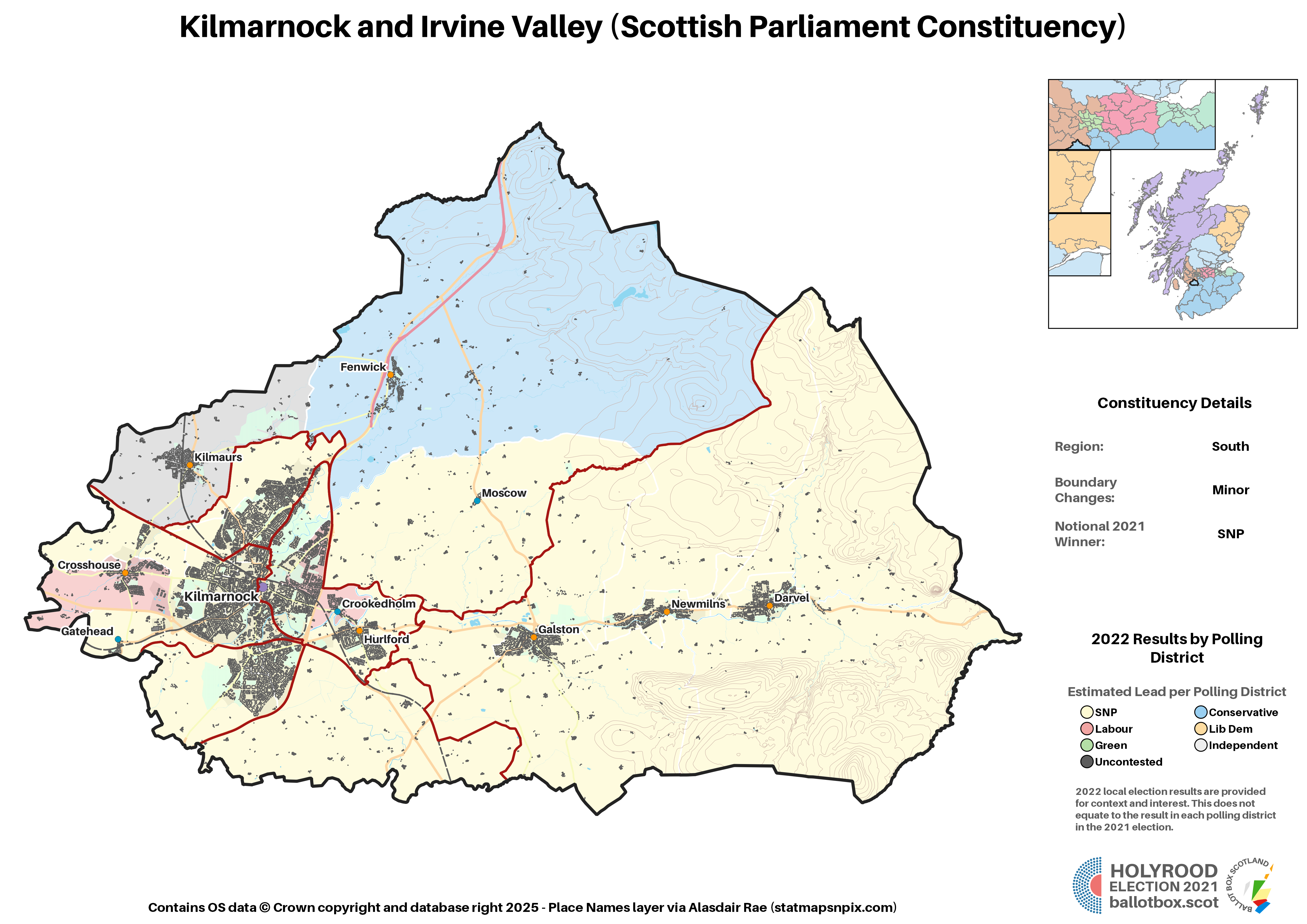
Sitting entirely within East Ayrshire Council, Kilmarnock and Irvine Valley has become more true to its name following boundary changes that have removed Stewarton and Dunlop, which sit on the Annick Water rather than River Irvine, to the West region. It’s still got a couple of the settlements to the north of Kilmarnock itself, in Kilmaurs and Fenwick, mind you. The Irvine Valley section contains Galston, Newmilns and Darvel.
The SNP have held this seat, previously named Kilmarnock and Loudoun, since they gained it from Labour in 2007. This is their strongest and safest seat in the region, but that didn’t stop Labour from gaining the Westminster equivalent in 2024. They’ll only get this one if they are absolutely sweeping constituencies again this time, which polling thus far has not suggested they will.
Notional 2021 Constituency Vote
Notional 2021 Regional Vote
Constituency Map
Key Information
Notional 2021 Winner: SNP
Majority: 6826 (15.9%)
Boundary Changes: Loses Newtongrange to new Midlothian North
2026 Candidates
SNP: Calum Kerr
Conservative: Keith Cockburn, L6
Labour: Daniel Coleman, L6
Lib Dem: Duncan Dunlop, L1
Reform UK: Carolyn Grant, L5
Constituency Description
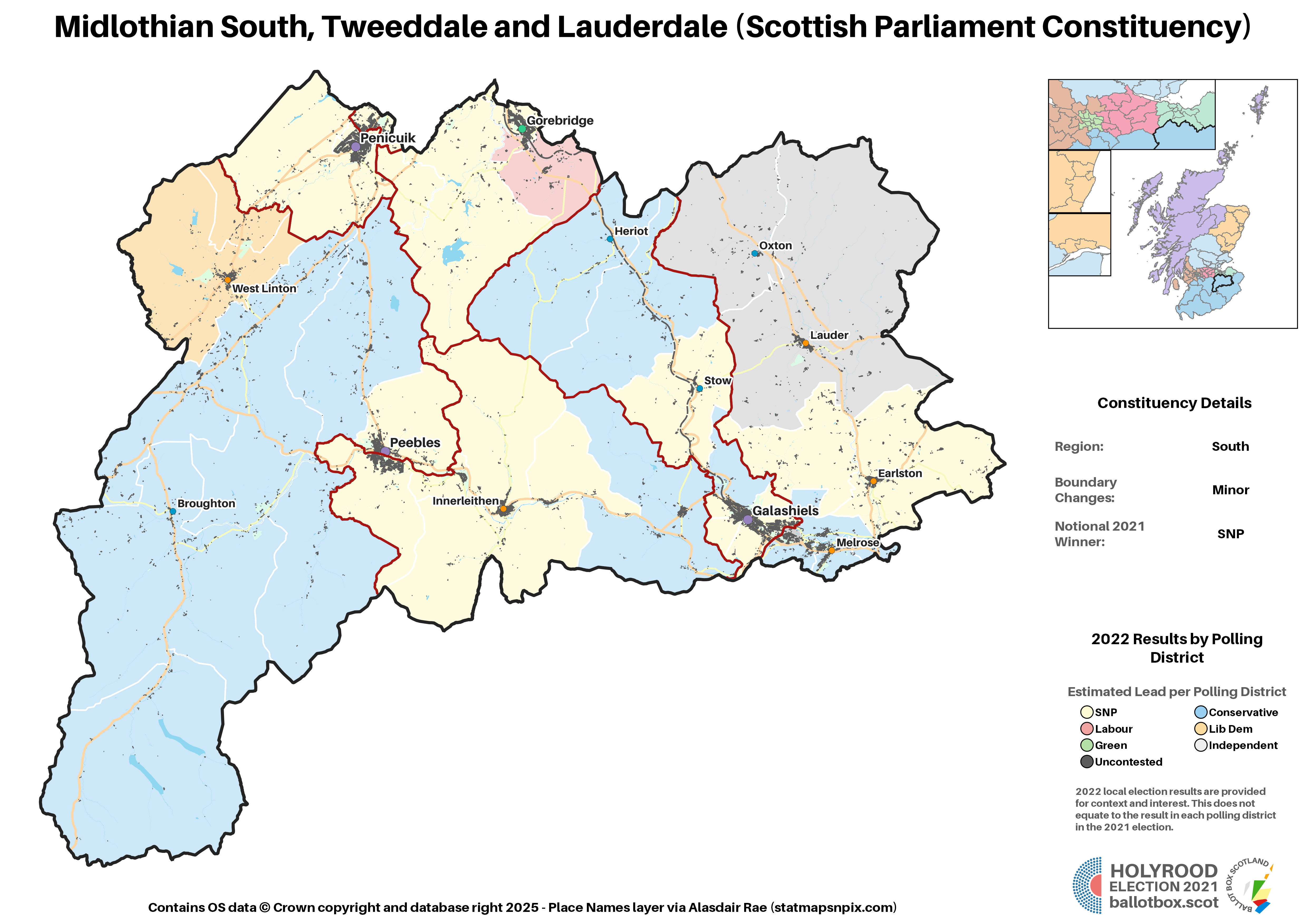
Split between the Scottish Borders and Midlothian Council areas, Midlothian South, Tweeddale and Lauderdale ensures that confusion around Lothian continues. Via Penicuik and Gorebridge, this contains the only parts of the Lothians not in regions that are so named, though it has given Newtongrange over to the other Midlothian constituency, so it’s not as much as previously. The Scottish Borders contribution is the old county of Tweeddale, centred on Peebles, plus the Lauderdale area which points towards Galashiels and Melrose.
The SNP have held this since it was created in 2011, the Lib Dems having held the prior Tweeddale, Ettrick and Lauderdale seat before that. The combination of the predominance of the Borders element, the fact that’s the best bit of the Borders for the SNP, and Penicuik is likewise the best bit of Midlothian for them, means they should be relatively safe here. The Conservatives are unlikely to be able to pick it up in their current state, and Labour are simply not a force in much of this area.
Notional 2021 Constituency Vote
Notional 2021 Regional Vote
To allocate list seats using the D’Hondt method, each party’s share of the vote is divided by one more than the number of seats they’ve won so far in the process. This is an important part of how the list seats then more fairly represent the diversity of views amongst voters. List votes cast for a party that has won lots of constituency seats are not “wasted”, they just aren’t needed to give their voters fair representation.
Starting Point
When allocating the first list seat, this starts with the number of constituencies won by each party:
- The SNP won 6 constituencies, so their vote is divided by 7.
- The Conservatives won 3 constituencies, so their vote is divided by 4.
Seat 1
Since Labour have the highest total here, they receive the first regional seat. We add that to their total, giving them 1 seat overall so far, and therefore for the next round of allocation their share is divided by 2.
Seat 2
Since Labour have the highest total here, they receive the second regional seat. We add that to their total, giving them 2 seats overall so far, and therefore for the next round of allocation their share is divided by 3.
Seat 3
Since the Conservatives have the highest total here, they receive the third regional seat. We add that to their total, giving them 4 seats overall so far, and therefore for the next round of allocation their share is divided by 5.
Seat 4
Since the Conservatives have the highest total here, they receive the fourth regional seat. We add that to their total, giving them 5 seats overall so far, and therefore for the next round of allocation their share is divided by 6.
Seat 5
Since Labour have the highest total here, they receive the fifth regional seat. We add that to their total, giving them 3 seats overall so far, and therefore for the next round of allocation their share is divided by 4.
Seat 6
Since the Conservatives have the highest total here, they receive the sixth regional seat. We add that to their total, giving them 6 seats overall so far, and therefore for the next round of allocation their share is divided by 7.
Seat 7
Since the Greens have the highest total here, they receive the seventh and final regional seat. We add that to their total, giving them 1 seat overall. This completes the list seat allocation process.
If you find this or other Ballot Box Scotland output useful and/or interesting, and you can afford to do so, please consider donating to support my work. I love doing this, but it’s a one-man project and takes a lot of time and effort. All donations, no matter how small, are greatly appreciated and extremely helpful.
(About Donations)