Background
The second Scottish ballot of 2026 brought us an odd mixture of absolutely jaw-dropping circumstances and a deeply unexciting outcome. In terms of circumstance, this was a relatively rare by-election to follow the conviction and jailing of a sitting councillor. Andrew Polson was elected as a Conservative councillor for Bearsden South in 2017, and served as Co-Leader of East Dunbartonshire Council for much of that term. Shortly after his 2022 re-election however, he was charged in relation to romance fraud, embezzlement (both of which he was ultimately convicted of) and electoral fraud. He then sat as an Independent until his disqualification as a councillor.
There’s more detail on the whole outrageous tale in my preview here, which I had waited three years to be able to write. In terms of the expected outcome though, it was relatively boring: this was clearly and obviously going to be won by the Lib Dems. The only other point of interest I picked out was what might happen between Labour and the Greens, and whether the latter might overtake the former, perhaps more due to how far Labour fell rather than a surge of support.
Headline Results
Councillors and Key Stats
1 Councillor Elected:
🟠Lib Dem: Ben Langmead
Change vs 2022 (notional): Lib Dem Hold
Change vs vacating: Lib Dem Gain from Conservative
Turnout: 42.7% (-15.1)
Electorate: 10785
Valid: 4581 (99.4%)
Spoiled: 26 (0.6%)
Quota: 2291
2 Continuing Councillors:
🟡SNP: Ian Gallagher
🟠Lib Dem: Vaughan Moody
Candidates
🔴Labour: Lorna Dougall
🟣Reform UK: John Fairlie
🔵Conservative: Duncan Evans
🟡SNP: Lynne Gibbons
🟠Lib Dem: Ben Langmead
🟤Family: Liam McKechnie
🟢Green: Emma Sheppard
First Preferences
Swing vs 2022
Note: Independent candidates won 4.7% and 2.3% in 2022.
First Preference History
My prediction for the winner was absolutely spot on, as not only did the Lib Dems win more than twice the share of any other party, but they won the highest share any party ever has in this ward’s history. I wouldn’t get too carried away about this though, as this is exactly what we’d expect in a by-election in this ward. In particular, don’t assume this puts them on track to win the Strathkelvin and Bearsden seat in May. This is just one ward of five making up that constituency, and the others get less Lib Dem friendly as you move further east. That’s not to say they have no chance, just to advise against being silly.
The SNP on the other hand slipped to their worst result so far, albeit not very far below typical past performance; you could argue that quite apart from the fact SNP voters are less likely to turn out for by-elections, this is a part of the country they were already running pretty close to their floor anyway.
Reform were able to place third, pretty close to the SNP. I would say this is a share a touch higher than I would have anticipated for an area inhabited by what one source termed “Jo Swinson Tories”, i.e. social liberals with somewhat right wing economic sensibilities, for whom Reform wouldn’t appeal. Emphasis though on “a touch higher”: I’d have have guessed at 12-13% beforehand.
I was a little more surprised with how resilient the Labour vote was. Especially given how easy a jump to the Lib Dems should be, and how absolutely catastrophically bad Labour’s recent results have been, I thought a single-digit % was believable. Rather than being comforting for the party though, I wonder if all this is telling us is that Labour are holding on a bit better in affluent suburbs than they are in their core working class territories: exactly the opposite to what they want going into May.
That meant the Greens didn’t overtake, nor did they get particularly close. Although they’ll be pleased to be able to say they are the only returning party bar the Lib Dems to register growth in support, and to have overtaken the Conservatives, they might have expected a little more growth and to hit 10%. Even more so than the SNP, Green voters are highly unlikely to turn out at by-elections, so there’s nothing here to worry them, it just speaks to modest rather than massive growth.
Lastly for the major parties, an utterly crushing result for the Conservatives. Of course, they won’t have been helped by the circumstances, but their support was completely devoured by the Lib Dems and Reform. Especially with that point about Green voters being least likely to turn out for by-elections in mind, to place behind them in yet another Central Belt by-election raises the very realistic prospect of dropping below 10% across the entire area. That’s the kind of thing that could take them from 12 MSPs across the four core regions to just 3; i.e. one per region outside Glasgow, where they risk wipeout.
Transfers
Two-Candidate Preferred
The Lib Dem lead would have been nigh-unassailable for any party, but for one so transfer friendly it was a mere legal formality running through the rounds to finalise their victory. Indeed they picked up so many transfers that they hit the necessary quota whilst both the SNP and Reform were still in the race. If we use the detailed data to push it to a following round nonetheless, as you’d expect this shows a solid Lib Dem improvement on their already chunky lead over the SNP.
Detailed Results
Results by Polling District
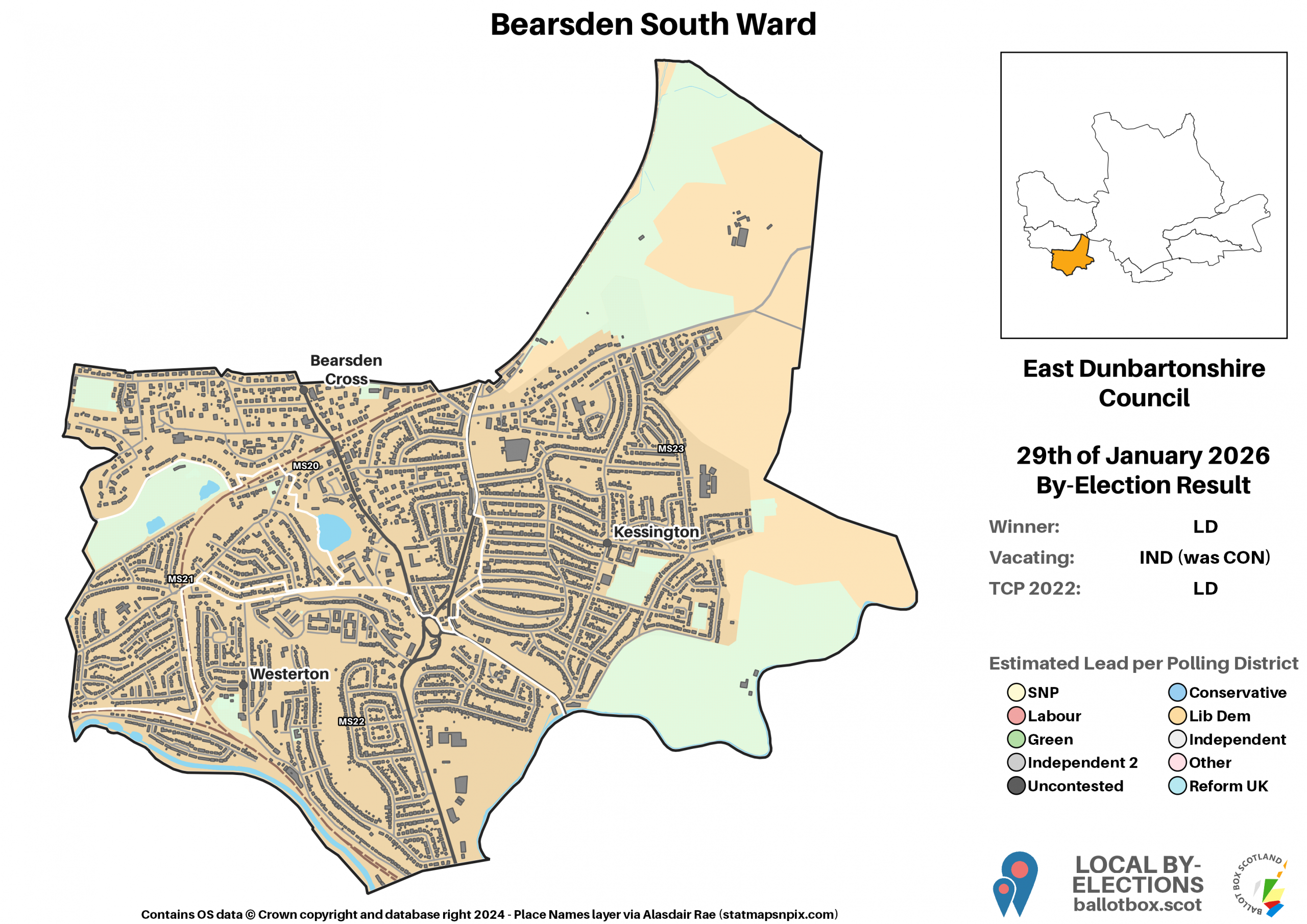
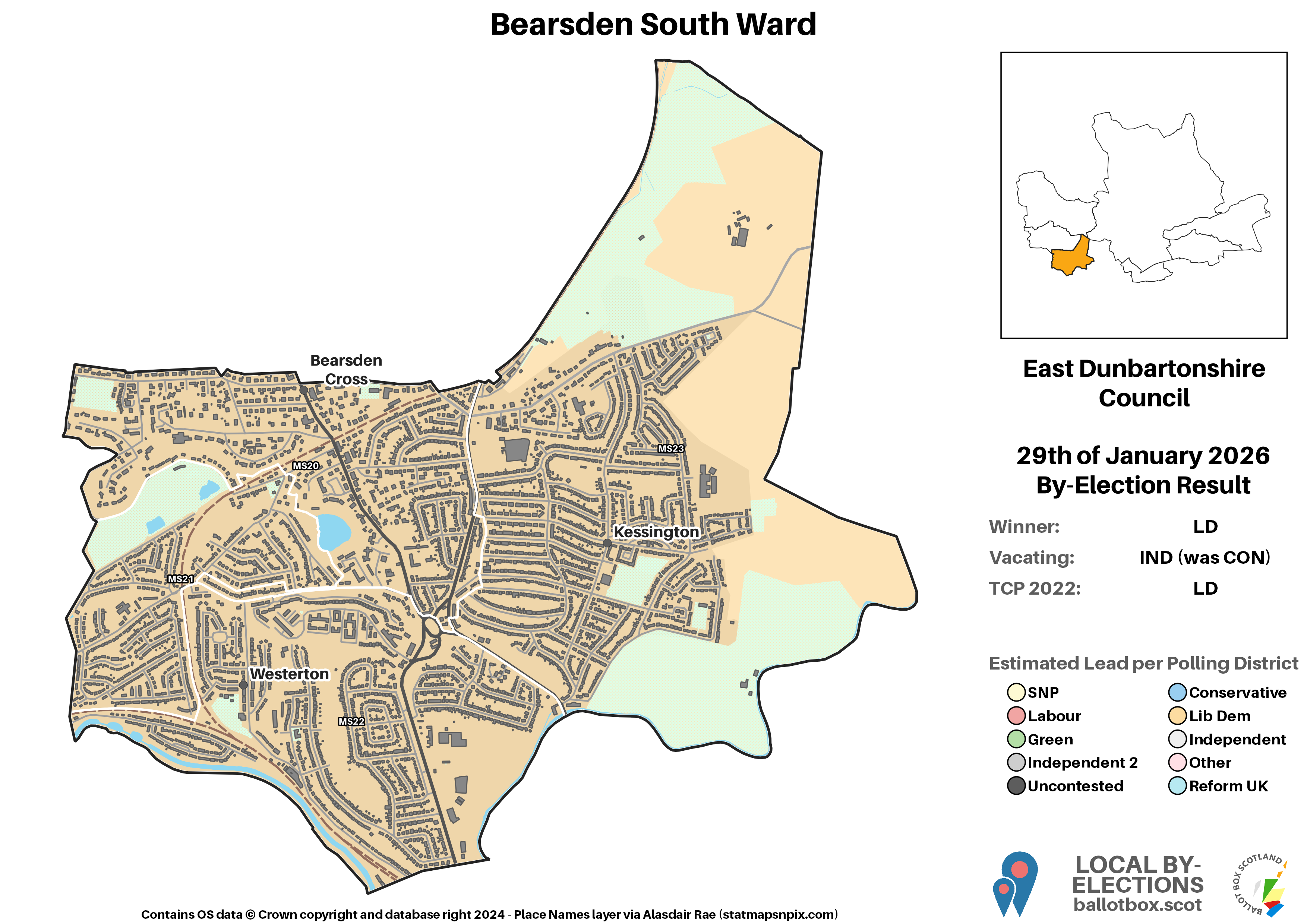
Absolutely no surprise that the scale of Lib Dem victory here also means they led in every polling district. Of those, they were strongest in the district just south of Bearsden Cross, where they won a majority of the votes cast. The SNP and Reform both had their best result in the only unidentified district on the map, the one by Colquhoun Park. Labour and the Conservatives meanwhile peaked in Kessington, and the Greens in Westerton.
Second Preferences
Direct second preferences show a pretty standard pattern for the Central Belt. That means a mutual flow between the Lib Dems and Labour, and between the SNP and Greens. The rump Conservative vote was most likely to go for the Lib Dems, with Reform not far behind. That’s quite different in both cases from 2022 when there was a strong Lib Dem to Conservative flow, and even stronger return. The remaining Conservative voter base has clearly moved to the right, as has the party overall, which likely contributed to making it a less appealing transfer destination this time.
Of course, the opposite is true for Reform UK voters themselves, who very strongly preferred the Conservatives to anyone else. Finally, and comically enough, the very small Family Party contingent was evenly split between keeping it culture war with a transfer to Reform, versus keeping it amongst the smaller parties with Green transfers. There aren’t enough of these people for this to mean anything, it’s just always funny when someone votes for the party most hostile to LGBTI+ people and abortion, and then follows that with a Green second preference.
One final thing to note is the relatively strong use of preferences here. We see that at full elections in this area too, suggesting there’s a link between the relative affluence of a community and how likely voters are to actually make use of their later preferences.
Nothing before the Holyrood election (probably)! For the first time in absolutely ages, following this by-election Scotland has hit Vacancy Zero: all 1226 councillor seats, plus all 129 MSPs and 57 MPs, are occupied. Unless a vacancy arises this week, the three month rule for holding by-elections will mean the next to arise will either be on (if it’s pretty soon) or after the Scottish Parliament election day on the 7th of May.
That being the case, remember you can keep tabs on the latest Ballot Box Scotland coverage on the Holyrood Hub page.
If you find this or other Ballot Box Scotland output useful and/or interesting, and you can afford to do so, please consider donating to support my work. I love doing this, but it’s a one-man project and takes a lot of time and effort. All donations, no matter how small, are greatly appreciated and extremely helpful.
(About Donations)