As the 2026 Scottish Parliament approaches, keep up to date with all the latest polling and analysis on Ballot Box Scotland’s Holyrood Hub page!
Poll Details and Context
With less than three months left to go until the election, is Scottish polling picking up pace? Ehhh, perhaps. It seems highly likely this specific outing from usual partners the Sunday Times (link to original writeup) and Norstat (link to tables) was triggered by Anas Sarwar’s dramatic call for the Prime Minister to resign, though perhaps they were due one now-ish anyway?
Note that we did have a More in Common poll a couple of weeks ago as well, but I’m finding Scottish polling very peculiar at the moment and considered that one quite dubious. Rather than give it the complete Find Out Now treatment of being ignored entirely, I’m doing a middle ground it’s incorporated for the averages, but I haven’t given it dedicated analysis. That analysis would otherwise be “I’m not sure where you’re finding 13% for the Lib Dems, or a 7% loss for the SNP since September, when no one else is, you must be applying some really funky weightings.”
The previous Norstat covered the 13th – 16th of January 2026. Changes are shown as (vs that poll / vs last election).
Regional Vote
Change vs Last Poll
Change vs 2021
Wee-ooo, wee-oo – it’s the Margin of Error Siren!
That means that changes in headline figures in this poll may simply be statistical noise, and should be understood accordingly. The biggest shift here does press up against the edge of that margin, with a 3 point jump for Reform putting them ahead of Labour and close to their peak of polling for this vote. Whilst the SNP’s single point gain isn’t worth noting in itself, it is the first poll for a while that has them in the 30’s.
Down ballot, what was a statistical tie becomes an absolute tie between the Conservatives and Greens for fourth place, as the former continue to struggle for a hearing having ceased to be the SNP’s main opposition. Given Norstat are typically on the lowest end for the Greens, they’ll probably be okay holding steady on a fair gain on 2021. There’s also a dip for the Lib Dems that’s the lowest Norstat finding in 18 months, and indeed the lowest they’ve polled with anyone bar Ipsos in that period. Again, I emphasise not to read too much into that, but it does jar enormously with More in Common’s eyebrow raising figure.
Constituency Vote
Change vs Last Poll
Change vs 2021
The Margin of Error Siren is still sounding!
Again, that means changes versus the last poll may just be statistical noise. Overall this largely repeats the findings of the list vote, with Reform squeaking ahead of Labour but both languishing far behind the SNP. In addition, it’s the Lib Dems rather than Conservatives that tie with the Greens here. That may be cold comfort for the Conservatives when you consider this is their joint-worst poll for this vote this term, the fifth time this number has come up over the past few months or so.
Seat Projection
Projecting that into seats might give us something like this:
Please see this page for how projections work and important caveats.

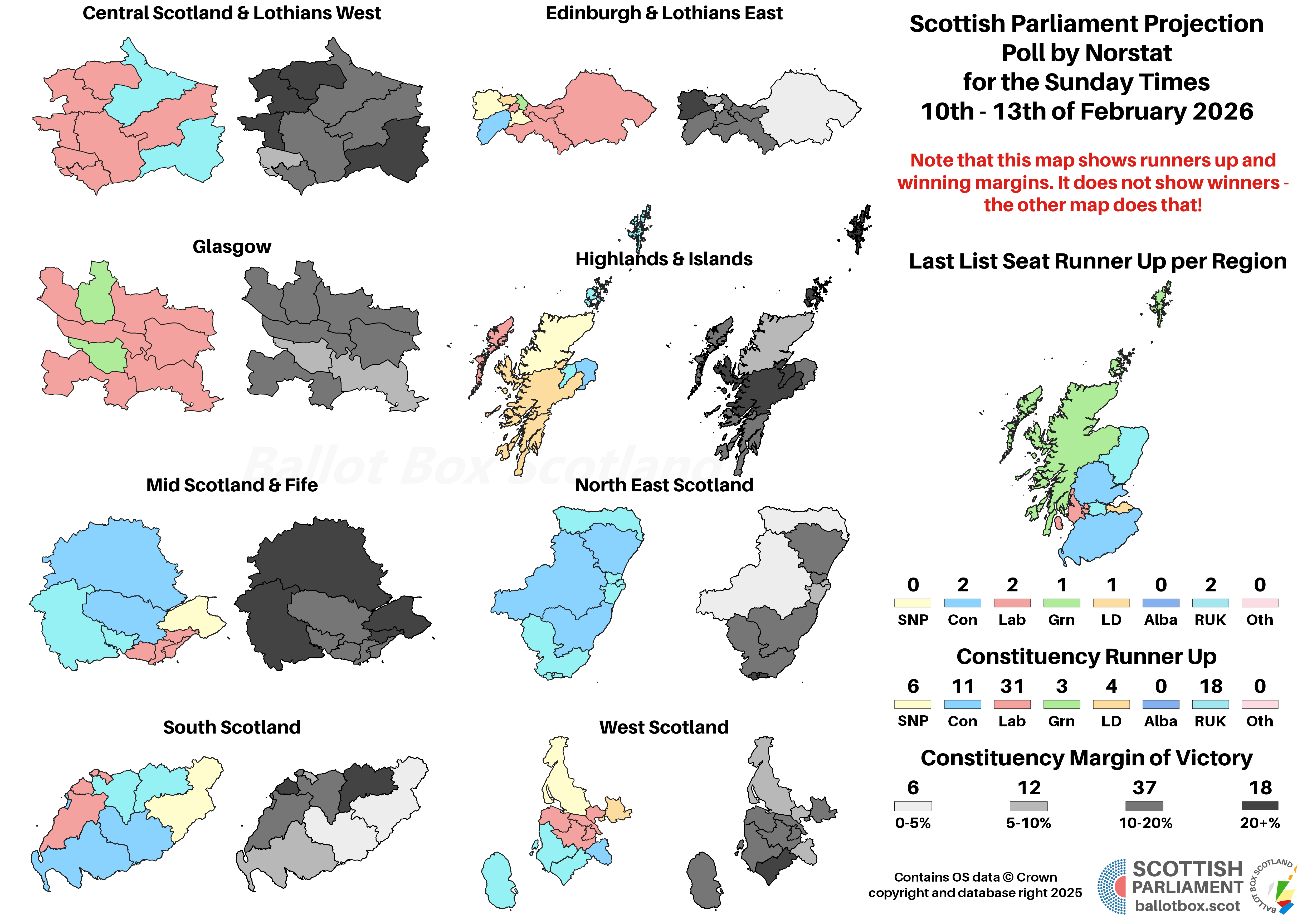
Small as the changes are, they are enough to put the SNP one short of a majority on my model. That’d be a gain of one seat versus the 2021 result on new boundaries, but completely flat versus the actual 2021 result. John Swinney would be laughing all the way back to Bute House with a result like that given how much support the SNP have shed since then. The Greens would again be sufficient to see them over the line, themselves narrowly overtaking the Conservatives in seats in this projection.
In terms of general expectations Labour would continue to be the last happy party in Scotland with this outcome, having gone from “almost certain next Government” to “third place also-rans” in an 18-month timespan. However, the Lib Dems might also look at this kind of result with deep disappointment: only the most recent Ipsos projected to such a meagre share, and the last time they were worse than this was another Ipsos in May 2023. I’ve said a few times I expect them to gain the Edinburgh Northern seat but my model simply can’t be convinced of that, and they may similarly have model-busting results in Highlands and Islands constituencies, but it’s still not a very fun number for them.
Possible Majorities
Note: these majorities relate simply to passing a vote in the Scottish Parliament. They do not imply the formation of a full coalition government.
- Traffic Light: Labour, Lib Dem and Green
- Independence Bloc: SNP, Green and Alba
- Grand Coalition: SNP and Labour
- Union Bloc: Labour, Conservative, Lib Dem and Reform UK
Change vs Last Poll
Change vs 2024
Sorry, I can’t get the Margin of Error Siren to stop screaming!
Just like the Holyrood figures, the Westminster findings really don’t show much change versus the last poll. The changes present are similar, namely down for the Lib Dems, up for Reform. The Lib Dems even place behind the Greens here, though the 1% separating them is a tie in statistical terms. For Reform, this is a joint-best result for them on this vote, continuing a general trend of doing better for the London Parliament than the one in Edinburgh. Meanwhile, Labour would face a return to oblivion, losing half of their vote versus 2024 and barely scraping over half the SNP’s share.
Change vs Last Poll
Change vs 2014
If I hit the Margin of Error Siren hard enough maybe it will shush?
Even more so than the parliamentary polling, there’s absolutely nothing really changed on the constitutional side of things. As it has for most recent Norstat polls, Independence holds a very small lead over the Union, but by no means a strong or sure one, as this too lies within statistical tie territory.
Hypotheticals
As ever, the last little bit of analysis concerns those hypothetical and more proportional voting systems that BBS likes to play about with. The use of pure FPTP at Westminster is an affront to democracy, and though Holyrood fares far better, AMS is still deeply imperfect. The examples here simply transpose the poll findings onto more proportional voting systems – the reality is that different systems would of course result in different voter behaviour.
Scandinavian Style Westminster
If you find this or other Ballot Box Scotland output useful and/or interesting, and you can afford to do so, please consider donating to support my work. I love doing this, but it’s a one-man project and takes a lot of time and effort. All donations, no matter how small, are greatly appreciated and extremely helpful.
(About Donations)