The day of the 2026 Scottish Parliament election is finally here. For the last time, you can cast your eye over all of the polling and analysis on Ballot Box Scotland’s Holyrood Hub page!
After a long and frankly not very exciting campaign, polling day is finally here! Polls will be open from 7am until 10pm, so make sure you find the time in the day to pop along and cast your ballots if you haven’t already sent a postal vote off. Yes, I am aware that if you’re reading my website you probably don’t need the reminder, but maybe you’re having a rough day at work and have only just remembered you have something important to do?
As usual, with no more polls due out (indeed, it’s illegal to publish new polling on the day of the election), I’m taking stock of where the campaign has ended and setting out my final predictions for the day. We aren’t counting votes overnight this year, but tomorrow you’ll be able to get more detail than pretty much anywhere else here on Ballot Box Scotland, so remember to check in from 9am onwards (be aware this link won’t go live until after polls close!) I’ll also be doing a few little livestreams throughout the day to touch base. For now though, let’s get into the final state of play!
Seat Projection
Parties:
SNP
Labour
Reform UK
Conservatives
Greens
Lib Dems
Final Polls
Note: for both votes I have ignored the final More in Common poll in my average. Of the six parties, it had five of them on notably divergent shares. Typically, a pollster will have one or two house effect outliers. Five is simply too many! I have instead kept their final MRP in the tally: they aren’t excluded entirely, I am just so dubious about that final poll I don’t think it should muddy the waters. I also don’t have FindOutNow in there and they went the opposite direction for the most part so they’d have cancelled out had I put them both in, for anyone feeling especially grumpy about my choices.
List Vote Average
List Vote Swing vs 2021
List Vote By Polling Agency
List Vote Trend (Final Month)
I know it riles some folk up that I start with the list vote, but this is the one that does the most to shape the parliament. It’s meant to be proportional, and this is the vote that drives that proportionality. Even with the substantial distortion expected by the SNP’s exaggerated constituency seat share, this is still what is going to determine how many MSPs from other parties make it into the chamber.
The SNP themselves are very unlikely, barring a massive polling miss, to see any MSPs elected on this vote, because they have lost around a quarter of their support compared to 2021. If there is a polling miss, it could still hand over an MSP or two in the likes of Highlands and Islands, South Scotland, or even Edinburgh and Lothians East, but this is a big, big loss in support. Notably they have continued to bleed support on this vote over the past month, slipping down by about 3%.
Now relatively settled in second place are Reform, after a gain of nearly 2% over the past month, though their average hasn’t quite hit 20%. As remarkable as that would be, if this is roughly accurate it will be the worst performance for a largest opposition party in Holyrood’s history. If Labour are able to claw ahead at the last minute, the same will be true, as they are down a couple of points against their 2021 result. They’ve effectively made zero progress on this vote all month, which is a killer for them.
Not that far behind are the Greens, and it’s worth pointing out that they were relatively steady all month too until the last minute. A pack of very positive final day polls added 1.2% to their average, growing it by a tenth in relative terms. That has them now a couple of points clear of the Conservatives, who themselves did have a slightly better time of it in a couple of the final polls compared to earlier entries by the same pollster. The Lib Dems aren’t that far behind and have scraped onto bang on 10%, which raises the prospect of having not just five but in fact six parties on double digits for the first time: never before has it been more than four.
Constituency Vote Average
Constituency Vote Swing vs 2021
Constituency Vote By Polling Agency
Constituency Vote Trend (Final Month)
For all that the list vote is the one shaping parliament overall, the constituency vote is more important than ever this year. It is the constituencies that hold the key to a proportionally undue and unearned SNP majority, and this is where things look shaky for them. Once accounting for the Greens only contesting 6 of the 73 constituencies, the SNP were sitting pretty on 40% of this vote. That has been eroded over the past month, dropping down now to just under 37%; a similar decline to their list vote, and again around a quarter of their support against 2021. With margins in key constituencies already very tight, that alone could be the difference between 65 seats and 55.
Yet it doesn’t appear to be Labour who have benefitted overall: they are sat on the same average, just shy of 19%, as they were a month ago. Reform too have barely budged, gaining just over half a percentage point. Instead, much of the movement has come from a roughly 1.5% gain for the Conservatives plus 1% for the Lib Dems. Rather than coming directly from the SNP, this may be an example of voter “churn”: one voter moves from A to B whilst another moves from B to C, or some people deciding not to vote and so on.
Green shares here are very small because polls have either been re-projected to estimate the impact of their absence in most constituencies (earlier in the month), or were conducted accounting for that absence in the first place (all of the final polls). That means we can draw very little from their support on this ballot in terms of how they will do where they are standing.
Seat Projection
Before we get into the projection, let’s lay out four big caveats that come with this. I am;
- ASSUMING that polling is roughly accurate
- NOT Predicting a specific number of seats
- NOT Predicting which party will win key battlegrounds
- NOT Predicting all other seats are safe and definitely won’t switch
This is very different to a standard poll projection, where I present specific winners for every seat. Those projections are offered on an “if polling and my model were both completely accurate, then…” basis. Obviously, we all know that perfection is unlikely, so for the actual election, it pays to be more cautious. The model number is still given for context, but it’s not attached to the usual map, and is simply the central predictive case.
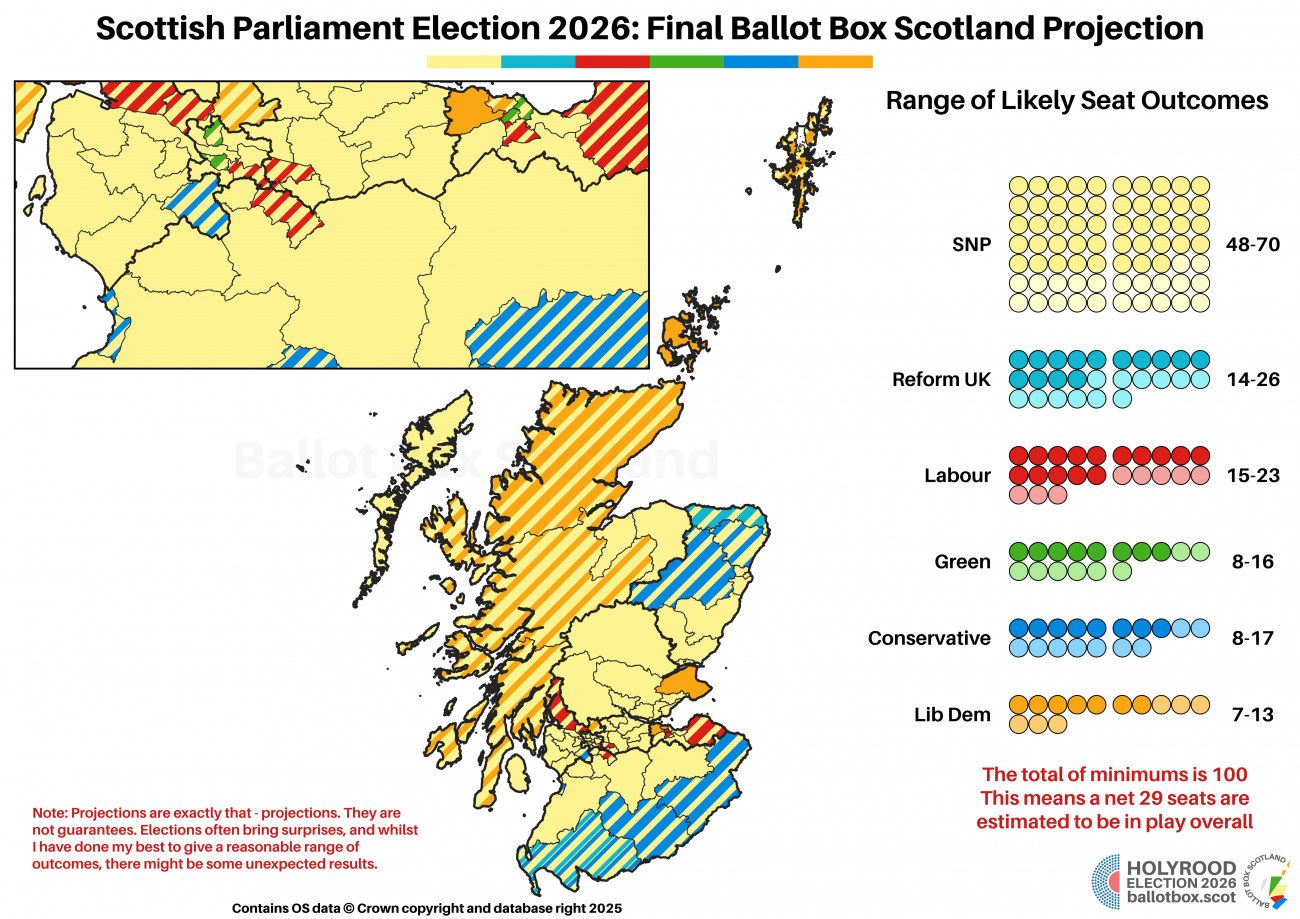
Range of Likely Seat Outcomes
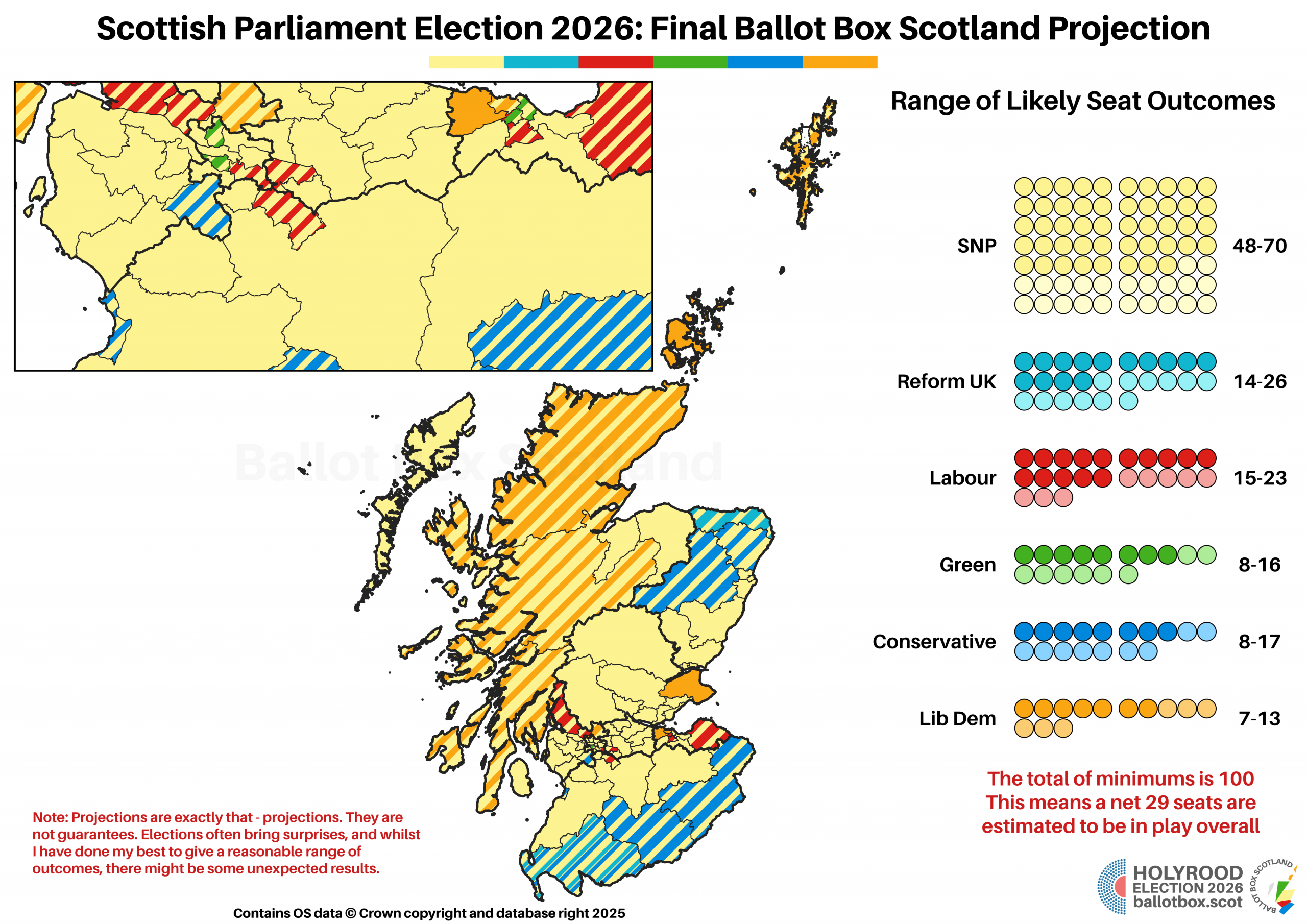
- SNP ~ 48 to 70 MSPs (model: 58)
- Reform UK ~ 14 to 26 MSPs (model: 20)
- Labour ~ 15 to 23 MSPs (model: 16)
- Greens ~ 8 to 16 MSPs (model: 15)
- Conservatives ~ 8 to 17 MSPs (model: 10)
- Lib Dems ~ 7 to 13 MSPs (model: 10)
I appreciate these are broad ranges, especially for the SNP. This is a combination of the variation in polling, the possibility the SNP slightly underperform, and that their opponents have very tightly concentrated vote distributions. It doesn’t take very much difference to tip a lot of constituencies away from the SNP, and unlike in 2011 they can’t rely on their list vote to make up any of the difference.
The crucial thing to do though is add up the minimums, which total 100 MSPs. In other words, just over three-quarters (77.5%) of seats are effectively settled in my view, with only 29 seats truly in contention. That could make an enormous difference to the final shape of Parliament, but it’s not as unsettled as you might instinctively have thought looking at how broad the ranges were.
One final point: this is a very simple tallying up of best and worst cases for each party. It says nothing about how likely they are to fall at a certain point in the distribution. For example, I would argue the Conservatives are far more likely to have their worst result than the SNP are. I recommend a look at Devolved Election Projection’s Monte Carlo method stuff, which by running 1,000 slightly different simulations spits out a variety of outcomes and an indication of probabilty.
Parties
SNP ~ 48 to 70 Seats
As has often, but not always, been the case in recent elections, the SNP’s trend over the course of the campaign has been largely downwards. Whilst a majority remains a statistical possibility, it has become even less statistically likely than it was a few months ago. They are still the party to beat though, miles ahead of their opponents on both votes, and very likely headed to enough seats that even without a majority John Swinney won’t be needing to move out of Bute House in the immediate future.
In a certain sense the SNP have possibly made a rod for their own back this election. By going all in on the patter that they can and must win a majority in this election, with the hopes of getting as much of their vote out as possible, they have now built up an expectation that is what the outcome should be. Objectively, given the expected crash in their vote and huge losses to Labour in 2024, anything above 50 MSPs would be a good result. Subjectively though, they’ve set themselves up for a “oh aye, where’s your majority?” reaction.
In many respects this mirrors their approach to the issue of a second Independence referendum. The focus on an SNP majority not just as one route but as the singular route to such a vote, again with the aim of bolstering their support by turning out Independence hardliners, could fatally undermine their aspirations. Winning a majority is hard under a proportional system, and not only might they not win one today, they might never do so. If they have overly tied an Independence Referendum to SNP success, well, they shan’t be getting another one of those either.
Reform UK ~ 14 to 26 Seats
For most of the campaign, I took the view that Reform would not live up to their best polling. They were already showing signs of decline in GB-wide Westminster polling, and when faced with the reality of electing a government rather than a protest vote, some of their voters might (more or less) reluctantly file back in behind Labour. There was a brief moment when the short campaign really took off where that seemed to be the case, but not anymore.
Reform are now polling far enough ahead of Labour on the list vote that we can be relatively confident, but not entirely certain, they will come second overall. They will not however, contrary to popular misconception, become “the Official Opposition”, because no such role exists at Holyrood. Nonetheless, this would be quite the coup for them if they do indeed pull it off. Breaking onto the scene is one thing mind you: making an impact when you’re there is another. Another point I’ve made frequently is that Farage Party parliamentary groups are always fractious, and that we can expect defections and expulsions pretty quickly, indeed potentially by the end of the year.
One notable quirk here is that their overall spread is wider than Labour’s at both ends. That reflects the general expectation in my model for their vote to be relatively evenly spread, which at lower vote shares translates to fewer MSPs than the same share would for the more geographically concentrated Labour.
Labour ~ 15 to 23 Seats
That Scottish Labour are facing a dire outcome is evidenced by the fact their squeeze message has been “the SNP don’t deserve to win”. When parties start desperately telling you, as their opening line, that their opponents are rubbish rather than that they themselves are great, things have taken a bad turn. It’s also evidenced by the fact that of all the parties, they are the ones whose modelled number is closest to their minimum.
The problem for Labour is that they are consistently polling below 2021 shares on both votes. Even if they have exceeded expectations in a few constituencies, their list vote being lower than 2021 means fewer MSPs. The best case here only puts them one MSP over what they actually won (two versus notional results on the new boundaries). Indeed, it seems that a fatal flaw in Labour’s campaign was that they have been so utterly fixated on the idea they are actually doing very well in some constituencies they haven’t run a proper “we need both your votes” campaign.
The SNP hammer “Both Votes SNP” at every opportunity, and the other opposition parties have been banging on about the “peach ballot” (i.e. the list vote) for weeks. Labour seem to have convinced themselves that if they could just win Hamilton, Larkhall and Stonehouse again, they get Bute House by default. If this is what has them stuck in third place again, they’ll have no one to blame but themselves: Keir Starmer didn’t make that decision for them.
Greens ~ 8 to 16 Seats
Whatever happens through the day, the Greens are clearly headed for a record result. They have a history of underperforming against their polling, yes, but only by a couple of points. Polling around 6% better off than their 2021 result, they are therefore all but guaranteed a double digit vote share. The final slate of polls were extremely good for the Greens and single handedly bumped their modelled tally from 11 to 15 MSPs. Were the SNP not exerting so much pressure on proportionality via their expected constituency haul, they could be pretty sure of hitting the upper range, but it’s far from guaranteed under present circumstances.
They are also pushing hard to win their first ever constituency seat in Edinburgh Central. Both the BBS central projection and YouGov’s final MRP think it will go their way. If it does, that surely must be a further impetus for the media to take the Greens a lot more seriously than they have until this point, seemingly viewing them as a Holyrood oddity not worth engaging with since they don’t have an MPs.
The best possible outcome for the Greens could however be under threat from “Independent Green Voice”, a fake party led by a former UKIP member expelled for holocaust denial decades ago, with a logo that has the word “Green” prominent, and stands exclusively to confuse voters and rob the real Greens of votes. They definitely cost the Greens one seat in 2021, and quite likely two. If that happens again this year, the Electoral Commission is going to have serious questions to answer, up to and including “why should every single one of you not just be sacked and a new body instituted to replace you?”
Conservatives ~ 8 to 17 Seats
If there’s one tiny silver lining for Labour in this election, it’s that at least they aren’t the Conservatives. Revived to great effect under the socially liberal Ruth Davidson in 2016, they’ve since gone hell for leather on nasty, reactionary social conservatism under two successive leaders. With Reform a much more obvious option for people who hold those views, and Labour and especially the Lib Dems more attractive to those who find them abhorrent, the Scottish Conservatives have done a spectacular job at shattering their own voter coalition.
That’s borne out in polling roughly on a par with their pre-revival worst, which is further amplified by that SNP over-representation in constituencies. The absolute best case scenario for the Conservatives barely has them ahead of their worst result. More likely is that they end up losing around two-thirds of their seats, and it’s quite likely they will be beaten by the Greens. They could even be beaten by the Lib Dems, if not in votes, then at least in seats.
To go from second place to sixth would be the worst catastrophe in the party’s history. They are at real risk of being reduced to a rump party, and not even a national one: if they lose both Glasgow MSPs, as is entirely possible, they will have a regional gap for the first time in Holyrood’s history.
Lib Dems ~ 7 to 13 Seats
The Scottish Lib Dems are currently providing a notable contrast to the GB-wide and Welsh parties. There really hasn’t been any appreciable, sustained improvement in prospects for Westminster or the Senedd over the past few months, but they are on track for decent gains at Holyrood. Part of that comes from the party’s mastery of intensive local campaigning: on a good day, they could win more constituencies than all the other non-SNP parties combined.
However, that local focus also constrains their growth. I remain of the view they simply cannot regain representation in Central Scotland and Lothians West region, and Glasgow is highly unlikely. Still, they will hardly be unhappy with the notion that even their worst expected result is a near doubling of their 2021 numbers. Given the likelihood of an SNP plus Lib Dem majority being possible, they may decide to continue getting some policy wins via budget deals with the government, giving them something to show to voters in 2031.
I also think that, assuming their constituency vote is accurate, their list vote may be 1-2% overpriced. Historically they have done significantly worse on the list than the constituency vote, for the exact same reasons they are great at winning a small number of constituencies. If that assumption is proven correct, that could chop a couple of prospective MSPs off their total.
Regions
Central Scotland and Lothians West (16 MSPs)
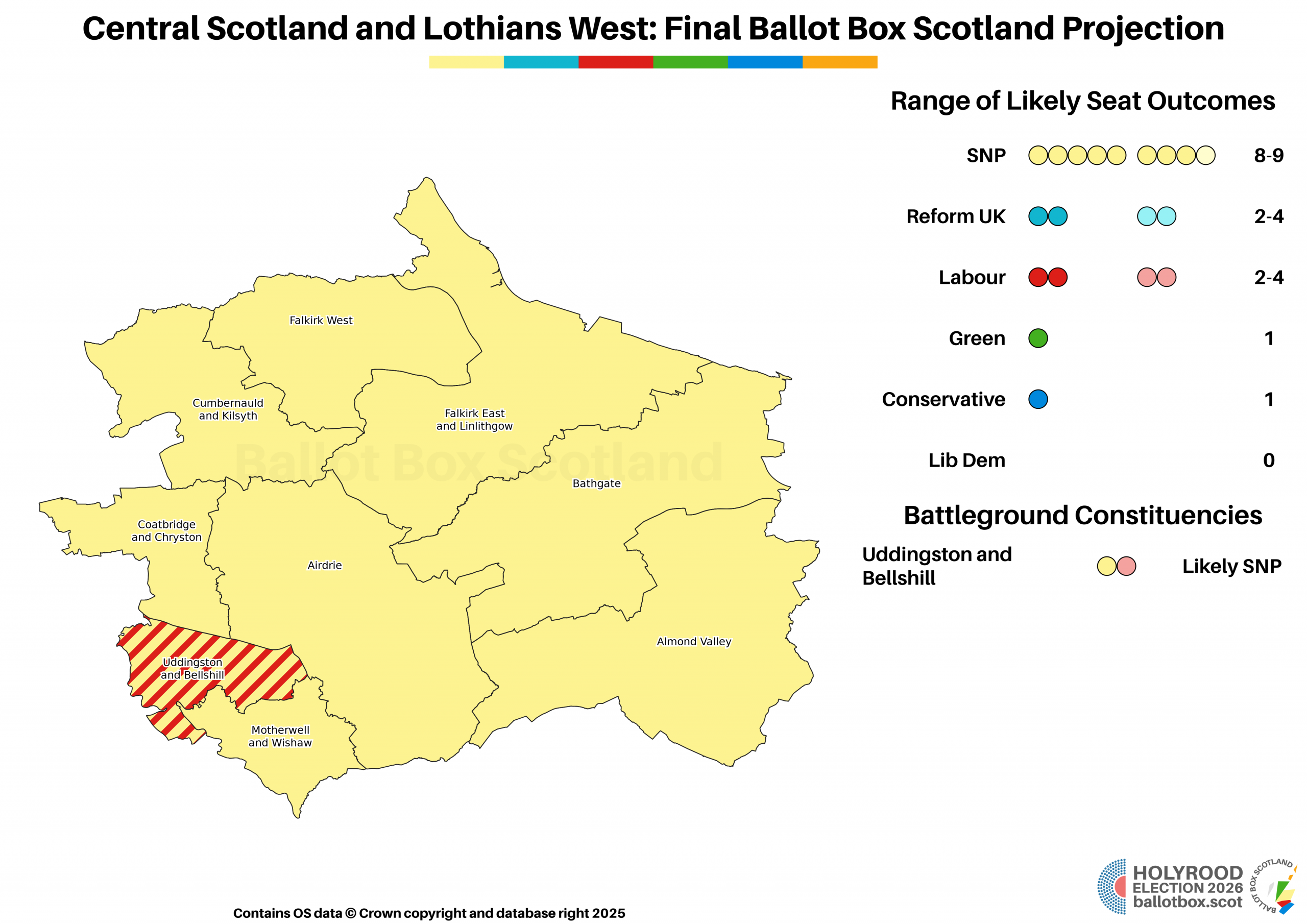
- SNP ~ 8 or 9 MSPs (model: 9)
- Reform UK ~ 2 to 4 MSPs (model: 3)
- Labour ~ 2 to 4 MSPs (model: 2)
- Greens ~ 1 MSP (model: 1)
- Conservatives ~ 1 MSP (model: 1)
- Lib Dems ~ 0 MSPs (model: 0)
First up alphabetically is a frankly not very exciting region. A couple of years ago, most if not all of the constituencies in Central Scotland and Lothians West would have been expected to flip from the SNP to Labour. Now, the central case is that none of them do. Uddingston and Bellshill is the only one where the SNP’s lead over Labour is below 15%, and only just at 14.7%. Even on a uniform swing to close that 15% gap, this would be one of just 8 constituencies Labour would win. The next two easiest gains are Airdrie, at 17.1% behind, and Falkirk East and Linlithgow, at 19.2%. Labour would need a big overperformance versus polling to put those in contention.
The list seats are likewise barely competitive. I reckon that based on their polling the Greens should be pretty secure here now, and likewise I can’t quite see the Conservatives crashing out entirely in this region. Nor can I see either having the votes for two MSPs here whilst the SNP are so dominant in the constituencies. If the SNP hold all of them, Labour and Reform will be battling to see who can get a third seat, with a fourth only at all possible if Uddingston and Bellshill does indeed change hands. Even on a very good day for the Lib Dems, I expect this to remain one of their two deadzones.
Edinburgh and Lothians East (16 MSPs)
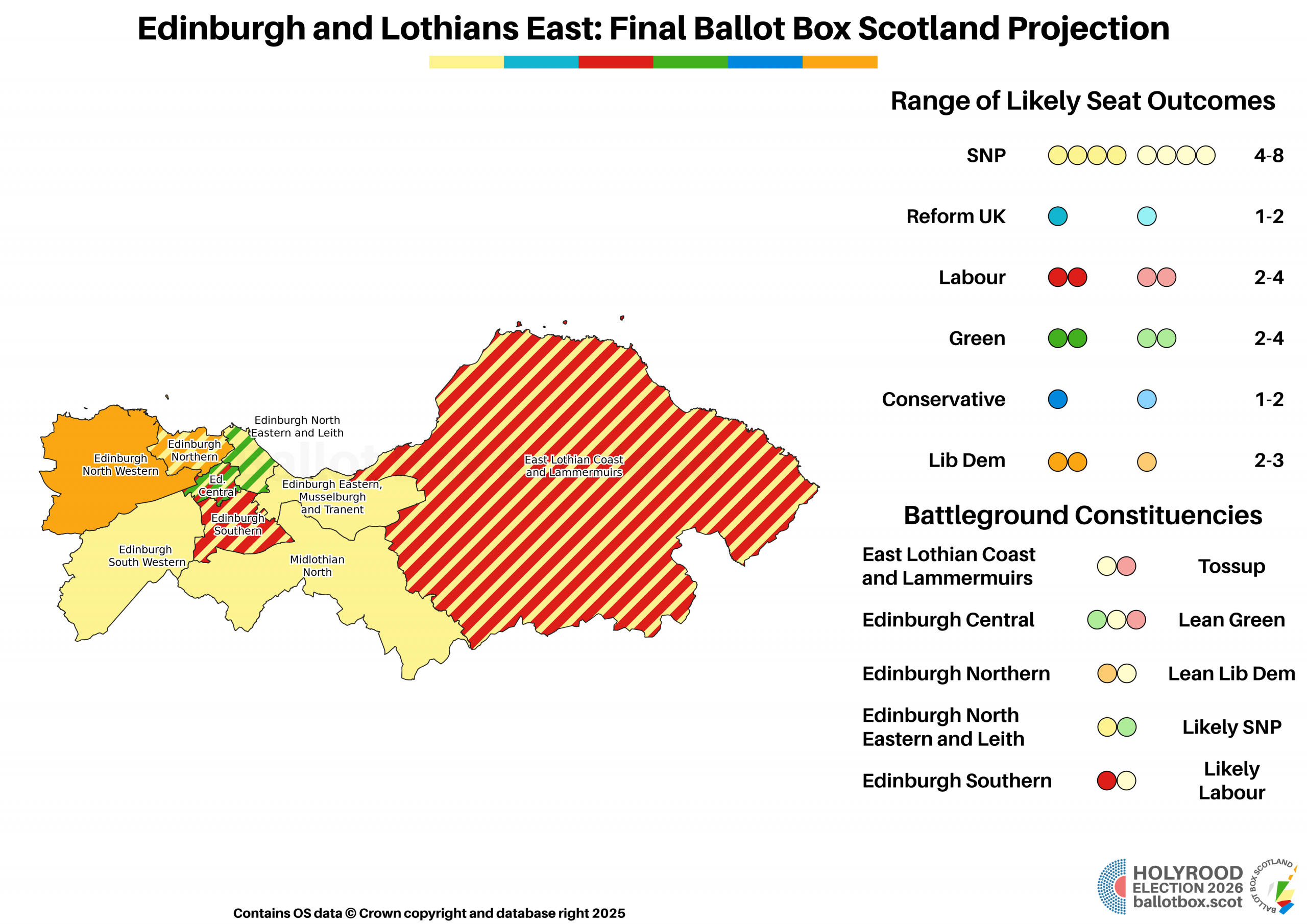
- SNP ~ 4 to 8 MSPs (model: 4)
- Reform UK ~ 1 or 2 MSPs (model: 2)
- Labour ~ 2 to 4 MSPs (model: 3)
- Greens ~ 2 to 4 MSPs (model: 4)
- Conservatives ~ 1 or 2 MSPs (model: 1)
- Lib Dems ~ 2 or 3 MSPs (model: 2)
This is a deliciously juicy region with lots going on and one of the widest ranges of possible SNP outcomes. On a really, really good day for them, the SNP don’t just hold their existing constituencies but gain the significantly redrawn Edinburgh Southern from Labour. I would be surprised if they have such a good day, and consider a Labour hold in a seat that now closely matches its Westminster equivalent the most likely outcome. In addition, East Lothian Coast and Lammermuirs is Labour’s easiest pickup in the entire country, so even on a bad day they could still regain it.
Further SNP losses are possible in Edinburgh Central and in Edinburgh Northern. In Central, the Greens are challenging for their first constituency, and by this stage in the campaign I’m increasingly leaning towards “good gods, they might pull it off”, versus my earlier “I think the model is slightly overegging their chances”. If they don’t win, it’s theoretically Labour’s second easiest gain nationwide, so could go their way instead of the SNP’s. Northern is kind of an opposite case in that I’ve long expected the Lib Dems would get it but my model took until the very last day of the campaign to agree.
If the SNP do lose all of those, it’s unlikely they’ll have the support needed to regain any seats via the list. They would only do so if by some freak turn of events the Greens also won Edinburgh North Eastern and Leith. Regardless of constituency wins, unlike the last election I expect the second Green MSP is very secure here, a third is quite likely, and a fourth is possible if they are on the upper end of their polling and there are no constituency imbalances.
They could even be vying for second place in the region with Labour, who have an identical overall seat envelope. I also reckon the Lib Dems have at least one nailed-on gain as even if they don’t get a second constituency, I’d be shocked if their regional vote wasn’t pumped up enough for a second MSP via the list instead, and it’s not impossible to envision a third. The weakest area for Reform, it’s the most likely one for them to end up stuck on a single seat in. The Conservatives meanwhile could on a good day still get a second MSP here.
Glasgow (15 MSPs)
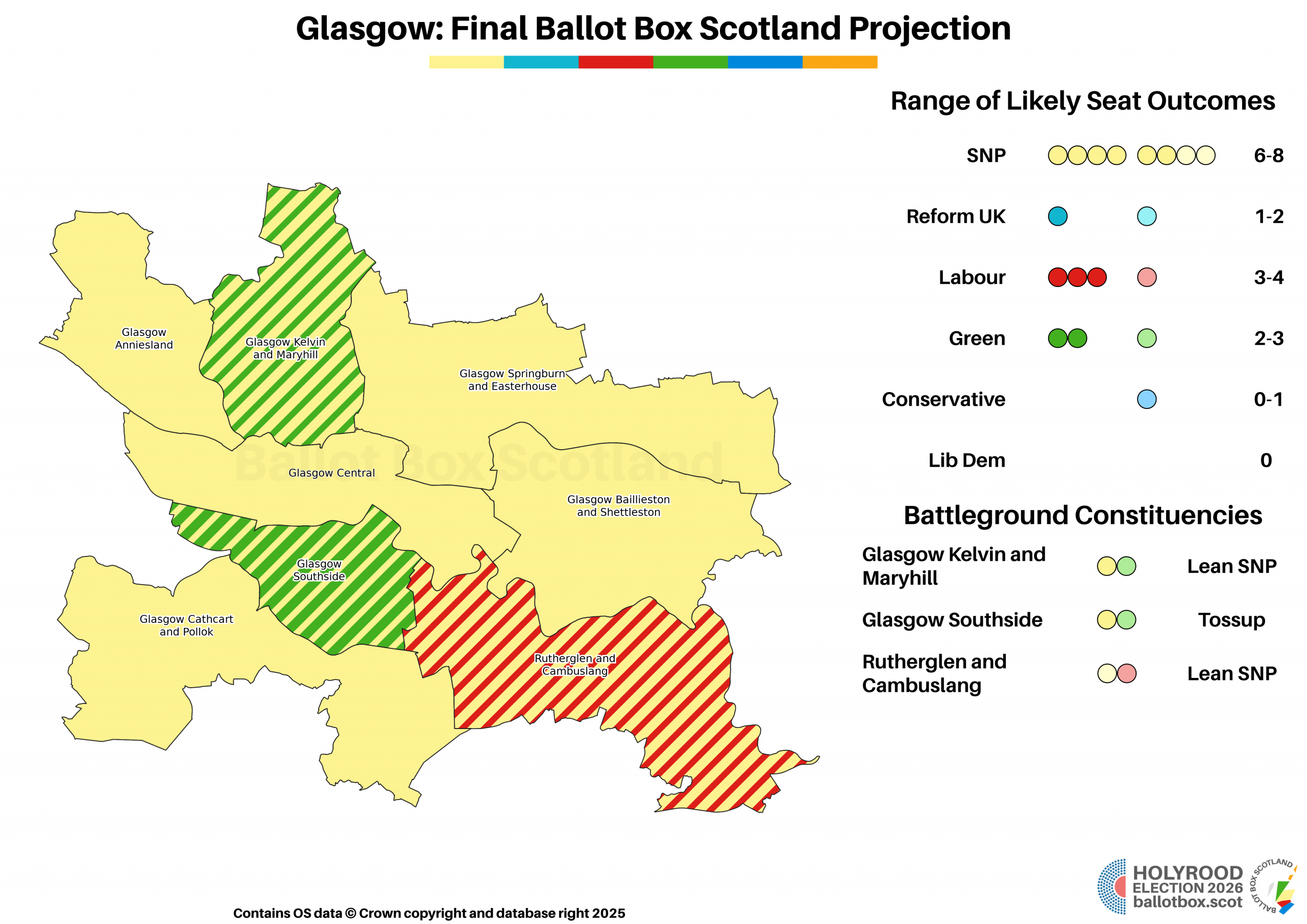
- SNP ~ 6 to 8 MSPs (model: 7)
- Reform UK ~ 1 or 2 MSPs (model: 2)
- Labour ~ 3 or 4 MSPs (model: 3)
- Greens ~ 2 or 3 MSPs (model: 3)
- Conservatives ~ 0 or 1 MSP (model: 0)
- Lib Dems ~ 0 MSPs (model: 0)
Glasgow is another region where not so long ago Labour would have been expecting to repeat the clean sweep they achieved at Westminster in 2024. Now, the prospect of any gains at all seems slim, never mind winning all 8 constituencies. Where they are in closest contention is Rutherglen and Cambuslang, which with a 12.9% SNP lead is the fourth easiest Labour gain anywhere. Nothing in the city itself has Labour any closer than 20% behind, hence why modelling just cannot imagine any of those seats changing hands.
The other constituencies marked as at all possible are in fact contests with the Greens. The party made a serious attempt at Kelvin in 2016 and 2021, coming second both times, but the pandemic scuppered the ground campaign they’d have needed to win the second time. Kelvin has been split four ways and the new Kelvin and Maryhill isn’t the party’s best prospect in the city anymore, though some MRPs hand it to them, and I’ve heard whisperings myself that the SNP are feeling threatened.
Instead, Glasgow Southside has combined three very good council wards into a single constituency and they are making a serious go of it. I would mark both out as more realistic prospects for 2031, but can’t write them off entirely. Whatever happens, I expect the Greens to get at least 2 MSPs this time. If they still only get 1, it’s polling that was wrong, not me! If they were to win both constituencies, sitting MSP Patrick Harvie wouldn’t have anything to fear, as the only reality in which they have support to win two constituencies is one in which they have enough for three overall.
Reform should do better here than in the capital, but I would still expect that to be noticeably below their national figure. That’ll vary across the city: expect Baillieston and Shettleston to be much stronger than Southside, for example. That could enable them to completely replace the Conservatives with a double, or it might stick them on one, it’s hard to say. The Conservatives themselves are at serious risk of losing both MSPs here, which would make this the first election they don’t have at least one in each region. Finally, this is the other no hope region for the Lib Dems in my view: barring patches of Rutherglen and Cambuslang, there’s nowhere with a real Lib Dem presence anymore.
Highlands and Islands (15 MSPs)
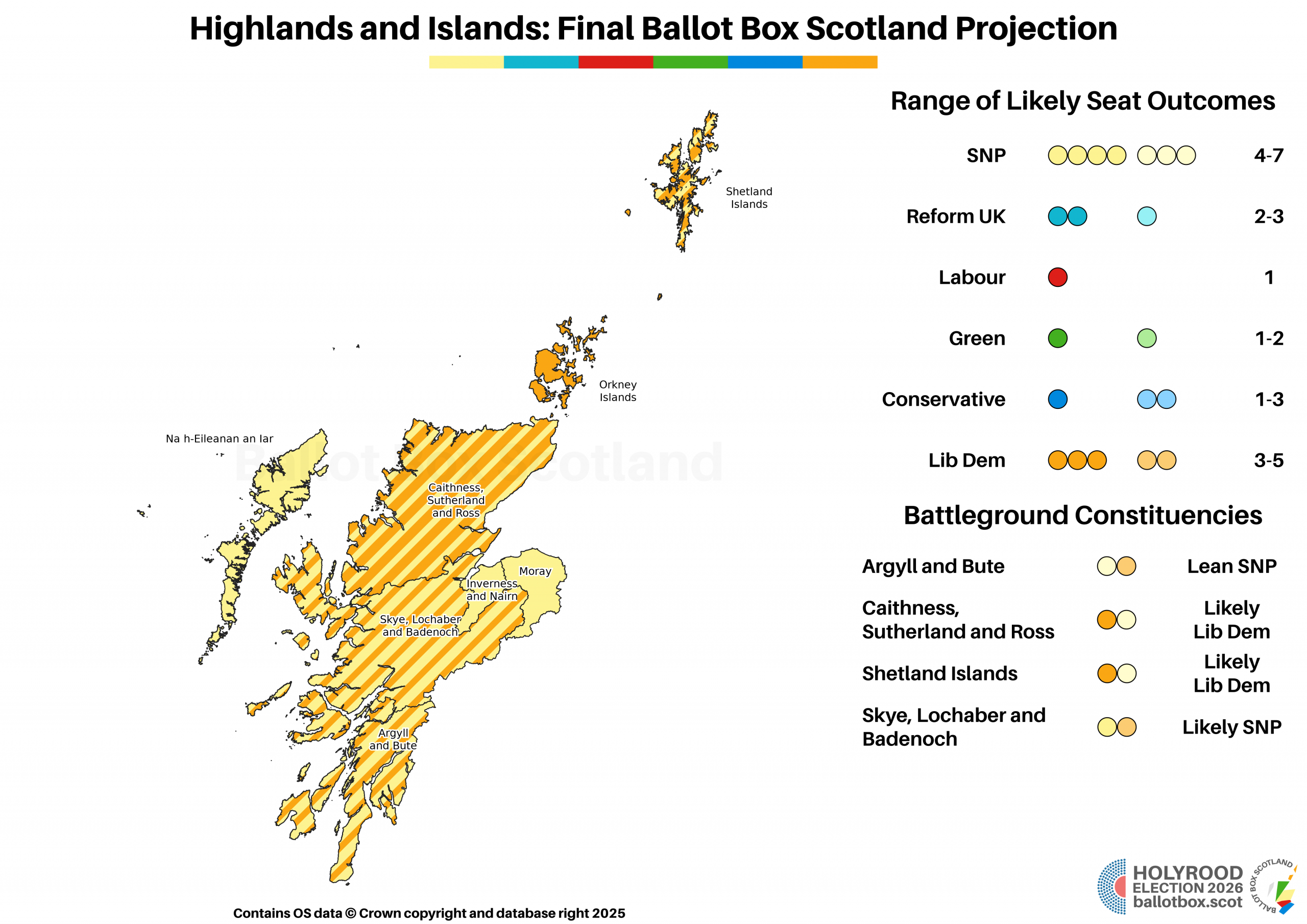
- SNP ~ 4 to 7 MSPs (model: 5)
- Reform UK ~ 2 or 3 MSPs (model: 2)
- Labour ~ 1 MSP (model: 1)
- Greens ~ 1 or 2 MSPs (model: 2)
- Conservatives ~ 1 to 3 MSPs (model: 2)
- Lib Dems ~ 3-5 MSPs (model: 3)
It feels like we’ve turned back time in the Highlands and Islands, because overall this is going to be a straight SNP vs Lib Dem contest. Labour have historic strength in Na h-Eileanan an Iar but it’s probably out of reach now they’ve totally collapsed again. The Lib Dems meanwhile are gunning for basically everything in this region barring that seat and Moray, and I wouldn’t write them off almost anywhere; I hemmed and hawed over Inverness and Nairn and eventually decided that I reckoned the anti-SNP vote would be too split there by the presence of Fergus Ewing. Ewing himself is not in contention, as I’ve heard on the grapevine (via the Lib Dem campaign funnily enough) that he’s garnering pretty limited support.
What seems pretty much certain is that the Lib Dems will gain Caithness, Sutherland and Ross. If that’s their only gain, don’t expect a weakened SNP to make up for it on the list vote. Only if additional seats fell – Argyll and Bute most likely, Skye, Lochaber and Badenoch much less so – would the SNP potentially enter the running for any compensatory seats. Were the Lib Dems to pull off such a big win, they could be the ones distorting the proportionality in this region!
It’s not all smooth sailing for the Lib Dems though, as apparently they are genuinely worried about Shetland. Picking the leader of the unpopular council as their candidate perhaps wasn’t the cleverest move, though as this is also one of the few constituencies the Greens are contesting, the SNP could be hamstrung enough to fall far short nonetheless.
Considering the list seats, my expectation is that Reform end up the third strongest party, giving them at least two but potentially three MSPs. The Conservatives are only certain of one in my view, but two is very likely, and three could happen on an expectation-busting day. The Greens are also in the hunt for a second here, which is one of many across the country that could be blocked by constituency disproportionality. Lastly, Labour only got one MSP here last time, and I don’t see their vote shifting enough in either direction to change that.
Mid Scotland and Fife (16 MSPs)
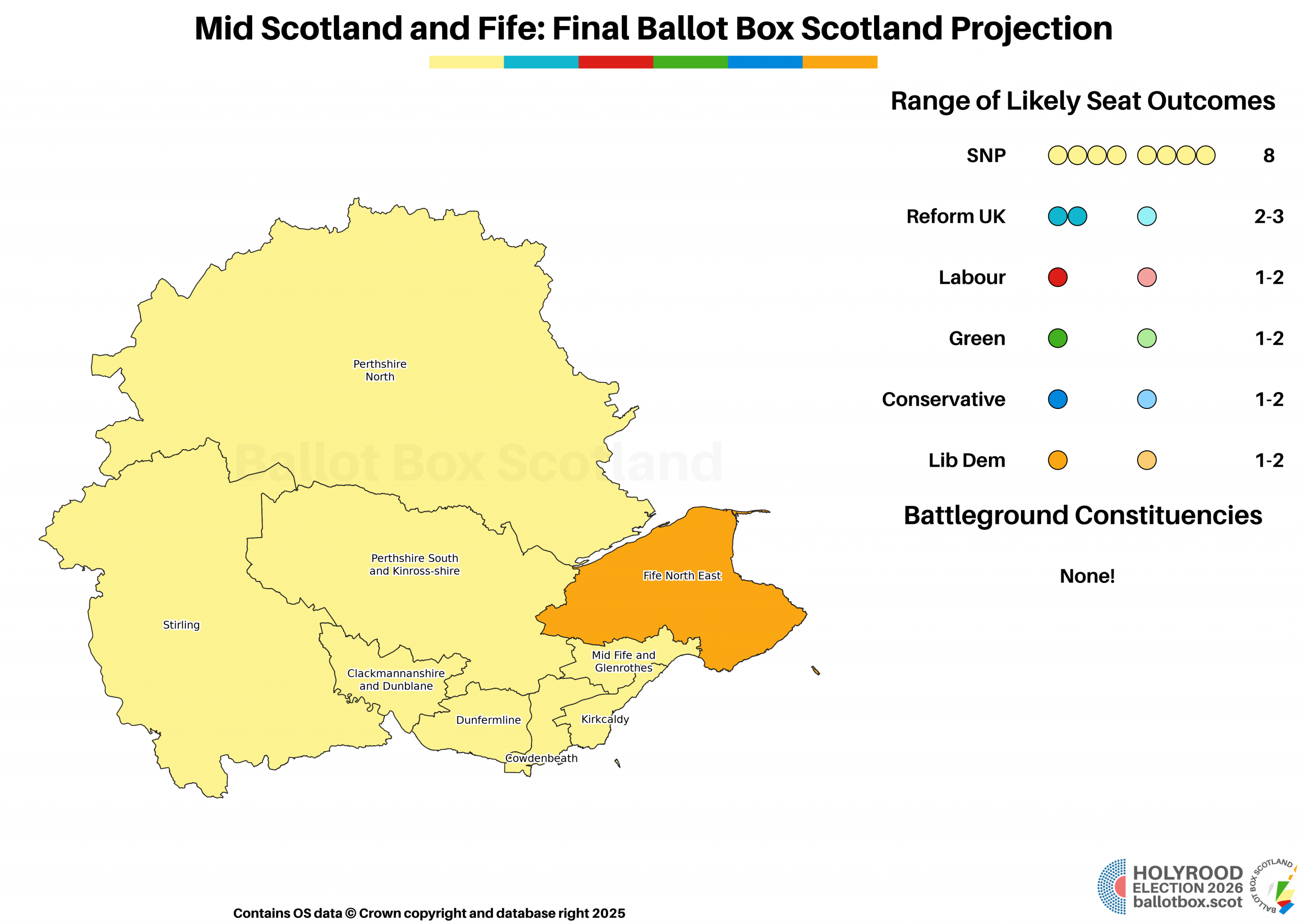
- SNP ~ 8 MSPs (model: 8)
- Reform UK ~ 2 or 3 MSPs (model: 2)
- Labour ~ 1 or 2 MSPs (model: 1)
- Greens ~ 1 or 2 MSPs (model: 2)
- Conservatives ~ 1 or 2 MSPs (model: 1)
- Lib Dems ~ 1 or 2 MSPs (model: 2)
Alas, poor Mid Scotland and Fife: constituency wise, this is the most boring region in the country. The two closest seats in 2021 terms were the Perthshires, but the Conservatives were still around 10% behind in each, meaning there’s no chance they gain them this election. Labour meanwhile haven’t got a single constituency where they were within 15% of the SNP, which has been my threshold for marking as potentially in play. Cowdenbeath comes closest at 17.6%, which is not entirely beyond the realms of possibility… if Labour’s dreams of a polling miss prove accurate.
The real contest here then is on the list seats, and this is where things are incredibly hard fought. I reckon that five of the seven seats are accounted for: two for Reform, plus one apiece for Labour, Conservatives and the Greens. What happens with the final two could be a messy five way scrap between everyone barring the SNP. Recently, my model has tended to have about 1% separating all of the Conservatives, Labour, Greens and Lib Dems, whilst Reform’s share has been nearly 1.5x as high, which is what it would need to secure them a third seat over a second for any of those parties.
This is where the SNP’s over-representation really bites if polling and my model are anywhere near correct. Parties estimated to be over 12% should be on two seats each, and one on 18% should be on three. Between them though that’s 10 MSPs (discounting the Lib Dem constituency), with just the 7 to go around. In other words, the SNP would need to be trimmed down to 5 constituencies in order to restore proportionality here, and that just isn’t happening.
North East Scotland (17 MSPs)
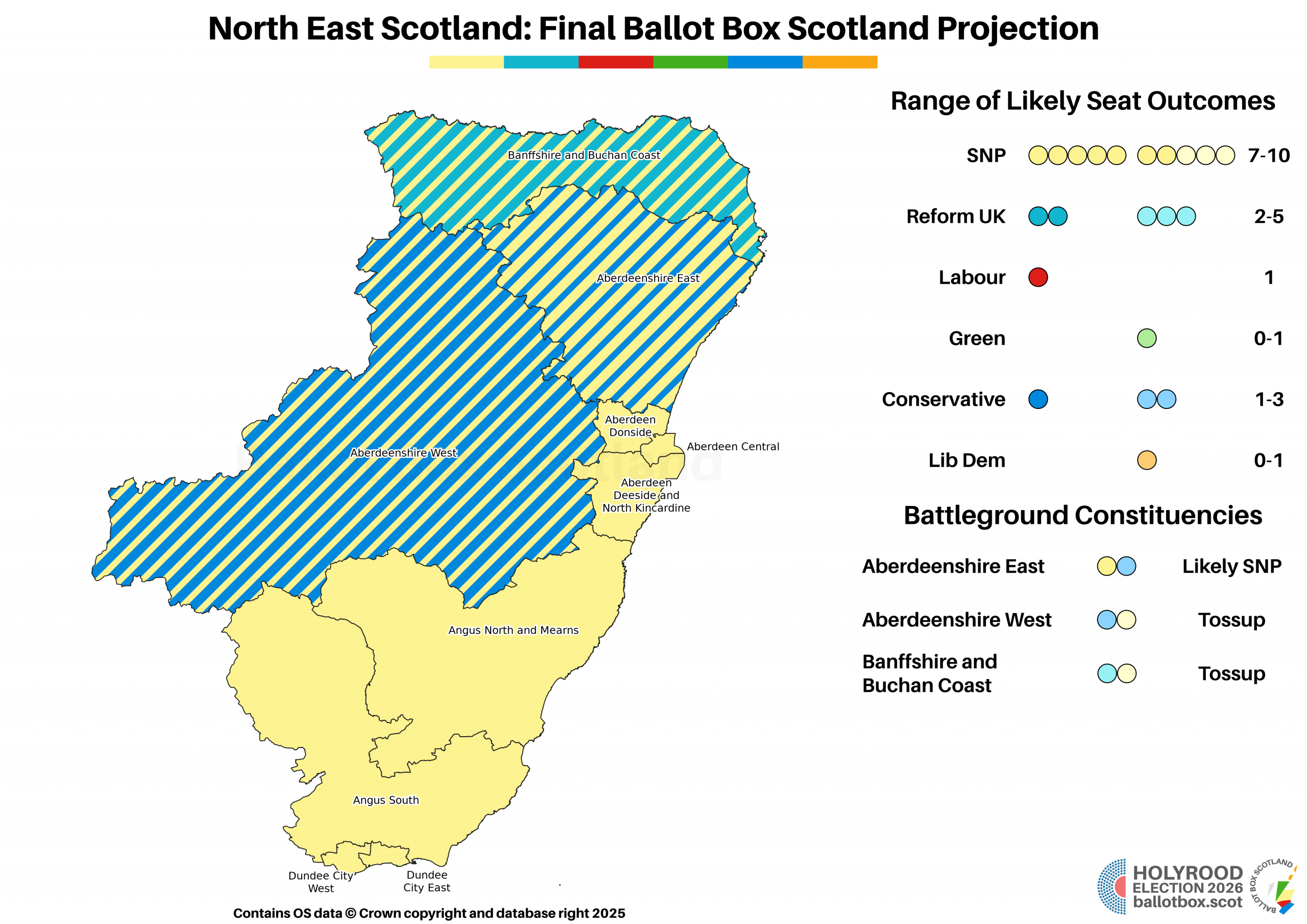
- SNP ~ 7 to 10 MSPs (model: 8)
- Reform UK ~ 2 to 5 MSPs (model: 4)
- Labour ~ 1 MSP (model: 1)
- Greens ~ 0 or 1 MSP (model: 1)
- Conservatives ~ 1 to 3 MSPs (model: 2)
- Lib Dems ~ 0 or 1 MSP (model: 1)
Consistently the most affected by the SNP’s over-representation in my model, the North East is where I’ve estimated Reform have the strongest prospects. That includes the potential to win Banffshire and Buchan Coast on a good day, building on the fact they got nearly 15% there in 2021. That was more than double their vote across Scotland as a whole, and at a time they were polling less than half what they are now. A Reform win would be a big moment, and also loosen some of the proportional pressure on the list.
Other sources have had moments of thinking the core Aberdeenshire seats could swing Reform. I lean towards the idea that the kind of historically Lib Dem rural voter probably isn’t as likely to swing behind Reform as they were the Conservatives, but I could very well be wrong. Both constituencies were very close between the SNP and Conservatives in 2021 however and it could effectively be a game of who loses less between those parties to determine the winner.
The competition for list seats could be especially fierce here, which is why this is the only region I have an existing Green MSP down as under threat. In some scenarios even 8% of the vote hasn’t been enough to deliver a list MSP, which could also negatively impact the Lib Dems’ chances as well. Labour won two here last time but given their vote slip and the proportional pressure, I’m giving them a flat one MSP.
It’s also a weird place for the Conservatives to be in because their vote share in my model should deliver 3 MSPs, but in scenarios where the SNP win every constituency they can end up cut down to just one. That makes it extra important for them to hold the Aberdeenshire West constituency, as that likely opens the door wide enough for at least a second. Reform are likewise tightly constrained with what could be the support for an easy four and at a stretch five possibly limited to two.
South Scotland (17 MSPs)
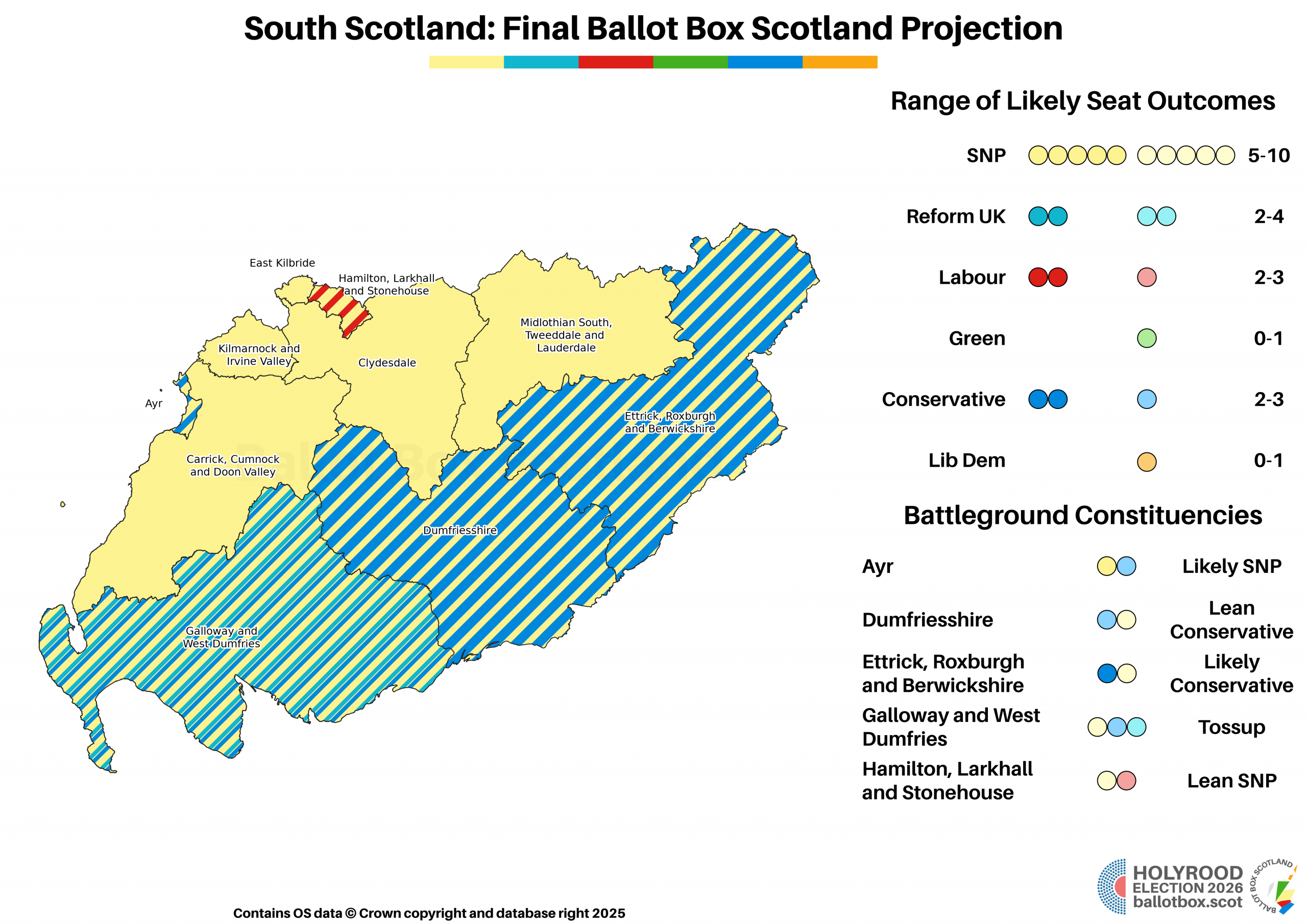
- SNP ~ 5 to 10 MSPs (model: 8)
- Reform UK ~ 2 to 4 MSPs (model: 3)
- Labour ~ 2 or 3 MSPs (model: 2)
- Greens ~ 0 or 1 MSP (model: 1)
- Conservatives ~ 2 or 3 MSPs (model: 2)
- Lib Dems ~ 0 or 1 MSP (model: 1)
Despite retaining the name, this isn’t 2021’s South region. Gone is the (always confusing) presence of the bulk of East Lothian, in comes East Kilbride and Hamilton, Larkhall and Stonehouse. Those Glasgow commuter belt seats have no business being in the same region as the Borders, and yet that’s what our awkward hybrid voting system has delivered. This region has a very wide variance in SNP numbers, because it has a lot of genuinely competitive constituencies.
The three border seats won by the Conservatives in both 2016 and 2021 now all have slightly different circumstances. Ettrick, Roxburgh and Berwickshire should remain in Conservative hands in my opinion: it’s the safest of the lot, and also it’s a historic Lib Dem patch so I’m less convinced about movement to Reform there. Dumfriesshire leans very slightly Conservative is my gut feel; it’s one of just three areas the SNP have never represented in either parliament so it’d be big if they took it. Finally, Galloway and West Dumfries is potentially a three way marginal with Reform in the mix as well now. That’s also very much a gut feel rather than a modelled one, mind you.
The more of those that the SNP fail to win, the better for everyone else in terms of proportionality. They aren’t the only constituency games in town though. Ayr was 2021’s most marginal constituency and could be another one that goes to the SNP or Conservatives not based on particular strength but just who is less badly wounded locally. Hamilton, Larkhall and Stonehouse on the other hand was of course won by Labour at last year’s by-election, but only just. My model thinks it will go back to the SNP, and if it does, that’s a dire sign for Labour.
Even if the Conservatives lost every constituency they should still be strong enough here for two list MSPs, and ditto Reform and Labour. Both the Greens and Lib Dems will be very much on the hunt for a gain here though. In the Greens’ case they only missed out by 115 votes in 2021 and the new boundaries notionally give them the seat, but given the SNP’s likely disruption to proportionality, it’s not quite in the bag. The Lib Dems meanwhile will need a rising national tide to lift them, as they’ve really faded in their historic Borders strongholds in recent years.
West Scotland (17 MSPs)
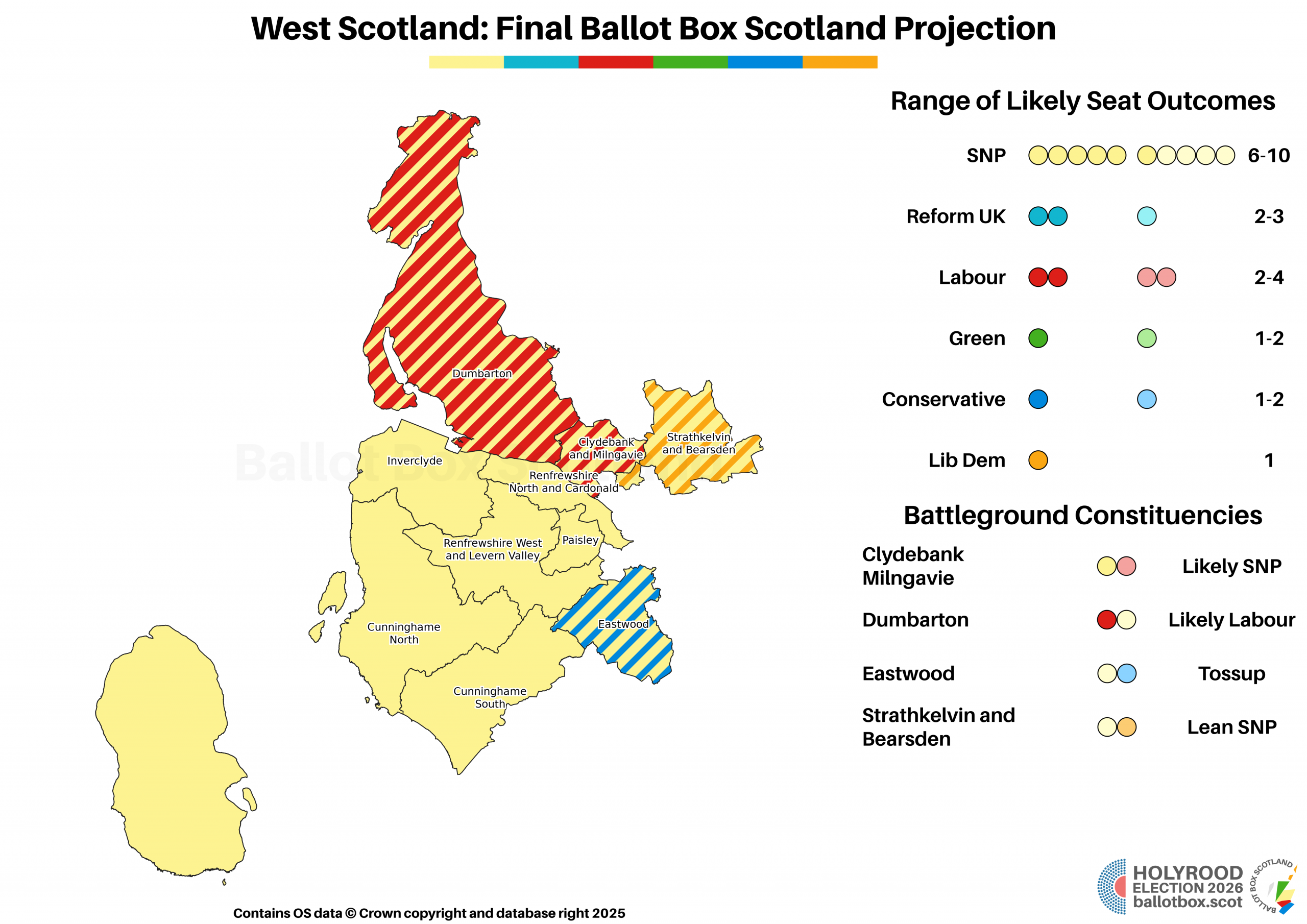
- SNP ~ 6 to 10 MSPs (model: 9)
- Reform UK ~ 2 or 3 MSPs (model: 2)
- Labour ~ 3 or 4 MSPs (model: 3)
- Greens ~ 1 or 2 MSPs (model: 1)
- Conservatives ~ 1 or 2 MSPs (model: 1)
- Lib Dems ~ 1 MSP (model: 1)
West is another one of those regions that based on 2024 you might have expected Labour to sweep the board, but where those dreams have since died. It nonetheless contains the one constituency, Dumbarton, they have held for Holyrood’s entire existence. If Jackie Baillie survived three elections with national swings that should have turfed her out, I find it hard to imagine she won’t hold it again this time… but that would also be exactly the kind of weird result voters love to throw up, so never say never.
Neighbouring Clydebank and Milngavie is their fifth easiest seat to gain in Scotland with a 14% deficit vs the SNP, so they need to win that to Anas Sarwar’s hopes of being First Minister alive. Next door though in Strathkelvin and Bearsden, the Lib Dems are really pushing to win. I think their chances are negatively impacted by the fact it’s actually only “Strathkelvin and Half of Bearsden”, meaning the crossover with their Mid Dunbartonshire Westminster seat isn’t great, but again, not one I’m willing to say no chance to. It doesn’t matter either way as their list topper is the same candidate, and I reckon that they have enough votes for that locked down now.
Finally for the constituencies, Eastwood. This was a direct Labour to Conservative flip in 2016 and remained blue in 2021. Whether it can do so this time does, in some circumstances, make an enormous difference to the Scottish Conservatives. It’s not impossible they only end up proportionally due one MSP in this region, so if they win this seat, that’s it. You know who loses out if that happens? Party leader Russell Findlay. On balance I think he’s more likely than not to be an MSP, but once again, voters love a shock upset.
Elsewhere on the list front, I think Labour only have two (on top of Dumbarton) locked down. A fourth is possible and was won in 2021, but the rise of Reform has really knocked their chances. They could win two or three themselves is my feeling, but I think they’ll be quite clearly third here. Based on polling the Greens would likely have the numbers for two here, were the SNP not squeezing proportionality so hard, which then makes this the least likely of their possible doubles.
One final plea to conclude: I absolutely love running Ballot Box Scotland, but it is a massive time sink. On the eve of poll, I worked my entire lunchbreak and then the entire time from 5pm until just after midnight pulling together as much analysis of polls as I could. The closest thing I got to a break was cycling to and from the studio for Scotland Tonight!
I put my heart and soul into this project and I’m very proud of it, and will never ask anyone to pay a penny to access my output. However, if you find my work useful, for example if you are one of the many MSPs, MPs, councillors or activists who have made use of it, to exult in your successes, to plaster motivational bar charts on leaflets, or to plan your campaigns, please consider chipping in a few quid. If you get elected tomorrow, you’ll certainly be able to afford it!
I am very grateful for all donations received, no matter how big or small, and it’s not an exaggeration to say the extra income from this project has helped change my life. The more reliable my income is though, the more I can do with BBS in the longer term. (About Donations)