Well, here we are after a lacklustre campaign: there’s a new Scottish Parliament, and indeed the newest since the very first. Half of the chamber is brand new to Holyrood, though several of them previously sat at Westminster. Although turnout was down significantly, this was a much more exciting election than 2021 when very few seats changed hands. That was also true in the sense that as last time we’d been in the middle of the pandemic, it had a very strange vibe covering it, whereas this year I was able to get a few folk to help log results. That wasn’t just a huge help but was also made it a lovely social event!
As usual there is a lot of data worth looking at after an election, which I’ll get to over the next few days and weeks. For a start though, let’s take a run through the headline results of the election. You can find all the results on the 2026 Scottish Parliament Election results page here on BBS.
Overall Results
Seats
BBS notional calculations available here. 2021 actual results were 64 SNP, 22 Labour and 8 Green.
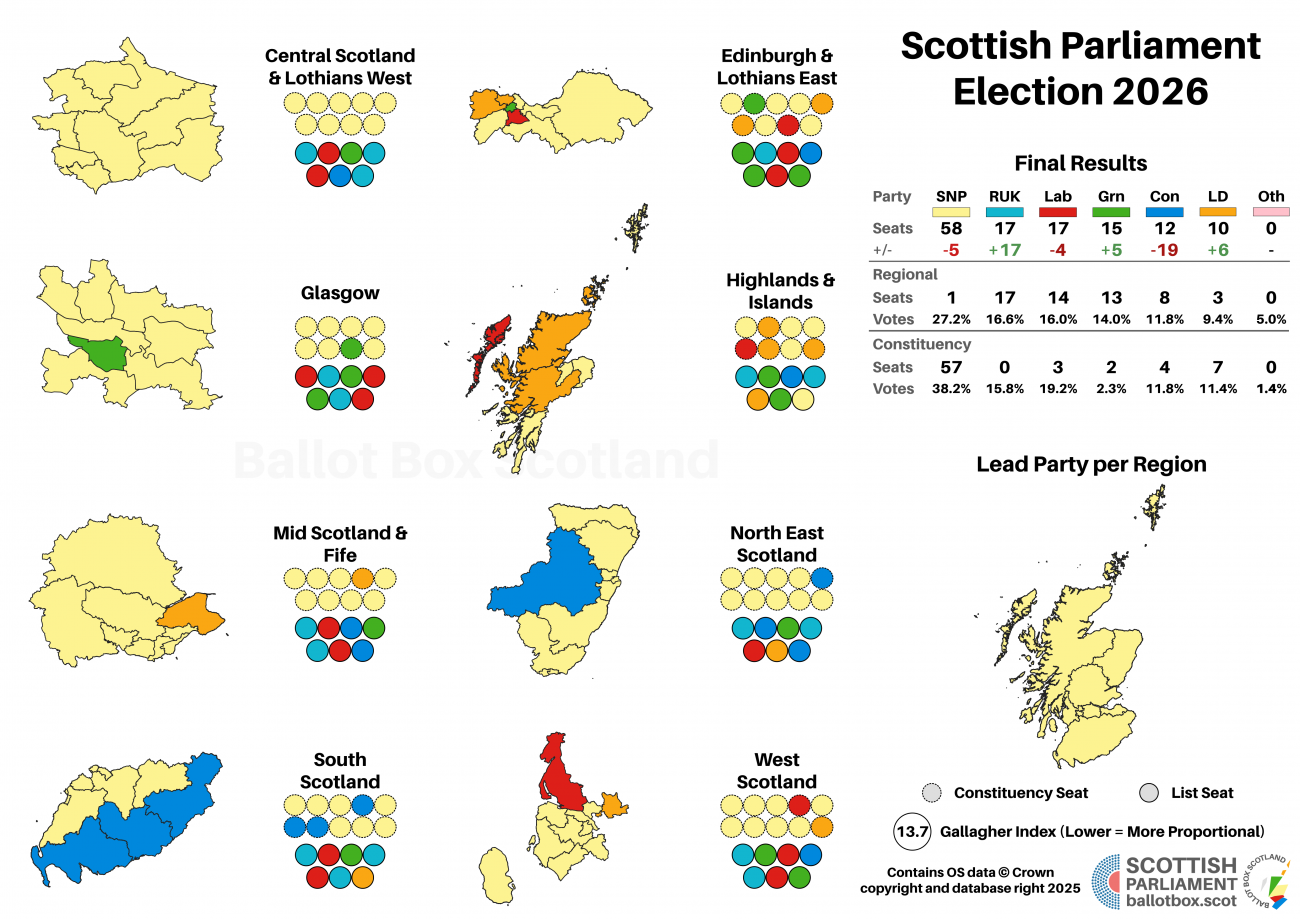
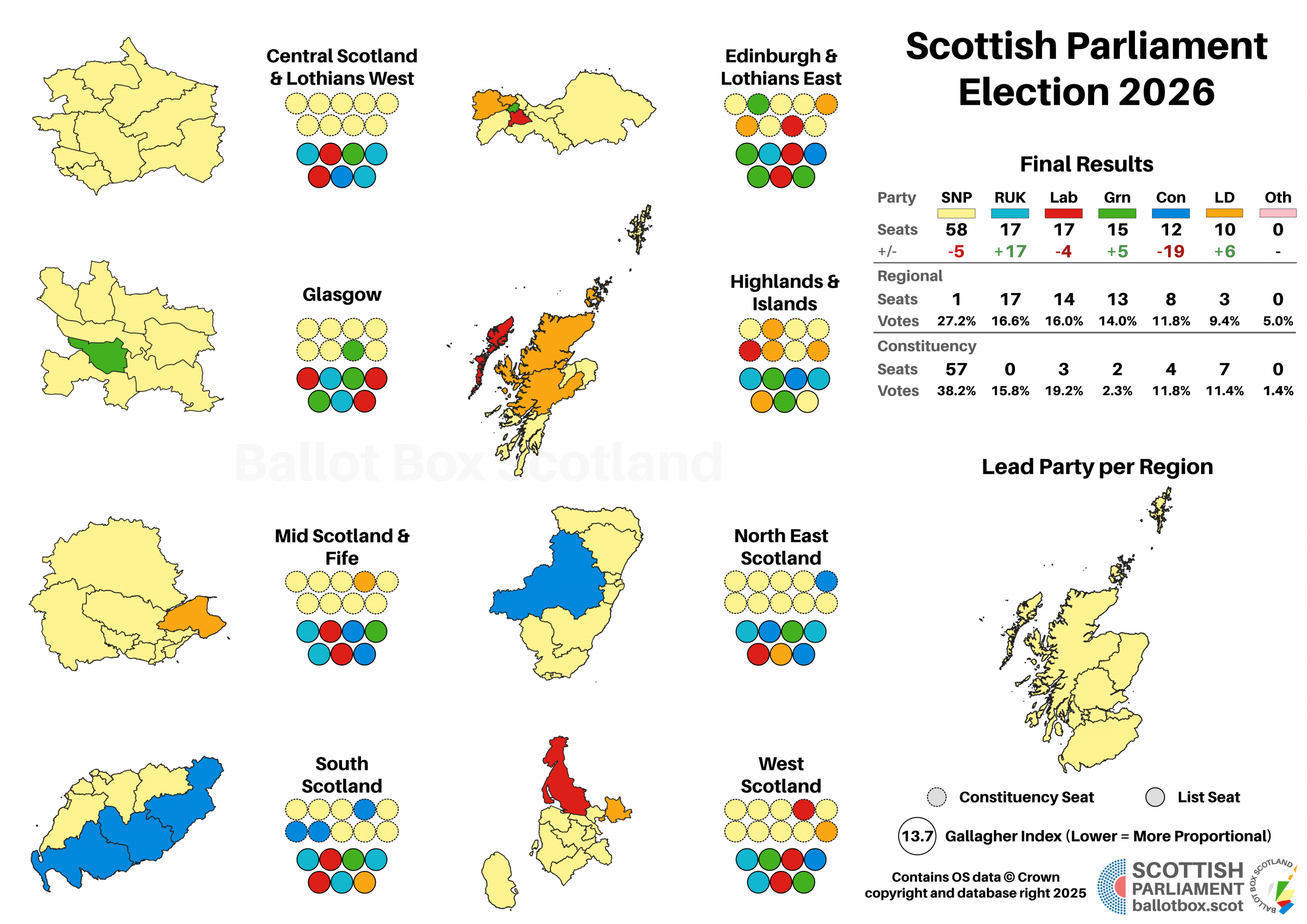
The SNP once again set their sights on a majority, and once again they fell short. It was always a longshot for them to achieve that goal, and likely a mistake for them to make such a big deal of it. They nonetheless held almost all of their seats, their handful of losses doing nothing to loosen John Swinney’s hold on the First Minister post.
In a remarkable joint second place came Reform and Labour. That’s the first time there’s been a tie for second place and it’s had a lot of people chatting about what it means in the Chamber. The answer is “not a lot”. Holyrood does not have an Official Opposition, a concept which ill-fits a proportional parliament. They’ll be given equal speaking time, equal debate slots, and equal Committee convenerships. As to First Minister’s Questions, my guess is they’ll take turns going first.
Still in fourth but much more strongly so were the Greens with a record breaking tally, which was a near doubling in real MSP terms, discounting 2021 notionals. This is hands down their best ever result, and put them ahead of the Conservatives who had an absolutely catastrophic election losing nearly two-thirds of their seats. Last but not least, the Lib Dems also re-entered double digits after 15 years, with some very well fought constituency gains and a smattering of list MPSs.
Regional Vote
Taking the proportional vote first, as the one that does most to shape the overall result, and the changes here are similarly massive. You’d never know the SNP had lost a third of their support on this vote, because their constituency gains masked how dire the day was for them. You have to go all the way back to 2007 to find a Holyrood election where the Government had less of a lead over their opponents on this vote than this year, at just 10.6%.
Reform didn’t have the lead over Labour the final polls suggested they might – more on that later – but they did squeak into second place here. That plus a further decrease in their vote was absolutely damning for Labour, and not a situation anyone could have envisioned two years ago. The Greens had the strongest increase of the two established Holyrood parties with positive stories to tell, though the Lib Dem increase is higher proportionally speaking. Conservative support meanwhile halved, their worst result in vote terms too.
Constituency Vote
The SNP got off relatively lightly on the constituency vote, losing only a fifth of their vote, but that’s because the Greens only contested 6 constituencies. Had they stood more widely, not only would they have ripped a huge chunk out of that share, their presence would certainly have tipped several seats. Contrary to silly conspiracy theorising about skullduggery, the reasons for this are simple: it historically hasn’t been a cost effective use of money for the Greens to stand in loads of constituencies. If you support the deposit system, as Labour and the Conservatives do, I’m afraid you’ll have to dry your eyes. Live by the UK’s democratically outrageous structures, die by the UK’s democratically outrageous structures.
Unlike the regional ballot, it was expected pre-election that Labour would just about pip Reform here, and ended up relatively comfortably ahead. That meant nothing when they were still 19% behind the SNP. The Conservatives then barely beat the Lib Dems, who saw a return to double digits here too for the first time since their Coalition-induced collapse. The Green share is very small due to their limited slate, but it speaks to how strong their performance was where they stood that their share almost doubled despite their contest rate halving.
Polling and Projection Analysis
With any election, we always end up dissecting polling at the end to see how accurate it was. Despite a big polling miss GB-wide in 2024, for example, Scottish polling was broadly accurate. So how did it fare this year?
Polling vs Reality
Final List Vote Average
vs Result
Final Constituency Vote Average
vs Result
On average, really, really good… with a caveat! The Final BBS Poll Average is not the same thing as the Final Poll Average. I long ago took the very rare and extreme measure of discounting Find Out Now entirely from my poll tracker. I also chose to bin the final More in Common ordinary poll, leaving in place a slightly older MRP. The More in Common in particular was an absolute shocker in terms of how much it got wrong (the SNP very much not only 1% ahead of Reform on the list vote), so it could have really distorted this average. In other words, I made a good call in terms of what I included.
On the list vote, Reform ended up somewhat overpriced. I spent the whole campaign saying I thought they were, then the fact they ended the campaign on a strong share rather than having lost some had me backpedalling. I should have stuck to my guns, because at a whole 2% over what they got, this was the biggest miss. Other differences are very minor, the only one worth noting is the Lib Dem figure. Again I said all campaign that polling had their list and constituency figures too close, and this one I stuck too.
With a very small underestimate on the constituency vote for the Lib Dems, that sums up to a 1% wider gap (for 2% in total) between the two votes. That seems about right so, forgive me, this theme will recur, great call on my part. Reform are also the most overestimated party on this vote, but the SNP underestimate is also relatively large. It’s still well within margin of error, but it perhaps suggests pollsters were failing to properly pick up the number of Green constituency voters that would flow to the SNP.
No More MRPs!
Do you know what wasn’t accurate though? MRP polling. You saw them everywhere. You probably saw me fuming about them. “Multilevel Regression and Post-Stratification” polls. These are intended to be much more in depth and cleverer than standard projection from poll methodologies, and were described in a piece by the Telegraph as follows: “MRP are considered the gold standard for predicting elections because they allow pollsters to take survey results and predict results in individual seats.“
This was before an MRP in which the firm that carried it out, JL Partners, hadn’t even done the D’Hondt calculations correctly. They had the SNP on 57 constituencies, precisely the same in number (but not spread) as they actually won, but a majority via 10 further list MSPs, which was impossible. Funny. I’d ask for my money back, were I the Telegraph, because those charlatans robbed you blind.
A fundamental problem with the way pollsters present their MRPs is they are trying to have it both ways. Before the election, it’s all very “look at our extremely impressive and scientific method for getting highly accurate constituency-by-constituency results!” After the election, it’s teeth-sucking “well, there’s margins here, and overall accuracy was pretty good!” Right but that wasn’t what you were selling: you were selling statistical wizardry that purports to be better at this than doing “if party support go up in poll, it go up nationwide in some form 😊”, a la Ballot Box Scotland.
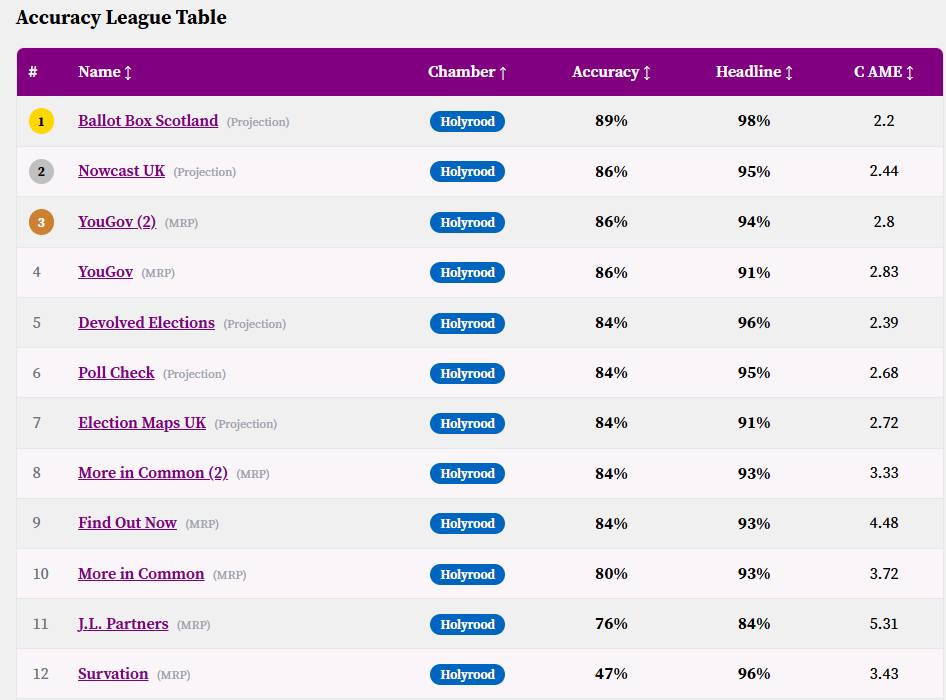
And it wasn’t. I did better than you! According to Devolved Election Projections, a project by someone with much more statistical know-how than me, Ballot Box Scotland’s final projection was the most accurate out of every attempt. I run my projections through an Excel spreadsheet! I have an Engineering degree I haven’t meaningfully used for a decade, I’m not an actual statistician! And I did it better than you.
Because at the end of the day, just applying simple formulae based on poll data and known past patterns of support turns out to be a perfectly adequate “close enough is good enough” approach. That’s especially true given I don’t have a paying client who is going to take any caution about margins of error and imperfections in process and throw it in the bin so they can print “SHOCK POLL HAS PARTY WE HATE LOSING THIS SEAT”.
By contrast, you go to so much more expense and effort only to end up with complete and obvious bollocks like “Reform will win Strathkelvin and Bearsden” (they got 10.4%), “Lib Dems will get 18% and 3 North East MSPs” (they got 8.4% and 1), or “Labour will gain Glasgow Anniesland by fewer votes than the Greens get” (the Greens were confirmed not contesting Anniesland.)
Not all MRPs were totally awful. YouGov’s was pretty good! What’s really an issue here is everyone and their mum setting themselves up as doing MRPs, and often lacking basic understanding of Scottish politics. In the worst case I heard of, one firm known for MRPs openly admitted they just treated Scotland broadly like it was England. Gobsmacking stuff. In future elections, MRPs should be a rarity, not something that was coming out as, if not more, frequently as normal polling.
Party Analysis
SNP
I’ve said a few times and in a few places over the past week that I think the SNP’s majority-centric campaign was a big mistake in the long run. Having experienced an absolutely crushing set of losses in 2024, they should have let Labour collapse around them and taken their return to government as an unexpected blessing, with 58 seats an objectively good result. Instead, by making it about whether or not they’d win a majority, they have set themselves up for a subjective “well, you didn’t get that majority, did you?” analysis.
This goes to a tension at the heart of the SNP after so long in government. Is it a party of government, or is it a party of radical constitutional change? The two are increasingly hard to marry with one another, and by trying to shore up their core vote by suggesting only an SNP majority can secure another referendum, they are at risk of putting party before principle. It’s hard to win a single party majority, and it might never happen again. Do the SNP really want to have shut the door on another referendum forever just so they could minimise losses at a Holyrood election?
If there’s one thing this election has shown, it’s that much like Labour at UK level, the SNP cannot assume they won’t be credibly challenged from their left. The two regions where the regional vote was closest between the top two are not against Reform, Labour or the Conservatives: it’s against the Greens. Flush with their success this time, the SNP can’t simply assume the Greens will sit out seats like Glasgow Central again next time. There are also seats very vulnerable to further Lib Dem growth, and to even marginal recovery by the Conservatives and Labour. In short, the SNP can’t expect to be so lucky come 2031.
Reform UK
I’m treating Reform as second because they got the second most list votes despite their tie with Labour. Much like the SNP, there’s a real “objective vs subjective” split in how to look at Reform’s performance. Objectively, it was very, very good. They came second in seats and proportional votes, despite never having elected MSPs previously. They displaced the Conservatives as the leading party of the avowed right in Scotland. And yet, they didn’t want to share second place. They wanted to completely overtake Labour.
They are also the weakest the largest opposition party has ever been in both vote and seat terms, and the first not to hold any constituencies: something that really matters to how seriously the media in particular take you, as the Greens can attest. Even worse, as I’ve said a million times by now, Farage Party parliamentary groups never last. There will almost certainly not be as many Reform MSPs by Christmas as there are today. As soon as the first whip resignation or expulsion happens, Labour become the largest opposition.
Still, that’s down the line. For now, there are lots of things Reform can take from the results. Beating Labour not just nationwide but in one of the core Central Belt regions, however narrowly, is a genuine coup. You know that I had to amend my final prediction to acknowledge Labour weren’t sure of 3 Central Scotland and Lothian West MSPs? I’m glad I did so, because that’d have blotted my otherwise good record! In addition, they are now well positioned to gain a substantial contingent of councillors next year.
Labour
What a disaster for Labour. Two years ago Anas Sarwar thought he had First Minister in the bag. Now he shares a unique bond with Jack McConnell: the only Scottish Labour leaders to lead the party into two successive losses of seats at Holyrood. And here I will have my one true break with non-partisanship to say: good. As a member of Scotland’s LGBT community, a gay man with a trans best friend, I am relieved a man who (along with his party) so completely and utterly betrayed us will not lead this country.
Anas Sarwar threw queer people under the bus and published an actively trans-segregationist manifesto, which drove several of Scottish Labour’s most dedicated partisans to advise not voting for the party. He did all of this to build bridges with a bunch of terminally online bigots who have no real presence amongst the electorate at large. And for what? To crash and burn regardless, having utterly alienated a huge number of progressive voters.
If you blanche at me saying things like this, maybe consider being more appalled by the hate campaign that Labour have completely capitulated to. Returning to standard election analysis, Labour also completely flubbed the campaign. They were still briefing until late on that their “promise rate” from canvassing in constituencies was so good it was going to carry them to victory. Meanwhile, John Swinney is hammering “Both Votes SNP” and every other party leader can barely say a sentence without including “and that’s why you must vote for MY PARTY on the PEACH BALLOT”, recognising the importance of the proportional vote.
Keir Starmer may be the root cause of Scottish Labour’s return to oblivion, but he is not solely responsible. He didn’t choose an over-extended constituency campaign that didn’t feel the need to shore up their proportional vote. Anas Sarwar and his team did. At the time of writing, he has not resigned as leader. It’s absolutely unthinkable that having overseen such a calamity that he doesn’t, but who else is there? The only credible challenger to his left, Monica Lennon, has lost her seat. The alternatives are at best a change of personnel, not course. It’s going to be a long five years.
Green
If Labour’s results were a disaster, the Greens’ were a triumph. With their largest ever group, first ever whole-nation spread, replacing the Conservatives, and within touching distance of second place, the Greens had an absolutely phenomenal election. Most notably, as figures earlier on showed, the finally broke their trend of underperforming against their polling. The final BBS poll average said precisely 14%, and precisely 14% they got.
Back on the accuracy front, I also think that whilst it wasn’t perfect, I’ve been vindicated in my approach of ignoring Green constituency poll figures and instead extrapolating from the list based on rough 2021 patterns where they stood. It correctly identified Edinburgh Central as a likely Green win, and even at the very end tilted Southside to them. Other sources (and this isn’t a dig, it’s a methodological musing) previously had Greens winning Central but stopped when constituency polling dropped to account for their limited spread, whereas I had already inoculated myself against that effect, and therefore didn’t have the problem of trying to project from 1-2% shares.
The impacts of this will extend beyond Holyrood itself, and not just because of the potentially much increased influence they have on what the parliament does. The Greens effectively tithe their MSPs for part of their income to help support the party, so double the MSPs, double the income from them. They also did so well, placing first on the list vote in several seats and second in many more, including some outside Glasgow and Edinburgh, that they can expect a much increased crop of councillors next year too.
The only damper on their day was once again being denied a seat by the fake party with literally no campaign led by a guy expelled from UKIP for holocaust denial, “Independent Green Voice”. The Greens were 0.3% short of beating the Conservatives in Mid Scotland and Fife, but IGV won 0.87%. Something has got to be done about this before 2031. Whatever you think of the Greens, it cannot be the case in a fair and democratic society that one party, and only one, is the victim of a deliberately and malicious spoiler campaign that has so far prevented three women (two in 2021, and Mags Hall this year) from becoming MSPs.
Conservative
There was one silver lining for Anas Sarwar yesterday: at least he wasn’t Russell Findlay. The Scottish Conservatives, after two terms as the largest opposition party, have crashed down to fifth place. They had never before been below third. Everything about this result is the worst in Holyrood history for the party, right down to losing representation in Glasgow entirely, something I had seen coming from a mile away. Indeed, but for want of 733 votes in Eastwood, Jackson Carlaw would still be MSP and Findlay would not.
Their vote shares are now a little bit below what Ruth Davidson inherited in 2011. I think that’s worth reflecting on. Davidson revived the party with a two pronged approach of trenchant opposition to a second Independence Referendum and through a softening of the party’s image on social issues, moving it onto the same more liberal ground (particularly around LGBT people) that David Cameron did around the same time. The former didn’t feel important in this election and the latter has been completely abandoned in favour of playing to a reactionary gallery.
In that sense some might suggest it was absolutely galling that Davidson herself came to campaign for someone who had so utterly repudiated her legacy. There’s party loyalty and then there’s letting the leopard eat your face. Besides, it was to no avail, as their support collapsed so hard that they managed to achieve such dramatic flops as going from four Highland MSPs to one. Given that of their dozen MSPs only one pre-dates the Davidson Surge and none of them are new, they may find it extremely difficult adjusting to a parliament in which they have one third the time, resources and attention as they are used to.
Lib Dem
The Lib Dems may still be stuck as the smallest party at Holyrood, but they’ve got plenty of cause for celebration. After three elections in which they went absolutely nowhere, they are back with a substantial group and a parliament in which there may be much more opportunity for them to use the power that brings. As is Lib Dem tradition their success was built on some stunning constituency wins, most incredibly in my book Strathkelvin and Bearsden, even if they must have entered into a Faustian pact that involved losing Shetland in return. They now have the second most any constituencies of any party.
Unlike their 2016 and 2021 retreat to strongholds, they were able to accompany this with enough growth in their regional vote to pick up some list MSPs too. Both Central Scotland and Lothians West and the Glasgow region continued to elude them, sure, but that was always going to be the case in my view. Importantly, they have also been well set up for further gains in future, for example via the Mid Scotland and Fife regional list if the SNP’s proportionality-warping stranglehold on the non-Fife North East constituencies can be broken.
One small thing to watch out for with the Lib Dems though is the likelihood that they are the first party to lose an MSP. If so, it won’t be for a negative reason, but instead because Orkney MSP Liam McArthur is seen as the obvious choice for the next Presiding Officer. He served as a deputy in the previous term, and is very well liked across party lines at Holyrood. With what is the most messy and fractious parliament elected in a very long time, he may be exactly the kind of person needed to take up that role.
Much more to come!
It is of course early days yet for analysis of this election, and I’ve got so much to do in terms of looking at swings and so on. In meantime, remember you can check out the overall results on the interactive maps on the dedicated page here; note that there is still, at time of writing, a bit of missing info for 9 constituencies due to what I consider to be a really unacceptable failure to “put a PDF on the internet” at the end of a count. I also recorded a little video run through of the results earlier:
I would like to once again thank everyone who has been so supportive of Ballot Box Scotland; despite the move from Twitter to Bluesky, there was a lot of engagement with my reporting throughout the day! Me and my team had a great time pulling all the results together, and I hope it was useful and enjoyable for everyone else. If you can afford to, please do consider popping a wee donation my way through the links below.
If you find this or other Ballot Box Scotland output useful and/or interesting, and you can afford to do so, please consider donating to support my work. I love doing this, but it’s a one-man project and takes a lot of time and effort. All donations, no matter how small, are greatly appreciated and extremely helpful. (About Donations)