Contents
Make sure to check out Ballot Box Scotland’s Holyrood Hub page for polling, analysis and updates ahead of the 2026 Scottish Parliament election.
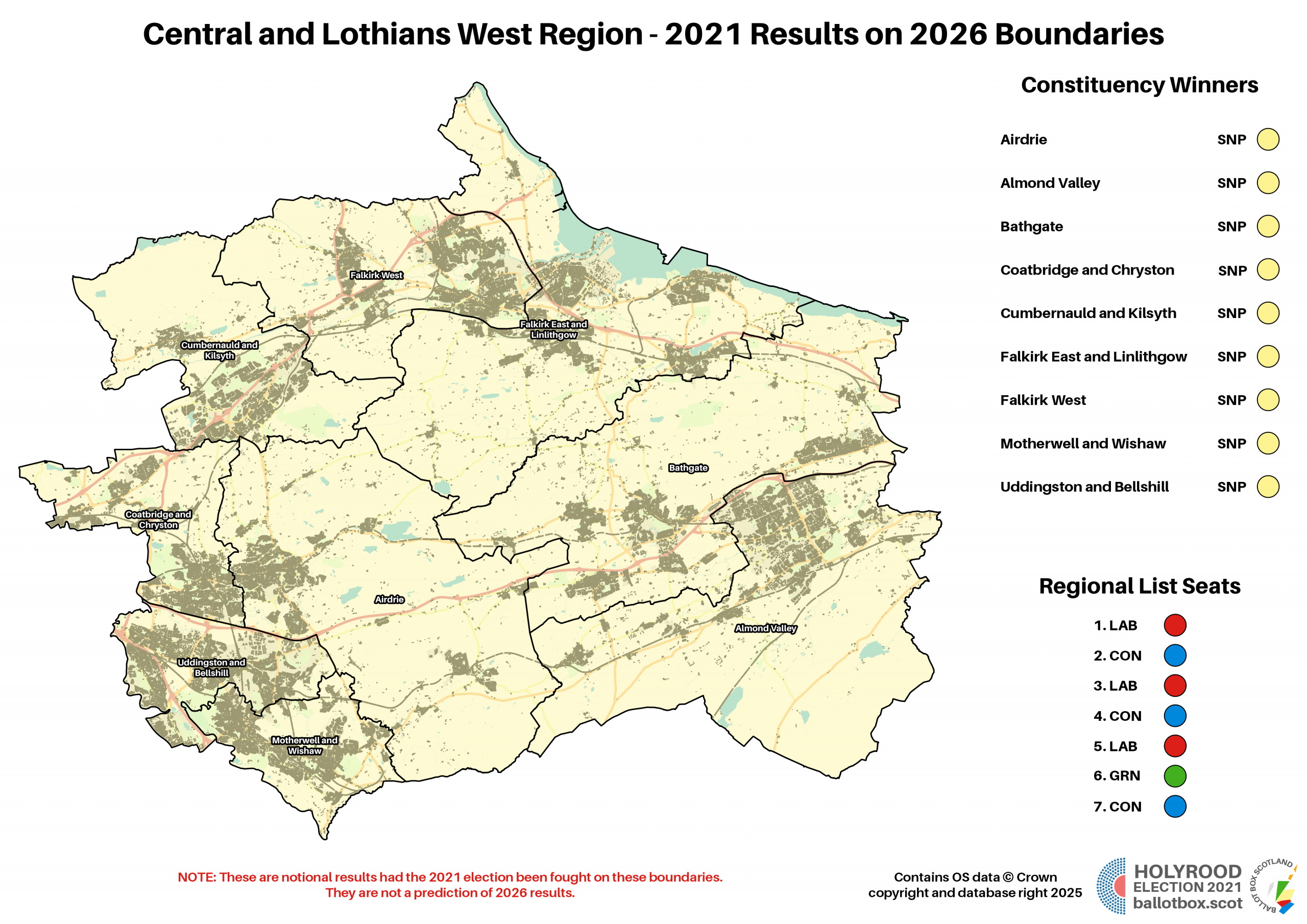
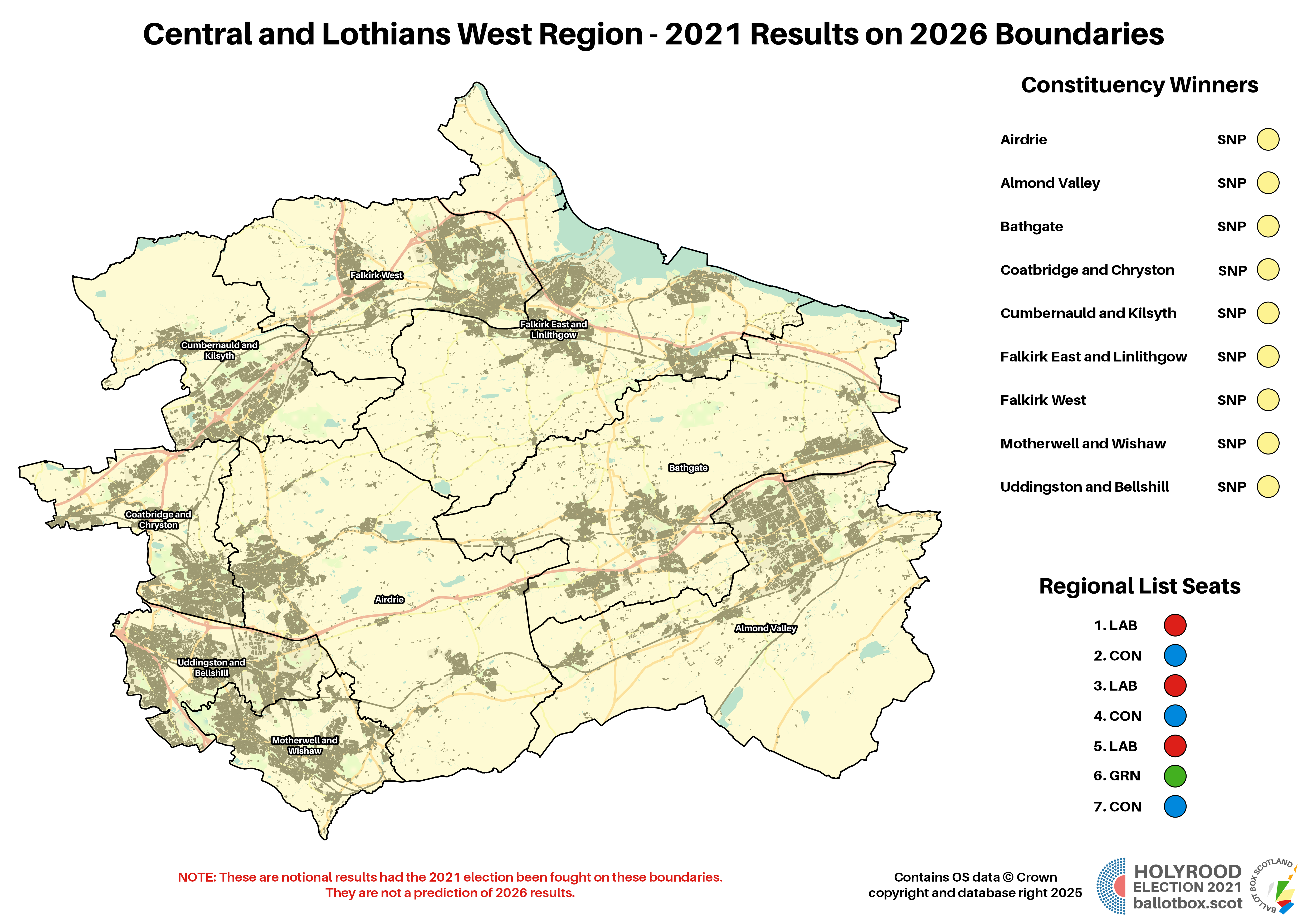
Region Map
Region Description
This is one of the most significantly redrawn regions under the new boundaries, hence the addition of “Lothian West” to the name. To compensate for gaining West Lothian, it loses the East Kilbride and Hamilton, Larkhall and Stonehouse constituencies. That makes this the most truly Central Belt region, encompassing almost the entire highly urbanised stretch between Scotland’s two largest cities. Even so, there’s enough rurality that you can almost think of this as three urban clusters.
Firstly, we have the central Lanarkshire component, covering formerly mighty industrial towns like Motherwell, Airdrie and Coatbridge. There’s then a spur that goes through the New Town of Cumbernauld and then historic southern Stirlingshire, the bulk of which is now Falkirk, itself weel-kent for the refinery at Grangemouth. Last but by no means least there’s West Lothian, with its own New Town at Livingston now the central hub for an area once dominated by mining. Defining it instead by council areas, it covers all of Falkirk, North Lanarkshire and West Lothian, plus a small portion of South Lanarkshire by Bothwell and Uddingston.
What to Watch For in 2026
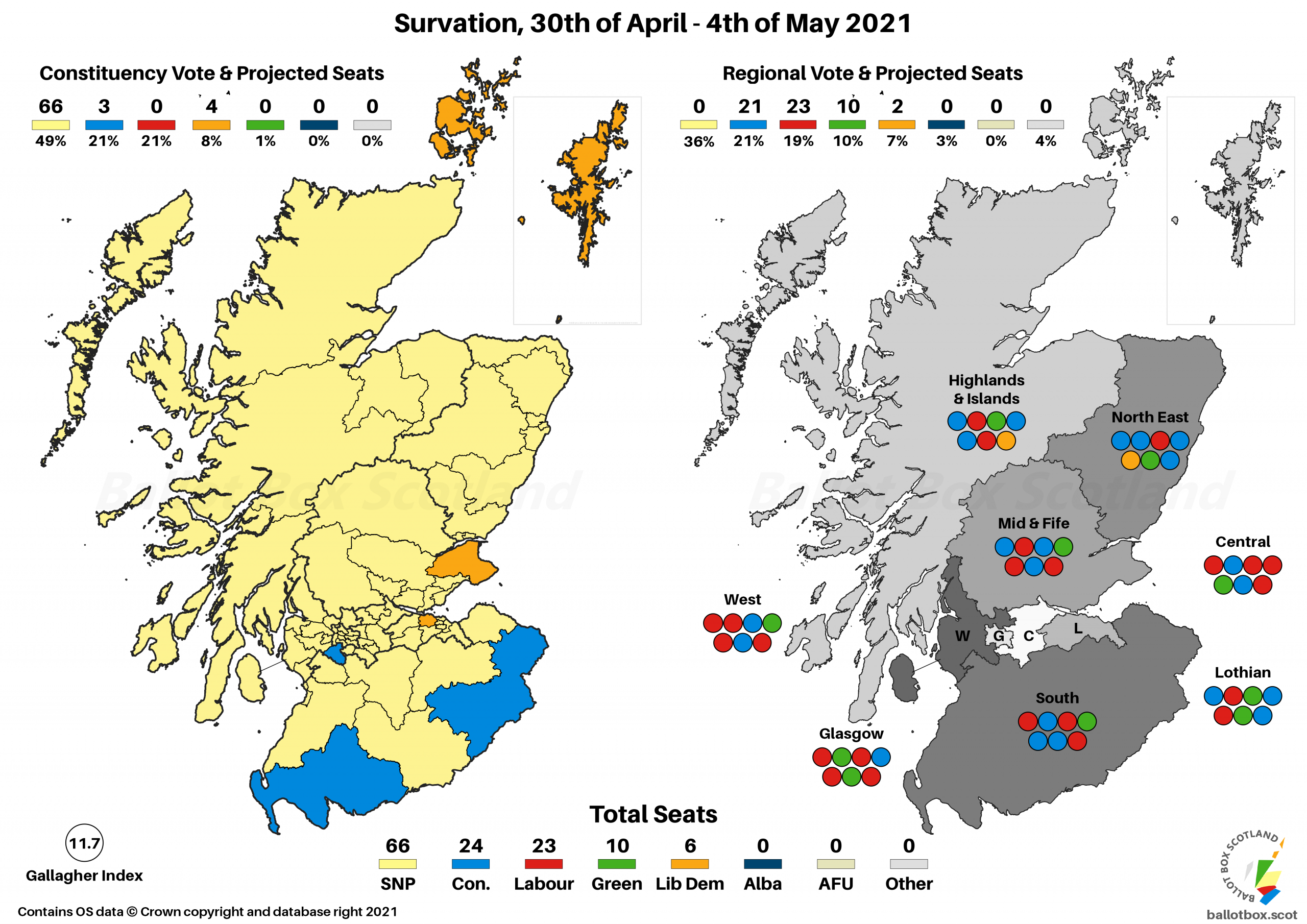
A highly urbanised, strongly working class demographic has led to this region largely being contested between Labour and the SNP. At the 2024 Westminster election, Labour swept every seat in this part of the country. To replicate that at Holyrood however, Labour need to overcome some huge majorities. None of the constituencies here are marginal (below 10% majority), and in fact only three of the nine are below 20%. With their vote share slumping back to where it was in 2021, even with the SNP crashing that would look like a challenge.
That’s especially true given this is also the kind of ground that has proven fertile for Reform UK. They’ve been ripping chunks out of the Labour vote in recent polls, having already gorged themselves on Conservative support to such an extent that the latter risk being reduced to a single MSP here. If Labour can’t win at least a couple of these constituencies, the list apportionment will end up substantially skewed by SNP overrepresentation. Equally, were Labour’s revival to pick back up, a clean sweep on their part would be just as proportionally damaging.
Given the Greens only won the final seat in the previous Central region by 107 votes in 2021, they could be a little worried at such clean sweep scenarios. The reformulation of this region to one inclusive of West Lothian counts in their favour though, notionally boosting their margin of victory to around 2000 votes and giving them the sixth rather than final seat in 2021 terms. The addition of Linlithgow specifically also helps the Lib Dems, though this remains a region it’s extremely hard to see them picking up a seat within.
Notional 2021 Constituency Vote
Notional 2021 Regional Vote
Notional 2021 Seat Winners
Constituency
Airdrie: SNP
Almond Valley: SNP
Bathgate: SNP
Coatbridge and Chryston: SNP
Cumbernauld and Kilsyth: SNP
Falkirk East and Linlithgow: SNP
Falkirk West: SNP
Motherwell and Wishaw: SNP
Uddingston and Bellshill: SNP
Regional List
1: Labour
2: Conservative
3: Labour
4: Conservative
5: Labour
6: Green
7: Conservative
Central Scotland and Lothians West: 2021 Notional Results (Regional Vote)
Central Scotland and Lothians West: 2021 Notional Results (Constituency Vote)
1999 to 2011 Boundaries
Elections in 1999, 2003 and 2007 for Central Scotland were fought on boundaries that covered the whole of Falkirk, North Lanarkshire, most of South Lanarkshire (excluding the Glasgow Rutherglen and Clydesdale constituencies), the Kilmarnock and Loudoun area of East Ayrshire, and a small portion of East Dunbartonshire around the south of Lenzie.
Labour’s decision to block popular Falkirk West MP Dennis Canavan from standing for selection was the only thing that prevented them from winning all 10 constituencies in 1999, as he then stood extremely successfully as an Independent.
Constituency results were unchanged in 2003, but the SNP’s loss of support nationwide opened up space for the so-called “Rainbow Parliament”, with Central’s contribution being one MSP apiece for the Scottish Socialist Party and, uniquely, the Scottish Senior Citizen’s Unity Party.
2007 saw the SNP’s first constituency gains, winning the Falkirk West seat after Canavan retired, as well as Kilmarnock and Loudoun. They also effectively regained the list seats that had been won by the Rainbow parties in 2003.
2011 to 2026 Boundaries
Elections in 2011, 2016 and 2021 for Central Scotland were fought on boundaries that covered the whole of North Lanarkshire, Falkirk and most of South Lanarkshire (excluding the Rutherglen and Clydesdale constituencies), including the addition of Larkhall from the prior Clydesdale constituency and South region.
In their shock 2011 landslide, the SNP won a total of 6 constituencies, leaving Labour with just 3: Coatbridge and Chryston, Motherwell and Wishaw, and Uddingston and Bellshill. Both also won 3 list seats, with a sole Conservative the only representation outside the two dominant parties.
In 2016 the SNP swept the constituency board, whilst the Conservative revival saw a trio of blue MSPs elected. That left Labour with just four seats.
In 2021 Labour would be further relieved of one of their seats when the Greens won their first ever MSP in the region by just 107 votes.
The full list of candidates will not be known until nominations close shortly before the election. I will aim to add data about the major parties as and when it becomes available until then. Candidates in both this section and individual constituencies are marked if they are an incumbent MSP:
- (*C): Incumbent for that constituency, or equivalent if significantly impacted by boundary changes
- (*OC): Incumbent for another constituency
- (*L): Incumbent on the list
2026 Total Candidate Numbers
Central Scotland and Lothians West: 2026 Regional List Candidates
The six parties expected to win seats in the Scottish Parliament in 2026 are listed in order of national support in 2021. Remaining parties are in alphabetical order, and Independents listed last.
Candidates that are contesting both the List and Constituency ballot have their constituency noted after their name on the list.
- Pauline Stafford (Bathgate)
- Neil Gray (*C, Airdrie)
- Toni Giugliano
- Clare Adamson (*C, Motherwell and Wishaw)
- Callum Cox
- Steven Bonnar (Uddingston and Bellshill)
- Stacey Devine
Note: The original 7th placed candidate, Tracey Carragher, was withdrawn shortly before the close of nominations in relation to allegations about her conduct.
- Meghan Gallagher (*L, Uddingston and Bellshill)
- Lewis Stein (Falkirk East and Linlithgow)
- Neil Benny (Falkirk West)
- Keith Allan (Cumbernauld and Kilsyth)
- Andy Bruce (Coatbridge and Chryston)
- Peter Heggie (Bathgate)
- Damian Doran-Timson (Almond Valley)
- Bob Burgess (Motherwell and Wishaw)
- Euan Blockley (Airdrie)
- Mark Griffin (*L, Uddingston and Bellshill)
- Jenny Young (Bathgate)
- Kieron Higgins (Coatbridge and Chryston)
- Siobhan Paterson (Falkirk East and Linlithgow)
- James McPhilemy (Cumbernauld and Kilsyth)
- Suzanne Macleod (Airdrie)
- Ayeshah Khan (Motherwell and Wishaw)
- Jordan Stokoe (Almond Valley)
- Gillian Mackay (*L)
- Claire Williams
- Cameron Glasgow
- Anne McCrossan
- Paul McGarry (Falkirk East and Linlithgow)
- Lucy Smith (Falkirk West)
- Caron Lindsay (Almond Valley)
- Stephen Harte (Bathgate)
- Brian Howieson (Cumbernauld and Kilsyth)
- Daniel Mancini (Coatbridge and Chryston)
- Jenni Lang (Motherwell and Wishaw)
- Graham Simpson (Airdrie)
- Mandy Lindsay (Coatbridge and Chruston)
- Amanda Bland (Falkirk East and Linlithgow)
- Richard Fairley (Falkirk West)
- David McLennan (Bathgate)
- Duncan Macmillan (Motherwell and Wishaw)
- Steve Grant (Cumbernauld and Kilsyth)
- Malcolm Jones (Almond Valley)
- George Hobbins (Uddingston and Bellshill)
- John Jo Leckie (Airdrie)
- Mark Tunnicliff
- Greig McArthur (Motherwell and Wishaw)
- Alan McManus (Cumbernauld and Kilsyth)
- David Baird
- Graham Fraser
- Steve Arnott
- David Richardson
- Leo Lanahan
- Norma McLachlan Diffin
- Ailish Ann Lanahan
- Julie McAnulty
- James Stewart
Note: Independent Green Voice are a front group for a bunch of Glasgow bampots, led by someone who was expelled from UKIP for alleged Holocaust denial. They are standing purely as a spoiler party in this election, targeting the legitimate Scottish Green Party, and their simple one candidate per region slate is further evidence of this dodgy dealing.
- Lukasz Furmaniak
- Collette Bradley
- Lewis Clark
- Conor Gibley
- Neil Wilson
- Stephen Paul Hollis
- Margaret Garbutt
- Abdul Dean
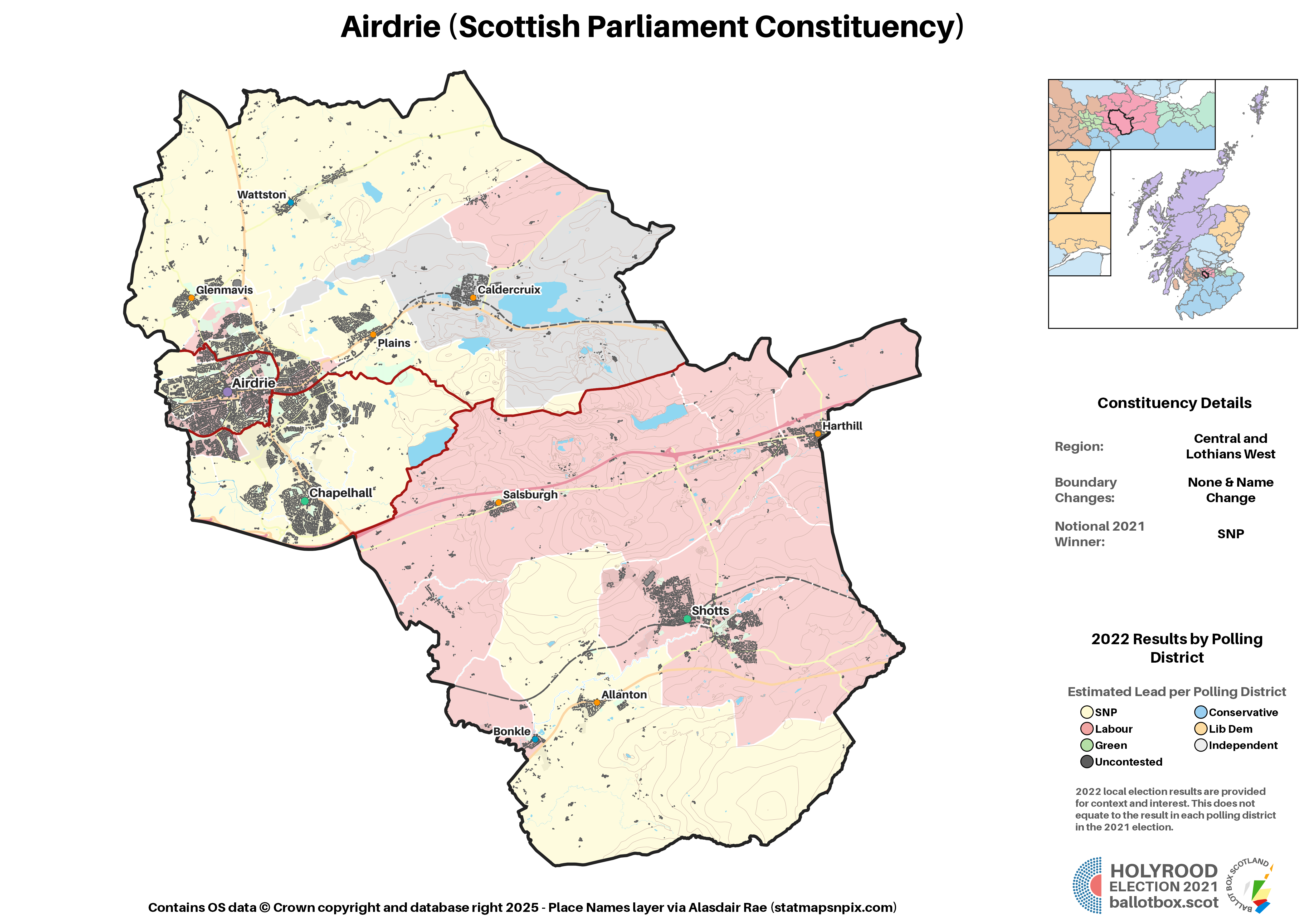
Constituency Map
Key Information
Notional 2021 Winner: SNP
Majority: 5468 (17.1%)
Boundary Changes: None, but loses the “and Shotts” part of the name
2026 Candidates
SNP: Neil Gray (*C), L2
Conservative: Euan Blockley, L9
Labour: Suzanne Macleod, L6
Lib Dem: Ed Thornley
Reform UK: Graham Simpson (*L), L1
Independent: Brendan O’Donnell
Abolish the Scottish Parliament/British Unionist Party: John Jo Leckie, L1
Constituency Description
Sitting entirely within the North Lanarkshire Council area, the primary component of Airdrie is obviously the town of that name. Several smaller settlements lie within Airdrie’s orbit, including Chapelhall, Plains, Caldercruix, Glenmavis and Wattston. The secondary centre of population is Shotts, which sits at the centre of a more rural stretch which also contains Salsburgh, Harthill, Allanton and Bonkle.Â
Previously known as “Airdrie and Shotts”, the only reason the second half of the name was dropped was to differentiate it from the identically titled Westminster constituency. The SNP have held this seat since 2011, when they gained it from Labour. If Labour do manage to start picking constituencies back up, this will be one of the first in the region to go their way.
2021 Constituency Vote
2021 Regional Vote
Constituency Map
Key Information
Notional 2021 Winner: SNP
Majority: 12021 (29.4%)
Boundary Changes: Loses Seafield to the new Bathgate
2026 Candidates
SNP: Angela Constance (*C)
Conservative: Damian Doran-Timson, L7
Labour: Jordan Stokoe, L8
Lib Dem: Caron Lindsay, L3
Reform UK: Malcolm Jones, L8
Constituency Description
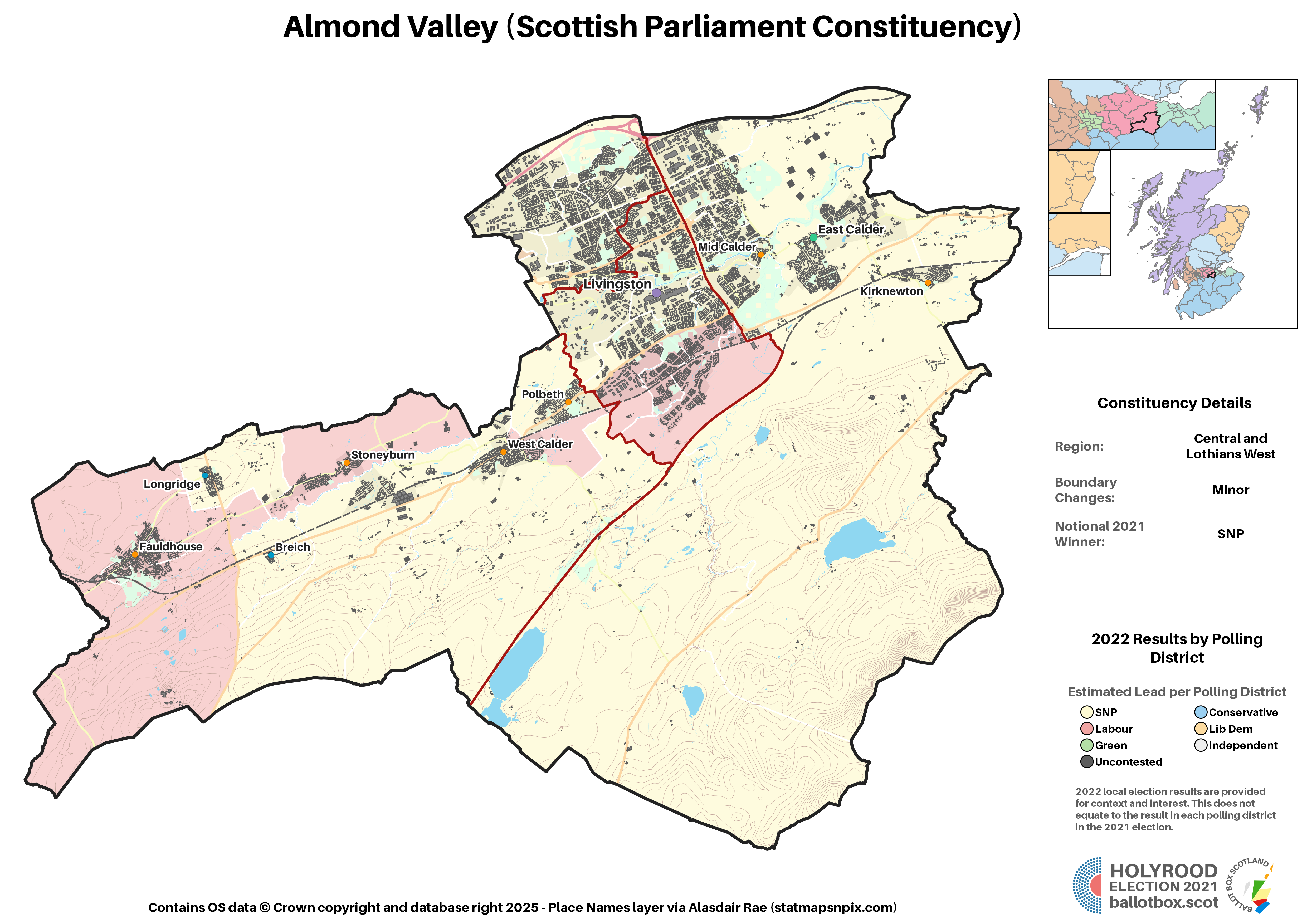
Sitting entirely within the West Lothian Council area, the bulk of Almond Valley comes from Livingston. Despite the name, the watercourse that defines much of the rest of the constituency is the Breich Water which flows by Fauldhouse, Longridge, Breich, Bents, Stoneyburn, Addiewell and West Calder, before joining the River Almond north of Polbeth. Further downstream on the Almond lie Mid Calder, East Calder and Calderwood, whilst Kirknewton sits a little removed from everything else.
The village of Seafield is the only loss in the boundary changes this time around. The SNP have held this seat the entire time it has been known as Almond Valley, having gained it in its previous Livingston form from Labour in 2007. With a nearly 30% majority, this would be one of the last seats to fall to any Labour resurgence.
Notional 2021 Constituency Vote
Notional 2021 Regional Vote
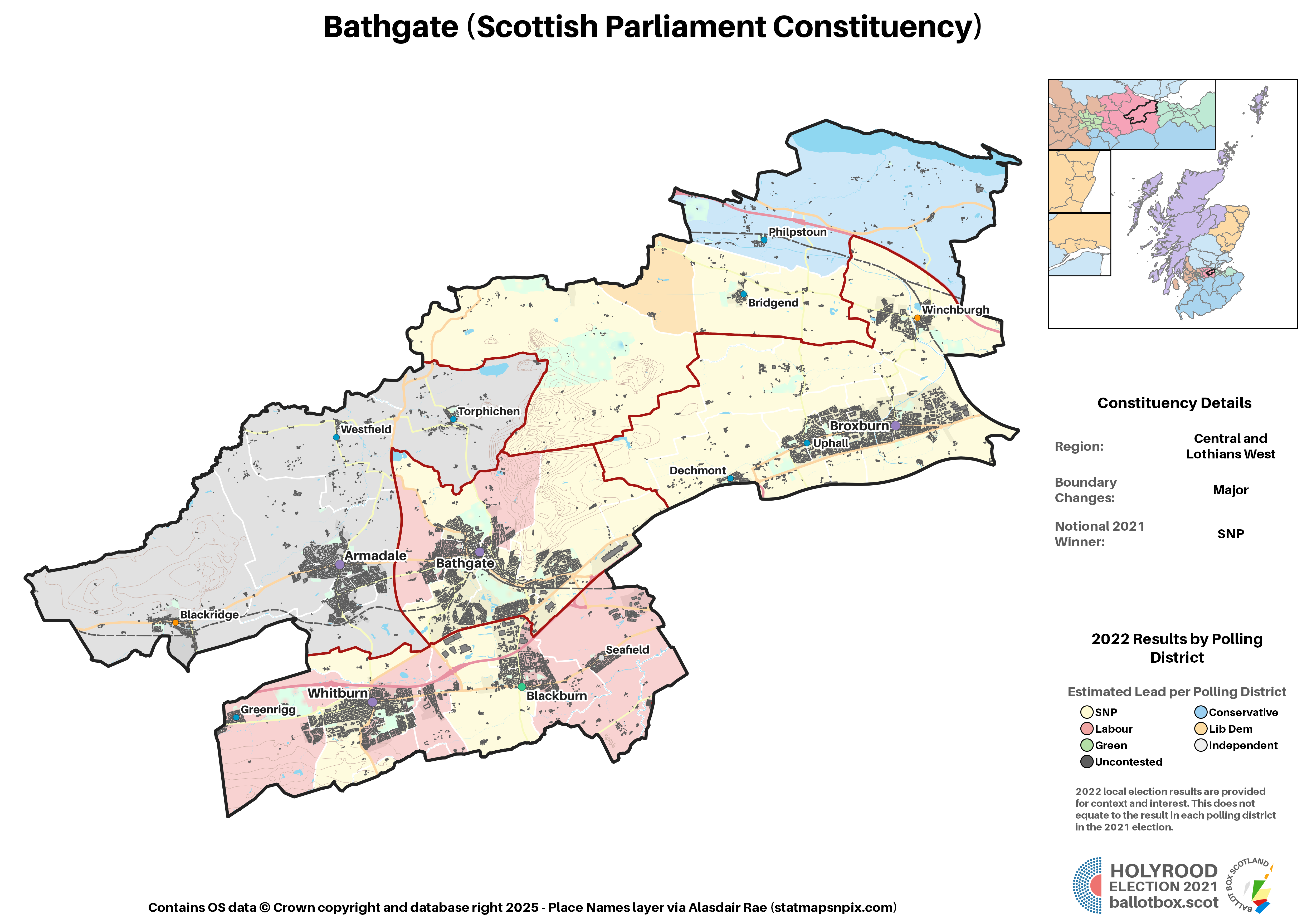
Constituency Map
Key Information
Notional 2021 Winner: SNP
Majority: 8467 (22.0%)
Boundary Changes: Renamed from Linlithgow due to losing that area to new Falkirk East and Linlithgow, gains Seafield from the old Almond Valley
2026 Candidates
SNP: Pauline Stafford, L1
Conservative: Peter Heggie, L6
Labour: Jenny Young, L2
Lib Dem: Stephen Harte, L4
Reform UK: David McLennan, L5
Abolish the Scottish Parliament/British Unionist Party: Gus Ferguson
Constituency Description
Sitting entirely within the West Lothian Council area, Bathgate itself is the largest but by no means dominant component of this medium-town constituency. Other five-digit populations are to be found in neighbouring Armadale and Whitburn, as well as the Broxburn and Uphall agglomeration. It also covers smaller settlements including Blackburn, Blackridge, Greenrigg, Dechmont, Westfield, Torphicen, Bridgend, Philipstoun, and new addition Seafield.
Although it still contains the majority of the population of the prior Linlithgow seat, the loss of the town itself necessitated the name change. Labour had held the original Linlithgow seat since 1999, but the SNP gained a somewhat redrawn version in their 2011 landslide. In terms of Labour prospects for a gain, this is roughly in the middle for this region.
Notional 2021 Constituency Vote
Notional 2021 Regional Vote
Constituency Map
Key Information
Notional 2021 Winner: SNP
Majority: 9437 (26.4%)
Boundary Changes: None
2026 Candidates
SNP: Fulton MacGregor (*C)
Conservative: Andy Bruce, L5
Labour: Kieron Higgins, L3
Lib Dem: Daniel Mancini, L6
Reform UK: Mandy Lindsay, L2
Constituency Description
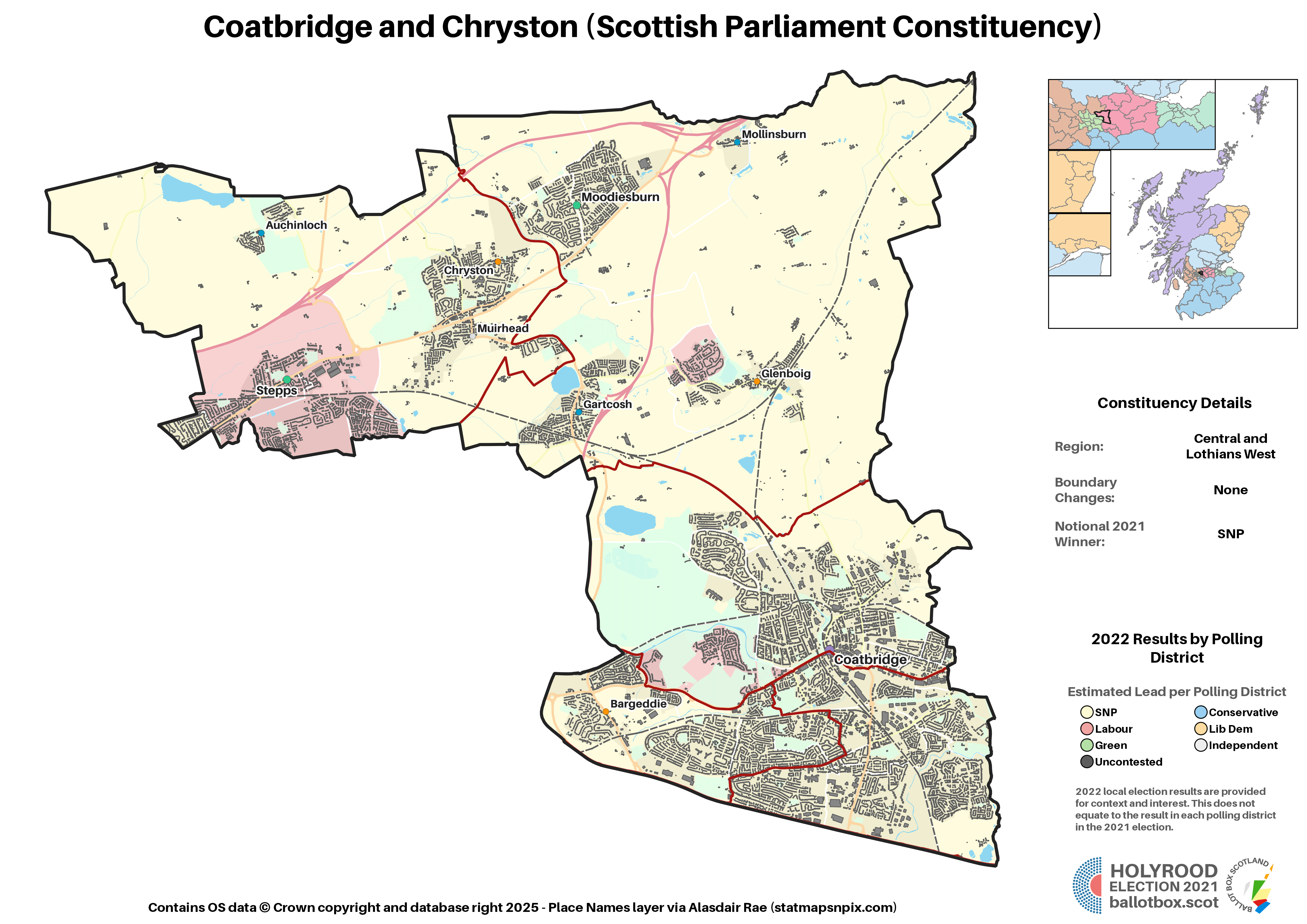
Sitting entirely within the North Lanarkshire Council area, Coatbridge and Chryston has most of its population in the first part of the name. Alongside the neighbouring village of Bargeddie, it sits on one spur off Glasgow. The rest of the area lies on another spur, stretching out from Stepps through Muirhead, Chryston and Moodiesburn, with Gartcosh and Glenboig lying in the middle.
This seat has maintained the same name since the Scottish Parliament was set up, though with a bit of a boundary change in 2011 that unhooked it from Lenzie: that was a relic of the prior “Strathkelvin” local government district. It took the SNP until 2016 to gain this seat from Labour, yet in terms of margin it should be one of the hardest for Labour to win back.
It’s a bit of an oddball though because Coatbridge is simultaneously heavily Pro-Independence yet the UK constituency swung back to Labour briefly in 2017. I’d put that 50/50 down to SNP supporters doing a stay at home – a risk for them again here – and the fact that seat extended into more Labour favourable Bellshill.
2021 Constituency Vote
2021 Regional Vote
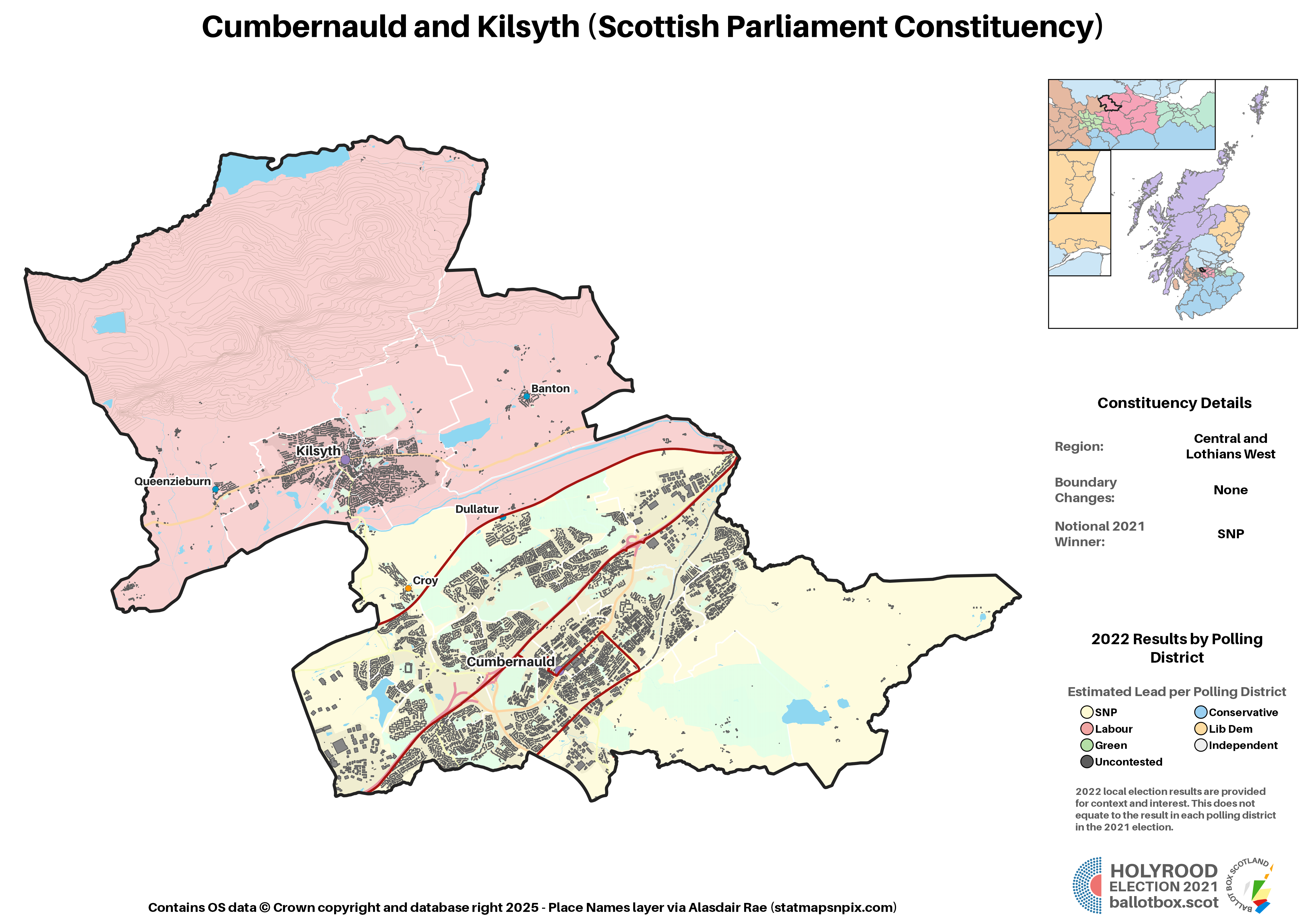
Constituency Map
Key Information
Notional 2021 Winner: SNP
Majority: 9841 (29.4%)
Boundary Changes: None
2026 Candidates
SNP: Jamie Hepburn (*C)
Conservative: Keith Allan, L4
Labour: James McPhilemy, L5
Lib Dem: Brian Howieson, L5
Reform UK: Steve Grant, L7
Alliance to Liberate Scotland: Alan McManus, L2
Constituency Description
Sitting entirely within the North Lanarkshire Council area, Cumbernauld and Kilsyth really is what it says on the tin. It’s the massive New Town of Cumbernauld, and the much smaller old town of Kilsyth, pretty simple! Okay, there are also a handful of smaller villages that lie within their orbit, namely Croy, Dullatur, Queenzieburn and Banton, but they’re very minor parts. This is also the only mainland constituency which hasn’t had even the tiniest changes since it was first created in 1999, making it the country’s most geographically stable.
That means the only changes here have been political, with the SNP gaining the seat from Labour in 2011. Cumbernauld is a big Independence and SNP supporting hotspot, which is why this is theoretically one of their safest seats in the country. Labour absolutely can win it on a really good day, but at time of writing that doesn’t seem like the kind of day they will have.
2021 Constituency Vote
2021 Regional Vote
Constituency Map
Key Information
Notional 2021 Winner: SNP
Majority: 8323 (19.2%)
Boundary Changes: Gains Linlithgow from the old Linlithgow, loses Carron, Carronshore and Stenhousemuir to but gains Hallglen and Lionthorn from Falkirk West
2026 Candidates
SNP: Martyn Day
Conservative: Lewis Stein, L2
Labour: Siobhan Paterson, L4
Lib Dem: Paul McGarry, L1
Reform UK: Amanda Bland, L3
Independent: Ian Wallace El-Paget
Constituency Description
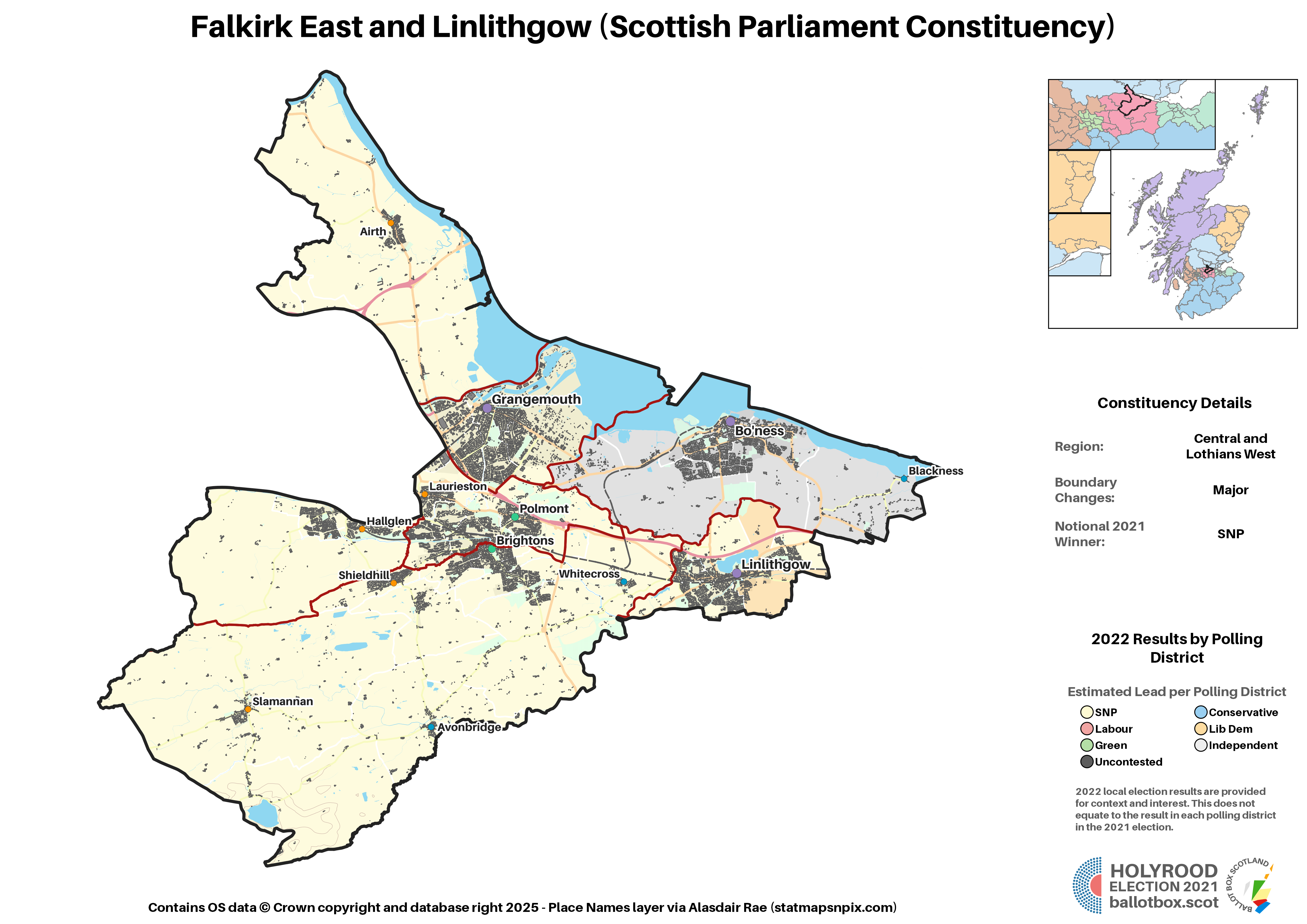
The bulk of Falkirk East and Linlithgow lies within the Falkirk Council Area, incorporating everywhere to the south and east of Falkirk itself. That includes substantial towns in the form of Grangemouth and Bo’ness, as well as the incredible tangle of interconnected villages in the Braes area: Polmont, Redding, Westquarter, Laurieston, Reddingmuirhead, Shieldhill, California, Wallacestone, Brightons, Rumford and Maddiston. Further flung villages are also to be found at Whitecross, Blackness, Avonbridge and Slamannan, plus Airth off to the north. Phew! The minority West Lothian Council component is much easier to describe, as it’s literally just Linlithgow.
The addition of Linlithgow is only one part of the change to this constituency, as it also loses chunks it had to the west of the M9 and to the south of the Glasgow-Edinburgh railway line. As with so many of the constituencies in this part of Scotland, the SNP gained the prior Falkirk East version from Labour in 2011. Although the SNP’s majority is pretty substantial, it’s their third lowest in the region, meaning this would be one of Labour’s easier gains.
Notional 2021 Constituency Vote
Notional 2021 Regional Vote
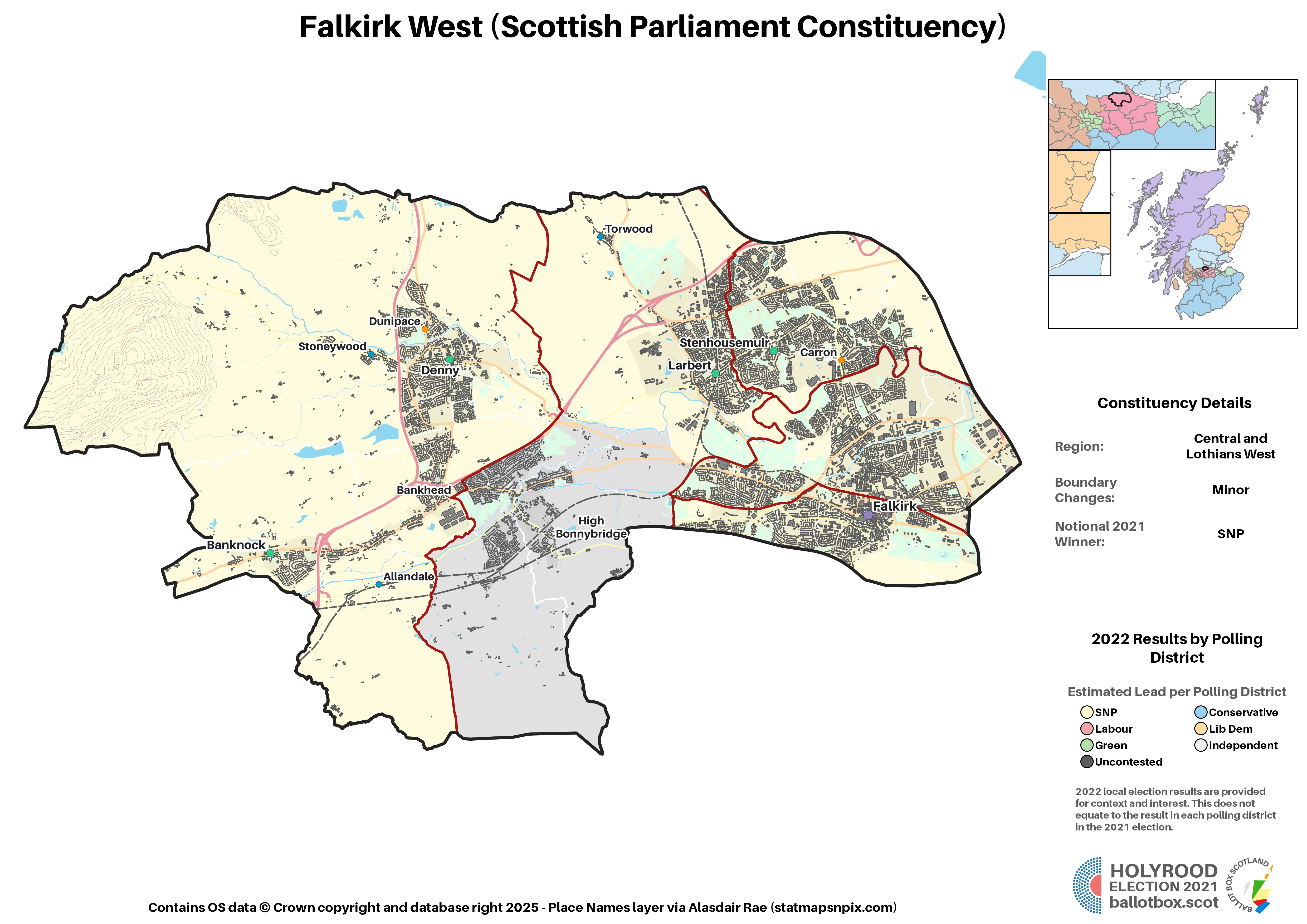
Constituency Map
Key Information
Notional 2021 Winner: SNP
Majority: 12848 (29.0%)
Boundary Changes: Gains Linlithgow from the old Linlithgow, gains Carron, Carronshore, Stenhousemuir from but loses Hallglen and Lionthorn to Falkirk West
2026 Candidates
SNP: Gary Bouse
Conservative: Neil Benny, L3
Labour: Paul Godzik
Lib Dem: Lucy Smith, L2
Reform UK: Richard Fairley, L4
Independent: Stuart McArthur
Constituency Description
Sitting entirely within Falkirk Council area, Falkirk West is the one that actually has Falkirk itself within it, as the major but not completely dominant component. It also includes the urban agglomeration just to the north, of which Larbert has always been a part of the seat, but Stenhousemuir, Carron and Carronshore are recent additions. Separate and forming a cluster of their own are Denny, Dunipace, Stoneywood, Bankhead, Bonnybridge, Banknock and Allandale.
Overall this is a somewhat larger seat than it had been up until now, with the trimming off of Lionthorn and Hallglen not really making up much of the difference. The SNP have held this seat in its prior form since 2007, when they won it in an effectively open contest following the retirement of extremely popular local Independent Dennis Canavan. Formerly a Labour MP for the same area, his barring as a party candidate in 1999 stands out as a remarkable self-inflicted wound, sweeping to an easy solo victory. The SNP’s success in 2007 was undoubtedly helped by Canavan’s refusal to endorse his former party.
Notional 2021 Constituency Vote
Notional 2021 Regional Vote
Constituency Map
Key Information
Notional 2021 Winner: SNP
Majority: 7813 (22.9%)
Boundary Changes: None
2026 Candidates
SNP: Clare Adamson (*C), L4
Conservative: Bob Burgess, L8
Labour: Ayeshah Khan, L7
Lib Dem: Jenni Lang, L7
Reform UK: Duncan Macmillan, L6
Alliance to Liberate Scotland: Greig McArthur, L1
Independent: Dominic Alderson
Constituency Description
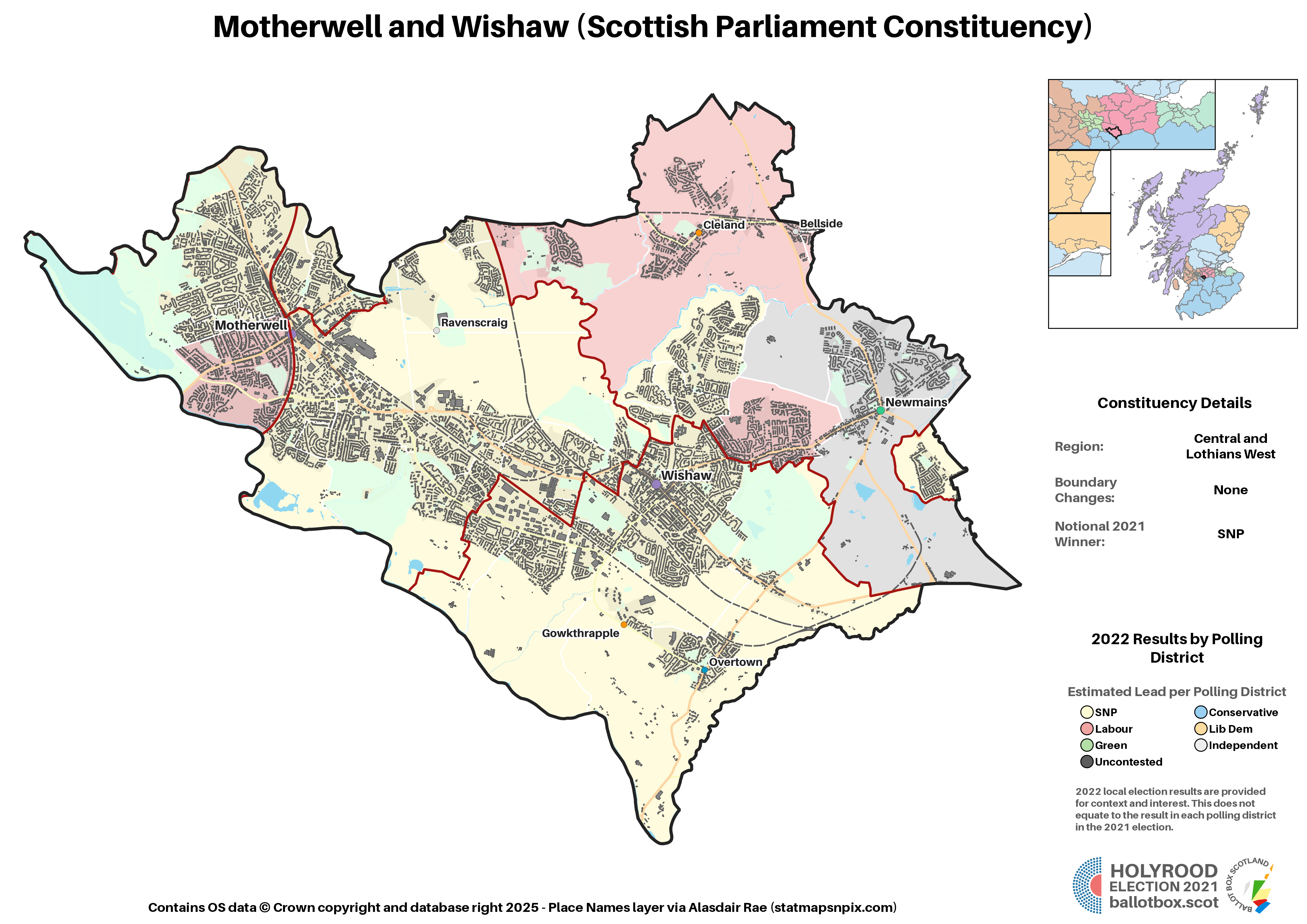
Sitting entirely within the North Lanarkshire Council area, as you would expect from the name Motherwell and Wishaw basically covers those two, historically twinned, towns. It also incorporates the neighbouring villages of Newmains, Morningside and Cleland. Although there were no boundary changes this time around, substantial redevelopment underway at the site of the former Ravenscraig Steelworks might swell the electorate before the next review.
The SNP gained this one from Labour in 2016. From creation up until a 2011 redrawing it was the seat of Jack McConnell, who to this day remains Labour’s longest serving First Minister. Motherwell contains some of the Independence hotspots in North Lanarkshire, which may explain why this is within the middle of the difficulty distribution for Labour to pick back up.
2021 Constituency Vote
2021 Regional Vote
Constituency Map
Key Information
Notional 2021 Winner: SNP
Majority: 5306 (14.7%)
Boundary Changes: None
2026 Candidates
SNP: Steven Bonnar, L6
Conservative: Meghan Gallacher (*L), L1
Labour: Mark Griffin (*L), L1
Lib Dem: Ben Munnoch
Reform UK: George Hobbins, L9
Constituency Description
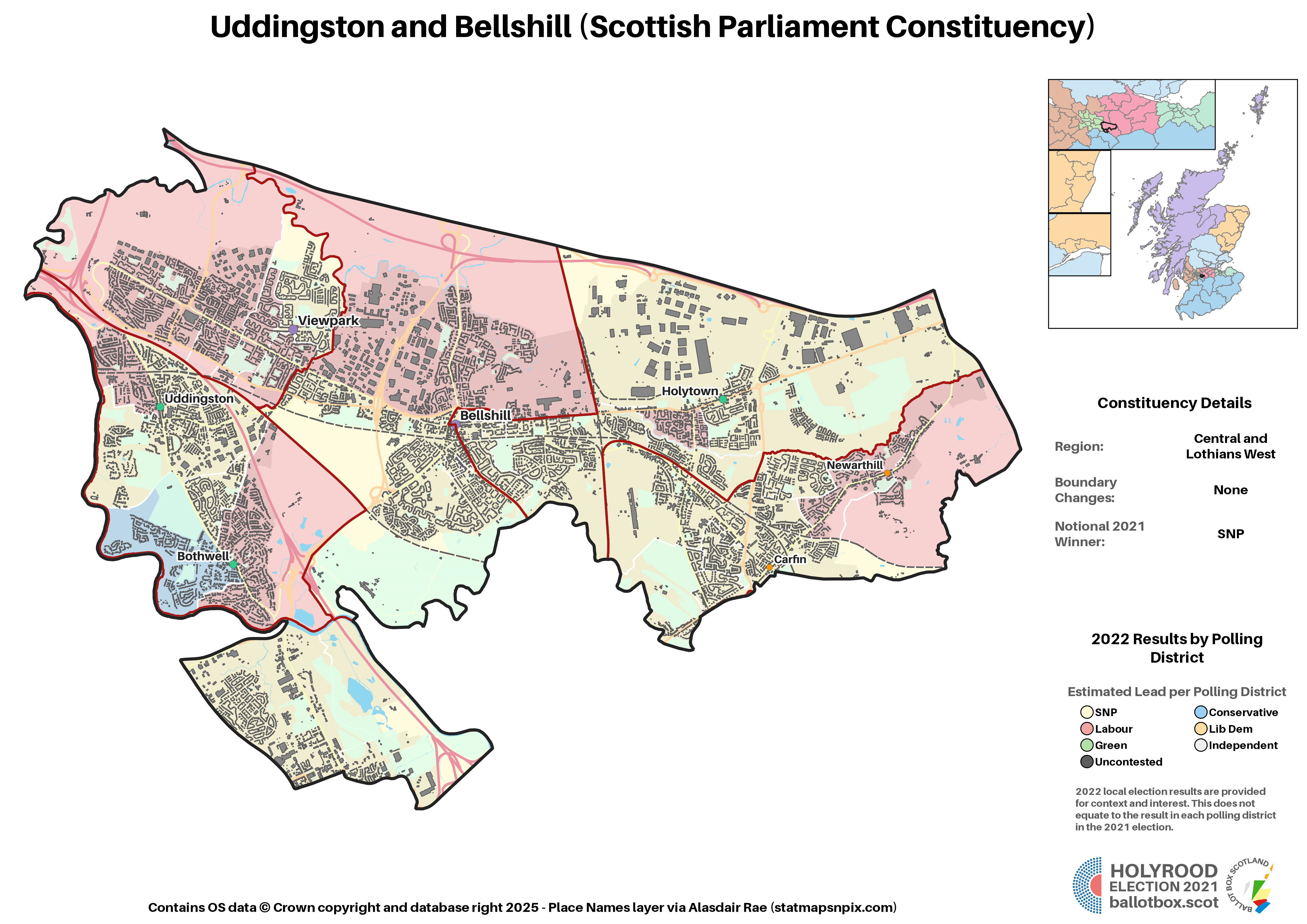
The bulk of Uddingston and Bellshill sits within North Lanarkshire Council area, covering a densely built up area that runs from Viewpark through Bellshill, Holytown, Newarthill, Carfin and New Stevenston. It also includes the last remaining minor fragment of South Lanarkshire to remain within the redrawn region, around Uddingston, Bothwell and the Whitehill estate in Hamilton.
Although there are no changes compared to the 2011 version of the constituency, that was itself a bit of a change from the prior Hamilton North and Bellshill seat. The SNP gained this seat from Labour in 2016, who had held it in both forms prior to then. This has the narrowest majority for the SNP in this region, and indeed it’s one of the closest nationwide, and it’s therefore the easiest to imagine turning Labour red on the map.
2021 Constituency Vote
2021 Regional Vote
To allocate list seats using the D’Hondt method, each party’s share of the vote is divided by one more than the number of seats they’ve won so far in the process. This is an important part of how the list seats then more fairly represent the diversity of views amongst voters. List votes cast for a party that has won lots of constituency seats are not “wasted”, they just aren’t needed to give their voters fair representation.
Starting Point
When allocating the first list seat, this starts with the number of constituencies won by each party:
- The SNP won 9 constituencies, so their vote is divided by 10.
- No one else won any constituencies, so their votes aren’t divided.
Seat 1
Since Labour have the highest total here, they receive the first regional seat. We add that to their total, giving them 1 seat overall so far, and therefore for the next round of allocation their share is divided by 2.
Seat 2
Since the Conservatives have the highest total here, they receive the second regional seat. We add that to their total, giving them 1 seat overall so far, and therefore for the next round of allocation their share is divided by 2.
Seat 3
Since Labour have the highest total here, they receive the third regional seat. We add that to their total, giving them 2 seats overall so far, and therefore for the next round of allocation their share is divided by 3.
Seat 4
Since the Conservatives have the highest total here, they receive the fourth regional seat. We add that to their total, giving them 2 seats overall so far, and therefore for the next round of allocation their share is divided by 3.
Seat 5
Since Labour have the highest total here, they receive the fifth regional seat. We add that to their total, giving them 3 seats overall so far, and therefore for the next round of allocation their share is divided by 4.
Seat 6
Since the Greens have the highest total here, they receive the sixth regional seat. We add that to their total, giving them 1 seat overall so far, and therefore for the next round of allocation their share is divided by 2.
Seat 7
Since the Conservatives have the highest total here, they receive the seventh and final regional seat. We add that to their total, giving them 3 seats overall. This completes the list seat allocation process.
If you find this or other Ballot Box Scotland output useful and/or interesting, and you can afford to do so, please consider donating to support my work. I love doing this, but it’s a one-man project and takes a lot of time and effort. All donations, no matter how small, are greatly appreciated and extremely helpful.
(About Donations)