Background
This week’s by-election gave us a relatively rapid return to East Ayrshire, and to Kilmarnock in particular, following the West and Crosshouse by-election in November. Whereas that was due to a councillor becoming MP, unfortunately Kilmarnock North followed the sad passing of Labour councillor and local group leader Maureen McKay.
If you’re an avid follower of BBS you may have noticed that this analysis has been published incredibly promptly compared to last week’s East Dunbartonshire by-election. That’s because East Ayrshire are absolute stars and had everything I needed for full analysis published by not even 10am this morning, whereas East Dunbartonshire… did not. As a Dunbartonshire lad myself (albeit West, which is best) it pains me to say it, but East Ayrshire is clearly the superior East.
Previewing this one, I’d noted that it would have required a swing of 5% compared to 2022 for Labour to clinch it, and they haven’t generally achieved that in the past few months. In particular, their issue has been that whatever happens with first preferences, they haven’t been able to pick transfers back up from the likes of Reform. In the prior Kilmarnock vote for example, an 8.1% swing on first preferences shrunk to 3.7% after transfers. I therefore had it as leaning SNP.
Headline Results
Councillors and Key Stats
1 Councillor Elected: SNP: Caroline Barton
Change vs 2022 (notional): SNP Hold
Change vs vacating: SNP Gain from Labour
Turnout: 21.7% (-18.7)
Electorate: 9726
Valid: 2092 (99.1%)
Spoiled: 18 (0.9%)
Quota: 1047
2 Continuing Councillors:SNP: Elaine CowanSNP: David Richardson
Candidates
 Green: Finlay AffleckSNP: Caroline Barton
 Independent: Ian Grant
 Reform UK: Sandra Kirkwood
 Conservative: Allan MacDonald
 Labour: Greg MacKenzie
 Lib Dem: Lee ManleyIndependent: Stephen McNamara
First Preferences
Note: Alba won 2.6% of the vote here in 2022.
First Preference History
Whilst I don’t get absolutely every call 100% spot on, my instincts were bang on here. The SNP maintained a first preference lead here, though with a sharp decrease in their vote that gives them their worst share here to date. Labour end up effectively static on 2022, though when you consider they tend to benefit at by-elections and where they were in July, this is in certain respects as bad a result as the SNP’s. If this by-election had been in, say, September, Labour would have led overall. Regardless, this amounts to a nearly 6% SNP to Labour swing: keep that number in your head until we get to the transfers.
Returning Independent (and former Conservative councillor) Ian Grant may not have won overall, but he feels like the biggest winner out of the batch, recording a solid increase in his share compared to 2022 and placing third overall. It’s possible this was aided by the fact Reform UK had disavowed their candidate for basically being horrible online, which may be why although they got to double digits this is on the lower end of their recent results. It still placed them ahead of the Conservatives, who are another party on their worst share yet.
Returning for the first time in over a decade, the Greens managed another one of those shares I’d class as “modest but respectable” given the ward. It’s almost twice what they got the last time they were here, and East Ayrshire is one of their weakest areas in the entire country at other levels of election. The Lib Dems won about half as many votes, but again this is a tremendously feeble area for them anyway. Lastly, and speaking earlier of candidates disowned by Reform UK, Stephen McNamara has possibly set the record for the fewest votes ever won in a Scottish election. Just two people popped a number in his box.
Transfers
Two-Candidate Preferred
Purely theoretically, with only an 8% lead for the SNP, and a 60:40 split between Pro-Union and Pro-Independence candidate votes, Labour should have been able to win this one. However, things unfolded exactly as I suggested in the preview: they simply didn’t pick up the transfers. Although their first preference share was unchanged, after transfers they actually lost support. Certainly the SNP still lost more, but they actually lost less by this measure than in first preferences.
You remembered the 6% swing figure from above, right? Well, after transfers, that was slashed to just a 2.5% swing from the SNP to Labour. That’s half of what they needed to take it. Voters just aren’t giving Labour their preferences, even further down the rankings. That’s costing them multiple seats by this point, and in this case it has created a ward with one party control of every seat. As I always point out when this happens, this completely defeats the point of using a PR system, and it’s why by-elections aren’t actually a democratically optimal solution when you use STV in particular.
Detailed Results

Results by Polling District
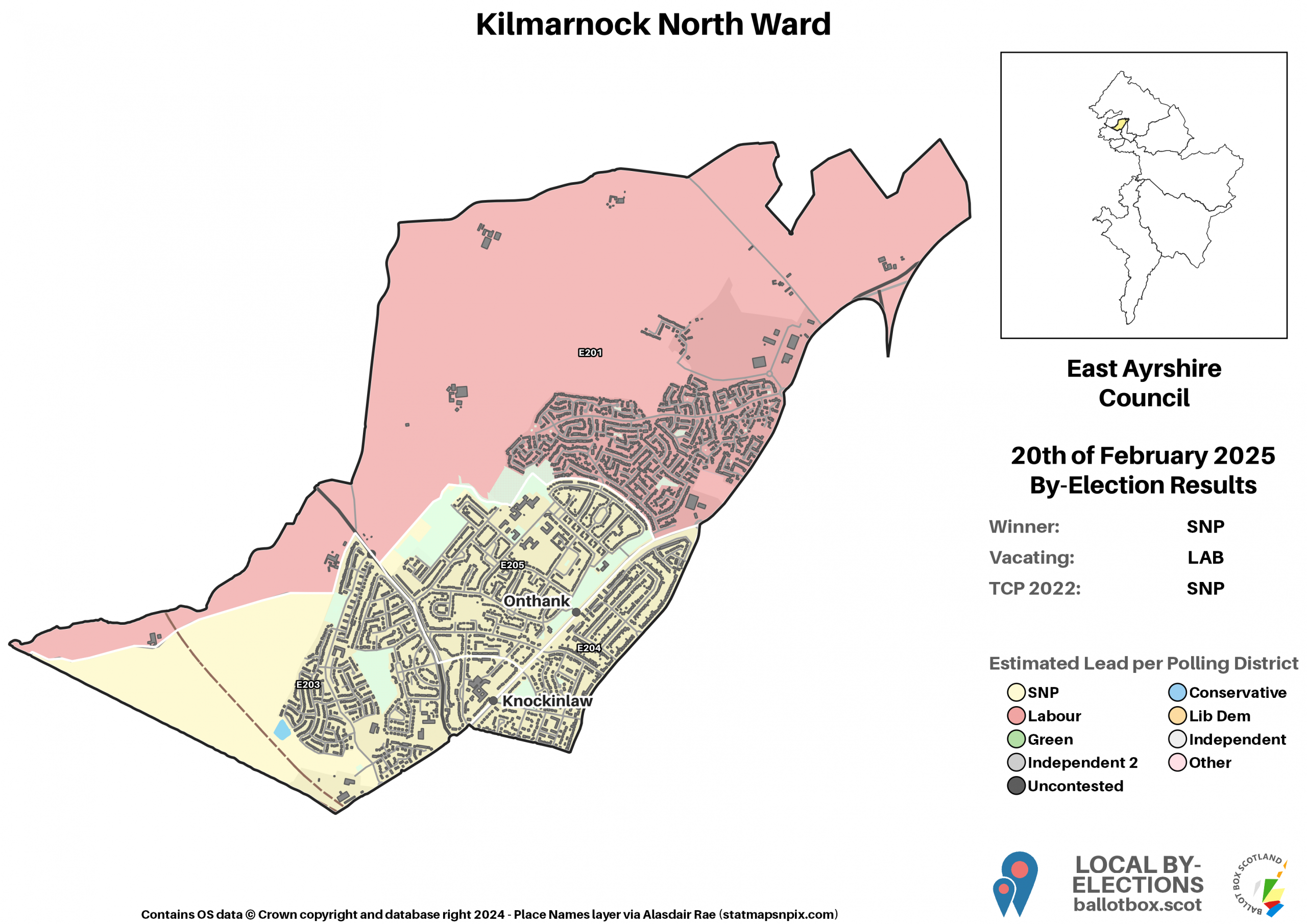
Despite the low turnout, polling district arrangements here are such that they’re mostly able to be kept separate, with only one merger, which is geographically neat. The SNP took a commanding lead in the districts covering Onthank, Knockinlaw and Altonhill, whilst Labour led in what I guess is probably like northern Onthank but isn’t actually clearly named anywhere – I’m sure a local would have a specific locality name for it.
Of the SNP led districts, it was Onthank they did best in. Labour meanwhile obviously did best in the district they led, which was similarly the best patch for Grant and the Lib Dems. However, be aware that the Lib Dems had the biggest imbalance between postal and in-person votes of any party, at a nearly 9:1 ratio. That means my apportionment of their vote to districts is even more of an estimate than usual. Lastly, Reform, the Conservatives and Greens all polled most strongly in the merged Knockinlaw and Altonhill districts. Given both were postal I have absolutely no idea where McNamara’s pair came from.
Second Preferences
Second preferences for this one are a bit all over the place, even if some of the most favoured options are pretty standard. The SNP and Greens are, as usual, one another’s top pick, but the flow is somewhat anaemic in historic terms especially coming from the SNP. Labour voters most commonly plumped for the SNP, which is not too much of a surprise in an area the Lib Dems are weak, whilst Labour themselves were the most popular choice for Grant, Conservative and Lib Dem voters. Reform tended to favour the Conservatives, and only one of the McNamara duo transferred their vote at all, and that was to the Greens.
We’ve got a few weeks breathing space before the next by-election, which will bring us to West Lothian for Broxburn, Uphall and Winchburgh. That will be a particularly interesting one because it had a by-election at the end of 2022 that Labour won, but the actual full 2022 vote had an SNP lead of 7%: in other words, if Labour had the same 2.5% swing versus 2022 they got in this by-election, they wouldn’t win.
If you find this or other Ballot Box Scotland output useful and/or interesting, and you can afford to do so, please consider donating to support my work. I love doing this, but it’s a one-man project and takes a lot of time and effort. All donations, no matter how small, are greatly appreciated and extremely helpful.
(About Donations)