Background
After a blissful few weeks without a by-election (I’m a bit knackered at the moment after last year so relishing the peace!), this week we were back in West Lothian for the Broxburn, Uphall and Winchburgh by-election. We’d already visited this ward back in December 2022, an unfortunately prompt by-election due to the death of the newly elected Labour councillor.
Although Labour won that time around, in my preview I noted that the SNP’s lead in the full 2022 election was larger than Labour have tended to overturn lately. It wasn’t vastly ahead of what they’ve been averaging but it was enough that, especially given Reform UK continue to be a disruptive presence on ballot papers across the country, I marked this as a tossup between the two lead parties.
Headline Results
Councillors and Key Stats
1 Councillor Elected:
🟡SNP: Mike Carlin
Change vs BE 2022 (notional): SNP Gain from Labour
Change vs full 2022 (notional): SNP Hold
Change vs vacating: SNP Hold
Turnout: 25.0% (-2.2 / -16.7)
Electorate: 17404
Valid: 4320 (99.2%)
Spoiled: 37 (0.8%)
Quota: 2161
3 Continuing Councillors:
🟡SNP: Janet Campbell
🔵Conservative: Angela Doran-Timson Labour: Tony Boyle
Candidates
⚫Alba: Frank Anderson
🔴Labour: June Andrews
🟡SNP: Mike Carlin
🟢Green: Chris Cotter
🟠Lib Dem: Oliver Ferrario
🟣Reform UK: David McLennan
🔵Conservative: Marnie Taylor
First Preferences
Note: Independent Chris Horne won 6.1% and Independent Steven Laidlaw 2.8% at the December 2022 by-election. The Family Party won 1.3% at the full election in 2022.
First Preference History
Score another one for my predictive powers on this one, because that was an absolutely spot-on assessment. In first preference terms, the SNP regained the lead over Labour they’d lost in December 2022. That came from Labour falling a lot harder (about three times) than the SNP did rather than any recovery for the latter, and relative to 2022 it’s a big drop for the SNP and only a very small one for Labour. That should nonetheless be deeply worrying for Labour, given that this time last year they were generally expecting to far exceed their 2022 performances.
Continuing both a national and specifically West Lothian trend of very solid results, Reform UK placed third very comfortably ahead of the Conservatives. For the Conservatives themselves, don’t let their only slight decline versus December 2022 fool you. Firstly, it’s much starker compared to the full 2022 result, and secondly the previous by-election actually saw the former Conservative councillor for the ward standing as an Independent: he’s the one that got a smidge over 6%, and so expect an extra roughly -2% off the “real” Conservative share had he not done so back then.
Bringing up the rear, the three smaller parties on the paper all did what I would describe as “respectably, given the circumstances”. The Lib Dems I think are generally benefitting a little from Labour dissatisfaction, so experience a wee bump here. The Greens manage to roughly return to their May 2022 share, having dipped in the December, which they’ll be perfectly fine with given their voters don’t turn out for by-elections and this is so far from a target for them it might as well be on the moon. Lastly, Alba recorded decent growth against both 2022 votes, aided I reckon by the fact their candidate had previously been an SNP councillor for years in the ward next door.
Transfers
Two-Candidate Preferred
Historically speaking, an SNP lead of less than 3% with over 30% of the first preferences going to other Pro-Union parties should have meant Labour had this in the bag. Given the recent surge for Reform and the unwillingness of most of those voters to transfer though, converting these kinds of second places to wins is proving much harder. So it was here: they needed a roughly 3.4% swing versus the full 2022 result to win this, and they ended up with 3.2%, missing out by just 17 votes.
Those Reform votes simply aren’t transferring anywhere. Although Labour do generally do better out of them, with 17.4% of the total to the SNP’s 10.7%, that leaves a whopping 71.9% just going absolutely nowhere. In this case the margin is so tiny that I would bet the different was made up by people who don’t understand the system rather than people actively choosing not to preference Labour, but at the end of the day, that doesn’t matter after the fact: it cost them the win either way.
Detailed Results
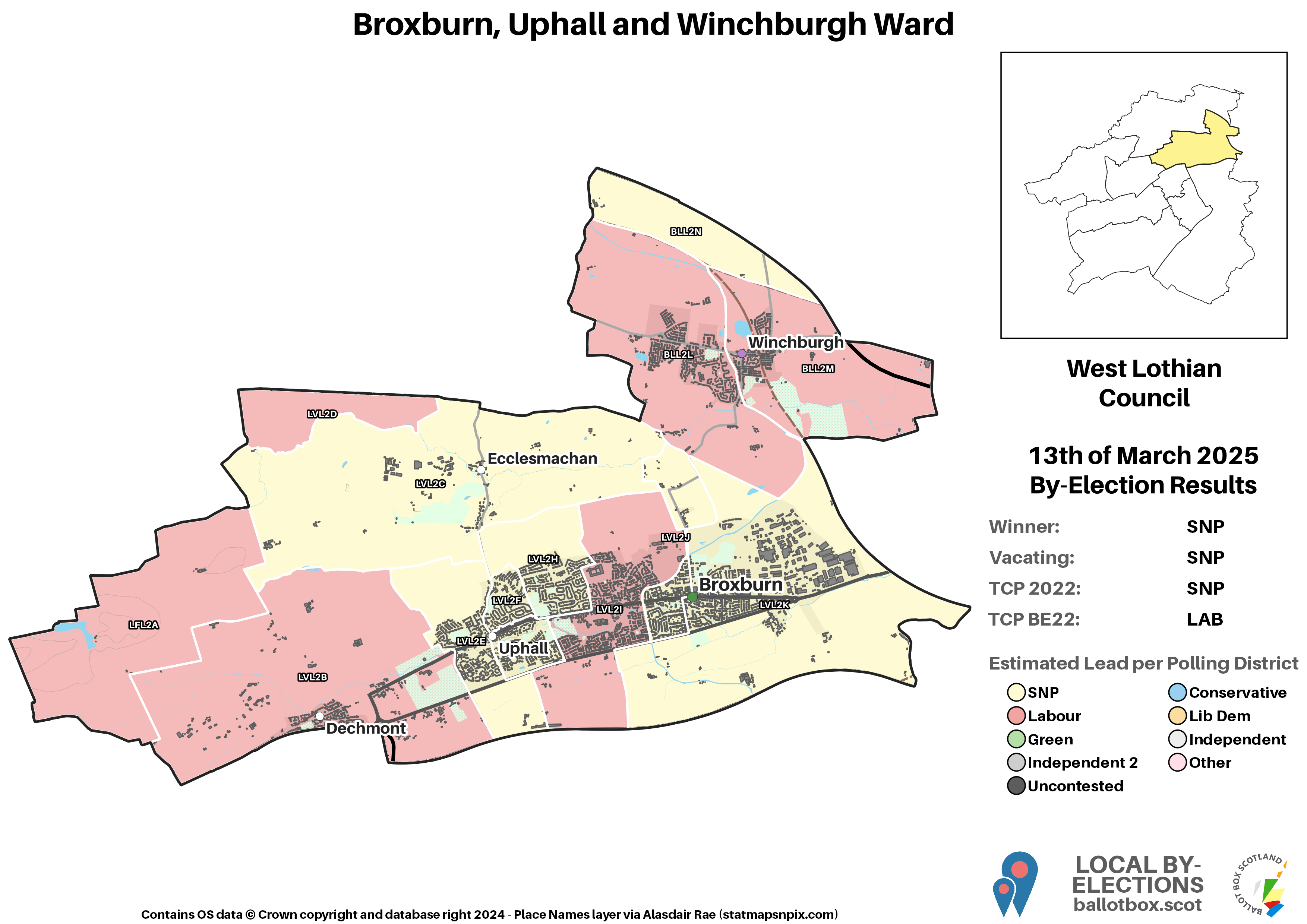
Results by Polling District
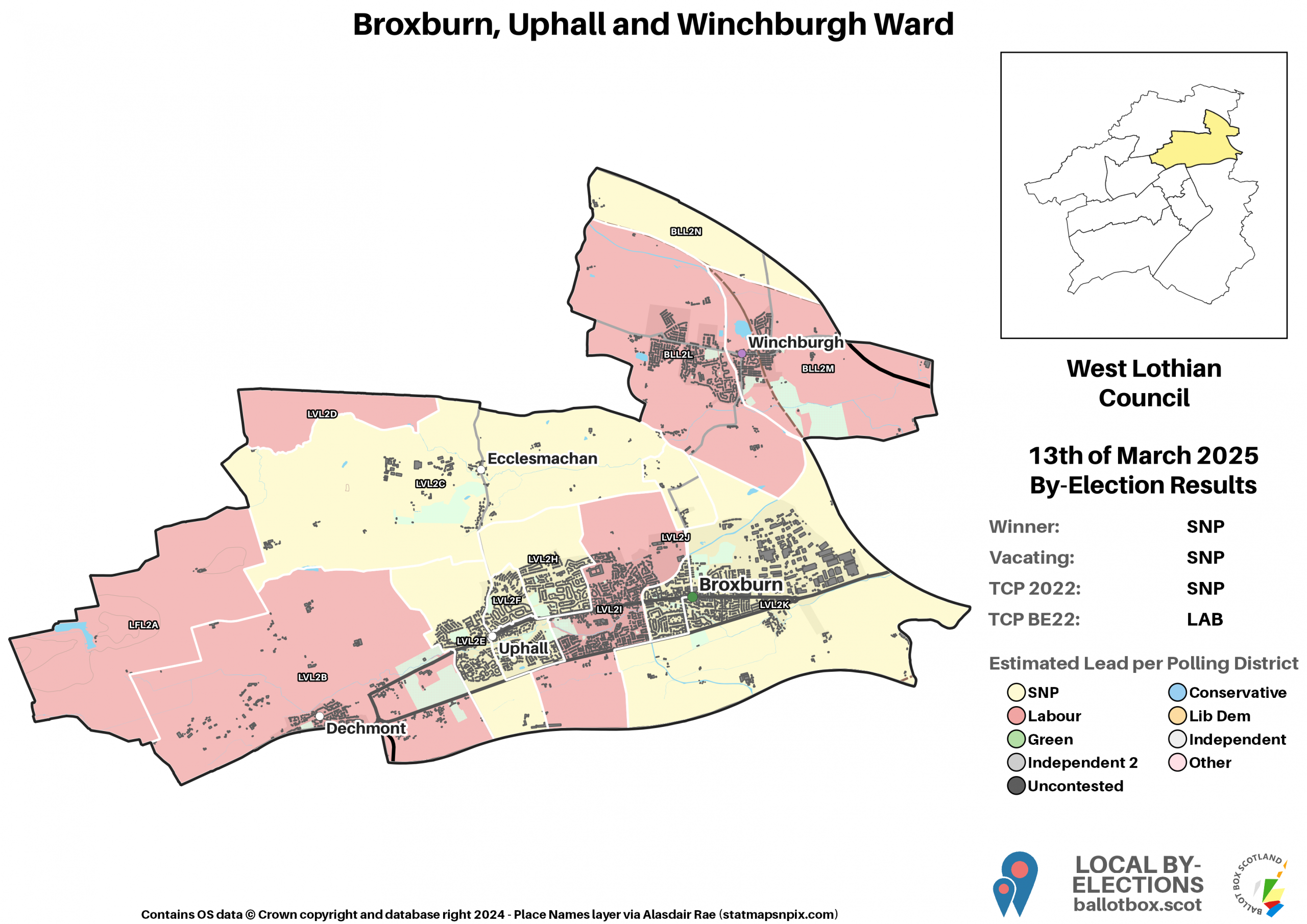
West Lothian are a commendably quick turnaround on their detailed data, which shows an almost clean split between the SNP and Labour in terms of where they had leads. But for one patch of red in western Broxburn, the SNP would have led all of Broxburn and Uphall, as well as Ecclesmachan, with Labour out in front in Winchburgh and Dechmont. Of these, the SNP were strongest in Northwestern Broxburn and Labour in Dechmont and eastern Winchburgh.
The other parties largely paired up for their top spots, with Reform UK and Alba recording their best shares in eastern Broxburn. The Conservatives and Lib Dems meanwhile peaked in western Winchburgh, leaving the Greens to billy nae mates it with a solo spike in central-ish Broxburn.
Second Preferences
Direct second preferences then show a bit of buddying up going on. There are three mutual preference pairs: the SNP and Alba, Labour and Lib Dems, and Reform and Conservatives. None of those are particularly shocking, especially in the context of this kind of ward. The fact that the SNP pool most commonly plumped for Alba continues the Greens’ trend from the above section of standing a bit apart, as they ended up the only party not to have a mutual top preference with another party. They weren’t that far behind Alba in terms of SNP later preferences though, so nobody get carried away though!
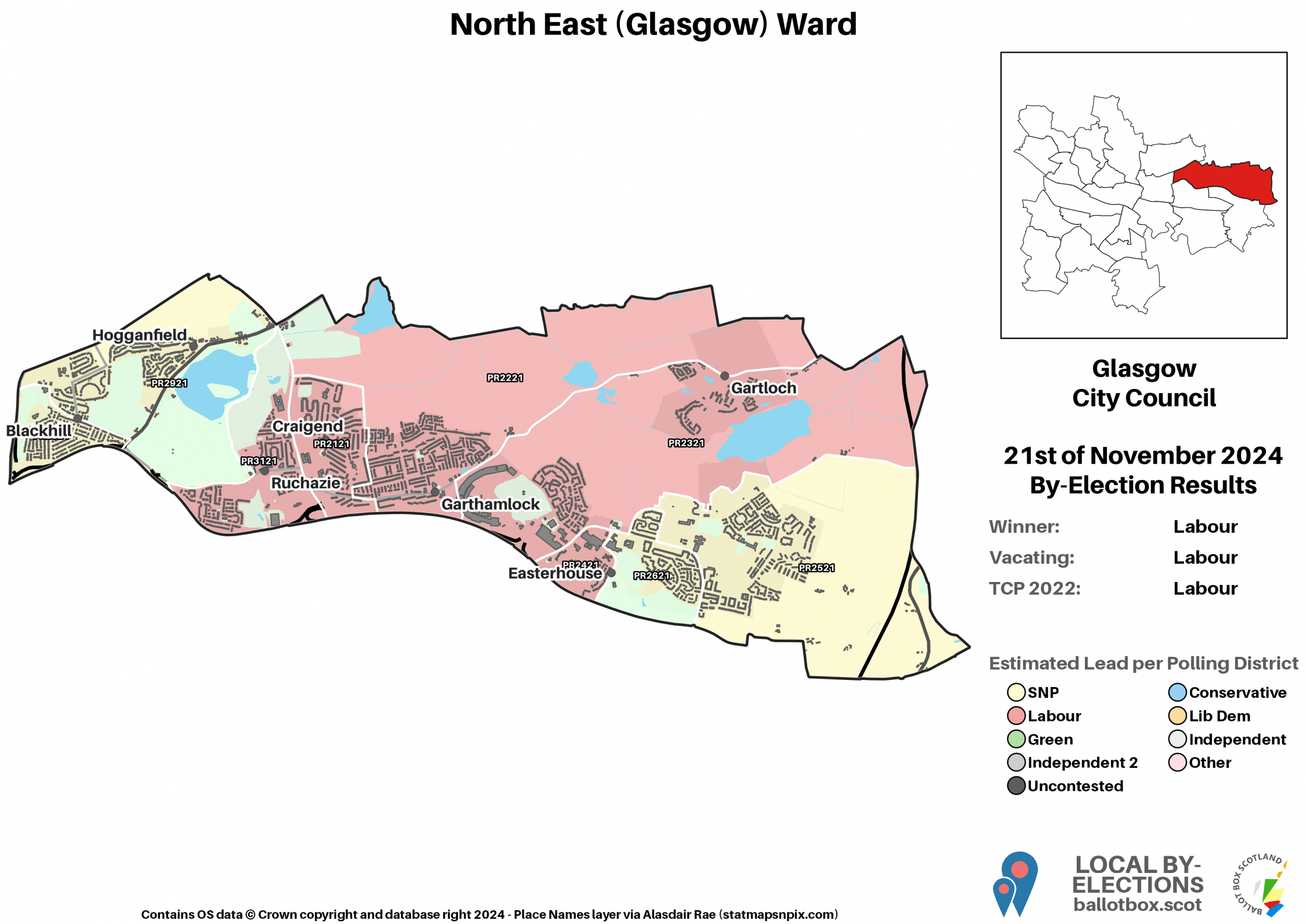
Next week brings a Glasgow double-dip, one of which is a rather embarrassingly quick return to a ward that voted in November. Labour’s victorious North East candidate failed to quit her local council job within the required timescale and so was automatically disqualified as a councillor. That by-election had absolutely rotten turnout, with just one in eight (12.4%) of voters turning out. An already high Reform share could go higher. Meanwhile, Southside Central follows the sad passing of a Labour councillor, and it may be a route back in for one of the SNP’s highest profile local casualties. Watch too to see whether the Greens can reverse a streak of vote share losses in their strongest wards in the city.
If you find this or other Ballot Box Scotland output useful and/or interesting, and you can afford to do so, please consider donating to support my work. I love doing this, but it’s a one-man project and takes a lot of time and effort. All donations, no matter how small, are greatly appreciated and extremely helpful.
(About Donations)