Reputable Scottish polling continues to follow what appears to be a roughly monthly swinging between Norstat and Survation, with nobody else worth their salt apparently bothering. I would say “beggars can’t be choosers” but despite begging for more polling diversity I have been very choosy about what I consider worth acknowledging, but still: someone wake YouGov or Ipsos up from their naps. Don’t you know there’s an election on next year? Anyway, this month it’s Survation’s turn (link to tables), with a Holyrood-only poll on behalf of public affairs organisation Quantum Communications.
The previous Survation covered the 7th – 13th of January 2025. Changes are shown as (vs that poll / vs last election).
Regional Vote
As with so much recent polling, the general vibe here is actually “not much change”: most of the figures are within margin of error. A two point dip for the SNP takes them back into the 20’s, the same bracket Labour stay in by the skin of their teeth. All of the Conservatives, Lib Dems and Greens also go down a point, whereas Alba’s statistically meaningless fluctuation is one up.
Where things break from that is with a 3% gain for Reform UK, a more substantive shift that speaks to the party’s continuing growth, and vaults them past the Conservatives. This is easily their best share thus far, having previously capped at 16% on this vote. Due to the margin of error nature of everyone else’s changes I would caution against drawing a conclusion that “Reform are gaining from everyone else”, as we can’t be sure of that on these kind of numbers.
Constituency Vote
Nothing dramatically different on the constituency side of things, although Labour are actually up one with their marginal shift on this side of things, whereas the Conservatives and Greens take bigger hits in their tallies. Again, it’s Reform with the biggest increase here, and that similarly amounts to a 3% advance on their previous peak of 14%. Their support is still likely to be too evenly spread for that to lead to any constituencies, but I’m really going to need to revisit how my model handles their constituency presence because they might be getting to second in places by this point.
Seat Projection
Projecting that into seats might give us something like this:
Please see this page for how projections work and important caveats.
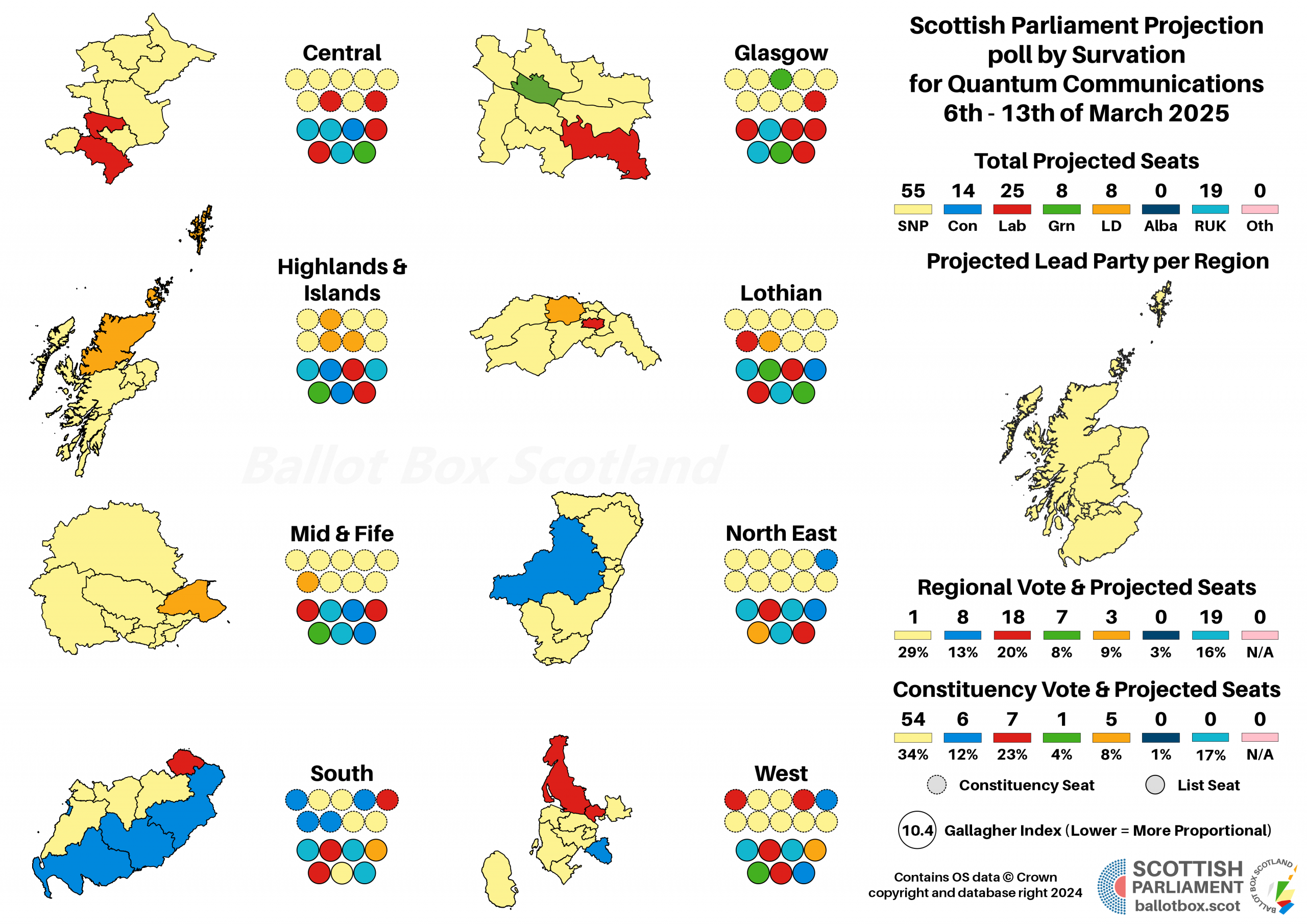
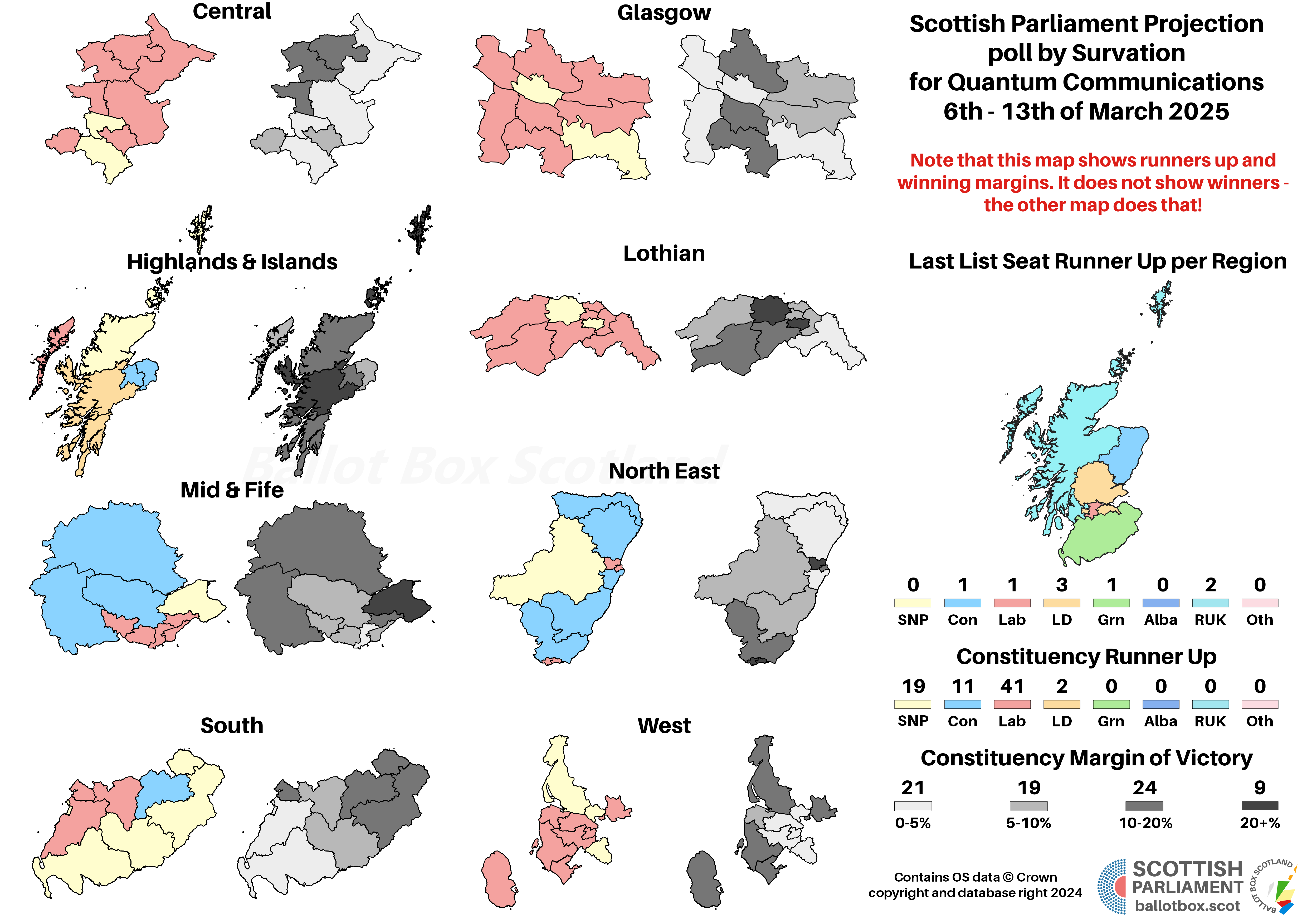
This comes out with a pretty messy mix, with no easy governing arrangement available. The SNP and Greens narrowly miss out on the majority they had in the previous poll, but whilst that gives a Pro-Union majority of 66 to 63, a huge chunk of that comes from the 19 Reform MSPs. You simply can’t make a workable government out of these numbers sticking to one side of the constitutional divide.
Whilst it’s a normal and entirely reasonable outcome of a proportional system that the first placed party doesn’t form the government if it can’t get a supporting majority, there is absolutely not a snowball’s chance in hell our political culture could handle Labour taking office with fewer than half the SNP’s seats. It’s also unlikely they’d be able to rely on Reform for much, especially given the clock would start ticking immediately until the inevitable splinters and fallouts in the Reform group that have plagued every substantial Farage-ite parliamentary grouping elected in the UK’s history.
The only even vaguely – and I emphasise “vaguely” – workable options here are for Labour to put on their big boy trousers and come to an accommodation with the SNP, or for the Lib Dems to repeat this year’s act of voting alongside the SNP and Greens on the budget. I don’t think the Lib Dems want to be lending support to an SNP government that would be entering its third decade, but nor do I think they’d be at all keen to work with Reform in an incoherent and fractious Union Bloc arrangement. With the far right on the rise across the western world, the relevant battle lines may cease to be constitutional and instead who is or isn’t willing to capitulate to them.
Just as a note, and with no harm meant to them, I’m very dubious about the single Alba seat that the Diffley Partnership reckoned 3% gives in the seat projection they gave to Quantum. I struggle to see where that could possibly come from. In 2021 their best performance was 2.3%, against their national 1.7%. Not only was that in the North East with Alex Salmond at the head of the list – obviously, not an option anymore – but it doesn’t suggest it’s likely they’ll get the near-double national share in any region they’d need to pick up a seat.
Possible Majorities
Note: these majorities relate simply to passing a vote in the Scottish Parliament. They do not imply the formation of a full coalition government.
- Traffic Light: Labour, Lib Dem and Green
- Independence Bloc: SNP, Green and Alba
- Grand Coalition: SNP and Labour
- Union Bloc: Labour, Conservative, Lib Dem and Reform UK
Hypotheticals
As ever, the last little bit of analysis concerns those hypothetical and more proportional voting systems that BBS likes to play about with. The use of pure FPTP at Westminster is an affront to democracy, and though Holyrood fares far better, AMS is still deeply imperfect. The examples here simply transpose the poll findings onto more proportional voting systems – the reality is that different systems would of course result in different voter behaviour.
If you find this or other Ballot Box Scotland output useful and/or interesting, and you can afford to do so, please consider donating to support my work. I love doing this, but it’s a one-man project and takes a lot of time and effort. All donations, no matter how small, are greatly appreciated and extremely helpful.
(About Donations)