One year from now, voters across Scotland will be going to polls to elect a new Scottish Parliament. We will be a whopping 19 years into SNP governance, spanning 70% of the existence of devolution, and not even two full years into a Labour UK Government. Not so long ago a change of government seemed the natural next step up here too, but Labour’s victory has seemingly turned to ash in a remarkably short timescale.
Last week’s local elections in England struck a devastating blow to the party, far worse than had been expected even in the broadly unfavourable context of county elections. A shock poll yesterday suggested they could be on track to place third in the Senedd Cymru next year. Reform are on the march in Scotland too, but like much of England and Wales the biggest challenge for Labour comes from parties of the centre and left.
A lot can change in a year, of course, but it’s worth taking stock of where we are now. As I’ll be getting into a bit of discussion about all of the relevant parties, be aware that this is a lot longer than usual (the little read time indicator will have told you that, mind you).
Boundary Changes
One of the biggest changes right off the bat is that we’ll have new constituencies and regions, with the biggest shakeup in the latter since Holyrood was created. I’ve got a complete analysis of every region and notional 2021 results on the new boundaries available elsewhere on the website. Technically these remain to be approved by Parliament at time of writing, but in reality parties have already started picking candidates based on them.
I’d advise going through the full rundown, but the short version is that if you live in the Central Belt your constituency, region, or both are likely to have changed and if you don’t, they won’t have. The three northernmost regions each only have one internal boundary tweak between constituencies. Constituencies in South only have very small boundary changes, but the constituencies making up the region have changed: out is East Lothian, in come East Kilbride and Hamilton, Larkhall and Stonehouse.
Glasgow and Edinburgh have had almost all of their constituencies completely redrawn, in part due to a shift in balance of population between our two biggest cities. The Glasgow region has lost Cardonald (which remains in the City Council, of course) to West, whilst the old Central and Lothian regions have been completely done away with. In their place come Central and Lothians West on the one side and Edinburgh and Lothians East on the other.
The net effect of these changes is mild in terms of seats in 2021, but in one party’s favour: two extra Green MSPs. The loss of Cardonald (which as you can see is a massively strong Labour ward and a very weak Green one) tips a Glasgow seat, whilst the larger South makes up for the near miss the party experienced in 2021 whilst removing one of the SNP’s very few remaining list MSPs.
If you follow Ballot Box Scotland closely, you’ll know I’ve been tearing my hair out about two things. Firstly, the relative dearth of credible Scottish polls. Secondly, and this ties back to the “credible” point, the fact what few polls we are getting are complete and utter bollocks from FindOutNow. Whilst I’ve opted to ignore them, that means there are only two pollsters in the current average: Norstat and Survation.
Amongst their particular house effects, both are known to be on the lower end of Green figures, Norstat is famously favourable to Alba, and Survation have a long history of higher than average Labour figures. Bear these caveats in mind when looking over the following figures. Hopefully the combination of new boundaries and a looming election will spur some other pollsters into action!
Regional Vote
Constituency Vote
Seat Projection
Projecting that into seats might give us something like this:
Please see this page for how projections work and important caveats. Note that whilst the projection here uses the new boundaries, the tracker page is yet to be updated to use them.
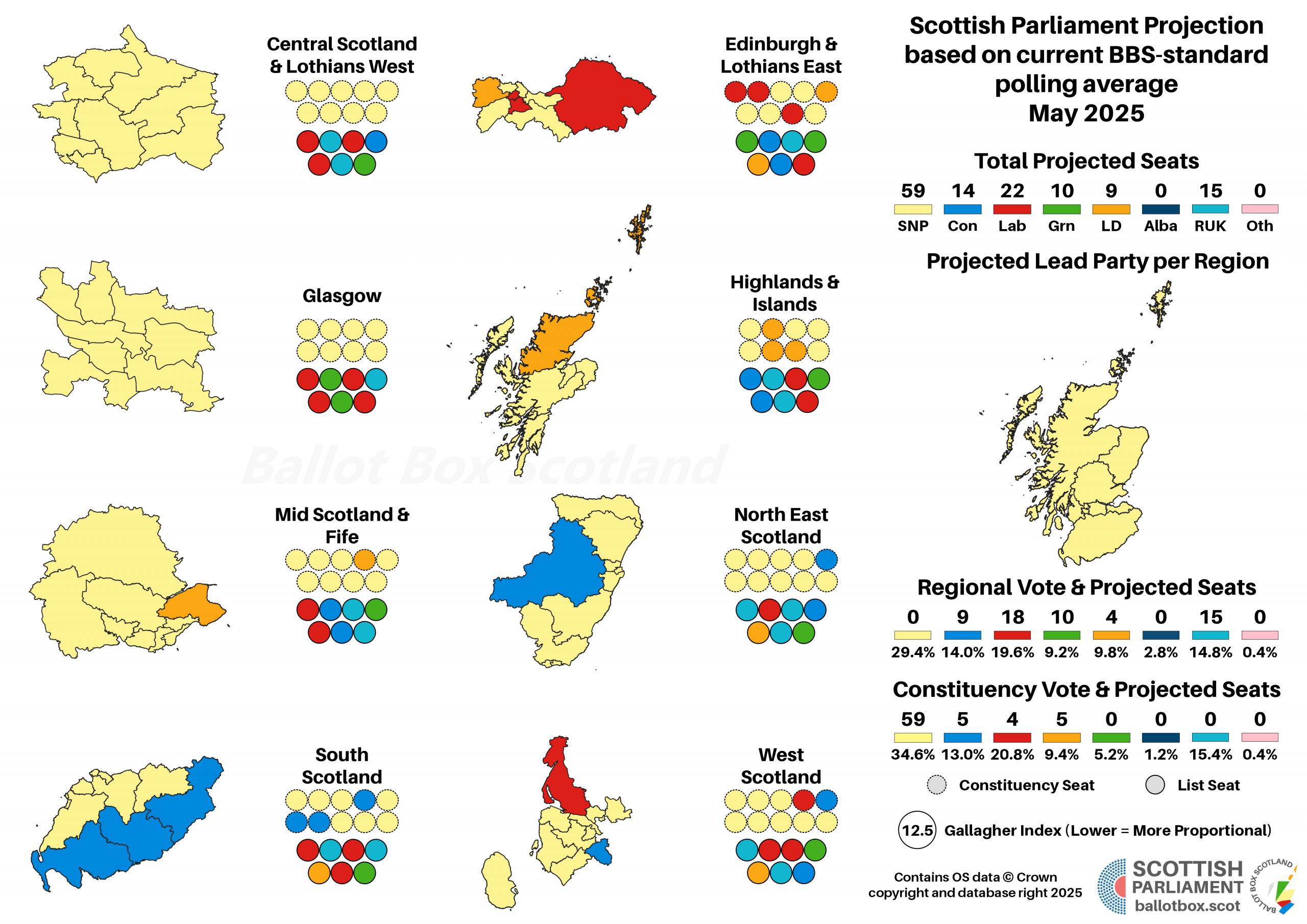
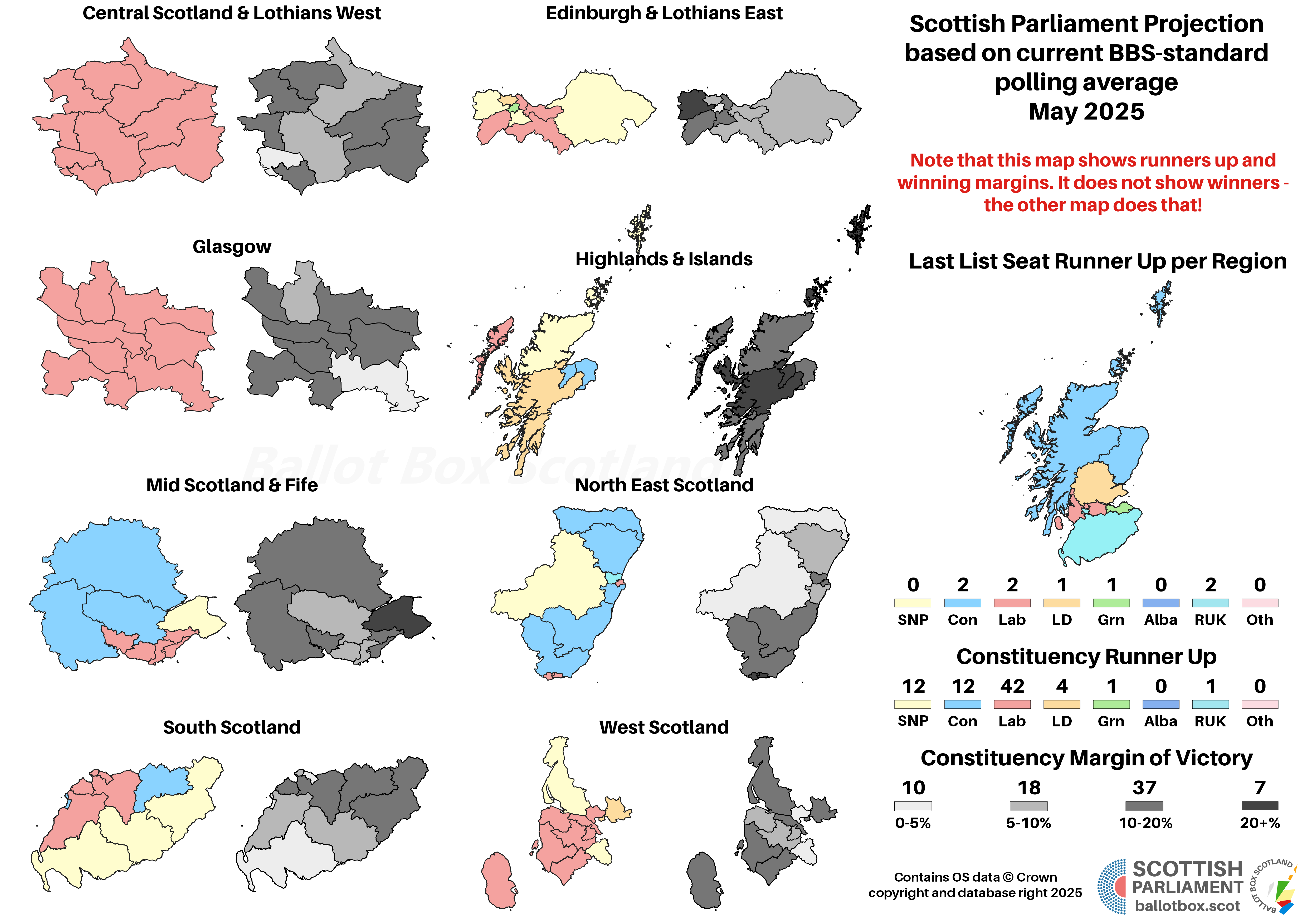
Despite substantial dips in their vote share across both votes, the SNP end up down only 4 seats versus their notional 2021 haul under the new boundaries. To give a sense of why this is the case, a useful comparator would be the 2017 UK election. That year the SNP managed to win 35 seats against 13 for the Conservatives (with a roughly 8% lead in votes) and 7 for Labour (leading by roughly 10%). All 6 of the Labour gains were by wafer-thin margins.
You create a scenario with a roughly 14% lead over Labour and 22% lead over the Conservatives and it’s no surprise almost no constituencies change hands. That allows the SNP an overrepresentation to the tune of 14 seats, and a combined Pro-Independence majority with the Greens. That’s also why although Labour are up on the proportional vote they make no net gains on their notional 2021 performance.
Possible Majorities
Note: these majorities relate simply to passing a vote in the Scottish Parliament. They do not imply the formation of a full coalition government.
- Traffic Light: Labour, Lib Dem and Green
- Independence Bloc: SNP, Green and Alba
- Grand Coalition: SNP and Labour
- Union Bloc: Labour, Conservative, Lib Dem and Reform UK
Party Analysis
SNP
If you said last July that John Swinney would seem the clear favourite for First Minister in 2026, people would have looked at you as if you had two heads. They’d have been right to. Fresh from their first defeat in almost 15 years and the self-destruction of their previous First Minister’s career, Swinney was clearly in place to stabilise the party rather than salvage long-term government.
Since then, the party’s fortunes have kind of reversed. Kind of, because the effect on their support has been exactly as intended with Swinney: it has stabilised, not recovered. I have gotten a little bit of a sense from how some folk in the SNP have been acting that they think they are effectively back in the driving seat and set for an easy victory. Nothing could be further from the truth.
The SNP’s share of the vote has only increased relatively marginally from their recent lows. They have made up about 1-2% on the list, and 3-4% on the constituency. That still amounts to a loss of about a quarter of their support on both votes versus 2021. Restored electoral dominance this is not. Yet their seat tally on my model is up from a low of 39 to 59 – from haemorrhaging MSPs to a minor graze. That’s an admittedly remarkable rebound on the face of it.
Rather than regaining vast amounts of trust and support though, they are benefitting from a collapse in the Labour vote (down 11% and 14%), the splintering of support amongst their opponents, and the fact Holyrood is only partly rather than fully proportional. That allows them to keep a lead in so many constituencies they blow proportionality out of the water.
Over the next year they could make gains that more clearly justify that result: it’s been quite common for the SNP to slump a bit in the middle of the term then rebound somewhat before the election. That’s especially true if people continue to feel unhappy with the UK Government: if you’re going to be unhappy with both governments they might as well at least be different parties so they balance one another out.
However, they also cannot afford to lose much support before constituencies start falling like dominos. They can’t rely on voters being more scunnered with 2 years of Labour government than 19 of SNP. Perhaps the biggest challenge facing the SNP after such a lengthy spell in office is what will they actually do next? It shouldn’t be controversial to say such long-lived governments run out of steam and ideas.
With no disrespect meant to John Swinney, the longest serving parliamentarian in Scotland, he’s, well, the longest serving parliamentarian in Scotland. A man who told the BBC he had tried to leave government repeatedly, before finally doing so with Sturgeon, should by rights have been retiring next year. That Humza Yousaf’s career has ended and Swinney’s extended does not speak to a vigorous, healthy party. The next generation making way for the elder statesman is not how it is meant to go.
If the SNP can’t find some energy, some zeal, some vision, then even a victory next year may be nothing more than a stay of execution. Further, as I’ve written previously, nigh-on-eternal SNP government may ironically weigh down their central cause of Independence. It’s harder to sell change when the people doing so have been the government since what feels like time immemorial.
Conservative
The counterweight to the SNP in so many ways, the Conservatives are experiencing a very different trajectory. Having been ejected from power at Westminster, the worst is yet to come. The spread of their vote and collapse of the SNP allowed them to minimise their Westminster losses on this side of the border, with only then-leader Douglas Ross losing as a direct consequence of playing dirty process games.
The proportional nature of Holyrood however means that without the advantage the SNP has of being first, their sliding vote share will be matched in seats. Indeed, they’ve started losing seats without a single vote having been cast, with Jamie Greene jumping ship to the Lib Dems. In doing so, he used a phrase that’s been on the tip of my tongue lately as well: “the Nasty Party”.
Although I like to joke I lived through Thatcherism, in reality I wasn’t even 6 months old when she left office. I remember nothing about John Major except that he’s a grey man who eats peas. I grew up with the New Labour government, and even as a child at the start of that period, I came to know one thing about the “Tories”: they were the Nasty Party.
In the late 00’s and much of the 10’s though, the Conservatives went to great lengths to dispel that notion, by at least reducing the number of societal groups they heaped scorn on. LGBT people were now to be treated with dignity and respect. David Cameron introduced marriage equality in England and Wales, and the initially exoticised “kickboxing lesbian” Ruth Davidson led a modernised Scottish wing dramatically into second place. Even Theresa May tried to legislate for self-ID for trans people.
That couldn’t be further from the party’s approach now. It is indeed the Nasty Party once again. Douglas Ross was very happy to lead it onto appalling culture war territory, and Russell Findlay is even worse. Not very long ago he was plastering his face over a graphic showing how he would – apparently – invest in public services, whilst John Swinney instead funded Stonewall. That sound you can hear is every dog in the West of Scotland barking.
This – the perception of nastiness, not necessarily the specifics of their main targets – is a serious problem for the Conservatives. The portion of middle Scotland that returned to them in the Davidson years was enabled to do so through the combination of social liberalism, relatively gentle centre-right economic policy, and strident defence of the Union. They aren’t socially liberal anymore; Conservative economic policy departed from “gently centre-right” when Liz Truss crashed the economy; and the salience of the constitution has been slipping.
People used to refer to Ruth Davidson as “the next First Minister of Scotland”. That was always unlikely in my view: the Conservatives were never coming first, and Labour couldn’t afford to vote her into Bute House from second place. Yet it at least seemed credible to ordinary voters.
If anybody ever said that about Douglas Ross, it didn’t last long. Russell Findlay has publicly acknowledged the idea he could hold that office is laughable. With nothing to offer the centre and with Reform gobbling up the far-right space the Conservatives contributed to opening, the Scottish Conservatives feel very much adrift right now.
That’s reflected in polling which has inched ever closer to not just third place behind Labour, but fourth behind Reform. That crossover happened with the Survation poll published today. Before Labour started imploding again and Reform surging, the Conservatives could at least console themselves with the knowledge they’d likely be a necessary partner for Anas Sarwar. Instead, they may well be headed towards a level of irrelevance and impotence they haven’t seen since the first two sessions of Holyrood.
Labour
It’s all gone wrong for Labour, hasn’t it? Especially after they swept to a big Westminster victory last year, they just assumed they were set to re-take office at Holyrood too. I wouldn’t have been surprised to see Anas Sarwar trying to sneak into Bute House to measure up the curtains. Instead, their support has completely cratered, both at UK and Scottish levels. The new Labour Government is astonishingly unpopular, and so is the party: and what’s more, it deserves to be.
I have my views on what they have (or in some cases) haven’t done, but I usually don’t share personal thoughts on policies. The exceptions are democratic systems and LGBT rights. As a gay man with a platform in Scottish politics, however small, I have always felt a moral obligation to use it to call out discrimination against my community – my whole community. Let me be frank: Labour has over the past few months been completely and utterly vile about trans people.
I don’t think all that many people are changing their votes over this issue, but I do think Labour have got the calculation completely back to front. Support for LGBT people, including trans people, is high amongst their natural voter base. Opposition is high amongst people who aren’t going to vote Labour regardless of what they do about it. Of those who are shifting, the balance will be to Labour’s disadvantage.
Crucially though this is far from the only issue where the party has deliberately chosen to alienate some of their core voters. Of all parties, you might think Scottish Labour would know what it’s like to take that core for granted and assume it’ll always be there. That’s especially true when they can’t raise the spectre of “what if the proper right wing wins instead because you split the vote!” when one, their primary opponents are another formally centre-left party and two, the proportional voting system means the Greens and Lib Dems are viable alternatives.
In my tracker just before the boundary changes were finalised, Labour recently dipped below their 2021 haul of 22 MSPs for the first time since the election. They are sitting nearly 40 seats adrift of the SNP in the projection above. Even if a Pro-Union majority emerges at Holyrood, unless there’s a massive turnaround, it’s hard to see how Sarwar becomes First Minister.
Leading a government from second place is a perfectly legitimate outcome of PR, but not only is it one we’re culturally unused to in UK parliaments, it’s unthinkable if the SNP end up with twice as many (or more) seats than Labour. That would be an astonishingly weak administration, and one completely and utterly reliant on Reform UK support. Sarwar might be desperate enough to try it, but I’m not sure the Lib Dems would be willing to kamikaze as well.
All that said, a year is a long time in politics. Labour has time to turn this around. Perhaps if they focus rather more on making people’s lives better, rather than aping Trumpian ideas like a Department for Government Efficiency, they might recover somewhat. Perhaps if they give people reason to vote for them rather than against the SNP, that might help. Perhaps if they stop putting the boot into trans people, something very few voters want to see as a priority, and start talking about the issues that matter, they could gain votes.
Greens
It’s been an odd auld time for the Greens. 2021 saw their biggest MSP group yet and the Bute House Agreement which brought them into government. They followed this with a doubling of their councillors in 2022, a strong rebuttal to those still believing the tactical vote myth. It all came crashing down last year though, when myth believer Humza Yousaf triggered his own downfall by throwing them out of government.
Far from destroying them, they went on to by far their best Westminster result yet Certainly, it was modest compared to other parties and elected no MPs, but by Green standards it was massive. They have done well at Holyrood after much worse Westminster results. Yet since then, their polling has ticked downwards, putting them below the Lib Dems.
Don’t read too much into this in isolation though. It’s above where they were in 2021. It’s artificially deflated by the fact we’ve only had the low-Green pollsters reporting lately (I’ve ignored some of the strongest Green polling in their history because it’s coming from a clearly dodgy pollster!) It’s similar to where they were at this point in the last parliament: up slightly on the previous, lower than what they ultimately achieved.
They are aided by a strengthened starting position thanks to the boundary changes. In four of the five regions that have been redrawn, they are more secure than before, and barely less so in the fifth. In two cases they even pick up an additional seat. That means they won’t struggle quite so much to hit the dual goals of double-digit MSPs and one in every region for the first time.
That doesn’t mean they can rest safe in the knowledge they are on track for another record win. They need to work for it, especially given the regional rather than national proportionality makes the 9-10% space a “deadzone” where growth in support probably doesn’t add any more MSPs past 10. Their BHA experience was bruising, but it has potentially given them some much-needed distance from the SNP. With Labour now doing everything they can to repel socially and economically progressive voters, the Greens have a big opportunity.
The upcoming post-Patrick Harvie leadership election is a key moment to signal their seriousness. With a fair-sized group of other MSPs to choose from, do they pick two from amongst that number, ensuring national leadership has national profile? Or do they wind back the clock to the era of one MSP, and one not, Co-Leader? The lengthy period they spent with a “not” saw them all but ignored externally, despite the party’s efforts, until a pandemic briefly forced journalists out of the Holyrood bubble.
More widely, the Greens must decide once and for all what their purpose is, and at this point I want to introduce the concept of a “Testimonial Party”. Enabled by a hyper-proportional system, some Dutch parties stand not to achieve power but to give testimony to their beliefs. They do not generally seek to enter government, shape its legislative agenda, or set budgets. That’s fine when you can win a seat on 0.67% of the vote.
It’s much less likely the 8-9% of voters needed to secure a seat in every region will have much truck with a party that never wants to achieve anything because it’ll never compromise. Compromising with other parties is an essential part of a proportional voting system, something the Greens are the strongest advocates of. It’s the only way they will ever get any of their policies enacted. Parties do not need complete policy purity to maintain their principles. If the Greens have learned that they’ll do well. If they haven’t? Hm.
Lib Dems
Shortly after Alex Cole-Hamilton became Scottish Lib Dem leader, I wrote about the party’s grim prospects. In focusing on a tried-and-tested “dig into key constituencies” approach, the Lib Dems appeared to be prioritising Westminster over Holyrood. This is a strategy that pays dividends under FPTP, but not under PR. That’s how the Lib Dem vote share remained static across 2011, 2016 and 2021, yet they went from a proportional entitlement of 6 MSPs in 2011 (albeit the 6th was denied by the SNP exceeding their entitlement in Lothian), to 5 in 2016, and ultimately 4 in 2021.
Elections since then have been somewhat mixed. A genuinely good result in the 2022 locals was driven largely by growth in existing strongholds like Edinburgh, the Highlands and North East Fife. Their 6 MPs in 2024 came not from increasing their support versus 2019 but redistributing it. It remains highly unlikely the Lib Dems will pick up a seat in Glasgow or the redrawn Central and Lothians West region, and therefore they will remain a regionalised rather than national grouping.
Even so, their prospects are looking rosier now than at any other point this term. They’ve edged ahead of the Greens in polling, though see earlier caveats about that being entirely low-Green pollsters. Likely easy constituency wins in Caithness, Sutherland and Ross plus the new Edinburgh Northern (that one won’t show in my model as it can’t account for hyper-local ground games) give them a floor of 6 MSPs regardless of list shares, and at the very least they should regain a North East list MSP with decent prospects in West and South.
That potential for decent regrowth also combines with a big, if unexpected and (from their perspective) sub-optimal, opportunity to exert significant influence over government for the first time in nearly 15 years. Although Cole-Hamilton couldn’t have been more obviously angling for a spot in a Sarwar cabinet not so very long ago, right now that doesn’t seem likely. Working with the SNP is not his first instinct. The Lib Dems however are nothing if not pragmatic.
In Aberdeen, they form the only surviving cross-constitutional council administration anywhere in Scotland. Earlier this year Lib Dems jumped at the chance to get a budget deal, the first time that’s been possible in several years. On social issues and topics like the UK Government’s cuts to social security, they have similarly aligned with the SNP and Greens. The constitution may be a divide but it’s not an unbridgeable one. That’s especially true if the alternative is an anaemic Labour administration that is utterly reliant on Reform UK.
That’s not to say I expect to see Cole-Hamilton serving in the ministry under Swinney. I think the (entirely reasonable) hankering for a cabinet spot was limited to a Labour-led administration. Instead, what I can see is a “modus vivendi” – a way of living – if the SNP and Greens come up short. The Lib Dems may very well consider that an uneasy, informal cooperation with the Pro-Independence bloc achieves more of their agenda than either stubborn refusal to engage or an even uneasier accommodation with Reform UK.
Reform UK
Historically speaking, Scotland hasn’t had much truck with parties to the right of the Conservatives. Even when UKIP were peaking at 30% of the vote in England for the 2014 European elections, they were barely scraping it across 10% in Scotland. In the following year’s UK election, 14% in England compared to 2.3% in contested seats in Scotland, and their MEP had to flee the count with his tail between his legs in 2016 when they only won 2% of the regional vote.
That all changed last year, when Reform UK contested every seat and pulled a solid 7%. They were never in contention for seats and that was half their UK-wide share, but it represented a genuine breakthrough. Since then they have been doing very well in council by-elections, frequently polling shares that would hand them a councillor at a full election. For next year it’s not a question of if Reform will elect MSPs, but instead how many. The real challenge then is what they do with them.
A consistent problem for Farage-led outfits has been the coherence, discipline and suitability of their representatives. UKIP’s European Parliament groups were remarkably fractious, losing MEPs to personal conflicts, impropriety, and occasionally even crimes. They lost 3 of 12 in the 2004 term; 5 of 13 from 2009; and all but 3 of 24 from 2014, of whom just 14 ultimately ended up in the newborn Brexit Party. In the mere months the 2019 intake served, that new outfit still managed to lose 6 of their 29.
It wasn’t just their MEPs at it. They picked up 7 seats in the Senedd Cymru in 2016. Yet that group immediately couped their own leader, Nathan Gill, in favour of Neil Hamilton, who ended up the only one still a UKIP AM come 2021. The 4 that joined the Brexit Party later abandoned that affiliation, 3 because they opposed the Senedd abolitionist position the party adopted, and the other to join the full-fat Abolish the Welsh Assembly Party.
All of which is to say when your party is defined not so much by a coherent ideology across a range of policy areas, but a small number of perceived “stick it to the woke elite” howls of anger, you get the candidates to match. You’ll elect a motley crew of angry people, most of whom have limited political experience, and who aren’t necessarily equipped for the job. There’s a lot to critique about the established political parties and their internal cultures, but they are at least relatively effective at skilling people up and binding them together as a vaguely functioning unit.
That is especially true in Scotland where there is absolutely zero meaningful history of organising and electing parties to the right of the Conservatives. An MEP at two successive elections is not a comparable base to the hundreds of English councillors UKIP once claimed. It’s not even comparable to the dozens of MEPs England cumulatively elected. At best, they’ve got those defecting councillors, but on past form alone it’s absolutely certain they will elect some complete howlers elsewhere.
Who is going to work with a group that will likely struggle to work with itself? A Reform UK MSP group will be as much of a culture shock for its members as for Holyrood. This isn’t intended to be scornful, but simply clear-eyed. Perhaps their Scottish arm will prove altogether more stable than past outings… just don’t bet on it is all I’m saying.
Alba
Alba was founded, regardless of what its members may wish to believe, fundamentally as an Alex Salmond vanity party. Alex Salmond is dead; so is Alba. It couldn’t even have a post-Salmond leadership contest without extreme factional bitterness leading to the expulsion of a prominent figure.
Dreams of winning any MSPs never mind a group are the just that, and if we actually had a wide spread of credible pollsters, that’d be more than evident from polling. Alas, we’ll need to muddle on with them being furious at me for stating the obvious for at least a few more months yet.
What next for the 2026 election?
Now that we’re at what feels like the start of the actual campaign, I’m of course thinking about all the Ballot Box Scotland coverage in advance of the election. Later this year I’ll be setting up one my usual hub pages that will include polling aggregation, a seat projection, and a list of MSPs that won’t be re-standing next year. It’ll also link to all the other content I produce.
Much closer to the day I’ll have my usual bits and pieces. There’ll be an in-depth profile piece for each party. I’ll also go through my Ballot Box Battlegrounds series which looks at the most marginal constituencies based on 2021 results, plus the bonus rounds of ones to watch that aren’t technically marginals. There will almost certainly be additional analysis articles looking at particular quirks or emerging topics of interest.
As ever, if you value the huge amount of work I put into Ballot Box Scotland, please do consider chipping in a few quid via the link below if you can afford it. I will also be running a crowdfunder later in the year to raise money for a poll (or two, you never know) ahead of the election, if you prefer to hold back until then!
If you find this or other Ballot Box Scotland output useful and/or interesting, and you can afford to do so, please consider donating to support my work. I love doing this, but it’s a one-man project and takes a lot of time and effort. All donations, no matter how small, are greatly appreciated and extremely helpful.
(About Donations)