Ward Profile
Cause of By-Election
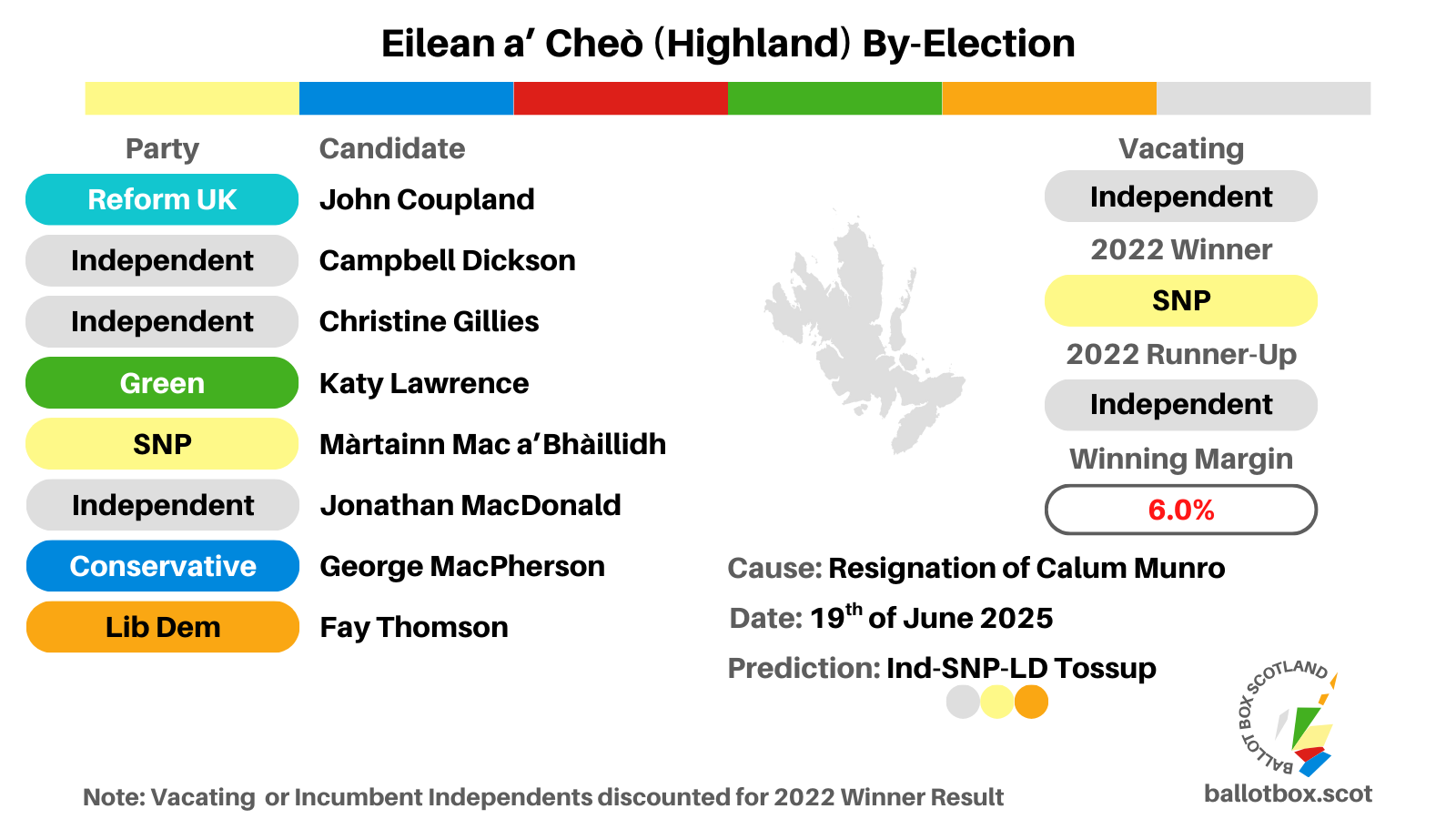
Roll up, roll up, we’ve got another Highland double bill coming. Highland has a particularly notable councillor turnover rate, but it sometimes manages to get them close enough together to be able to hold one round of by-elections rather than staggering them. For the June 2025 outing, one half takes us to Eilean a’ Cheò where Independent councillor Calum Munro has stood down. He was first elected in a 2020 by-election.
Ward Details
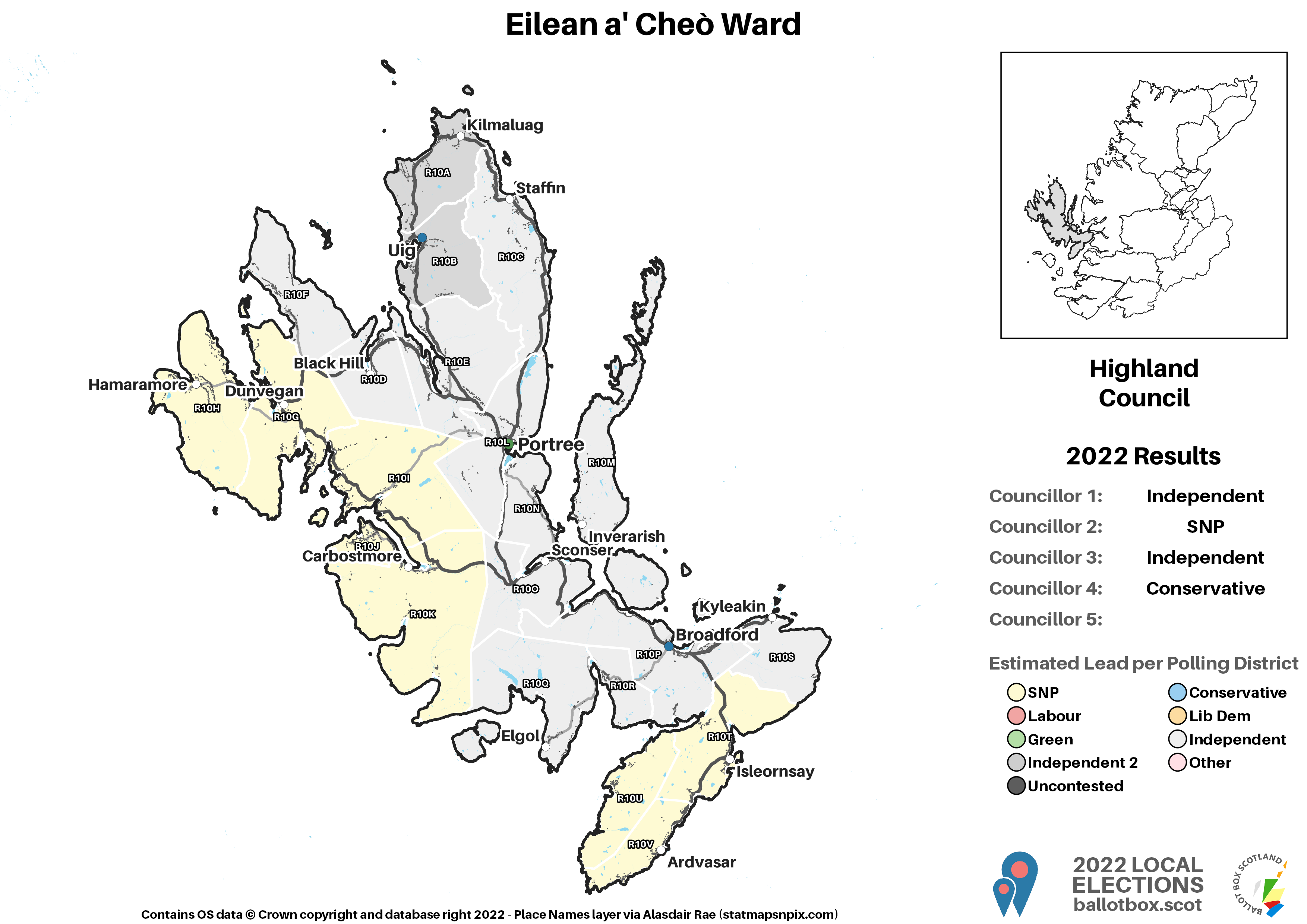
Eilean a’ Cheò is one of 21 wards in Highland, and elects 4 councillors at a full election. The main component of this ward is the Isle of Skye, with the Gaelic name here rather poetically meaning “the Island of Mists”. Poetic is the key term as I’m given to understand that on a daily basis it’d be known as An t-Eilean Sgiathanach. Skye is by no means the only island this ward covers, but of the others only Raasay’s population of around 160 people would need more than your fingers to count.
For elections to the Scottish Parliament, the ward is entirely within the Skye, Lochaber and Badenoch constituency which the SNP have held since creation in 2011. Under the prior boundaries it had been in Ross, Skye and Inverness West which was, as you’d expect at the time, a Lib Dem seat. At the UK Parliament it’s within the Inverness, Skye and West Ross-shire seat that the Lib Dems won last year. Previously that had been Ross, Skye and Lochaber, seat of the late Lib Dem leader Charles Kennedy, until the SNP gained it from him in 2015 in what he famously dubbed “the night of the long sgian dubhs.”
Electoral History
The first two elections to the ward returned the same pattern of councillors with two Independents (Hamish Fraser and John Laing in 2007) and two party councillors, the latter going one apiece to the SNP and Lib Dems. There was a slight change of personnel in 2012 though as Laing retired and was replaced by a new (poll topping) Independent, John Gordon. Partway through the term Lib Dem councillor Drew Millar quit the party (alongside Martin Rattray, a possible winner of the other by-election due on this same day) and formed a localist group alongside Independent Andrew Baxter (later a Conservative and now a Lib Dem councillor, following a by-election last year). Ahhh, the Highlands.
The new Lib Dem in 2017 did appallingly badly, and so the SNP ended up with the sole partisan councillor. There was a changing of the guard though as Ian Renwick’s decade of service did him no good in the face of Calum MacLeod’s alphabetically advantageous appellation. It wasn’t a good day for long-serving councillors as Hamish Fraser also got given his marching orders as two new Independents (John Finlayson and Ronald MacDonald) joined the re-elected Gordon.
The SNP likely regretted having stood this second candidate as he was out of the party by the end of the year. Ronald MacDonald gave it a half-term before he resigned, bringing Calum Munro into office. Finally, in 2022, John Gordon stood down, and the Conservatives squeaked the final seat alongside a fresh SNP councillor and the two incumbent Independents.
Even more than the Highland average, this is a ward that has seen its share of Independent candidates. I try and break them out a bit in these charts to show how their support shifted but that’d be such a headache here. I’ve instead grouped them as “win” and “lose” blocs. Even though Highland as a whole has gotten significantly more partisan over the years, dropping from 40.9% of the vote in 2007 to 25.6% in 2022, Eilean a’ Cheò has remained a tough nut for parties to crack, as none of them have even reached 30% of the vote at any election thus far.
The Lib Dems started out as the most popular party but were overtaken by the SNP in 2012, and have remained behind since. Note that a huge Lib Dem spike in the 2020 by-election which gave them their best share so far was followed by another complete collapse in 2022; their by-election candidate ended up standing as an Independent that time around. Note too the slow uptick for the Conservatives continuing even into a year they went backwards nationally in 2022. See also the Greens doing pretty well in the by-election then disappearing again: I must admit I was very surprised by this in 2022, as that’s the kind of share you’d assume would motivate a real run at a councillor.
Councillors and Key Stats
4 Councillors, in order elected:
⚪Independent: John Finlayson
🟡SNP: Drew Millar
⚪Independent: Calum Munro
🔵Conservative: Ruraidh Stewart
Change vs 2017: +1 Conservative, -1 Independent (Calum Munro newly elected, John Gordon retired, Ronald MacDonald retired mid-term)
Turnout: 51.3%
Electorate: 8912
Valid: 4515 (98.8%)
Spoiled: 56 (1.2%)
Quota: 904
Candidates
🟠Lib Dem: Jack Clark
⚪Independent: John Finlayson
⚪Independent: Donald MacDonald
⚫Alba: Hector MacLeod
🟡SNP: Drew Millar
⚪Independent: Calum Munro
🔴Labour: Peter Ó Donnghaile
🔵Conservative: Ruraidh Stewart
⚪Independent: Fay Thomson
First Preferences
Transfers (single winner recalculation)
Two-Candidate Preferred
Two-Party Preferred
By-Election
Candidates
It’s not quite the Holyrood 5 for this one, as it appears there’s a pattern emerging whereby Labour contest full elections and the Greens by-elections, but ne’er the twain shall meet in this ward. The four mainstream parties are joined by the recently commonplace Reform and three Independents.
Amongst these we’ve only got two returnees. Most notably, the Lib Dems’ well-performing 2020 candidate who stood much less successfully as an Independent in 2022 is back in the party fold. The SNP’s candidate is likewise a 2020 by-election throwback, though he was then the Independent who placed dead last.
🟣Reform UK: John Coupland
⚪Independent: Campbell Dickson
⚪Independent: Christine Gillies
🟢Green: Katy Lawrence
🟡SNP: Màrtainn Mac a’ Bhàillidh
⚪Independent: Jonathan MacDonald
🔵Conservative: George MacPherson
🟠Lib Dem: Fay Thomson
Analysis
If all we were looking at here was the 2022 result, we might assume this to be a pretty clear “SNP versus Independents” contest. If we run 2022 as the SNP versus the only Independent candidate making a return this time, they end up with a 6% lead; easily overturned in the current context especially. Except, of course, that Independent isn’t an Independent this time: she’s a Lib Dem. Again.
Thomson’s past performance as a Lib Dem was pretty impressive, and although she somewhat flopped as an Independent, I’d assume she’s weel-kent by this point. Add in the facts that the Lib Dems won the Westminster seat; they are gunning for the Holyrood equivalent (perhaps less successfully, given Kate Forbes’ personal vote, but that’s another topic entirely); and they are pretty much the only Holyrood party not enduring some kind of difficulty at the moment, and they could be well positioned for a win.
Highland by-elections always have an unpredictable air to them, and this is a particularly complex one. I’d say the SNP’s chances here are definitely better than in Cromarty Firth, given a recent history of beating the Lib Dems pretty heavily. As such I’m inclined to view this as a three way scrap: the SNP versus the Lib Dems versus one of the Independents. I haven’t the foggiest which of the Independents is likely to prove strongest, mind you, but I can’t know everything!
Prediction
SNP – Lib Dem – Independent Tossup.
2022 Results (Detailed Data)
Transfers (full election)
Results by Polling District
Second Preferences
If you find this or other Ballot Box Scotland output useful and/or interesting, and you can afford to do so, please consider donating to support my work. I love doing this, but it’s a one-man project and takes a lot of time and effort. All donations, no matter how small, are greatly appreciated and extremely helpful.
(About Donations)