Ward Profile
Cause of By-Election
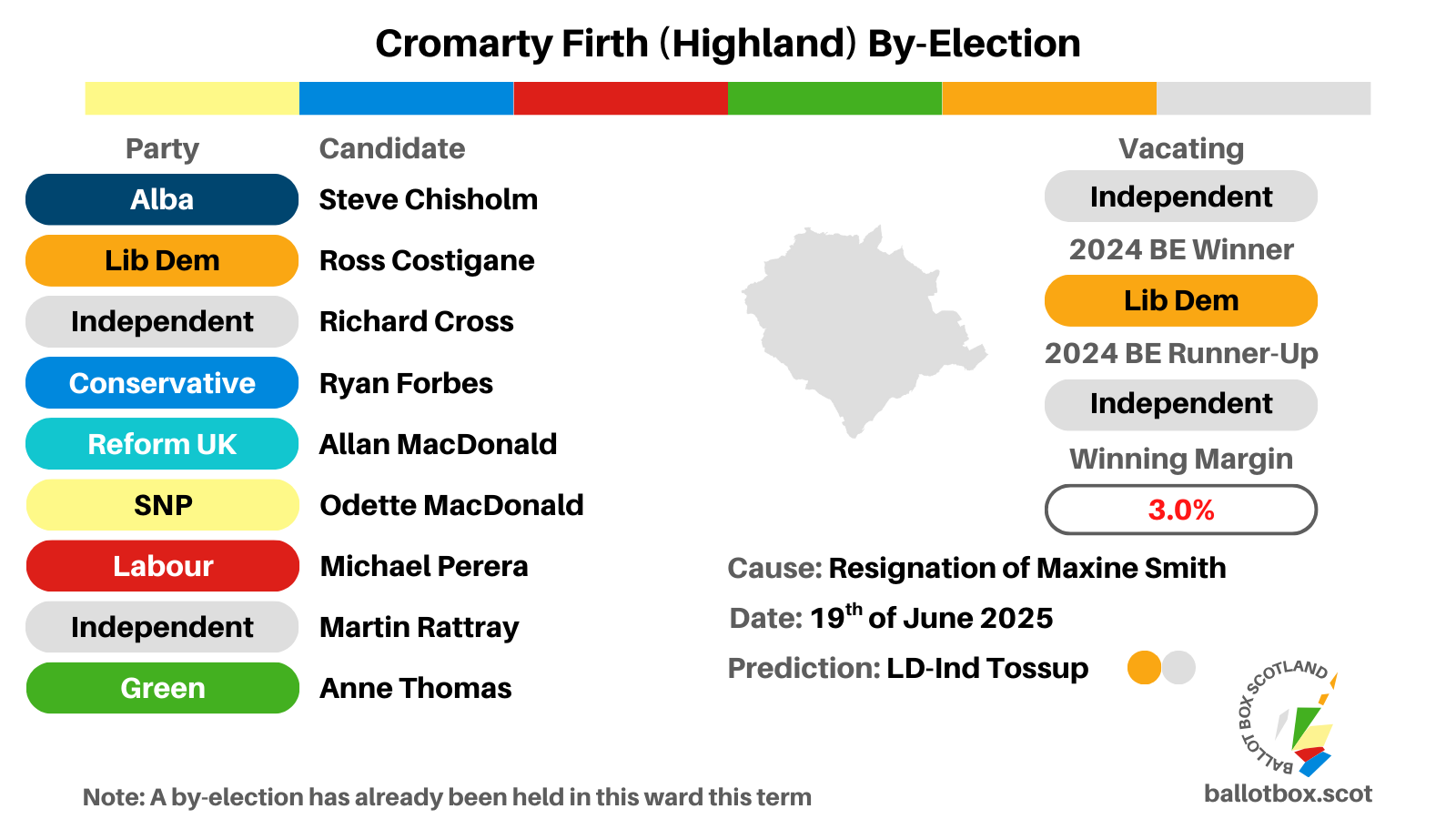
Roll up, roll up, we’ve got another Highland double bill coming. Highland has a particularly notable councillor turnover rate, but it sometimes manages to get them close enough together to be able to hold one round of by-elections rather than staggering them. For the June 2025 outing, one half serves us a quick return to Cromarty Firth, which already had a by-election in September last year. This time around it’s due to the resignation of Independent councillor Maxine Smith.
Smith was first elected back in 2007 as an SNP councillor, but although she went into 2017 as the SNP’s local group leader, she ultimately quit the party in 2020 as a result of internal divisions alongside fellow ward councillor Pauline Munro. Both were successfully re-elected as Independents in 2022. Smith has now chosen to quit the council entirely, citing abuse as her primary reason. This is, unfortunately, an all too common experience for councillors in the social media era, but that doesn’t make it any less grim when it forces someone out of their job.
As there has already been a by-election for this ward, much of the profile text below is just lifted and laid from the earlier preview.
Ward Details
Cromarty Firth is one of 21 wards in Highland, and elects 4 councillors at a full election. Although it takes up a geographically substantial portion of Easter Ross, the overwhelming bulk of the population does indeed reside on the coast of the Cromarty Firth. The three primary settlements here, in order of size, are Alness, Invergordon and Evanton. The inland portion is largely mountainous, surrounding Lochs Glass and Morie, though there’s a stretch of flatter land either side of the river Averon home to a scattering of more rural dwellings. There haven’t been any boundary changes here since STV was introduced, making electoral comparisons relatively simple.
For elections to the Scottish Parliament, the ward is entirely within the Caithness, Sutherland and Ross constituency which has been held by the SNP since it was created in 2011, the prior slightly smaller “… and Easter Ross” version having been Lib Dem for its entire history. At the UK Parliament it’s within the still-titled Caithness, Sutherland and Easter Ross seat which expanded enormously for last year’s election. The Lib Dems held it in that form, having won the smaller version that contained this ward at every election since it was created in 2005 except the SNP’s 2015 landslide.
Electoral History
Although the faces would change over the period, the ward very nearly ended up with the same pattern of representation over every election. 2007 set that pattern at one apiece for the SNP and Lib Dems, plus two Independents – Carolyn Wilson and Mike Finlayson. In 2012, all four incumbents were re-elected, though a second SNP candidate was a jaw-droppingly minuscule 0.01 of a vote shy of beating the Lib Dem.
Said Lib Dem would eventually break with his party that term, and re-stand as an Independent in 2017. Although he won more votes than his former party, neither would make it over the line, giving a 2:2 split between the SNP and Independents. Both of the SNP councillors, as mentioned earlier, would go on to quit the party during that term.
Although 2022 then re-established the same pattern as the first two elections, the Independents in question were those former SNP councillors, as both Wilson and Finlayson opted to retire that year. The resignation of the Lib Dem and both 2022 Independents over the past few months means that the SNP’s Tamala Collier is the only remaining councillor elected at the full election. September’s by-election maintained the pattern, as it was Lib Dem plus one Independent out, and Lib Dem plus one Independent in.
In voting terms, Wilson started out as both the stronger Independent and the strongest overall, placing a decent bit ahead of the SNP and well clear of both the Lib Dems and Finlayson, who would spend his entire career very heavily reliant on transfers. Patterns weren’t hugely different in 2012 except that the SNP pulled ahead and the Lib Dems went on the slide, which would continue into 2017.
When 2022 rolled round though, you can see the effect of intense Lib Dem campaigning locally for the Westminster seats, as their share skyrocketed, nearly equalling the SNP’s. For their part the SNP only lost a relatively small portion of their vote compared to 2017 despite both of their former councillors standing as Independents, perhaps given the glut of votes available from Wilson and Finlayson retiring. Whereas Munro was quite comfortably elected, Smith followed the Finlayson tradition of needing a very substantial transfer allocation.
In last year’s by-election, the SNP, Lib Dems and Conservatives all dipped substantially, though the Lib Dems were able to place ahead of the SNP for the first time. That may be due to the five Independents on the ballot, who hoovered up half the vote between them, compared to around 30% that went to the sum of Independents in 2022.
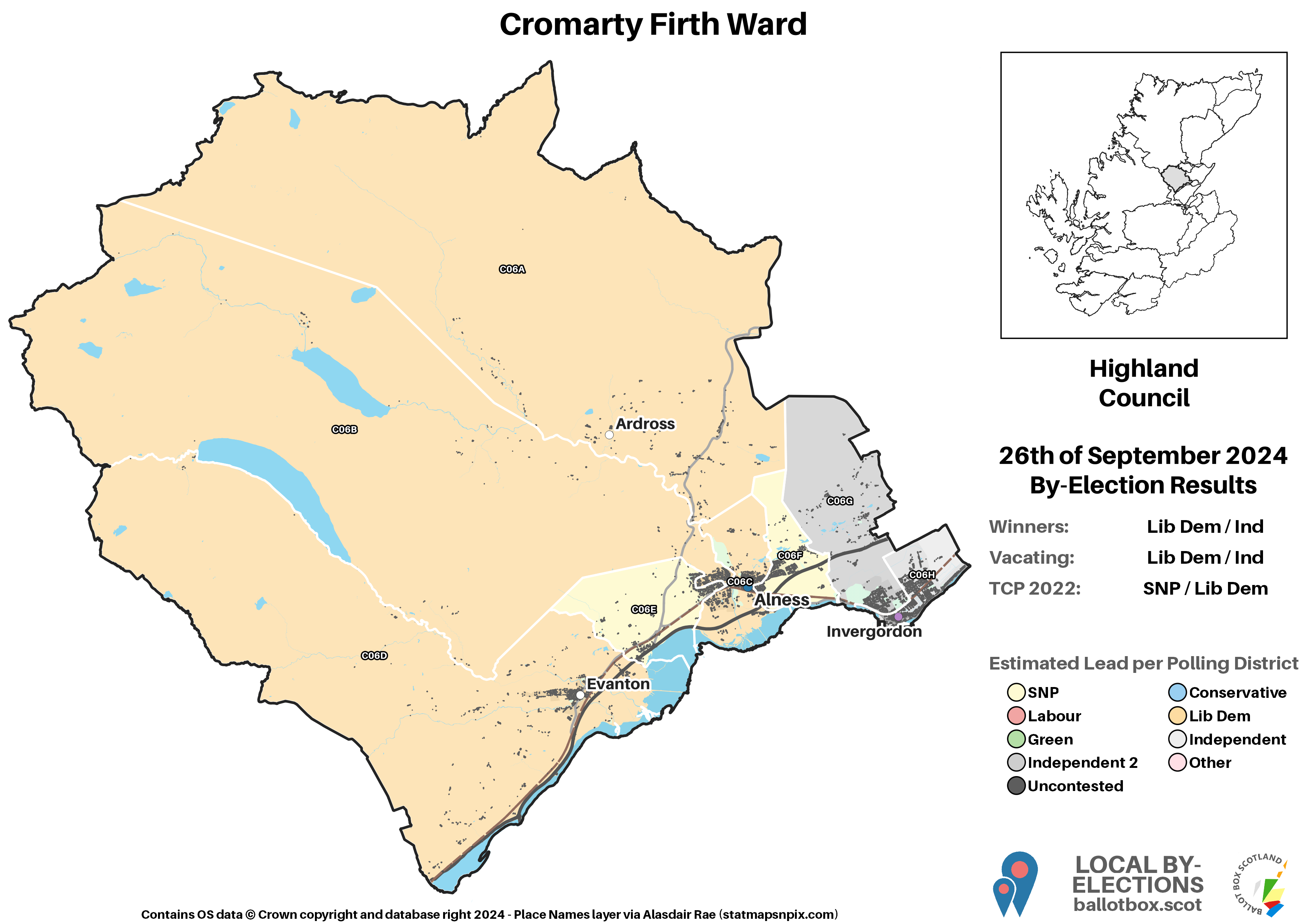
Councillors and Key Stats
2 Councillors Elected:
🟠Lib Dem: John Edmondson
⚪Independent: Sinclair Coghill
Change vs 2022 (notional): Lib Dem Hold, Independent Gain from SNP
Change vs vacating: Lib Dem Hold, Independent Hold (new Independent)
Turnout: 24.6% (-15.0)
Electorate: 9832
Valid: 2375 (98.1%)
Spoiled: 45 (1.9%)
Quota: 792
2 Continuing Councillors: SNP: Tamala Collier
 Independent: Maxine Morley-Smith
Candidates
🟢Green: Ryan Barrowman
⚪Independent: Sinclair Coghill
⚪Independent: Richard Cross
🟠Lib Dem: John Edmondson
⚪Independent: Brideen Godley-MacKenzie
🟣Reform UK: Kim Hanning Jackson
🟣Reform UK: Roland Hanning Jackson
🟡SNP: Odette MacDonald
⚪Independent: Tina McCaffery
🔵Conservative: Innes Munro
🔴Labour: Michael Perera
⚪Independent: Martin Rattray
First Preferences
Note: Other Independents collectively won 29.2% of the vote in 2022.
Transfers (single winner recalculation)
Two-Candidate Preferred (excluding elected Independent)
Two-Party Preferred
By-Election
Candidates
A slightly less stuffed ballot this time, in part due to a trimming down of the number of Independents: it’s the Holyrood 5, plus Reform, plus Alba, plus two Independents. Both Independents are returning from September’s by-election, recalling that Martin Rattray is a previous Lib Dem councillor for the ward, and the SNP and Labour are likewise re-standing the same faces. Most of the other party candidates also have a recent track record of standing, leaving just Reform and the Lib Dems as completely fresh faces.
The Greens’ Anne Thomas stood for the Westminster seat last year, in the Black Isle ward in 2022, and was second on the party’s Holyrood list in 2021. Notably, she achieved the highest vote share of any Green candidate in Highland but the quirks of STV meant she wasn’t one of the four councillors they elected. Alba’s candidate likewise stood for the Westminster seat, whilst the Conservative has contested two Inverness wards: West at the full elections in 2022, and South in a by-election last year.
⚫Alba: Steve Chisholm
🟠Lib Dem: Ross Costigane
⚪Independent: Richard Cross
🔵Conservative: Ryan Forbes
🟣Reform UK: Allan MacDonald
🟡SNP: Odette MacDonald
🔴Labour: Michael Perera
⚪Independent: Martin Rattray
🟢Green: Anne Thomas
Analysis
Rural Highland (by which I mean non-Inverness, appreciating there are quite large towns by Highland standards in this ward) by-elections are always tough nuts to predict. These days you can basically assume that some constellation of Independent, Lib Dem and SNP will be the only real runners, with everyone else just there for show. With two returning Independents from a recent by-election, one of whom has prior experience as a councillor, it’s even trickier to pin down.
If we run the earlier by-election back through without either the successful or the non-returning Independents, the Lib Dems beat Martin Rattray by 3%, though it’s near enough a three way split between them and non-transferring votes. However the other returning Independent, Richard Cross, wasn’t that far behind either Rattray or the SNP when he dropped out. If we remove Rattray instead, Cross pulls ahead of the SNP and then places 5.1% behind the Lib Dems. It’s therefore reasonable to suggest that any of those three could win, depending on how a likely smaller pool of non-transfers distributes.
Although the SNP aren’t far behind at any point in the process, they do end up over 11% behind the Lib Dems in a direct party matchup. They likewise end up 7.7% behind Cross and 8.4% short of Rattray if those are the head to heads. I wouldn’t go so far as to say the SNP have absolutely no chance but I do reckon it’s very unlikely they can get the transfers to win.
It’ll also be interesting to see how Reform do. In September the only established party they beat were the Conservatives. Their Scottish operation was also so threadbare at the time that, much to my amusement, neither their nominating officer nor either of their English incomer candidates seemed to actually understand STV. That’s why they nominated two candidates for two vacancies as if it was England’s “X past the post” abomination of a local voting system. I imagine they’ll do rather better this time around, having grown massively in profile and success in the past few months.
Prediction
Lib Dem – Independent Tossup.
2022 Results (Detailed Data)
Transfers (full by-election)
Results by Polling District
Second Preferences
If you find this or other Ballot Box Scotland output useful and/or interesting, and you can afford to do so, please consider donating to support my work. I love doing this, but it’s a one-man project and takes a lot of time and effort. All donations, no matter how small, are greatly appreciated and extremely helpful.
(About Donations)