As is so often the case here on Ballot Box Scotland, my fervent wishing for some polling outwith the recent batch was apparently made on a monkey’s paw. After 18 months of relative quiet, YouGov (link to tables and original writeup) have finally broken their post-GE24 silence with a new Scottish poll. Having got my wish, there are some aspects of it that have made me irrationally grumpy, not least the fact fieldwork was the 8th – 14th of January but it wasn’t released until the 29th! Given we’d had two other January polls ending on the 12th and 16th, I had to go back and re-work some data to slot this in. Is this a real problem? No. Am I just a slightly petulant person in general? Alas, yes.
The previous YouGov Holyrood poll covered the 20th – 25th of June 2024. Changes are shown as (vs that poll / vs last election). They had an Independence poll out from the 5th – 6th of November last year though so that’s more recent. Note that whilst there have been YouGovs for the Scottish Election Study’s SCOOP tracker in the intervening period, those use a different methodology. There’s nothing wrong with that, it just means I keep them separated and don’t count them for poll-to-poll differences.
Regional Vote
Change vs Last Poll
Change vs 2021
Let’s start with what I like (from a data perspective, not a partisan one) about this poll: the fact the last normal YouGov was just before the General Election may have been annoying up until now, but in this moment it’s actually extremely useful. That’s because it shows starkly how far Labour have fallen since then, but also how the SNP’s fortunes haven’t turned around due to anything they’ve done.
SNP support is exactly where it was 18 months ago, which is entirely in line with other polls finding a pretty flat trend. By contrast, Labour support has halved, taking them down to a joint-worst share on this vote this term. You have to go back to a November 2021 Ipsos to find another 15%. That’s absolutely dire for them, and although it’s by definition at the lowest end of their recent polling, it’s well within the margin of error overall. In other words, whilst the following point may mean they aren’t quite this low in reality, it’s not impossible that they are.
What I don’t like (again, on a data basis, not a partisan one) is Reform being on 20%. It’s not that 20% is unbelievable in and of itself: we have had polls from other firms hitting that figure, albeit it is the absolute peak of their polling. Instead, it’s that it puts YouGov as the highest of the current crop of pollsters in Scotland, when at GB-level they are notably the weakest Reform pollster, finding around 24-25% when other pollsters are sitting at around 28-30%. Whilst I accept and acknowledge the realities of margins of error and methodological differences, that just doesn’t wash with me.
If we take Survation for example as a pollster that did both a GB and Scottish poll at roughly the same time earlier this month, the GB share was 29% and the Holyrood list share was 18%. In general across all polling, Reform’s Scottish support has run at roughly two-thirds their GB level support. For YouGov to find it at four-fifths doesn’t pass my personal smell test. That’s especially the case when the (cautions very much apply) Scottish subsample of their most recent GB poll says 16%, and Reform are consistently doing a little better in Westminster than Holyrood polling up here.
In any case, the poll says what it says, and much like Ipsos and their tendency to find jaw-droppingly high Green figures, I can just raise my eyebrow at it and let averaging do the work elsewhere. Speaking of the Greens, they squeak ahead of the Conservatives here (on what is nonetheless a statistical tie), as the only party bar Reform to show any growth since the June 2024 poll. Compared to those aforementioned Ipsos highs, I think this is much more realistic, and also more realistic than the Survation lows. Meanwhile, the Lib Dems are still sitting pretty on the same share they had then, whilst Alba limp on through these last few months of me acknowledging their existence until their inevitable evaporation after this election.
Constituency Vote
Change vs Last Poll
Change vs 2021
If anything the constituency vote situation is even worse for Labour here, down a staggering 22% since their pre-GE24 peak. As I frequently note, typically the non-SNP parties are more reliant on list than constituency votes for representation, but with the SNP so far ahead on this vote, it’s actually costing their competitors huge numbers of MSPs. For Labour to be on their worst share on this vote of this term is grim news for Anas Sarwar. Again, note that the SNP are effectively unchanged in 18 months, it being their 14% lead over Reform that is securing the advantage in seats we’ll see below.
Seat Projection
Projecting that into seats might give us something like this:
Note: if you compare the seat changes versus last poll here against what went out in my original Bluesky post, you may notice a slight discrepancy. That’s because in my haste to get the figures out, I forgot that the previous YouGov obviously pre-dated the finalised boundary changes, and compared against the seat projection as-was rather than as re-calculated for the new boundaries.
Please see this page for how projections work and important caveats.
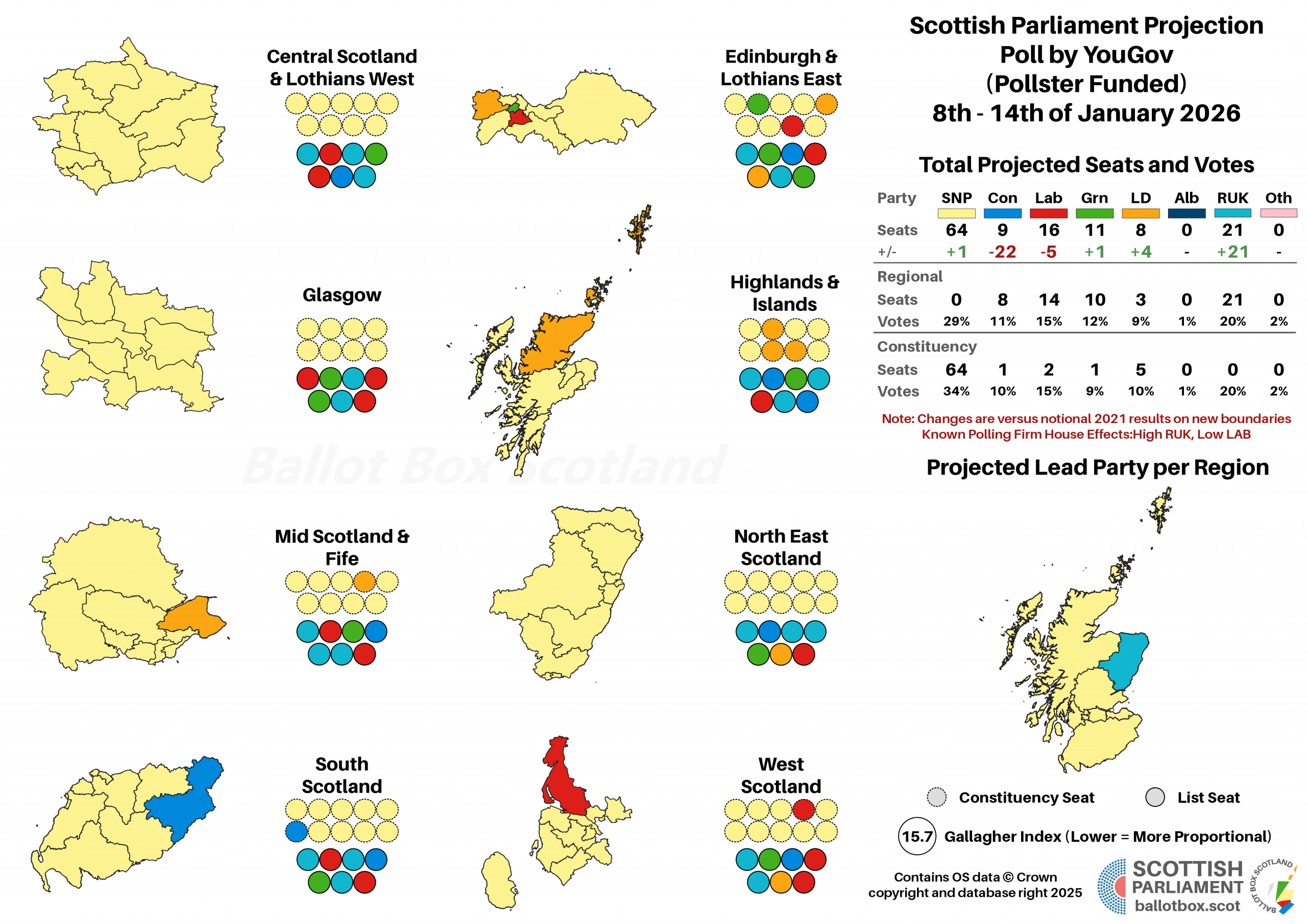

Again, thanks to the fact that the last ordinary YouGov was just before the 2024 election, we can see how Labour have totally collapsed over the past 18 months. Their projection here is less than a third of what it was back then, and even if we were able to strip out the SNP’s constituency advantage and restore proportionality, the loss of votes compared to 2021 would still mean ending up with their smallest ever MSP group. That’s also the fate facing the Conservatives, who slip behind the Greens on this projection.
For their part, the SNP end up with as many seats as they had in 2021, which is a bump of one compared to notional results on the new boundaries, and would be just one shy of a majority, which the Greens then easily provide. As I so often say, I’m of the view that Edinburgh Northern at the very least is going to go Lib Dem and so will hack one off their tally. I can’t get my model to account for such highly localised outcomes however, and it also can’t account for any Reform hotspots it turns out.
Even though I’ve set Banffshire and Buchan Coast up to be highly Reform friendly, even at 20% it hasn’t tilted their way. Having pointed a finger at YouGov’s methodology for throwing up something I think is peculiar and unbelievable, I’ll also put my own hands up and say I think my model is underestimating the potential for Reform to win constituencies. Whilst it’s true their vote will be relatively more evenly spread nationally than any of the other Pro-Union parties, it’s hard to imagine it’s so even as to translate to no constituencies on a fifth of the vote.
Part of the reason for this is actually how I deal with the Greens, which also explains some of my difference from other people’s projections. Remember, my model assumes the Greens don’t stand in most constituencies, and re-apportions their vote in a way that massively benefits the SNP over Labour, and almost infinitely more over Reform and the Conservatives. If I instead assume the Greens stand in every constituency, which you can see down in the hypotheticals section as the “Full Green Slate” line, it takes 5 seats off the SNP’s total, including Banffshire and Buchan Coastal which does go Reform instead.
Possible Majorities
Note: these majorities relate simply to passing a vote in the Scottish Parliament. They do not imply the formation of a full coalition government.
- Traffic Light: Labour, Lib Dem and Green
- Independence Bloc: SNP, Green and Alba
- Grand Coalition: SNP and Labour
- Union Bloc: Labour, Conservative, Lib Dem and Reform UK
No Westminster figures in this poll, which is another reason for me to be a mite grumpy. If you’re doing VI polling, do it all! Also, given my eyebrows raised at Reform shares for Holyrood, it’d have been useful to get Westminster for further context.
Change vs Last Poll
Change vs 2014
YouGov’s Independence polling has had a much more recent outing, and with a small swing in favour of the Union, continues to be both the most positive for the status quo and also the pollster with the most uncertain voters. It’s still running pretty close though, and marginally closer than 2014, so whilst the issue remains on the backburner it’s not yet off the hob entirely.
Hypotheticals
As ever, the last little bit of analysis concerns those hypothetical and more proportional voting systems that BBS likes to play about with. The use of pure FPTP at Westminster is an affront to democracy, and though Holyrood fares far better, AMS is still deeply imperfect. The examples here simply transpose the poll findings onto more proportional voting systems – the reality is that different systems would of course result in different voter behaviour.
If you find this or other Ballot Box Scotland output useful and/or interesting, and you can afford to do so, please consider donating to support my work. I love doing this, but it’s a one-man project and takes a lot of time and effort. All donations, no matter how small, are greatly appreciated and extremely helpful.
(About Donations)