Ahead of every parliamentary election, one of my major pieces of coverage is always my Ballot Box Battlegrounds series. These mostly focus on marginal constituencies, taking a look at those seats where the winner’s majority at the previous election was 10% or below. Given that marginal seats don’t always change hands even if national trends suggest they would, and non-marginals do even if they aren’t expected to, I also include bonus rounds looking at other interesting constituencies.
Ahead of this election and accounting for the boundary changes, 16 of the 73 constituencies (just over a fifth) at Holyrood were estimated to be marginal. With the SNP’s vote having taken such a huge hit, a new party on the scene, and big constituency wins for challengers in the formerly small parties, we’ve obviously had a pretty big shakeup to the map. Whilst it may pain people to start thinking about 2031 already, it’s always worth figuring out early on where the next election will be hardest fought.
Overall spread of marginal seats
Interactive Map
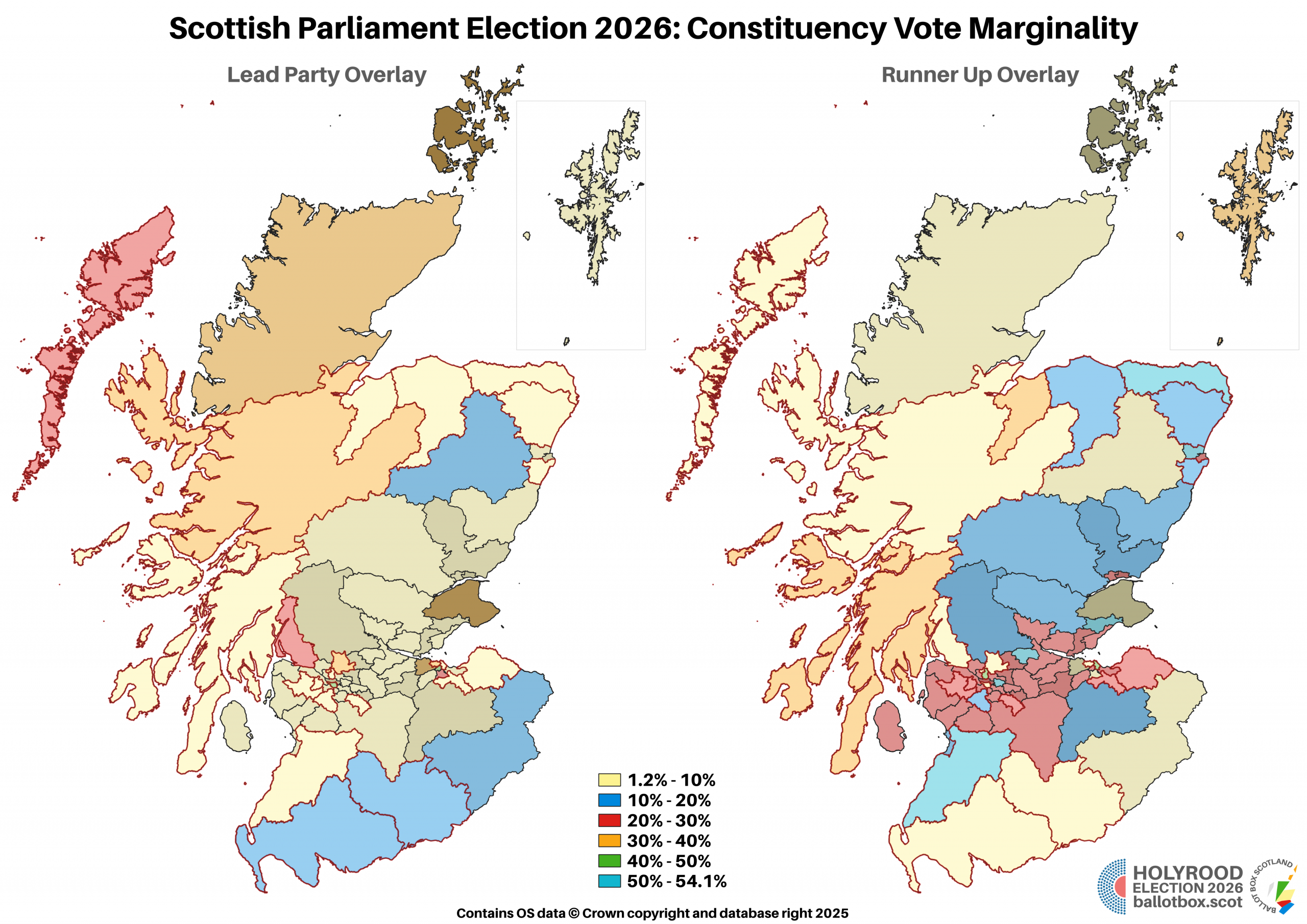
In total, there are now 23 marginal constituencies; just shy of one-third of the overall total. There has been a notable change in the character of them as well. Last time, three-quarters of them were outwith the Central Belt. This time roughly half are located in Scotland’s urban core, reflecting not just a closer fight with Labour, but also the Lib Dems and Greens in certain areas.
The range of marginality ranges from 1.16% (going to the second decimal place as there are four at 1.2%) in Inverness and Nairn up to an eye-popping 54.1% in Orkney Islands. Indeed were it not for the lack of a Green candidate in Glasgow Central meaning the SNP’s share was enormous, the top 3 safest seats would be those the Lib Dems won in both 2021 and 2026.
If we use the standard banding that appears on BBS projection maps, 9 constituencies fall within the extremely marginal 0-5% band, a further 14 between 5%-10%, 34 from 10% to 20%, and 16 in the (theoretically) ultra-safe 20%+.
Marginals by Party
Marginals by Winner
Marginals by Runner Up
If we look at the spread of marginals by party, it’s perhaps no surprise that the bulk of them are held by the SNP. Given the substantial loss of constituency votes they suffered and the relative concentration of their opponent’s votes, that’s exactly what we’d expect. Labour meanwhile are vulnerable in two of their three constituencies.
Only one of the two Green constituencies meets the definition of a marginal, and despite their own collapse the Conservatives did well to turn one of their marginals into a theoretical safe seat. All bar one of the new Lib Dem constituencies remain within marginal territory.
Looking at it in the other direction, the SNP were the runner up in every marginal constituency they didn’t win. The rest are spread pretty widely across the other parties, with only two seats in the whole country where Reform were the primary challenger. That speaks to how well spread their vote was relative to everyone else. For all the talk of Labour’s constituency-focused campaign, it’s notable they still only have a further five seats they came a close-ish second to the SNP.
A couple of SNP MSPs may be feeling a little nervous about how close the Greens were to them in a couple of seats, and the Conservatives would only need relatively modest pickups from Reform voters to gain a handful of seats as well. Lastly, the Lib Dems still have the potential to absolutely wreck Highland proportionality at the next election.
Out with the old, in with the new
No longer marginal
Angus North and Mearns (25th, 11.2%)
Previously the 16th most marginal seat with a 9.9% majority, Angus North and Mearns has only seen a modest widening of the SNP’s lead. Nonetheless, that was enough in this case.
Ayr (28th, 12.5%)
Previously the absolute most marginal seat with a majority of 0.4%, the Conservatives were absolutely hammered here. In what was Sharon Dowey’s only hope for a return to Holyrood, they crashed down by 19.2%, making the SNP’s -7.1% look positively gentle by comparison.
Edinburgh Southern (29th, 12.5%)
Previously the 5th most marginal seat with a majority of 4.0%, Labour took a redrawn constituency that aligns well with their Westminster equivalent stronghold and bedded in. Incidentally, other sources use notional figures that have this as an SNP seat in 2021 terms. My own calculations disagree and I feel this result has rather vindicated me.
Shetland Islands (32nd, 13.2%)
Previously the 10th most marginal seat with a majority of 6.8%, the fact this finally fell to the SNP was jaw-dropping enough. For it to do so whilst bypassing marginal status, and when the Greens were on the ballot, is a very impressive outcome. It also indicates just how poor a candidate choice the Lib Dems made.
Perthshire South and Kinross-shire (34th, 13.9%)
Previously the 7th most marginal seat with a majority of 4.4%, the SNP had a relatively mild -5.3% hit to their vote, against the -14.7% for the Conservatives, returning a traditional heartland to broadly safe territory.
Aberdeenshire West (42nd, 15.6%)
Previously the 14th most marginal seat with a majority of 8.1%, the Conservatives experienced only a small -4.3% decrease to their vote in Aberdeenshire West. As the SNP saw a much chunkier -11.8%, that helped secure the Conservative hold on this seat, and in so doing ensure they won a dozen MSPs. As the seventh and final list seat in the North East went to the Conservatives, had they lost this constituency, they would have effectively bumped their own MSP off the list.
Caithness, Sutherland and Ross (47th, 16.7%)
Previously the 11th most marginal seat with a majority of 7.0%, this was the one constituency I had in my head as a basically certain Lib Dem gain. Sure enough, they had suck a stonking victory here they didn’t even have to pass through the marginal waystation. This is also the only seat the SNP lost where, if it was a sitting MSP, they didn’t lose that MSP: Maree Todd made it back in as the party’s sole list MSP.
Newly marginal
Inverness and Nairn (1st, 1.16%)
Previously the 48th most marginal seat with a majority of 21.5%, the SNP were pressured in two directions to make this the closest run contest of the election. On the one hand, original 1999 MSP Fergus Ewing fell out spectacularly with the party and stood as an Independent, winning a creditable 21.3%. On the other side, the Lib Dems devoured the Conservative vote to gain 22.8%. A big SNP loss of 18% nearly did them in, but not quite, securing Emma Roddick’s position for another term.
Na h-Eileanan an Iar (4th, 1.25%)
Previously the 55th most marginal seat with a majority of 23.7%, this was the big surprise result on the day, the only one I hadn’t identified as a possibility or included in my Battlegrounds series even as a bonus. Labour snatched this from the SNP on a 10% gain vs -14.9% dip, almost certainly rooted in the terrible state of the ferries connecting the islands.
Skye, Lochaber and Badenoch (6th, 2.4%)
Previously the 71st most marginal seat with a majority of 34.3%, this was an absolutely huge gain for the Lib Dems, but not an entirely unforeseen one. They’d gained the equivalent Westminster seat and with Kate Forbes standing down, they picked up 23.9% against the SNP’s 18.4% losses. It’s not a huge win but were I the SNP I would feel resigned to this staying firmly orange next time and focus everything on holding the two neighbouring seats.
Glasgow Kelvin and Maryhill (12th, 6.4%)
Previously the 40th most marginal seat with a majority of 20.4%, I had thought the shattering of the old Kelvin seat into four pieces would make this unwinnable this election for the Greens. Instead, they came pretty close, and in fact beat the SNP on the list vote here. 2031 is a long way away, but Bob Doris may have left the count feeling anxious about his future prospects.
Strathkelvin and Bearsden (13th, 6.5%)
Previously the 56th most marginal seat with a majority of 24.8%, here’s another huge Lib Dem win. They were up 25.1% in a seat I thought too dissimilar to the Westminster Mid Dunbartonshire to be sure of flipping, yet with the SNP on -12.5% it did exactly that.
Edinburgh Northern (14th, 6.5%)
Previously the 49th most marginal seat with a majority of 22.0%, I had this picked out from early on as a likely Lib Dem gain. Although the notional majority was chunky, this brand new seat was in a strong Lib Dem area. Aided by the presence of the Greens, which a la 2016 ensured an additional Green on the list, their +16.3% easily overtook the SNP who were down 12.3%.
Glasgow Southside (15th, 8.1%)
Previously the 68th most marginal seat with a majority of 30.0%, the resignation of a titan of Scottish politics, Nicola Sturgeon, plus favourable boundary changes had me viewing this one as a possible Green gain in 2021. Yet on the final day’s set of polling, my model tipped it Green by a hair, and then it got there relatively securely. The SNP lost a staggering 31.5% of the vote, against a Green win of 36.5%.
Edinburgh North Eastern and Leith (16th, 8.1%)
Previously the 62nd most marginal seat with a majority of 27.6%, here’s another one where a sitting SNP MSP, Ben Macpherson, should be worried about further Green growth at the next election. Leith is very much a hotbed of Green politics and they took an easy lead on the list vote.
Midlothian North (18th, 8.6%)
Previously the 31st most marginal seat with a majority of 17.6%, this is what passed for a relatively easy gain for Labour in 2021 terms. They didn’t get there, but they did pull it into marginality, though given they lost -1.2% it’s more accurate to say the SNP’s -10.1% did that.
Hamilton, Larkhall and Stonehouse (19th, 8.7%)
Previously the 21st most marginal seat with a majority of 12.6%, this was Labour’s third easiest seat to gain in the whole country. Gain it they did… briefly, in 2025, at a by-election, where what should have been an alarming victory by a mere 2% spent 11 months being spun as an augur of great victory. Hubris, thy name was Davy Russell. After less than a year on the job, a vs 2021 dip of -4.4% meant the SNP’s -8.4% did little to shift the dial, handing this back to the yellow team.
Carrick, Cumnock and Doon Valley (20th, 9.1%)
Previously the 20th most marginal seat with a majority of 12.2%, this is a really interesting seat in that it has historic Labour strength that could have seen them gain, but the Conservatives had been ahead last time. This time it was Reform who placed second, in one of just two marginals they were second. They won 24.1%, whilst the SNP fell by -9.6%.
Argyll and Bute (21st, 9.3%)
Previously the 60th most marginal seat with a majority of 20.7%, other sources quite reasonably had this going Lib Dem when I did not. That was based on the fact this was a stronger bet on paper than the two other seats they either won (SLB) or came very close to (I&N). A gain of 10.2% for former MP Alan Reid wasn’t enough though, even with the SNP down -9.5%.
Renfrewshire West and Levern Valley (22nd, 9.6%)
Previously the 37th most marginal seat with a majority of 19.5%, this was one of relatively few seats with an SNP over Labour majority below 20%. What narrowed this one was, you guessed it, more the SNP loss of -8.5% of the vote than Labour’s +1.4%… though at least this was an increase for them, unlike most other seats.
Paisley (23rd, 9.8%)
Previously the 33rd most marginal seat with a majority of 18.2%, we finish up next door to the previous seat with one that was theoretically an easier gain. Labour’s campaign here can’t have been as… well, effective is hardly the word given their result, but as well-managed as next door, as they were only up 0.3% against an SNP loss of -8.1%
Still marginal
I’m about to hit the hard limit of finishing BBS work at 5pm on Monday I set myself before the election, so I’m not going to give the still marginal seats as much of a run through, just list their past and present positions:
- East Lothian Coast and Lammermuirs, 2nd with 1.17% (was 3rd with 3.8%)
- Banffshire and Buchan Coast, 3rd with 1.23% (was 2nd with 1.9%)
- A wee note on this one to acknowledge it was Reform’s closest attempt at a win!
- Eastwood, 5th with 1.9% (was 9th with 5.2%)
- Again, a very quick note: Russell Findlay breathing a sigh of relief that Jackson Carlaw lost, because he was for the chop otherwise.
- Aberdeenshire East 7th with 2.7% (was 8th with 5.1%)
- Dumfriesshire, 8th with 3.4% (was 15th with 9.9%)
- Aberdeen Deeside and North Kincardine, 9th with 3.6% (was 6th with 4.3%)
- Galloway and West Dumfries, 10th with 5.3% (was 12th with 7.1%)
- Dumbarton, 11th with 5.3% (was 4th with 3.9%)
- “Jackie Baillie could survive a direct hit on Faslane” – someone on Bluesky
- Moray, 17th with 8.1% (was 13th with 7.7%)
More to come...
Phew! Right, I am now on a day-and-a-half off of Ballot Box Scotland, to make up for having had no weekend to speak of. I’ll be back later this week with a look at how each party’s vote was distributed and changed across the whole of the country, which is bound to throw up some interesting titbits.
If you find this or other Ballot Box Scotland output useful and/or interesting, and you can afford to do so, please consider donating to support my work. I love doing this, but it’s a one-man project and takes a lot of time and effort. All donations, no matter how small, are greatly appreciated and extremely helpful. (About Donations)