Note: you can also read the PDF version of this letter here.
Open Letter from Ballot Box Scotland to Scottish Broadcasters and the Press; the Scottish Government; Scottish Local Authorities; and the Electoral Management Board for Scotland.
DELIVERING FULL AND ACCURATE REPORTING ON SCOTTISH PARLIAMENT ELECTIONS TO IMPROVE TRANSPARENCY AND PUBLIC UNDERSTANDING OF RESULTS
Considering the continued disappointing failure to treat both Scottish Parliament votes on an equal basis, to the detriment of democratic transparency and public understanding of results, Ballot Box Scotland urges the following changes in approach in time for the 2031 Scottish Parliament Election:
- Simultaneous counting and declaration of both votes for each constituency;
- Adopting clear media guidelines that give the regional vote equal attention to the constituency vote, for example via displaying graphics for both;
- The creation of a central electoral authority, Elections Scotland, for devolved elections, with a remit including coordinating and publishing real-time count data.
The Problem: Failure to adequately report on the Regional Vote
Last week, Scotland went to the polls for the seventh time since the Scottish Parliament was established. Just over a quarter of a century into devolution, many of our electoral administrators and journalists will now have spent most, and in an increasing number of cases all, of their lives with this system in place. By this point the workings of Scotland’s two-vote Additional Member System should be well understood and accounted for.
Frustratingly however, that is not the case. As with the previous three Scottish Parliament elections in which I have been able to vote and thus have paid attention, only one of the two votes has been fully and transparently reported on: the Constituency Vote. Across broadcasters and print media, primacy has consistently been given to this vote at the expense of the Regional Vote.
In one of the worst examples, Sky News didn’t even display the Regional Vote on their website at all: nowhere does their coverage indicate the nationwide result of that vote. You could be forgiven for being very confused about how the Greens won 15 MSPs with just 2.3% of the vote if this was your primary source of count day information, and it should not be necessary to check the individual regional pages to see any Regional Vote information at all.
This is perhaps encouraged by the failure on the part of electoral authorities to consistently and prominently report the results of the regional vote on a per constituency basis. This information exists, is gathered, and is ultimately published in some form, but approaches to declaration and publication on the day are, at best, inconsistent.
Taken together, this constitutes a failure to properly inform the voting public of the results of an election. In a democratic society, few things are more important for the functioning of government than transparency of and trust in elections. Yet consistently voters in Scotland have their Regional Votes treated as such an afterthought that it is as if they disappear into a black hole and only re-emerge in the form of late declared, whole-region results.
Indeed, because no other reporting platform except Ballot Box Scotland collated regional vote data prior to the first full regional declaration, it took until approximately seven hours (roughly 19:20) after the first constituency declaration (roughly 12:20) for anyone else to publish any useful Regional Vote data. How are ordinary voters meant to understand what is going on in Scottish Parliament elections when the count is almost over before they even hear about half of the ballot papers cast – by far the most important half? Other countries which use two vote systems do not experience this issue.
This must not continue. In 2031, we cannot again be in a circumstance where fully half of ballots cast in a Scottish Parliament election are effectively sidelined for the vast majority of the count period. By choosing only to fully collate, declare and publish the regional vote on a whole-region basis, electoral authorities, broadcasters and the press fail to accurately and adequately convey the story of the election to the public.
The (possible) cause: A lack of understanding of the voting system
It is apparent to me that part of the problem – beyond a broader acculturation to First Past the Post – is that in many cases the voting system is simply not fully understood. That there are 73 constituency MSPs and 56 regional MSPs is very often taken to mean that the constituency vote is somehow more important or that it does the most to determine the result of the election. This is not the case.
The Regional Vote is the more important of the two. It is the vote that determines the overall shape of parliament. Whilst it is possible to win so many constituencies that the intended working of the system is distorted, as the SNP demonstrated to an unprecedented degree in this election, it cannot determine the majority of seats in the Scottish Parliament. (Note: this is distinct from winning a majority of seats via this vote, which is possible, but most of those would still have been delivered were the system list-based instead.)
In this election for example, removing the constituency vote from the equation entirely and allocating every seat in each region as if it were a list seat results in a net change of 18 seats away from the SNP. That is of course significant, but what it means is that effectively 111 of the 129 seats at Holyrood fell in line with what the list vote alone would have delivered, because that is how the system is intended to work. It is by far the more important vote overall, even if the constituency vote is of course an important determinant of the final result.
For Electoral Authorities: Simultaneous counts and declarations
One way to substantially improve the reporting of Regional Vote figures would be relatively simple: adopt a process of simultaneous counts and declarations. For each constituency, both votes should be counted simultaneously. Once that count is complete, the results for both votes should then be made as part of a single declaration.
It may even make sense to state the Regional Vote figures as the first half of this declaration, then invite candidates onto the stage to conclude with the Constituency Vote figures. This would both increase the prominence of the Regional Vote results, whilst also making sure that everyone present at the count is able to access the same information, journalists included.
This simultaneous declaration process should be supplemented by a single declaration form. This would include all the data for both votes in the same document, ensuring that it is not possible to publish the declaration for one vote and not the other. Directions by the Electoral Management Board for Scotland should also make clear the need to publish the declaration online as soon as practically possible, and certainly on the same day as the count.
For Broadcasters and the Press: Guidelines and policies that properly engage with the Regional List Vote
Most people who are tuning in to check election results will do so via a major media source, often a broadcaster such as the BBC, or a major newspaper like the Times. For many of them, a couple of minutes checking their own constituency may be the extent of their engagement. It is therefore essential that these sources offer the fullest and most accurate picture possible. For Scottish Parliament elections, the only way to do so is via a full and equal treatment for both votes.
New Zealand uses a similar system to Scotland, adopted a few years earlier, and their media do a fantastic job at working with the reality of a two-vote system. See for example this screenshot from public broadcaster TVNZ’s 1News coverage of the 2023 election:
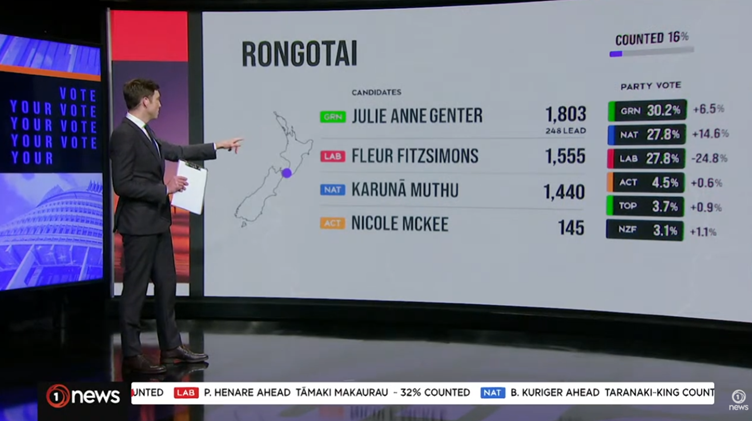
This displays both the raw number of votes counted so far for the Rongotai constituency (referred to as an “Electorate” in New Zealand), as well as the percentage share and swing for the list vote (referred to as the “Party Vote” in New Zealand). Similarly, the website of news outlet Stuff has a list of every seat in the country that when clicked fully displays the details for both votes in that Electorate.
A similar approach should be adopted for Scottish Parliament elections. For broadcasters, this could entail graphics in line with the example from New Zealand above, and an editorial policy requiring the provision and discussion of the other vote in any given constituency if one of them is mentioned or displayed. Live reporting websites should display both votes with equal prominence, and should follow the Regional Vote in live time as individual constituency figures are declared, rather than only upon conclusion of each overall regional count.
Whilst the principle of transparency of election results is the most important consideration, Broadcasters should also consider that more fully reporting on regional results by constituency will enable a more informed and exciting analysis. I tried, but was not fully able due to this year’s deficiencies, to have a “horse-race” section on the BBS website:
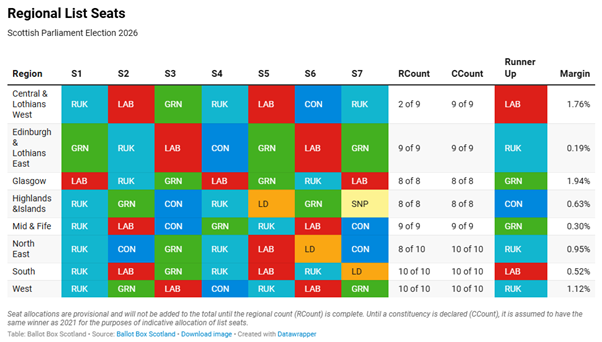
This was populated based on the results received thus far and had regional results by constituency been made more easily available, would have seen these tiles shifting a lot more over the day. Nonetheless, it allowed me for example to publicly conclude that the Greens would get a third MSP in total in Glasgow even without the final declaration, as there was no mathematical possibility of the final constituency’s results changing that.
This would mean that during long periods of waiting for results, instead of treading verbal water on air, the broadcast team could point to in-progress regional results. “Currently, Party A are on track for three list MSPs in X region. However, the last of these is closely fought with Party B. Guest from Party B, how confident are you feeling about making up the difference in Y constituency?” This could make for more engaging and informed discussion that keeps the audience tuned in, rather than giving up after another round of “we’re still waiting for the final result in X region.”
For the Scottish Government: Creating a central electoral authority, Elections Scotland
Scotland, and the UK overall, is in the relatively peculiar position of not having a true central electoral authority. Many other countries have such a body which integrates a range of functions which here are distributed haphazardly across several bodies. The Electoral Commission for example regulates the conduct of elections, the registration of parties, and party finances, but it does not administer elections, nor does it act as the central repository for results.
The Electoral Management Board for Scotland provides directions and guidance on election administration, but it has no obligation to collate and publish results data in real time. In addition, it does not have meaningful separation from local authority election teams, meaning that the board does not necessarily have capacity to fully coordinate national processes on count day. The wider availability of results as they come in therefore comes down entirely to whether a given local authority publishes a declaration online.
Many of our European neighbours possess such a body which amongst other functions receives and publishes data, in real time, as it is provided from counts, typically available on a modern, interactive website. I have myself followed, in great detail and in live time, elections from Moldova to Mecklenburg-Vorpommern, from Latvia to La Rioja, via the relevant authorities’ websites.
It’s odd that with all the technology available to make near-instant reporting of results possible that there is no such body in Scotland or the UK. As part of a long-overdue modernisation of our election administration, I suggest the creation of a new public body to serve this role (amongst other things): Elections Scotland.
Elections Scotland would be a significant transformation of the Electoral Management Board for Scotland, taking on its functions as well as an additional responsibility as the national repository for election results. Insofar as is practical it should have its own dedicated staff, which may be augmented at election time, reducing the burden and pressure on local authority election teams to also perform national functions.
It should be responsible for developing and maintaining a public portal for election results data. In practical terms this would involve a legal duty, as part of the counting and declaration process, to transmit declarations immediately to Elections Scotland, who themselves would be required to publish it promptly on the portal. Such a portal has already been established in Wales for the Senedd Cymru, albeit it could be more detailed.
This would ensure that there was a clear, authoritative source for both the media and the public to find results data. It would also avoid a repeat of the unacceptable failure this year on the part of several councils to publish the Regional Vote figures for individual constituencies until the Monday after the election.
This could also be an opportunity to consider how to better use existing election data and develop mechanisms for collecting more. Following the 2022 Local Elections, Ballot Box Scotland undertook the most detailed analysis of any election in Scottish history, through using the data generated by the electronic count process.
To my knowledge, no other source has ever used this data to make public information such as the distribution of first preferences by polling district or the direct second preference rates for all parties. This process took me three months to complete, unpaid and on a voluntary basis out of interest and a desire to break the privileged hold parties have on such data. It could and should have been the responsibility of a body like the proposed Elections Scotland.
Another example of improvements that Elections Scotland could help deliver would be supporting the collation and publication of polling district level results for Scottish Parliament elections. Again, many of our peer nations publish this information as part of their live election result portals. This is particularly useful for understanding boundary change impacts.
By amending the count process slightly, such that the verification stage for a ballot box is also followed by a count of the votes in that box, we could easily collect this information. It could likewise then be transmitted to Elections Scotland for publication on the national portal. This would also allow voters to follow the progress of the count in real time, as in the example image from New Zealand earlier in this letter, which showed the state of play in a constituency in which only 16% of votes had been counted thus far.
Conclusions
It is not my intention in writing and publishing this letter to be unduly harsh on the election staff and journalists who work extremely hard to deliver and report on elections. I have a deep appreciation for the essential work that they do over the course of the election, particularly given how intense and emotional counts can be. However, it is clear to me that significant improvements are needed to existing processes.
It should not be the case that the primary source, on count day, for half of the votes cast in a national election, is a hobbyist’s website.
It should not be the case that in several constituencies, half of the votes cast were left unpublished for a whole weekend.
It should not be the case that major broadcasters are omitting one of the two votes, mathematically the most important one, from their coverage.
The voters of Scotland deserve to have full, transparent, effective, and informative coverage of their democratic choices. 27 years into devolution they are, unfortunately, yet to receive that. It does not have to be this way at the next election in 2031. In this letter, I have set out reasonable and achievable changes that can be made, several of those through simple tweaks to procedures and presentation.
I hope that when I am reporting, as my hobby, on the next Scottish Parliament election, I am no longer the only place where voters will be able to find the Regional Vote result for their constituency. I hope that voters do not have to go 10 hours into count day before seeing a single indication of the Regional Vote. I hope that broadcasters and the media are able to engage in informed and informative discussions about the developing situation over count day.
I hope that I don’t have to write another letter.
Yours sincerely,
Allan Faulds
Ballot Box Scotland
If you find this or other Ballot Box Scotland output useful and/or interesting, and you can afford to do so, please consider donating to support my work. I love doing this, but it’s a one-man project and takes a lot of time and effort. All donations, no matter how small, are greatly appreciated and extremely helpful. (About Donations)