Constituency Profile
Cause of By-Election
Even before the first vote in last month’s Scottish Parliament election had been counted, there was a very clear expectation it’d trigger two UK Parliament by-elections. With the SNP Stephens seeking to make a move from Westminster to Holyrood and polling suggesting they’d make it, they would have to resign as MPs following new rules banning dual MP/MSP mandates. In Aberdeen South, it’s (now former) SNP Westminster Group Leader Stephen Flynn who successfully made the leap as new MSP for Aberdeen Deeside and North Kincardine, though with a slender majority of 3.6% over the Conservatives.
Amusingly enough, it was perhaps Flynn’s over-confident entry into the Holyrood selection race where he stated his intention to hold both posts (inexplicably describing potentially 3 years out of a 5 year term as a “short period”) which triggered this provision being added to legislation already making its way through parliament. Readers can draw their own conclusions about the making of such missteps. Regardless, it’s worth noting that dual mandates were already banned at the Senedd and Stormont, so Holyrood was an outlier in not having done so earlier.
Flynn was first elected as MP in 2019. He’d previously served as councillor for Kincorth, Nigg and Cove ward of Aberdeen City Council, where he was the SNP group leader going into 2017. He’d been elected in the prior Kincorth and Loirston ward in a July 2015 by-election, funnily enough to replace former council leader Callum McCaig who had been elected SNP MP for Aberdeen South that May.
Constituency Details
Aberdeen South is one of two constituencies covering the city of Aberdeen. It contains 6 of the city’s 13 council wards in full: Lower Deeside (covering Peterculter, Milltimber, Bieldside and Cults); Hzlehead, Queens Cross and Countesswells; Airyhall, Broomhill and Garthdee; Kincorth, Nigg and Cove; Torry and Ferryhill; and George Street and Harbour. In addition it includes a small portion of the Midstocket and Rosemount ward to the west of the city centre. When boundaries were redrawn ahead of the 2024 election, effectively this constituency had George Street and Harbour ward added on whilst losing the Gilcomston area.
For elections to the Scottish Parliament, most of the area of this constituency is within Flynn’s new Aberdeen Deeside and North Kincardine seat. Previously titled Aberdeen South and North Kincardine, the SNP have held this since 2011. In the original Holyrood boundaries from 1999, the Aberdeen South seat was held by the Lib Dems. The remainder, the city centre portion, is within Aberdeen Central which has likewise been SNP since 2011 and was Labour before that.
Electoral History
MP Elected
For simplicity, I’m not going to go earlier than 2005: remember that Scotland’s Westminster contingent dropped from 72 to 59 in 2005, meaning that boundary changes were huge, whereas at least in this seat’s case those in 2024 were pretty mild. This spent the first decade of its existence as a Labour seat, Aberdeen serving as a Labour bastion amidst the sea of Lib Dem and SNP seats north of the Tay.Â
Obviously, that changed in 2015 when the SNP’s enormous landslide handed them almost every seat in the country. Facing a collapse in enthusiasm on one hand and the Conservative revival on the other, they then lost this to the Conservatives in 2017. The SNP regained it in 2019 and then held it in 2024, by which point the new (and slightly more favourable to them) boundaries were in place.
Vote Shares
It’s easy to forget in the post-2011 era how little support the SNP used to have in much of the country. In 2005, they were a distant fourth here, and it was instead the Lib Dems vying with Labour for this constituency, with almost twice the support of the Conservatives. 2010 was a no-change election in terms of Scottish MPs and the vote shares in Aberdeen South reflected that: yes, there’s a little bit of movement, but really nothing to write home about.
2015 then shows the expected SNP boosting into such a comfortable lead that they won more support than any other party had since the constituency took that form. The Lib Dems of course crashed and burned, falling so hard as to lose their deposit, but look at that Conservative line: it’s not very much of an increase, but it is an increase. Nationwide they went backwards in 2015, indicating this was a constituency they were really trying in.
That almost certainly contributed to just how well they did in 2017, leapfrogging both Labour and the SNP and establishing a new high water mark for an Aberdeen South victor. The Conservatives went on to cut their own Scottish revival short as a result of Brexit, something that handed them a stonking majority down south but lost half their MPs north of the border. For the third election in a row the winning share was a recent local high, and Labour lost so much support the Lib Dems finally beat them… for third place.
Labour’s recovery in 2024 would squeak them the barest fraction ahead of the Conservatives for second place, leaving a much weakened SNP to hold onto the redrawn seat. In many respects this was a prelude to this year’s Holyrood election, with the SNP able to secure victory on less than a third of the local vote as the non-SNP vote was so hopelessly split.
2024 Key Stats
Winner:SNP: Stephen Flynn (HOLD)
Majority: 3758 (8.1%)
Electorate: 77328
Turnout: 60.2%
Valid: 46523 (99.6%)
Spoiled: 178 (0.4%)
Candidates
SNP: Stephen Flynn
Labour: Taqueer Malik
Conservative: John Wheeler
Lib Dem: Jeff Goodhall
Green: Guy Ingerson
Reform UK: Michael Pearce
Family: Graeme Craib
Independent: Sophie Molly
Votes
By-Election Details
Candidates
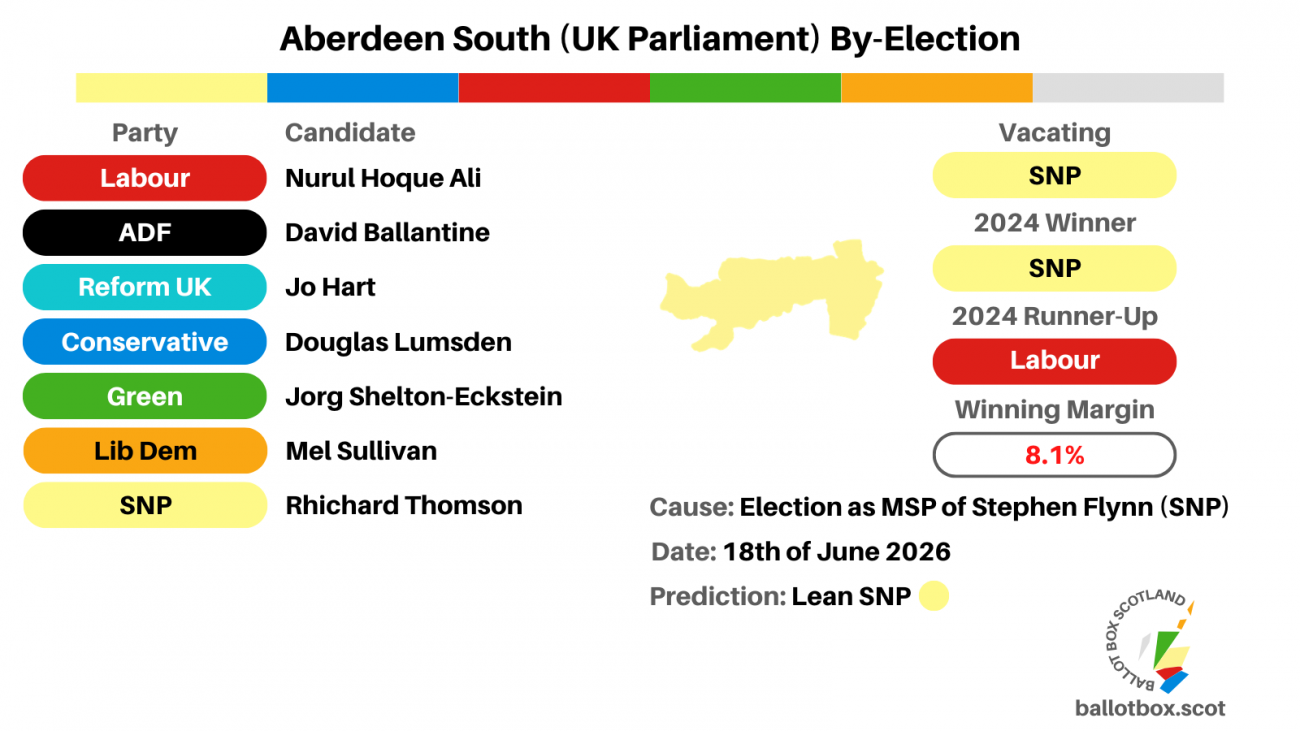
All six Holyrood parties are on the ballot for this one, plus the Alliance for Democracy and Freedom. We’ve got a fair few returning faces amongst this pack of candidates. Most notable is Conservative candidate and North East MSP Douglas Lumsden, who also stood in Aberdeenshire East last month. The SNP’s Richard Thomson is a former MP for Gordon from 2019 to 2024, losing out in Gordon and Buchan in 2024 where the Labour candidate here also stood.
Reform’s candidate likewise stood in both 2024, in Aberdeenshire North and Moray East, and 2026, in Aberdeenshire West and on the list. The Lib Dem is another who stood for Holyrood this year, and the only one to do so in an overlapping constituency, having contested Aberdeen Deeside and North Kincardine as well as the list. Finally, the ADF candidate has embarked on quite a trek up from having contested Hamilton, Larkhall and Stonehouse and the South Scotland region earlier this year.
Labour: Nurul Hoque Ali
Alliance for Democracy and Freedom: David Ballantine
Reform UK: Jo Hart
Conservative: Douglas Lumsden
Green: Jorg Shelton-Eckstein
Lib Dem: Mel Sullivan
SNP: Richard Thomson
Analysis
Let’s make very clear, as was indicated above: Aberdeen South is not Aberdeen Deeside and North Kincardine. This is a substantially different seat to the one that Stephen Flynn won pretty narrowly last month, so the automatic assumption many are making that this will be on a knife edge needs a little bit of tempering. In relative terms swapping out that North Kincardine component for city centre areas is clearly to the SNP’s advantage. That said, what that may largely do is counterbalance the SNP’s losses to lower turnout and the more restrictive Westminster franchise.
In other words, by no means should the Conservatives be written off. The presence of the Greens will also gnaw on the SNP’s vote, with the George Street and Harbour area that goes to the polls again the following week being a particular hotspot. That’s within the Aberdeen Central constituency where the Greens actually placed second in the list vote, one of only two constituencies outside Glasgow and Edinburgh they ranked so highly. They will certainly see a lot of those voters going to the SNP on a tactical basis though, and the local party is still reeling from the chaos around the deselection and departure of their previous Aberdeen South candidate, Guy Ingerson.
If the Conservatives do pull off a win here, it’ll mean Douglas Lumsden going in the opposite direction to Stephen Flynn, giving up an MSP seat to become MP. It’d also give the party their only new blood in this term, bringing James Adams in via the list: as is entirely fair and proper, the Conservative voters of the North East Scotland region having voted for such representation. Conservative losses were so severe that their rump group was entirely composed of sitting MSPs, but Adams would be another newbie. Incidentally that’d also make Holyrood majority new MSP, as the election split it 65:64 in favour of returning MSPs!
Labour are conspicuous by their absence in my commentary thus far despite narrowly placing second in 2024, and that’s because they absolutely bombed last month. Although the Conservatives did worse in a Holyrood-to-Holyrood basis, they didn’t do all that much worse nationwide than they did in 2024. Labour on the other hand lost about half of their support. There’s absolutely no way they are in contention here, and indeed probably will have only won about 12-15% of the vote across the equivalent area at Holyrood.
A big question mark hangs over Reform voters. They did respectably in Aberdeen last month, but how tactical are their voters feeling? If they saw the SNP get run close at Holyrood, do they make the switch to the Conservatives to give them a bloody nose? Or are they so scunnered with established parties they don’t care?Â
One last thing to note: relative availability of resources. The Conservatives ran the SNP close at an election in which the SNP were fighting hard across the whole country to hold onto seats, compared to a more limited Conservative spread of effort. Whilst the Conservatives will be able to concentrate all their resource on this single by-election, the SNP will be able to do likewise, seeing as the other by-election is far less competitive.Â
Overall my instinct is that, especially when you consider a lot of the dissatisfied Labour vote might nonetheless still prefer the SNP to the Conservatives, the SNP go into this the narrow favourites. They are not so favoured for me to go for “Likely” winners, but certainly “Lean SNP” seems reasonable.
Prediction
Lean SNP.
If you find this or other Ballot Box Scotland output useful and/or interesting, and you can afford to do so, please consider donating to support my work. I love doing this, but it’s a one-man project and takes a lot of time and effort. All donations, no matter how small, are greatly appreciated and extremely helpful. (About Donations)