Background
With just 57 MPs, Westminster by-elections are a real rarity in Scotland; until yesterday, there had only been one in the entire eight year period since I launched Ballot Box Scotland. Naturally then two came along at once, following the election of the SNP Stephens to Holyrood last month. As it is now impossible to hold a dual mandate as MSP and MP (for longer than 49 days), that triggered by-elections.
For Aberdeen South, the vacating Stephen was Flynn, who had been SNP Group Leader at Westminster until his move to Holyrood. In my preview, I’d noted his narrow lead over the Conservatives in his new Holyrood seat, but also that this constituency was not a perfect mirror of that one. I certainly didn’t write the Conservatives off despite this, but had this marked out as leaning SNP; i.e. the slightest advantage I can see for a party.
Results
Councillors and Key Stats
MP Elected: Conservative: Douglas Lumsden
Change vs 2024: Conservative Gain from SNP
Turnout: 38.1% (-22.1)
Electorate: 76033
Valid: 28,897 (99.8%)
Spoiled: 53 (0.2%)
Candidates
 Labour: Nurul Hoque Ali
 Alliance for Democracy and Freedom: David Ballantine
 Reform UK: Jo HartConservative: Douglas Lumsden
 Green: Jorg Shelton-Eckstein
 Lib Dem: Mel Sullivan
 SNP: Richard Thomson
Votes
Swing vs 2024
Note: the Family Party won 0.9% and an Independent 0.5% in 2024.
First Preference History
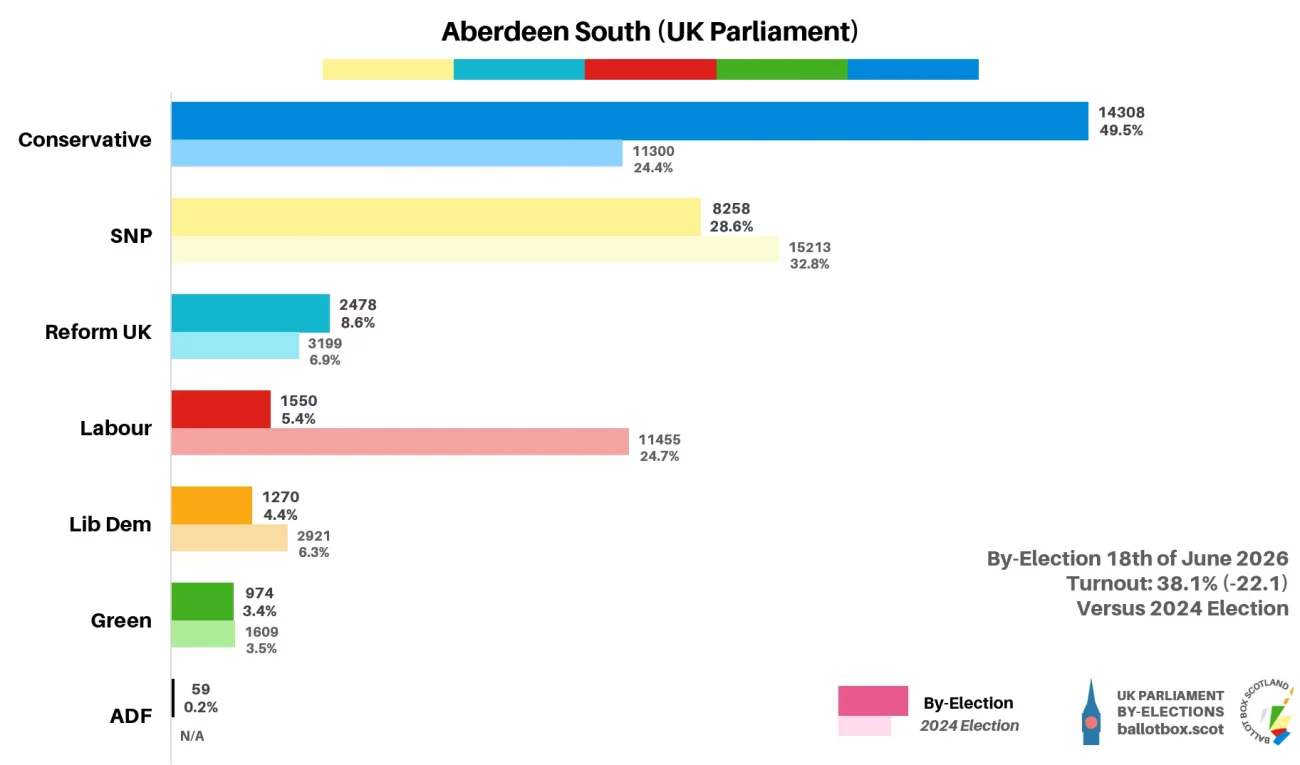
Not only were the Conservatives well in contention, but they won a stonking victory. They doubled their share of the vote, setting a new record for the seat and coming very close to an outright majority of votes cast. The SNP meanwhile slumped to their worst result since before the Independence referendum, a pretty dire result. I would say there are two key things to take away from this outcome.
Number one is how effectively the Conservatives were able to mobilise the anti-SNP vote. In 2024 they received 44% of the Pro-Union party vote; this time they acounted for 73% of the total in that camp. Consider we just last month had a proportional election, where you would expect votes to be more “genuine” than tactical, and across the area of this constituency the Conservatives will have landed in the low-to-mid-20%’s.
To earn over double that share the next month clearly requires tactical voting, the clarity and viability of which was enhanced by the closeness of the constituency result. To be clear, this isn’t a criticism or a de-legitimisation of the Conservative’s impressive victory here. This is how First Past the Post works, and they worked with exactly the strategy they needed to win in that scenario. That said, given the slip in SNP support, they didn’t actually need most of what they picked up.
Number two is that there’s very, very little we can actually infer from this result at the national level. The other by-election, in Arbroath and Broughty Ferry, was a comfortable SNP win. There are clear and obvious local circumstances relating to the future of the oil and gas industry, and part of the Conservatives’ successful vote mobilisation came from cleverly playing that card. The measures needed for the SNP to reverse this loss however may not necessarily help them elsewhere in the country, so from their perspective, caution rather than rash reaction would be wise.
At the risk of being extra cheeky, folk weighing up the inevitable contest to replace Swinney later this term might want to wonder what column “precipitates a by-election the party then lost” gets tallied into. Is it the same column as “obviously agitated for a show of strength over rather than gentle separation from Green Ministers, causing downfall of own First Minister”? What about “fumbles own selection announcement so badly they become the face of Holyrood legislating to require MPs to resign if they become MSPs”? What might these indicate about the political nous of the person inquestion? Positive things, I’m sure!
Anyway, moving down the results list, Reform barely saw any increase in their vote. Again, refer to last month’s Holyrood election: allowing for fact boundaries don’t perfectly align, they would have been on around 16-17% across this constituency. It’s very unlikely their support has halved since then, and so this is instead a clear indicator of that tactical rowing in behind the Conservatives.
Ahead of the vote, Labour were briefing they expected to lose their deposit. They managed to avoid that indignity by 0.4% of the vote, or just 105 raw votes. Nonetheless their share dropped by almost four-fifths, and that can’t all be ascribed to tactical incentives. Having won about 11-12% locally last month, they were already sitting on about half what they got in 2024. In other words of their loss in share (not necessarily raw votes), we can probably say two-thirds is down to their own loss of popularity, and a third to tactical voting.
Speaking of lost deposits, that was the fate for the other parties. The Lib Dems were a lot less negatively affected than Labour, but their support was still about half what they got last month which was about 8%. The SNP also failed to eat into the Green vote, as their share was barely changed versus 2024. It’s a third of the roughly 10% I reckon they’ll have got here last month, but by Green standards, at Westminster by-elections, under First Past the Post, it could have been a lot worse for them. The real local test for them will be the council by-election next week.
Before we get to other by-elections, part of what’s up next will be Douglas Lumsden resigning as MSP. Just like Stephen Flynn, he cannot hold office as both MP and MSP at the same time, and has 49 days to resign as MSP. He will then be replaced by James Adams, who was fourth on the Conservatives’ North East list. He’ll become the only new Conservative MSP, and he’ll also flip the balance at Holyrood to a single seat majority for brand new MSPs.
This is an entirely reasonable and democratic outcome: voters in the North East were due 3 Conservative MSPs (proportionally, they were due 4, but the SNP’s over-representation in constituencies knocked one out), so filling the vacancy with the next list candidate preserves that balance. A by-election for hundreds of thousands of voters to replace just one of their regional MSPs would be a ridiculously vast undertaking, never mind that it would distort that proportionality.
Quite aside from that, voters overwhelmingly vote on the basis of party, not candidate. As much as it may bruise their egos to hear this, constituency MSPs are elected because of their party logo, not their name. Almost nobody voted for Douglas Lumsden in this election because he was Douglas Lumsden, and almost nobody voted for Stephen Flynn in May because he was Stephen Flynn. The idea of a personal mandate granted by First Past the Post is one of the silliest myths in UK politics, and we all know is a myth right up until we want to moan about parties we don’t like getting fair(ish) representation under PR. Behave yourselves!
Anyway, there are two by-elections next week, one of which is in this constituency: George Street and Harbour. I expect turnout for that to be absolutely rotten; it was already only 28.3% in 2022, and I wouldn’t be surprised if it gets close to 10% this time. Having voters turn out two weeks in a row is a recipe for them not to bother with the second. The other is in Highland’s East Sutherland and Edderton ward which is thankfully not going to be quite so impacted by voter exhaustion.
If you find this or other Ballot Box Scotland output useful and/or interesting, and you can afford to do so, please consider donating to support my work. I love doing this, but it’s a one-man project and takes a lot of time and effort. All donations, no matter how small, are greatly appreciated and extremely helpful.
(About Donations)