Constituency Profile
Cause of By-Election
Constituency Details
Hamilton, Larkhall and Stonehouse is currently one of the 9 constituencies making up the Central Scotland region, and one of 5 that cover South Lanarkshire Council area. The core areas it covers are made pretty clear in the name, though it’s missing Blantyre which is to all intents and purposes a suburb of Hamilton these days. Hamilton serves as the centre of South Lanarkshire council and became the county town for Lanarkshire as a whole a few years before County Councils were abolished. Larkhall is a much smaller town which sits wedged in between the River Clyde and Avon Water, by which the smaller still town of Stonehouse is situated. The constituency also encompasses the villages of Ashgill, Netherburn and Quarter.
In terms of local council wards, this contains the whole of four wards: Hamilton North and East; Hamilton West and Earnock; Hamilton South; and Larkhall. It also contains part of a fifth ward, which is (obviously enough) the Stonehouse component of Avondale and Stonehouse, which is otherwise in the Clydesdale constituency. The SNP had a vote lead in three of these wards in 2022, whilst Labour led in Hamilton South and in Larkhall.
This constituency was a new creation for the 2011 Scottish Parliament election, and had been won by McKelvie and the SNP at every election thus far. In the initial set of boundaries, which replicated then-current Westminster seats, the bulk of Hamilton (plus Blantyre) sat within the Hamilton South constituency. A small portion in the north was within Hamilton North and Bellshill, whilst the Larkhall and Stonehouse components were in the initial version of Clydesdale. All of these seats were Labour throughout their existence.
At the UK parliament, this area is almost entirely within the Hamilton and Clyde Valley constituency. The exception is Stonehouse which instead lies within East Kilbride and Strathaven. In both cases those were seats Labour notionally gained from SNP at last year’s election. Prior to that it had been split three ways: Rutherglen and Hamilton West (a minority of Hamilton); Lanark and Hamilton East (most of the area); and East Kilbride, Strathaven and Lesmahagow (Stonehouse only). Those were all SNP gains from Labour in 2015, but Rutherglen and Hamilton West see-sawed between the two, changing hands in 2017, 2019 and the 2023 by-election.
Unlike the most recent Parliamentary by-election in Scotland (which was that October 2023 vote in the Rutherglen and Hamilton West seat at Westminster), this by-election is not one last hurrah for this constituency. Hamilton, Larkhall and Stonehouse has emerged unscathed from under the Boundaries Scotland scalpel… almost. Although the boundaries of the constituency remain unchanged, the seat has been transferred from the Central Scotland region (which will be rebranded Central Scotland and Lothians West) and into the South region along with East Kilbride. I’m not personally convinced it’s logical to stick Glasgow commuter belt seats in the region that borders England, but South Lanarkshire Council were content for this to happen.
Electoral History (Constituency Vote)
Due to the substantial redrawing of boundaries in 2011, I am not considering any prior seat to be the predecessor to this one. This tracker therefore starts fresh with the 2011 result that saw Christina McKelvie shift from a regional to constituency MSP. I will however note that was a rematch for her and Labour’s Tom McCabe, who had faced off in Hamilton South in 2007, when Labour won by nearly 16%. McCabe was Minister for Finance and Public Service reform at the time of the 2007 election, but the SNP’s first narrow victory saw him ejected from that office.
His loss to McKelvie by nearly 9% in 2011 then saw him ejected from Parliament entirely, in part due to Scottish Labour’s internationally mocked internal policy that at that time banned dual candidacy on both constituency and list ballots. Although the SNP share was effectively flat into 2016, the ongoing collapse of Labour and revival of the Conservatives saw McKelvie win a much more comfortable majority of almost 18%. Finally in 2021, facing unsuccessful Labour leadership contender and Central Scotland list Monica Lennon, a modest and against national trend Labour recovery saw the SNP’s majority narrowed down to just shy of 13%, half what it was nationwide.
Electoral History (Regional Vote)
As this is a constituency by-election, voters will not be casting a regional ballot. However, I thought it would be useful to provide for information. Note some slight differences between the two votes, with SNP on a downtick over the period, and the Labour-Conservative gap narrowing rather than widening in 2021. For all that our political sphere is obsessed with an exaggerated belief in tactical voting on the list (primarily in relation to the Greens), it remains the case that if you want tactical voting, First Past the Post remains the voting system par excellence. The Labour share is notably lower on the list, almost certainly because people who had moved to the Conservatives knew fine and well that it was SNP vs Labour in the constituency.
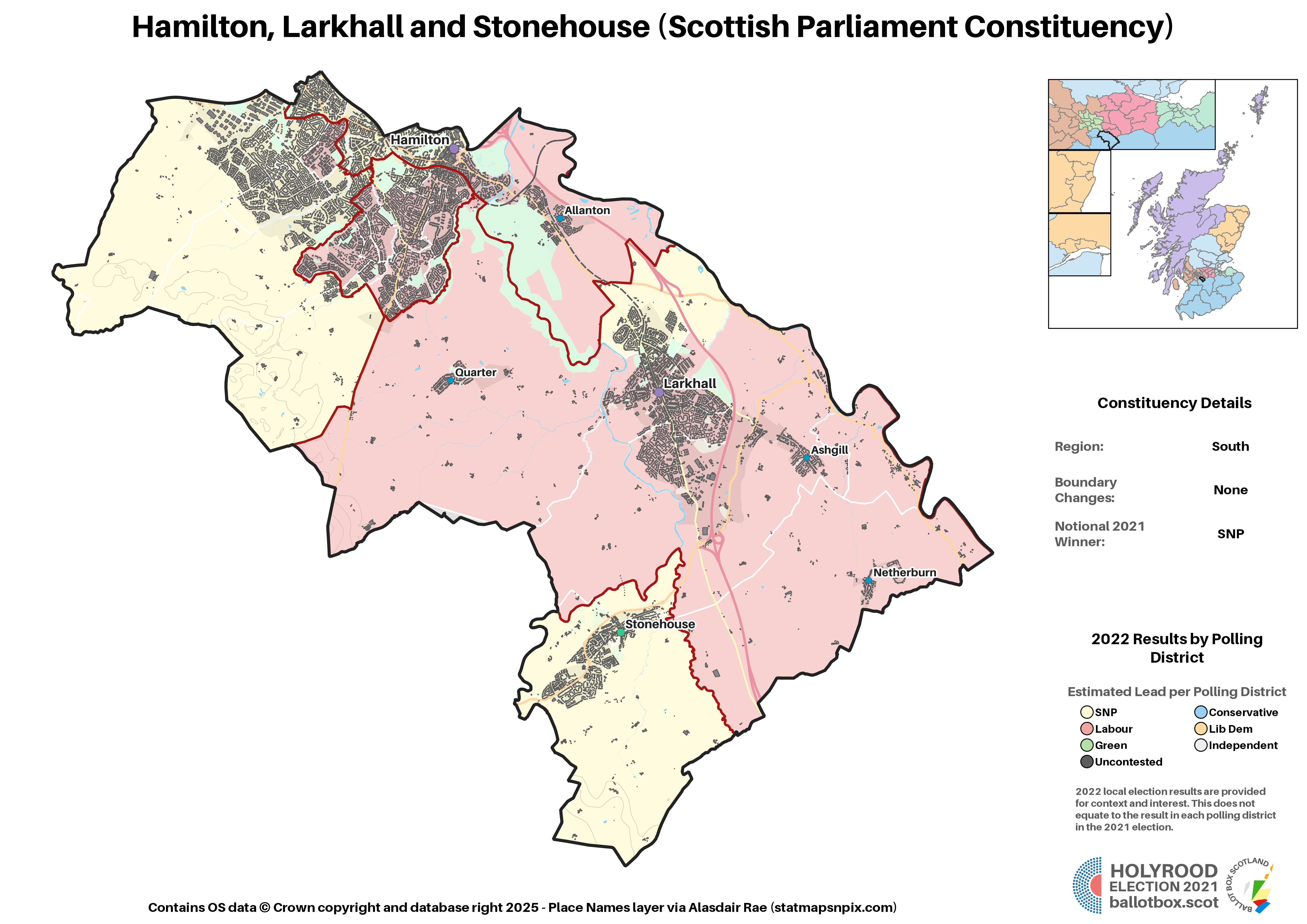
(Forgive my laziness: I’d made a new map for this constituency for wider boundary change purposes, so I’ve just used it complete with the marking as “South” region which takes effect for next year!)
Winner and Key Stats
Winner: SNP: Christina McKelvie
Change vs 2021: SNP Hold
Turnout: 60.9%
Electorate: 59,769
Valid: 36,284 (99.6%)
Spoiled: 136 (0.4%)
Majority: 4,582 (12.6%)
Candidates
🟡SNP: Christina McKelvie
🔴Labour: Monica Lennon
🔵Conservative: Meghan Gallacher
🟠Lib Dem: Mark McGeever
Constituency Vote
Regional Vote
By-Election
Candidates
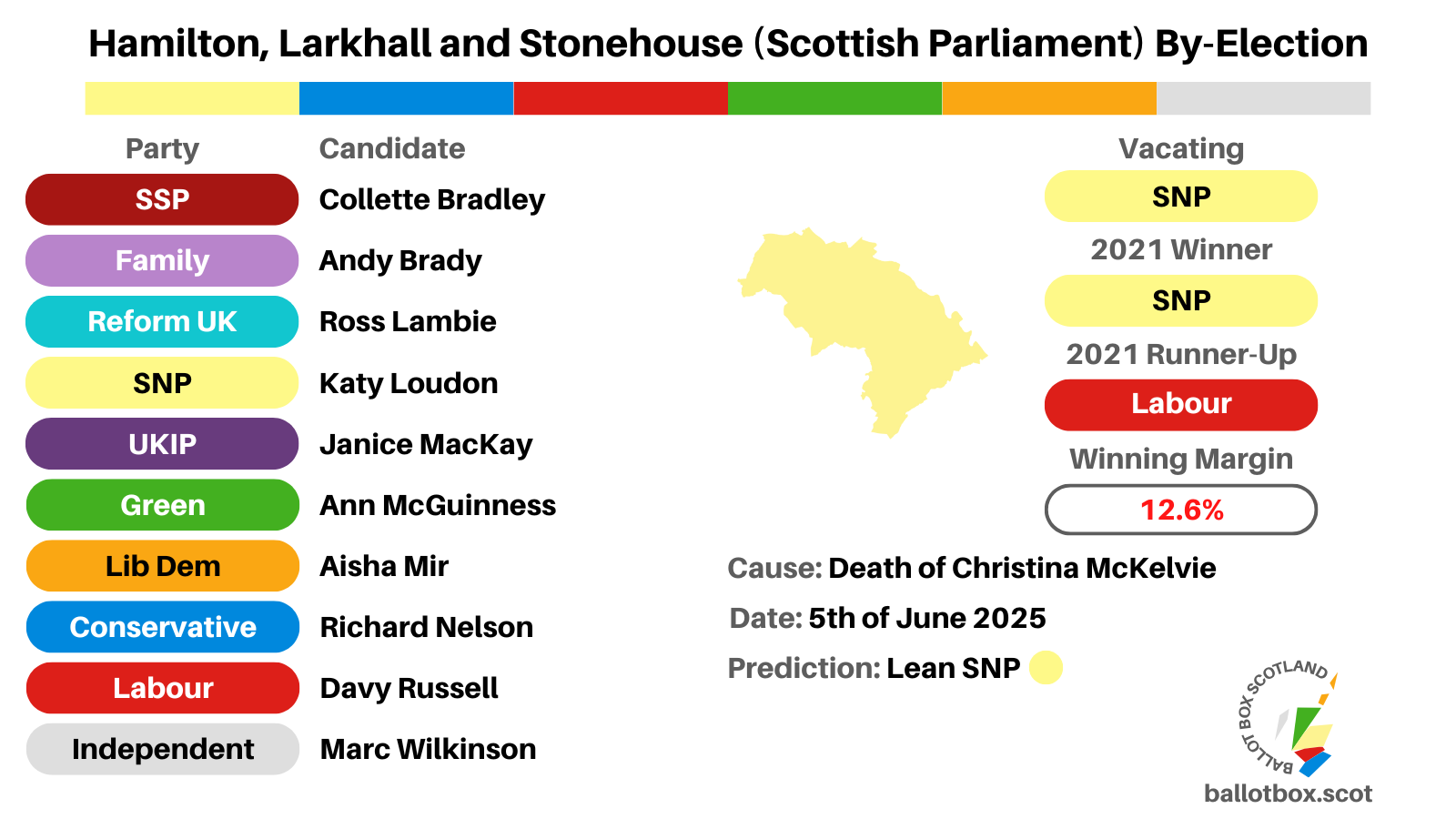
I often say that with by-elections the circus comes to town, but that’s only party true in this case. Certainly there are a few minor party candidates to complement the Holyrood 5, but these are all parties we’re used to seeing on our ballots. We don’t have anyone truly odd the way that we typically do for Westminster by-elections. Maybe Holyrood is a less interesting prospect for weirdo egotists?
Of the candidates, the SNP name should be most familiar, as it’s Cambuslang East councillor Katy Loudon, who stood for Rutherglen and Hamilton West in the 2023 by-election. It’s astonishing I even have to say this but it’s not odd for folk to make multiple runs at election: 2023’s victor took until at least his fourth try to make it over the line (indeed, I was myself defeated for election in substantially the same ward he once was).
Most of the other candidates are returners in some capacity. Clydesdale South councillor Ross Lambie was elected for the Conservatives and stood for them in Aidrie and Shotts and the Central list in 2021, plus East Kilbride and Strathaven last year, but defected to Reform UK earlier this year. The Greens’ Ann McGuinness made unsuccessful runs at the same ward and Westminster constituency. Aisha Mir was also a candidate in the same Westminster seat last year and the Central list in 2021.
For a bit of a break, Conservative Richard Nelson is a local councillor for Larkhall and stood instead in Hamilton and Clyde Valley last year. UKIP’s Janice MacKay is one of their remaining stalwarts and a perennial candidate who stood in Eastwood and the West list for Holyrood in 2021. Independent Marc Wilkinson is, if you’ll excuse me, quite possibly the closest we’ve got to a vanity candidate this time as he also stood in 2024… in Edinburgh South West. He subsequently contested both recent Colinton and Fairmilehead by-elections in that city too. Hamilton isn’t all that proximate to the capital, it must be said.
That leaves the SSP, Family and Labour as fresh faces in this cycle.
🟤Scottish Socialist Party: Collette Bradley
🟤Family: Andy Brady
🟣Reform UK: Ross Lambie
🟡SNP: Katy Loudon
🟤UKIP: Janice MacKay
🟢Green: Ann McGuinness
🟠Lib Dem: Aisha Mir
🔵Conservative: Richard Nelson
🔴Labour: Davy Russell
⚪Independent: Marc Wilkinson
Analysis (UPDATED)
Well, things certainly moved rapidly in the days and weeks after publishing this piece. Down south, Labour suffered an absolutely crushing set of County Council and Mayoral results as Reform UK surged to unforeseen success. Although there were no elections in Scotland, the shape of polling UK-wide has shifted in Reform’s favour, with Labour slipping into second place. Though starting from a lower base, they have likewise been on a steady upwards climb up here too.
That has massively destabilised this by-election to the extent that I think Labour are now quite likely out of the running. “Quite likely” is important: I’m not saying they’ve got no chance, just that the by-election situation has developed not necessarily to Labour’s advantage. With Reform making gains and by-elections serving as a classic opportunity to give governments a kicking, I now expect them to do even better than previously assumed. That will damage Labour’s prospects much more than it will the SNP’s, never mind that Davy Russell has taken to hiding from media engagements.
As such, I think that means the SNP now have the edge here, and it will be a battle between Reform and Labour for second place. There’s even a chance that Reform could win, though I’d still say that’s substantially less likely than the SNP doing so. Even if they do, let’s not forget the history of Hamilton by-elections. Winnie Ewing’s famous 1967 victory put the SNP on the map, but she failed to hold it at the next full election.
Prediction
Lean SNP.
Analysis (ORIGINAL)
Note: Significant changes in the state of play over the course of the campaign led me to a somewhat revised position. This is the original analysis, preserved for information purposes.
One thing I want to get out of the way right at the outset: this is not a “bellweather” seat. In a classic attempt to heighten the stakes and in some cases pre-set the stage for narratives some media outlets find favourable, I’ve seen a few journalists describing this by-election in that way. The clues for why it’s not a bellweather or an absolute must-win for the SNP the way it is for Labour are peppered throughout earlier bits of this piece.
Labour won all the seats covering the area in 2007, the SNP’s first (narrow) victory; Labour won a partly overlapping Westminster seat in 2017 but the SNP still won a majority of Scottish seats; the SNP’s 2021 majority here is half what their national lead over Labour on the constituency vote was. As I set out when I was on Scotland Tonight a few weeks ago, all of that combines to mean the stakes are very different for the SNP and Labour, and in that sense this is identical to Rutherglen and Hamilton West.
If Labour can’t convert a 12.6% SNP majority into a win at a by-election, how on earth will they manage to gain seats where the SNP hold 15%, 20%, 25% leads? The presence of a proportional element at a full election means they can win lots of seats without winning constituencies (as is democratically fair and right), but if they can’t win low-hanging fruit, that would suggest a relatively poor regional showing as well.
The SNP meanwhile can easily lose this seat. At the time of writing (and using the existing boundaries, as the most recent poll on the 22nd of April pre-dated the final report on the new ones) the BBS projection has the SNP beating Labour to this seat by about 1% whilst placing a thumping 39 MSPs ahead overall. At the time of my Scotland Tonight interview, it was 1% Labour’s way but with the SNP 32 seats ahead. This is therefore nice to have but not essential for the SNP. As such what is going to matter here is, just like Rutherglen and Hamilton West, margin.
If the SNP win at all, that’s bad news for Labour. If Labour win it by the skin of their teeth, that suggest they’ll struggle next year. Only if they get solidly into double digits will it be a sign that a big victory could be on the cards. Given that current projections are for that 1% Labour lead, this one is too close to call. What may play further in Labour’s advantage here, but also emphasises why it’s the size of the margin that matters, is that turnout at by-elections amongst habitual SNP voters is typically lower than amongst Labour’s.
One little oddity if Labour do win though: that will, in effect, give them (however briefly) their “correct” apportionment of seats in this region. Although the Holyrood voting system aims for proportionality, the inclusion of a FPTP element allows parties to exceed their fair share of seats overall if they win too many constituencies. In 2021 the SNP were fairly due 8 seats here, but won all 9 constituencies. As such someone else had to lose out, and that was Labour. This isn’t a phenomenon unique to the SNP era, and indeed the SNP’s net 2021 excess of 4 seats (their highest so far) is short Labour’s net of 7 proportionally unearned seats in 1999, but it’s an interesting wee quirk nonetheless.
With one exception, the other parties in this by-election are basically just happy to be there. That exception is I fully expect Reform UK to place third, but just how strong will that be? That may help measure how well they can anticipate doing next year. How far will the Conservatives fall? This isn’t a natural Lib Dem area, but they are an attractive prospect for any unhappy Labour voters wanting to do a protest vote without backing the SNP, so could they overtake? How will the Greens do in an FPTP contest in one of their weaker seats when there’s a clear tactical incentive to vote SNP?
One last thing worth noting is that, as I have refused to be quiet about, we are currently witnessing the worst rollback of minority rights in the UK of my lifetime. With the not merely quiet assent but enthusiastic backing of a UK Labour Government and the Scottish Labour Party, trans people have been made into the targets of a constant, vicious national witch hunt. It’s abhorrent and absolutely frightening as a gay man, watching much of the same hateful rhetoric I’m used to seeing about me recycled against trans people.
That’s particularly relevant in the case of this by-election. In his emotional tribute to his late partner, fellow MSP Keith Brown made a specific point of highlighting that “Christina was a trans ally. Christina supported trans people.” No one wanted this by-election to happen, but now that it is, I cannot help but think it would be an affront to McKelvie’s memory for Labour to win a by-election caused by her death when they have completely failed trans people.
If you find this or other Ballot Box Scotland output useful and/or interesting, and you can afford to do so, please consider donating to support my work. I love doing this, but it’s a one-man project and takes a lot of time and effort. All donations, no matter how small, are greatly appreciated and extremely helpful.
(About Donations)