Background
Concluding a busy run of by-elections from councillors becoming MP, Kirkintilloch East, North and Twechar came about because Lib Dem Councillor Susan Murray became MP for Mid Dunbartonshire. She’d been a councillor here since 2017, with what appears to be a bit of a personal vote. Unfortunately my analysis of this one has been delayed by the fact that East Dunbartonshire Council are ma nouvelle bête noire when it comes to the publication of election data.
In my preview, I’d said it was quite hard to be confident of any of the top three winning as each had circumstances they could benefit from at the moment, but I stuck my neck out on a Lean Lib Dem. They have a knack for bedding in and I assumed since it was their councillor that had vacated, plus they deliberately picked the one councillor who doesn’t really represent an area in the Mid Dunbartonshire seat to be that MP, they must have had a solid plan to sweep to victory.
Headline Results
Councillors and Key Stats
1 Councillor Elected:
🔴Labour: Aidan Marshall
Change vs 2022 (notional): Labour Hold
Change vs vacating: Labour Gain from Lib Dem
Turnout: 26.2% (-18.3)
Electorate: 12319
Valid: 3177 (98.4%)
Spoiled: 51 (1.6%)
Quota: 1589
2 Continuing Councillors:
🟡SNP: Pamela Marshall
🔴Labour: Stewart MacDonald
Candidates
🟠Lib Dem: Marthos Christoforou
⚫Alba: Eamonn Gallagher
🔵Conservative: Satbir Kaur Gill
🟣Reform UK: Bruce Hampton
🔴Labour: Aidan Marshall
🟡SNP: Serina Marshall
🟤Sovereignty: Alan McManus
🟢Green: Elizabeth Rowan
First Preferences
Note: The Freedom Alliance won 1.3% of the vote here in 2022.
First Preference History
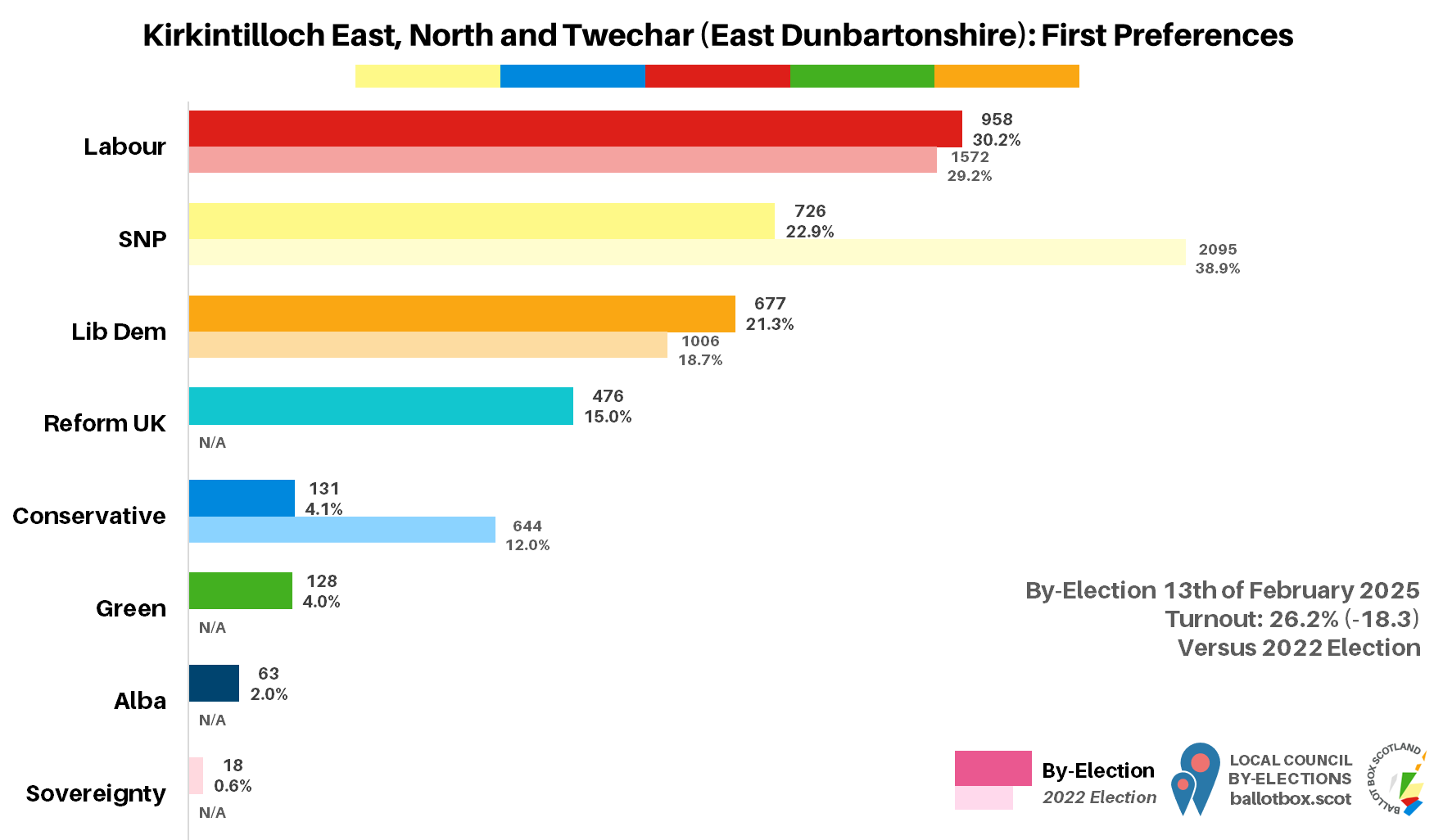
As it turned out, the Lib Dems remained in third place. Perhaps they didn’t give this ward the carpeting I expected they might? In any case, this result is otherwise largely a story of who lost out the least in the face of additional ballot options, with the Lib Dems at least claiming the most growth of any returning party. Labour taking first place this time wasn’t really to do with any growth in their own support, the modest 1% uptick being the kind of thing that can happen simply due to the fact it’s the SNP’s voters who are amongst the least likely to turn out at by-election time.
The SNP for their part saw a huge loss in their share, of the kind that feels more of a sort of a few months ago than I was expecting right now. Some will be beguiled by the near-symmetry of a 16% SNP drop and 15% for Reform UK, but don’t be. Whilst there certainly will be some SNP to Reform movement, the aforementioned lower turnout and the presence of other Pro-Independence options is likely to have done most of the work here. For what it’s worth, 15% for Reform UK in this ward feels about “right”: East Dunbartonshire as a whole isn’t very Reform-favourable ground, but this is the patch most likely to be.
Where much of that Reform vote will actually have come from is the Conservatives, who lost nearly two-thirds of their share. That placed them just 3 votes ahead of the Greens, which gives us a great example of how the same level of support can tell very different stories. For the Conservatives, that’s disastrous. For the Greens, it’s twice what they got the last time they contested this ward, when it was their weakest in East Dunbartonshire, and therefore reassuring if unremarkable for them.
Bringing up the rear, a relative rarity (of late) in the form of an Alba presence, but not apparently a ward or candidate cherry picked to give a (likely) false narrative of growth, given that notably modest share. Lastly, Sovereignty managed less than half the vote share and precisely one quarter of the raw votes that their candidate achieved in 2022 under the “Freedom Alliance” banner.
Transfers
Two-Candidate Preferred
Labour’s lead was sufficient here I would have been sure on these first preferences alone that they’d go on to win, as they duly did. However, I would also have assumed that given the theoretically deep ideological opposition between Lib Dem and Reform UK, the SNP would remain comfortably in second place after the two smaller Pro-Independence parties dropped out. Not so, with Reform voters proving most favourable to the Lib Dems out of the top three. Perhaps speaking to a protest vote that the Lib Dems have regained a decade after the end of the Coalition?
That therefore set up a Labour vs Lib Dem head to head, where it’s notable that despite their first preference gains, both actually lost ground compared to 2022. That’s all those votes tied up with Reform UK, as nearly two-thirds didn’t transfer when they were eliminated.
Detailed Results
Results by Polling District
So, this is where the first of my annoyances with EDC lies: it hasn’t published the GIS data for its new polling districts. Whilst I have a breakdown by (pairs of) polling districts above, I don’t have the data necessary to visually map it. By polling place, CS02 and CS03 were at Oxgangs Primary; CS04 Twechar Primary; CS05 Harestanes Primary; CS06 and CS07 at Hillhead Community Centre; and CS08 and MS49 at St David’s Memorial Park Church Hall.
Labour led in three of the four pairs, with the Lib Dems unsurprisingly leading in the one that includes a bit of Mid Dunbartonshire. Both Labour and Reform UK were strongest in the districts voting at Harestanes, the SNP in those voting in Hillhead, whilst the Conservatives and Greens shared their best patch with the Lib Dems. With Sovereignty not winning enough votes to register really anywhere, that leaves Alba who were strongest (but still sub-3%) in the districts voting at Oxgangs.
Second Preferences
Updated with the data after initial publication!
In terms of second preferences, Labour and the Lib Dems had a decent mutual flow. So too did the SNP and the Greens, though Alba weren’t all that far behind amongst SNP voters whilst being deeply unappealing to Greens. Reform meanwhile were most favourable towards the Conservatives, though as noted above, a surprising number went Lib Dem too.
Possibly reflecting that most of their right wing had gone to Reform, the remaining Conservative voters were much more likely to go for the Lib Dems. Perhaps unsurprisingly, although the largest portion went to the SNP, Alba voters were the most likely to give the bampot Independence micro-party a second preference. What few voters Sovereignty had themselves had an even split between Alba and Reform UK for their most popular next pick.
We’re straight back into another East by-election the week following this one, though we’re heading southwards to East Ayrshire. I have Kilmarnock North marked as leaning SNP, though that was on the basis of a poor run of Labour results lately; swings akin to this one would seal the deal for Labour, but this was abnormally high by recent standards.
If you find this or other Ballot Box Scotland output useful and/or interesting, and you can afford to do so, please consider donating to support my work. I love doing this, but it’s a one-man project and takes a lot of time and effort. All donations, no matter how small, are greatly appreciated and extremely helpful.
(About Donations)