Background
The second half (at least in the chronology of my analysis) of Highland’s double bill was in the Eilean a’ Cheò ward. Going by a poetic Gaelic name even for English purposes, it’s to all intents and purposes Skye. Although there hasn’t been much in the way of reason given as to why, this was triggered by the resignation of Independent councillor Calum Munro. As Munro was first elected at a March 2020 by-election, the timing of his resignation has effectively given him a “normal” tenure.
Even more so than your average Highland ward, this one was hard to predict. Skye loves an Independent, but you do need to be the right kind of Independent. If it was going to go party wards the SNP have previously done well here, as have the Lib Dems. For the latter, they may have done abysmally in 2022, but their strong 2020 by-election was back. I therefore flagged this as likely between those three options; or five, rather, given there were three Independents.
Headline Results
Councillors and Key Stats
1 Councillor Elected:Independent: Christine Gillies
Change vs 2022 (notional): New Independent
Change vs vacating: New Independent
Turnout: 40.2% (-11.1)
Electorate: 8767
Valid: 3504 (99.5%)
Spoiled: 19 (10.5%)
Quota: 1753
3 Continuing Councillors:Independent: John Finlayson
SNP: Drew Millar
Conservative: Ruraidh Stewart
Candidates
Reform UK: John Coupland
Independent: Campbell Dickson
Independent: Christine Gillies
Green: Katy Lawrence
SNP: Màrtainn Mac a’ Bhàillidh
Independent: Jonathan MacDonald
Conservative: George MacPherson
Lib Dem: Fay Thomson
First Preferences
Note: Other Independents won 56.1%, Alba 3.7% and Labour 3.5% in 2022.
First Preference History
Now admittedly you can’t go wrong suggesting an Independent could win in Highland, so obviously that was a reasonable prediction with Christine Gillies taking a lead. Just like the concurrent Cromarty Firth though that was with fewer than a quarter of first preferences. In an opposite case to the other ward where the Lib Dems were down and SNP up compared to the prior contest, here the Lib Dems were challenging for victory, with another very strong by-election share. If they can keep Fay Thomson on board as a party candidate this time, maybe 2027 will be their moment?
Moving down ballot, Campbell Dickson also did pretty well: there’s less than 6% separating him and Gillies, so in theory he could overtake with transfers. In reality though we typically see later preferences showing a similar pattern of favourability between Independents, as proved the case here. The SNP meanwhile did relatively poorly, only narrowly exceeding their previous worst share.
The last of the Independents, Jonathan Macdonald, posted a creditable share but at sub-10% he clearly wasn’t ever in contention. That put him pretty close to the Greens who, whilst falling short of their 2020 by-election share, must have picked a decently weel-kent candidate to register a respectable tally.
Reform UK by contrast can’t have made a particularly good choice, because this is their worst showing for quite some time: not something to read much into otherwise, given other evidence. Barring areas with a strong Green history, I typically wouldn’t expect them to place this way round at the moment. Despite the anaemic Reform share, the Conservatives still lost about three-quarters of their vote, continuing a run of dire Independent results.
Transfers
Two-Candidate Preferred
Two-Party Preferred
I’m an old enough hand at this now to say that kind of distribution means you just have to watch as the lead Independent coasts to victory, and sure enough that’s what happened. There’s a really neat pattern to how the top three all start relatively close together and then transfers gradually fan that out until Gillies takes a reasonably comfortable win. If we run it as a purely party affair, the Lib Dems take an even healthier win over the SNP.
Detailed Results
Results by Polling District
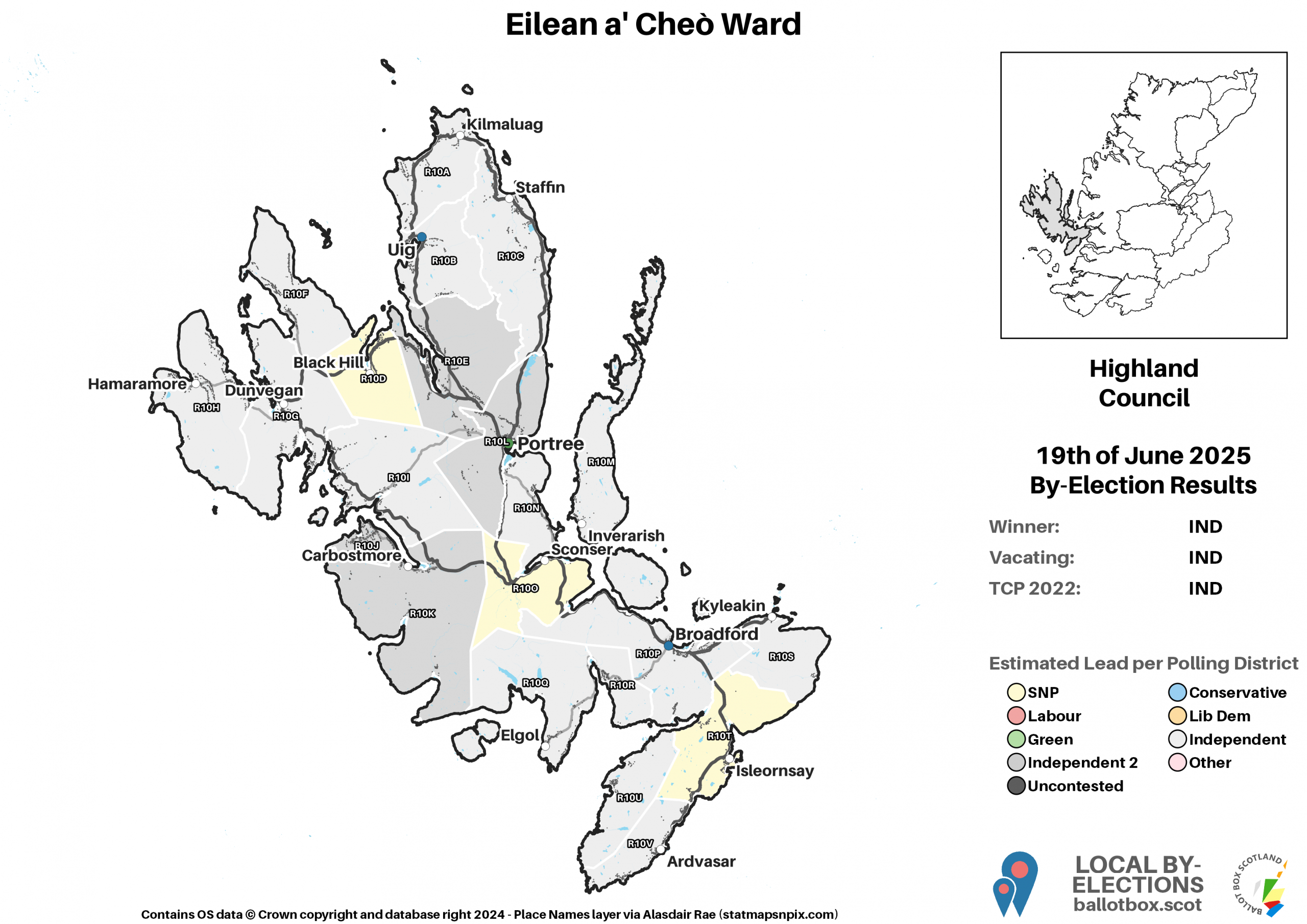
Unfortunately, Skye is a lot of very small polling districts so they all have to be merged together at full elections anyway, never mind a by-election. A lot of these mergers are quite geographically disparate (I may contact the excellent team at Highland to enquire about them taking a different approach going forward), so there isn’t too much to be read into it.
From the data as merged, it appears that Gillies did best in the bloc including Kyleakin, whilst both the Lib Dems and Dickson excelled in the local capital of Portree. The SNP’s top bloc includes Isleornsay, Sconser and Blackhill, and for the Greens Dunvegan seems to have been the hot spot. Both Reform and Macdonald did well in Broadford, and the best bit for the much depleted Conservatives was in an opposite-points merger including Uig and Ardvasar.
Second Preferences
Looking at the direct second preferences, there are effectively three patterns to look at here. The first is towards Gillies, further emphasising the ultimate ease of her victory: Dickson, SNP, MacDonald and Green voters all went that way. The second is towards the Lib Dems, with both Gillies and the Conservatives going that way. The last one isn’t really a pattern, admittedly, it’s just what’s left: Reform voters proving narrowly most favourable to the Conservatives.
There are only another couple of by-elections currently on my radar. Up just a week after this one we have Edinburgh’s Fountainbridge and Craiglockhart. That’s going to be complete chaos, with an argument to be made for any of the Holyrood 5 parties being in contention for it, so it’ll be especially worth keeping an eye on!
If you find this or other Ballot Box Scotland output useful and/or interesting, and you can afford to do so, please consider donating to support my work. I love doing this, but it’s a one-man project and takes a lot of time and effort. All donations, no matter how small, are greatly appreciated and extremely helpful.
(About Donations)