Posted in

SP26: Ballot Box Battlegrounds Bonus Round 1 (Near Marginals + Mid and Fife Region)

As the 2026 Scottish Parliament approaches, keep up to date with all the latest polling and analysis on Ballot Box Scotland’s Holyrood Hub page!

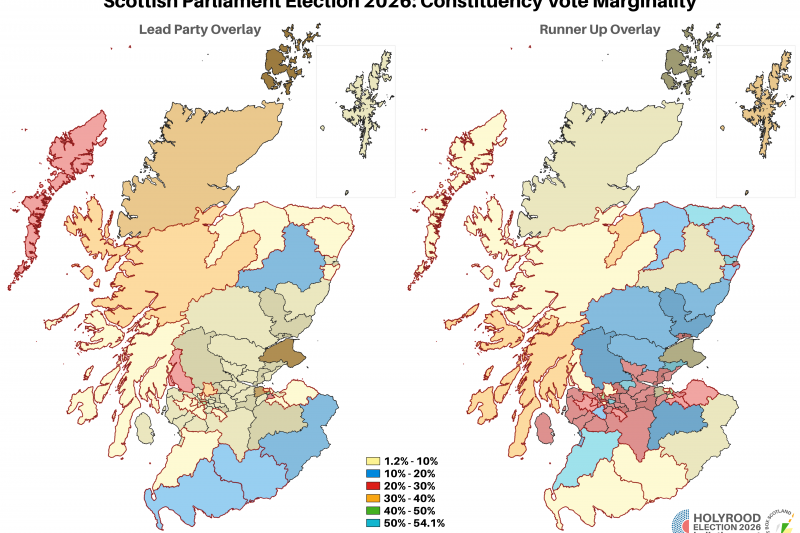
With just a few weeks left to go until the big day, it’s time for the regular Ballot Box Battlegrounds series! Over this week, we’ll be taking a look at every constituency in Scotland considered marginal in 2021 terms – i.e. where the winner’s majority is below 10%. More than at any Holyrood election up until now, constituency winners really matter, because the SNP are expected to win so many more than their “ideal” proportional share if the voting system was working perfectly.

I’ve also picked out two bonus rounds worth of seats that are worth keeping an eye on even though they aren’t marginal. Each entry in the series will also look over one of the regions. Although that means three regions will go un-Battlegrounded, remember I’ve done regional previews (which also include some thoughts on every constituency) which are available here.

Note that for constituencies and regions impacted by boundary changes, I’m using my own notional calculations for 2021 results on the new boundaries. The reason we compare with 2021 rather than current projections is simple: even with boundary changes, we can be relatively sure what those results were. By contrast, projecting constituency results from national polling is always subject to substantial margins of error. Better then to compare with a known quantity than a rough and highly changeable estimate of current support.

We’re now into the first of our two bonus rounds, this one looking at near-marginals. These are seats that don’t quite fall within the traditional 10% majority definition of marginality, but are still close enough that it wouldn’t be a Heraclean task to flip them.

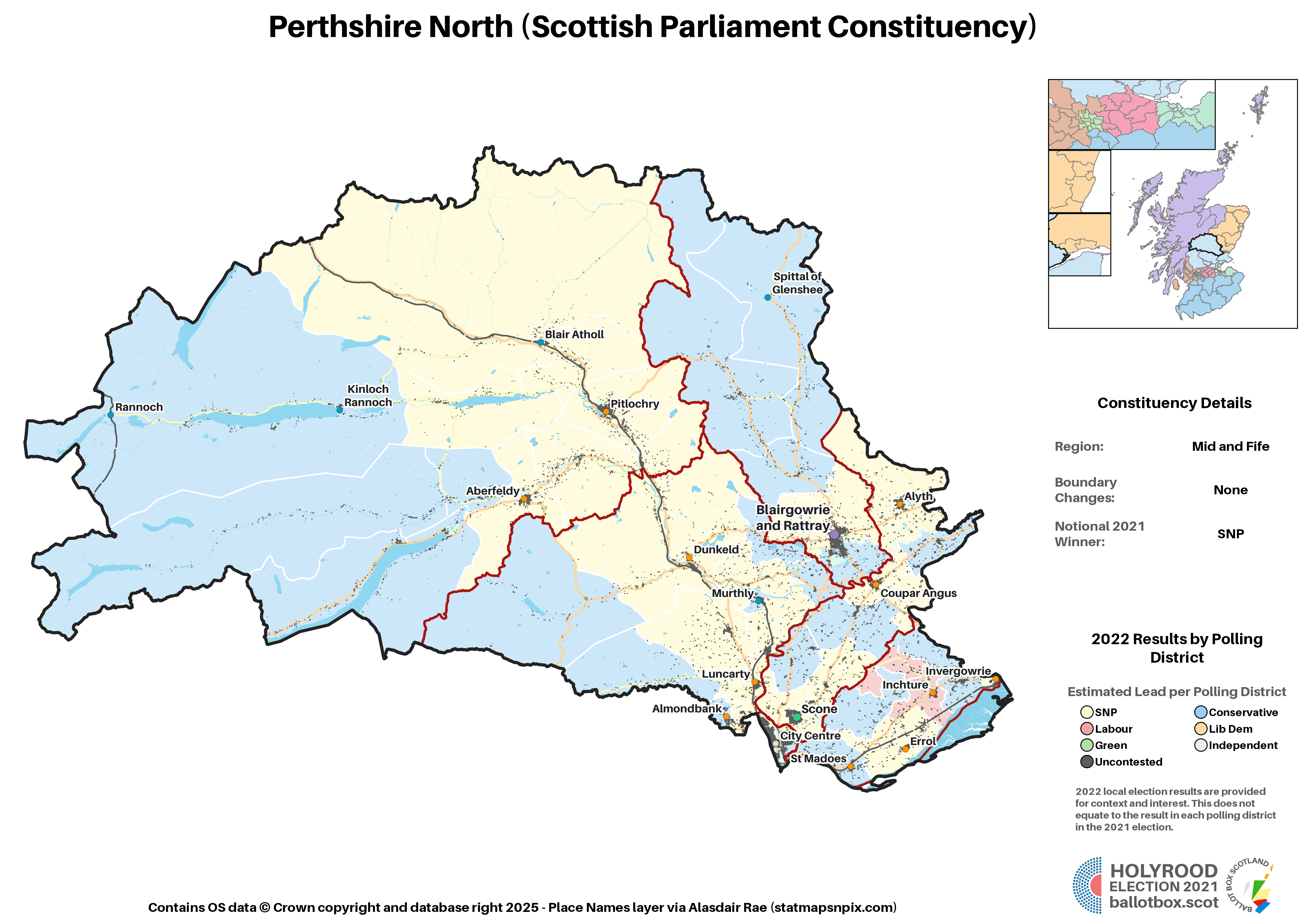
#17: Perthshire North

Constituency Map
Key Information

Notional 2021 Winner: 🟡SNP
Majority: 4053 (10.1%)
Boundary Changes: None
Region: Mid and Fife

2026 Candidates

🟡SNP: John Swinney (*C), L1
🔵Conservative: Murdo Fraser (*L), L1
đź”´Labour: Angela Bailey, L6
đźź Lib Dem
: Claire McLaren, L1
🟣Reform UK
: Kenneth Morton, L6

2021 Constituency Vote
2021 Regional Vote
Analysis

The first seat outside the marginal band is a corker, as it’s First Minister John Swinney’s own seat. He’s long held sway over this part of the country, his election in 1997 as MP for the then-North Tayside Westminster seat making him Scotland’s longest serving current parliamentarian, including an ill-fated spell as party leader from 2000 to 2004.

It was extremely obvious he was preparing to hand that title over to another class of 1999 MSP, retiring to a quiet life as an elder statesman. This was not to be however, as Humza Yousaf’s self-destruction had the SNP scrambling for a successor. Swinney is nothing if not completely dedicated to his party and put his retirement plans on hold to sweep back in as a desperately needed respected, unifying figure to prevent the party tearing itself apart.

In common with their other longstanding strongholds, Perthshire has gone from astronomical levels of support for the SNP (61% in 2011) to being hotly contested against the Conservatives. List MSP Murdo Fraser took the seat to strict marginal status in 2016 by slashing Swinney’s majority from 34.5% to 9.8%. The tiny widening up to a 10.1% margin in 2021 is barely worth remarking on.

If the Conservatives couldn’t gain this seat at the peak of their revival, there’s effectively no way they do so now. That’s especially true given the SNP surely wouldn’t be so foolish as to run a bare-bones campaign that leaves their leader vulnerable. Had it been a fresh candidate without Swinney’s history, perhaps it could be run closer, but the toppling of this particular giant won’t be one of May’s big stories.

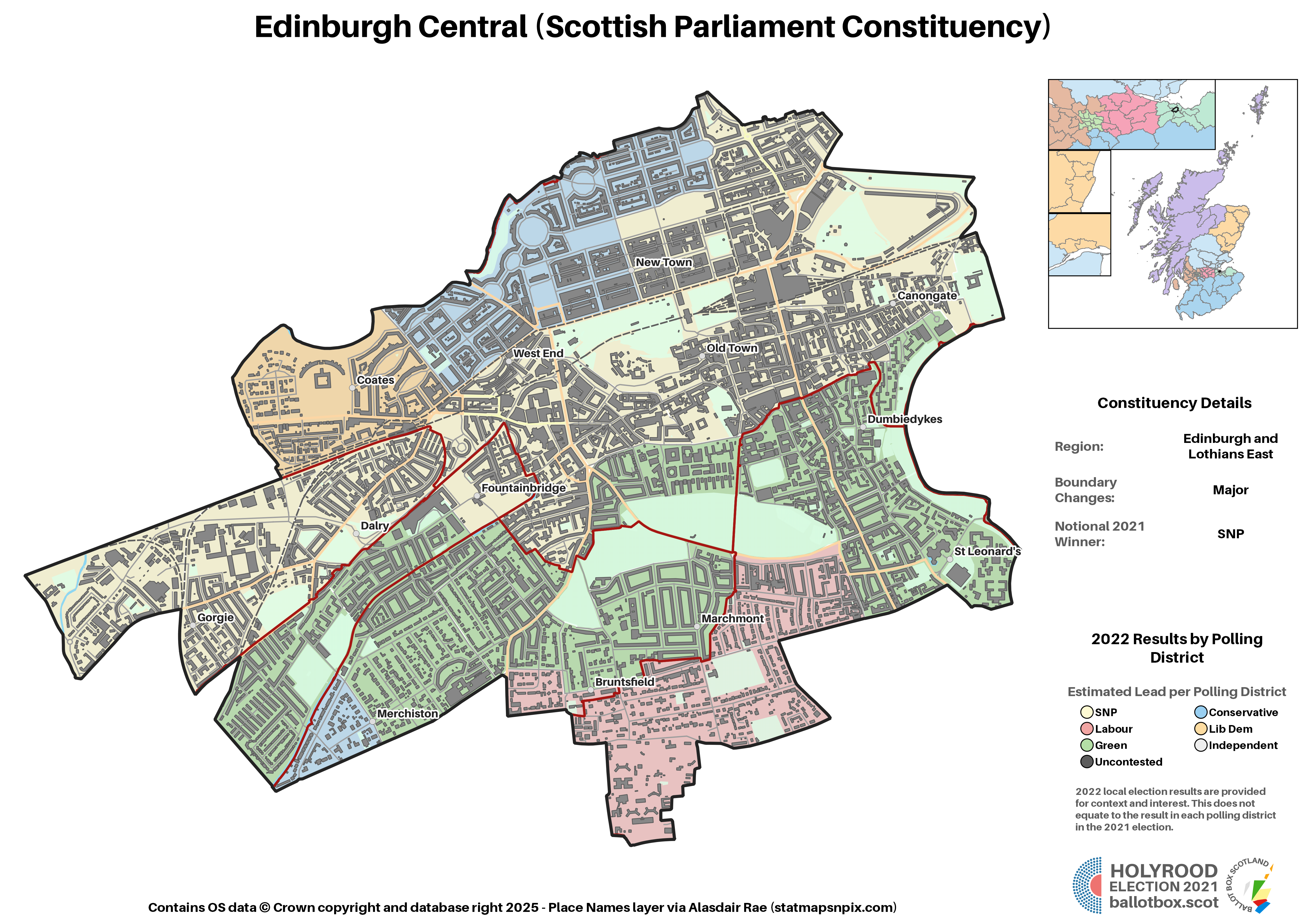
#18: Edinburgh Central

Constituency Map
Key Information

Notional 2021 Winner: 🟡SNP
Majority: 4262 (10.5%)
Boundary Changes: Current seat splits three ways: area within the Inverleith ward to new Edinburgh Northern; area within Corstorphine and Murrayfield ward to new Edinburgh North Western; remainder to new Edinburgh Central. Gains areas around Merchiston, Marchmont and Sciennes from old Edinburgh Southern
Region: Edinburgh and Lothians East

2026 Candidates

🟡SNP: Angus Robertson (*C), L4
🔵Conservative: Jo Mowat, L5
đź”´Labour: James Dalgleish, L7
🟢Green: Lorna Slater (*L), L1
đźź Lib Dem
: Charles Dundas, L3
🟣Reform UK
: Gary Neill, L7
🟤Alliance to Liberate Scotland
: Craig Murray, L1
🟤Libertarian: Tam Laird, L1
⚪Independent: “Bonnie Prince Bob”, L1
⚪Independent: Chris Creighton
⚪Independent: Robert Pownall

Notional 2021 Constituency Vote

Note: the Green vote is based solely on where they stood in 2021 and does not reflect a “true” share for this constituency.

Notional 2021 Regional Vote
Analysis

I promise we aren’t just going back up the five next most marginal constituencies – that would be dull! – but the new version of Edinburgh Central is indeed next on the numerical list. It’s an absolute corker of a contest though, and the words “new version” are absolutely key. This is not, despite the pretty shoddily misleading claims of incumbent MSP Angus Robertson, the same constituency as in 2021. Having ditched right-leaning areas to the north and west of the city centre, replacing them with left-leaning portions to the south, it is not a contest between the SNP and Conservatives.

Instead, it’s the second easiest gain anywhere in the country for Labour. The fact the SNP have a notional majority of 10.5% and that’s the second closest Labour are to gaining a seat from them speaks to the mountain the latter have to climb nationwide. There’s more than just the threat of Labour winning it, which has somewhat receded since their polling re-collapsed. Instead, there’s another party in the mix, and this is almost certainly why Robertson is misrepresenting the constituency as at risk from falling to the Scary Tory Boogeyman at an election where that party is dying on its arse: the Greens.

Forget the 2021 constituency share for the Greens which is distorted by, one, the genuine tactical pressure of that election and two, the lack of a Green constituency candidate in the bits that came from Edinburgh Southern. Look at that list vote: the Greens in second place, just 5% behind the SNP. This is the strongest Green seat that has ever existed on that basis, and indeed in the 2022 local elections, the Greens won the most votes across this area at roughly 26% to the SNP’s 23% and Labour’s 21%.

At the time of writing, my model thinks the Greens will win this. So too do Devolved Elections and Mark McGeoghegan. Although I’ve repeatedly stated I’m not sure the Greens have the ground campaign to actually win, I’ve also heard on the grapevine (via Labour, not the Greens!) that canvassing returns are pretty Green favourable. If Robertson’s canvassers are finding similar, no wonder he’s trying dishonest scare tactics, because your average SNP voter in central Edinburgh is going to be pretty Green friendly.

The 2022 local result however is instructive of what I would expect a possible Green victory to look like here. This isn’t going to be a Gorton and Denton-ian sweep to a 40%+ mega victory: instead, as befits Edinburgh’s status as Scotland’s most diverse voting area, a roughly 30% win against a split field. If former Green Co-Leader (and Minister) Lorna Slater does pull this off, it’ll be the first constituency win in the Scottish Greens’ history, and a poke in the eye for dodgy bar chart campaigns. If Robertson does lose here, he also almost certainly leaves Holyrood, as he’s fourth on the Lothian list behind a candidate without a constituency.

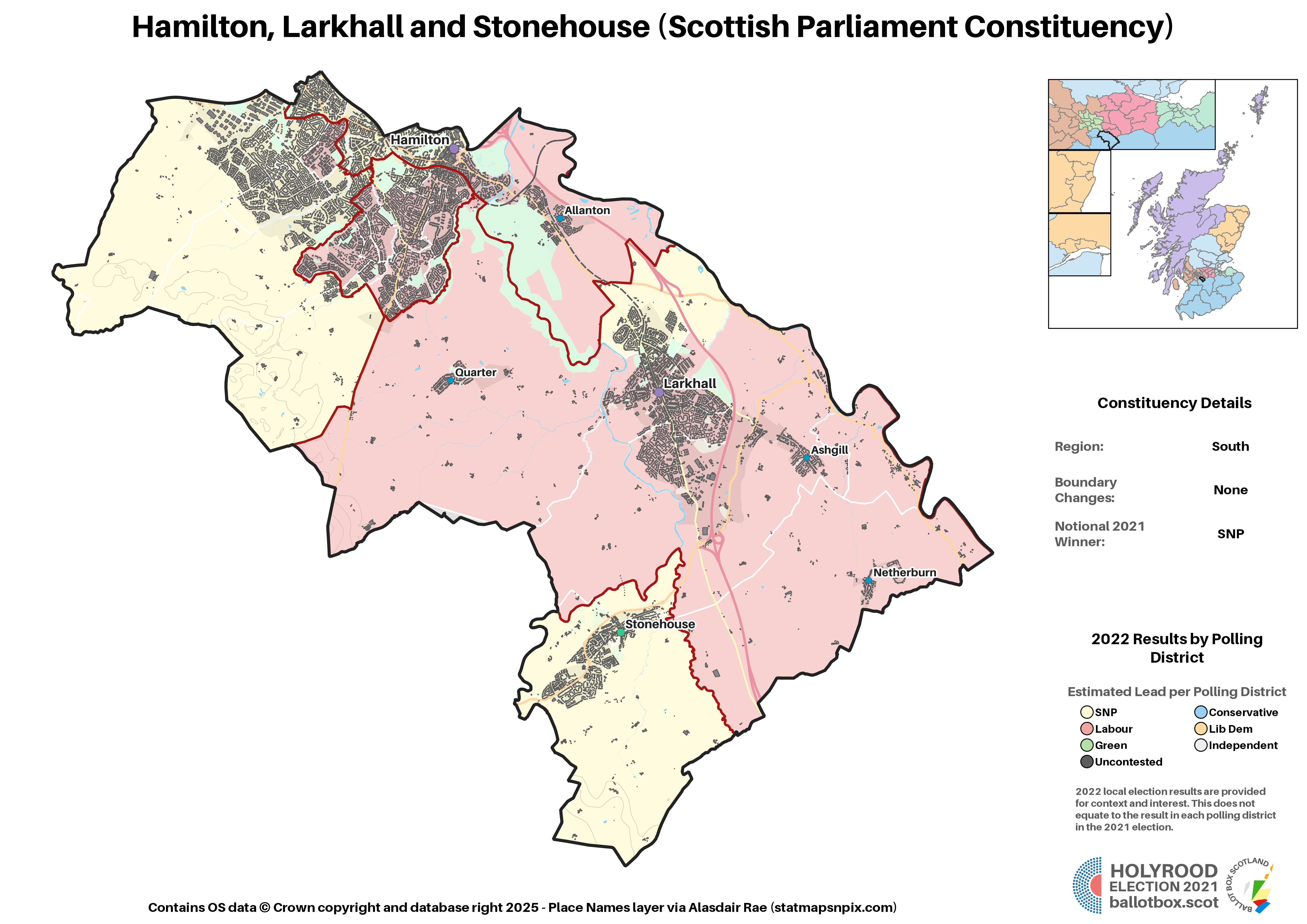
#21: Hamilton, Larkhall and Stonehouse

Constituency Map
Key Information

Notional 2021 Winner: 🟡SNP
Majority: 4582 (12.6%)
2025 By-Election Winner: đź”´Labour
2025 By-Election Majority: 602 (2.2%)
Boundary Changes: None
Region: South

2026 Candidates

🟡SNP: Alex Kerr, L9
🔵Conservative: Alexandra Herdman
đź”´Labour: Davy Russell (*C), L8
đźź Lib Dem
: Michael Weatherhead
🟣Reform UK
: John McNamee, L7
🟤Alliance for Democracy and Freedom
: David Ballantine, L1

2021 Constituency Vote
2021 Regional Vote
2025 By-Election Vote
Analysis

Of all the constituencies in this series, this should be the most familiar to people, given it had a by-election in June last year following the tragic passing of SNP MSP Christina McKelvie from breast cancer. After a hard fought campaign, it was ultimately won by Labour’s Davy Russell. This was understandably spun by the party as a massive win, but it really wasn’t. See how Edinburgh Central was the second easiest seat for them to gain from the SNP? Well, this is the third easiest.

If you win your third easiest gain by just 2.2% of the vote, at a by-election, against a party that typically has worst by-election turnout than you, when you were polling about 4% better than you are a few months later, that is what we in the business would call “Not Good.” Right now, the SNP are expected to regain this seat. There is of course no guarantee that they do, and whilst they’ll benefit from the absence of the Greens and (presumably) SSP on the ballot this time, Labour may benefit from fewer people going Reform at a general election. Labour may also invest some extra resource here just to avoid the embarrassment of losing it.

Importantly, if Russell does not win this seat his time at Holyrood will have come to a swift end. He has been placed a dreadful eighth place on Labour’s South list. At the risk of sounding a bit mean, the quality of candidate was something that came up a few times throughout the by-election campaign. Although furiously rebutted by the party at the time, if your own members have ranked the incumbent MSP for the most winnable seat in the region eighth on the list that, perhaps, is indicative of something.

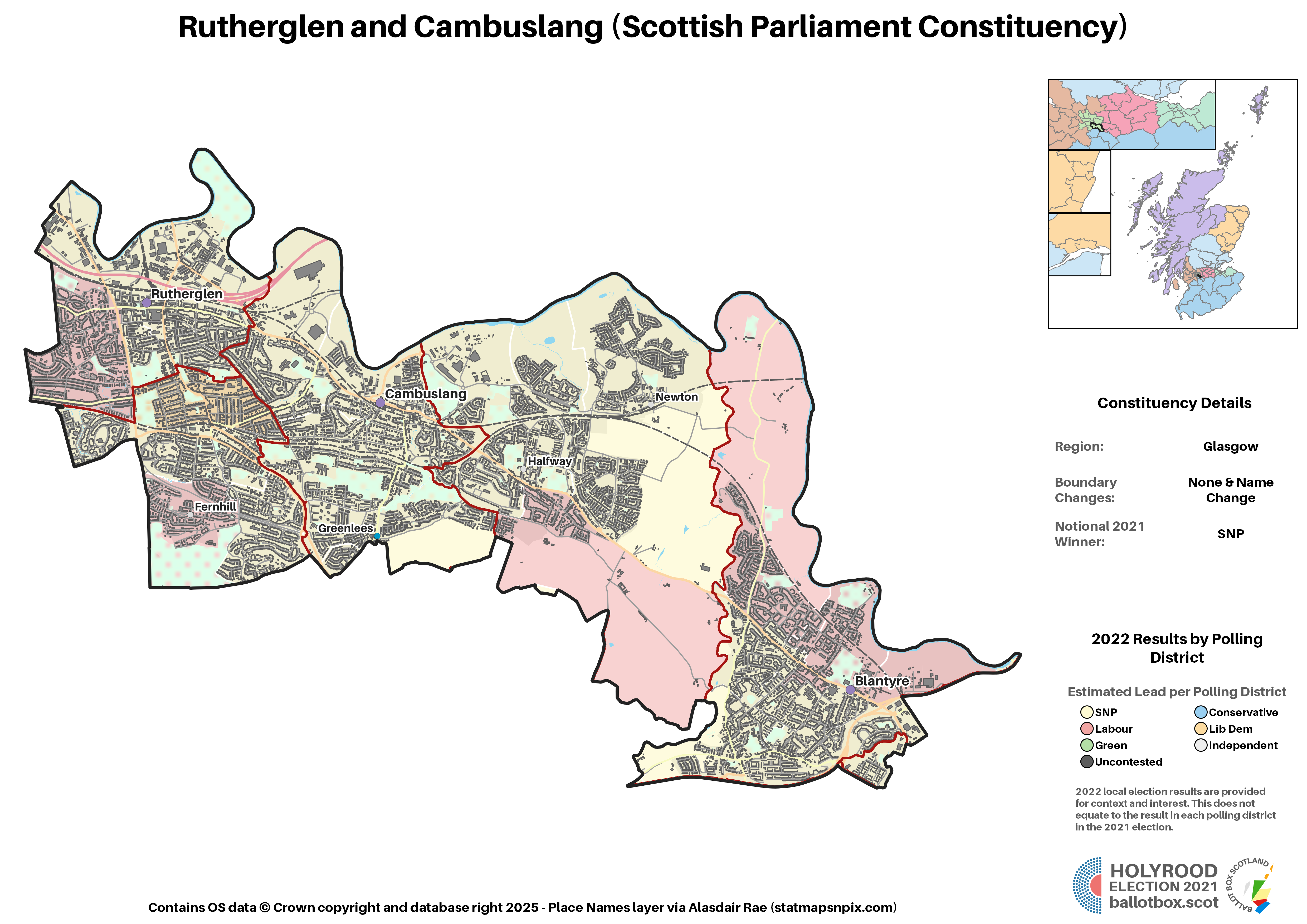
#22: Rutherglen and Cambuslang

Constituency Map
Key Information

Notional 2021 Winner: 🟡SNP
Majority: 1702 (12.9%)
Boundary Changes: No meaningful boundary changes, but name expanded from simply “Rutherglen”
Region: Glasgow

2026 Candidates

🟡SNP: Clare Haughey (*C)
🔵Conservative: Annie Wells (*L), L1
đź”´Labour: Monica Lennon (*L), L4
đźź Lib Dem
: Patrick Logue
🟣Reform UK
: Allan Lyons, L4
🟤TUSC
: Chris Sermanni

2021 Constituency Vote
2021 Regional Vote
Analysis

Don’t let the renaming to add “and Cambuslang” fool you, this is the exact same seat as the previous Rutherglen. It’s likely the name has been changed to differentiate from the UK equivalent Rutherglen seat. Despite not being part of the Glasgow City Council area (though excluding Blantyre, it was from the 70’s to 90’s), this constituency has always been in the Glasgow region, which is more than can now be said for the Cardonald portion of the city.

The reason this makes it into this Near Marginals piece is that it’s the easiest seat in that region for Labour to gain from the SNP. Indeed, following on from the previous one, it’s their fourth easiest pickup nationally. Whilst it would seem unlikely on current polling, winning this is pretty likely to be essential to current Central Scotland MSP Monica Lennon making it back to Holyrood. Having been the Hamilton, Larkhall and Stonehouse candidate in 2021, she’s obviously been replaced by Davy Russell, meaning she had to find another seat.

She’d already have had to jump region had she re-contested HLS as it moved into South, but by going into Rutherglen and Cambuslang she found herself facing off against three established city MSPs, all of whom ranked above her. Had Pam Duncan-Glancy not been forced to step down, Lennon may even have placed a definitely fatal fifth. Getting in from fourth is very unlikely, but at least possible, albeit that my notionals have Glasgow extremely narrowly giving a second Green rather than fourth Labour in 2021 terms. 

That could be highly consequential for Scottish Labour. Lennon has situated herself on the left of the current party, and was Sarwar’s competition for leader in 2021. If Scottish Labour suffer the kind of crushing defeat currently expected in May, Sarwar will have to immediately fall on his sword and trigger a leadership contest. If Lennon remains at Holyrood, they will have the option of someone taking a different course to Sarwar. If not, well, the option may be what I might describe as a Turbo-Sarwarist, and you may query whether doubling down on that approach after it lost two elections in a row is a good idea.

If Lennon does win, she also knocks the SNP’s Clare Haughey out of Holyrood entirely. Not only would the SNP not win any list seats if they only lost one constituency, but Haughey isn’t even on the list at all.

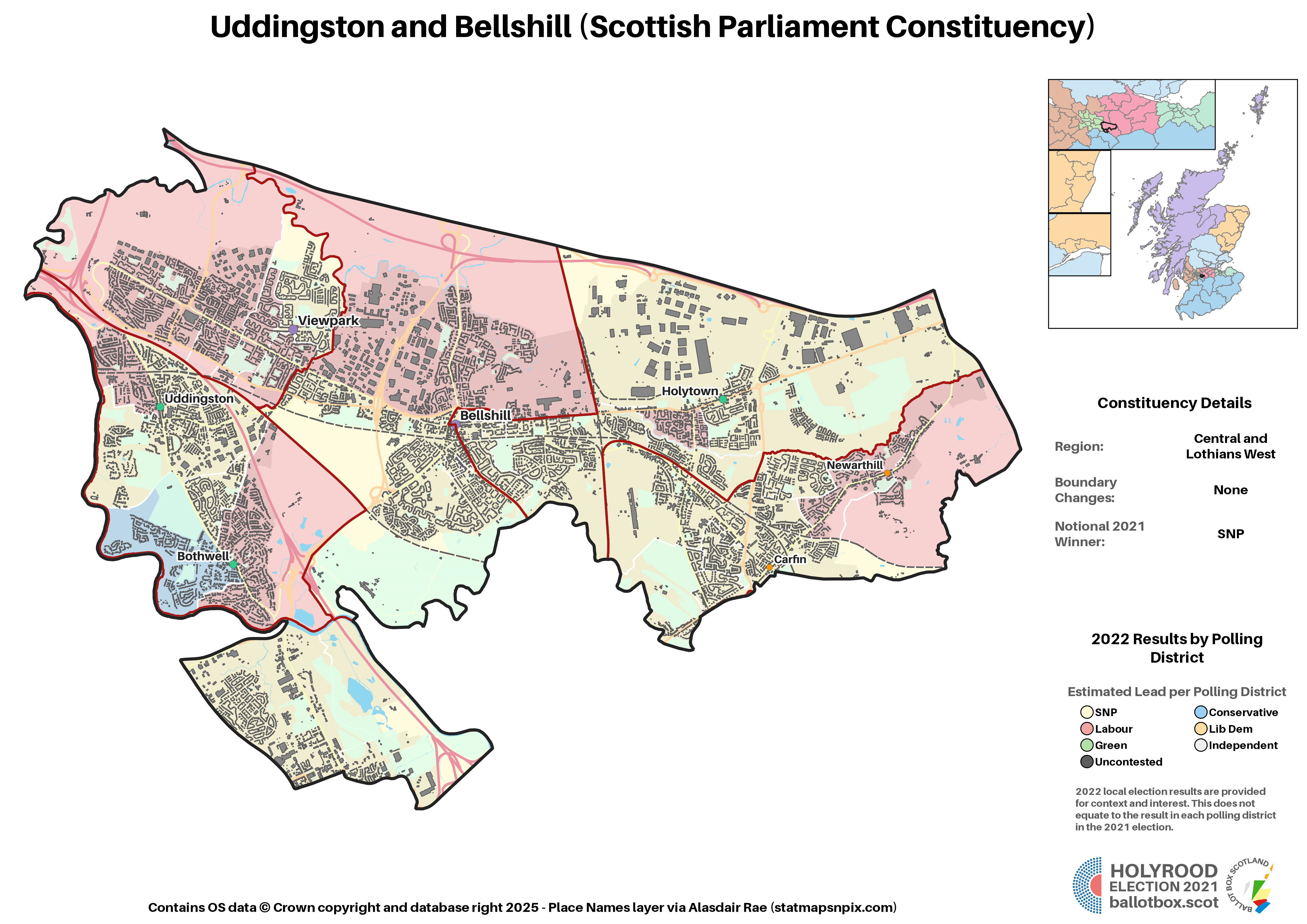
#26: Uddingston and Bellshill

Constituency Map
Key Information

Notional 2021 Winner: 🟡SNP
Majority: 5306 (14.7%)
Boundary Changes: None
Region: Central and Lothians West

2026 Candidates

🟡SNP: Steven Bonnar, L6
🔵Conservative: Meghan Gallacher (*L), L1
đź”´Labour: Mark Griffin (*L), L1
đźź Lib Dem
: Ben Munnoch
🟣Reform UK
: George Hobbins, L9

2021 Constituency Vote
2021 Regional Vote
Analysis

It’s been noted throughout this series that there’s a relatively limited number of true marginals which include Labour. That’s because in the post-IndyRef era, there’s almost total overlap between the SNP and Labour’s areas of maximum strength: the urban Central Belt. That means that even allowing for the fact Labour do a lot better there than nationwide, the scale of the SNP’s 2021 victory means huge swings are needed to make significant constituency gains from them.

Uddingston and Bellshill is a great example of how big the challenge facing Labour is: 14.7% is pretty far from traditional marginality and yet it’s the sixth easiest seat for them to gain from the SNP. If Labour did in terms of swing nationwide as they did in the Hamilton, Larkhall and Stonehouse by-election, this is as far down their list of prospective gains as they’d get. The other eight constituencies in the Central and Lothians West region are all harder for Labour to pick up, which is why this one matters and has made it into the bonus round in preference to a couple of closer seats in regions that have already had at least one featured seat.

It’s a new candidate seeking to hold this for the SNP, but not a new parliamentarian. Steven Bonnar was MP for Coatbridge, Chryston and Bellshill from 2019 to 2024, re-taking one of the half-dozen seats Labour had gained from the SNP in the 2017 UK Election. Hoping to gain it for Labour is sitting MSP Mark Griffin, who is also top of his party’s regional list here and therefore effectively guaranteed re-election. If he can win this constituency though he will relieve some of the proportional pressure the SNP are exerting, which even if it didn’t directly add another Labour MSP, would certainly add another opposition MSP via the list.

Regional Battleground: Mid Scotland and Fife

Region Map
2021 Constituency Vote
2021 Regional Vote
2021 List MSPs

1: 🔵Conservative
2: 🔵Conservative
3: 🔴Labour
4: 🟢Green
5: 🔵Conservative

6: 🔴Labour
7: 🔵Conservative

2021 List Seat 7
Mid Scotland and Fife: 2026 Regional List Candidates

The six parties expected to win seats in the Scottish Parliament in 2026 are listed in order of national support in 2021. Remaining parties are in alphabetical order, and Independents listed last.

Candidates that are contesting both the List and Constituency ballot have their constituency noted after their name on the list.

  1. John Swinney (*C, Perthshire North)
  2. Shirley-Anne Somerville (*C, Dunfermline)
  3. Fiona Law
  4. Alyn Smith (Stirling)
  5. Jim Fairlie (Perthshire South and Kinross-shire)
  6. David Torrance (Kirkcaldy)
  7. Susan McGill
  8. John Beare
  9. David Mitchell
  1. Murdo Fraser (*L, Perthshire North)
  2. Stephen Kerr (*OL, Stirling)
  3. Roz McCall (*L, Perthshire South and Kinross-shire)
  4. Alexander Stewart (*L, Clackmannanshire and Dunblane)
  5. Edward Sheasby (Fife North East)
  6. Thomas Heald (Dunfermline)
  7. Darren Watt (Cowdenbeath)
  8. Heather Greig (Kirkcaldy)
  9. Niamh Heald (Mid Fife and Glenrothes)
  1. Claire Baker (*L, Kirkcaldy)
  2. Joe Long (Dunfermline)
  3. Fiona Sword (Cowdenbeath)
  4. Kainde Manji (Stirling)
  5. Suzanne Grahame (Clackmannanshire and Dunblane)
  6. Angela Bailey (Perthshire North)
  7. Afifa Khanam (Mid Fife and Glenrothes)
  8. Luke Thomson (Perthshire South and Kinross-shire)
  1. Mark Ruskell (*L)
  2. Mags Hall
  3. Caitlin Ripley
  4. Ryan Blackadder
  5. Marie Stadtler
  6. Clare Andrews
  7. Andrew Adam
  8. Paul Vallot
  1. Claire McLaren (Perthshire North)
  2. Sally Pattle (Clackmannanshire and Dunblane)
  3. Ed Scotcher (Mid Fife and Glenrothes)
  4. Amanda Clark (Perthshire South and Kinross-shire)
  5. Lauren Buchanan-Quigley (Dunfermline)
  6. Jane Liston
  7. Fraser Graham (Kirkcaldy)
  1. Helen McDade (Perthshire South and Kinross-shire)
  2. Julie MacDougall (Kirkcaldy)
  3. Rachel Wright (Stirling)
  4. Mark Davies (Cowdenbeath)
  5. Mike Collier (Clackmannanshire and Dunblane)
  6. Kenneth Morton (Perthshire North)
  7. Otto Inglis (Dunfermline)
  1. Hilary Wheater
  2. Reece Lauder
  1. Eva Comrie (Clackmannanshire and Dunblane)
  2. Laurie Moffat (Cowdenbeath)
  3. John Penman
  4. Donal Hurley
  5. Frank Armstrong
  1. Richard Lucas
  2. Daniel Smith
  3. Alan Brown
  4. Marc Surtees
  1. Alexandra Hardie

Note: Independent Green Voice are a front group for a bunch of Glasgow bampots, led by someone who was expelled from UKIP for alleged Holocaust denial. They are standing purely as a spoiler party in this election, targeting the legitimate Scottish Green Party, and their simple one candidate per region slate is further evidence of this dodgy dealing.

  1. Paolo Caserta
  2. Jack Reekie
Analysis

Mid Scotland and Fife has not only emerged from the boundary review with an almost entirely unchanged constituency landscape (just one small tweak around Stirling), but is also quite possibly the least likely to see any changes to who wins them. With the Lib Dems secure in Fife North East, the Conservatives too feeble to challenge for Perthshire, and Labour back in the polling doldrums, I expect to see the same map emerge in May. Even the easiest seat for Labour to gain, Cowdenbeath, has a chunky 17.6% SNP majority.

For a region that was already straining under SNP over-apportionment in 2021, when that cost Labour a seat, a repeat constituency performance has even more potential to do other parties in. At the last election Mid and Fife became the third strongest region for the Greens, and their 12.2% in the BBS model at time of writing should lead to two MSPs. It doesn’t. They are in a perfect vote share tie with the Conservatives who also only get one MSP, which would mean losing sitting MSP Stephen Kerr, in addition to the much more certainly doomed Roz McCall and Alexander Stewart.

However, with 12.7% the Lib Dems do get a second seat, so even a very slight difference in distribution could send that seat elsewhere. Labour’s estimated 13.4% isn’t much higher either so I wouldn’t say their second seat is entirely secure at this point. Reform UK are likewise projected to what should be a three MSP share of 17.4% but only come out with two.

At a net total of three “wrong” seats this isn’t as bad as the four or even five that can crop up in the most affected regions. Yet where this region stands out at the moment is being the only one where all six major parties are currently projected to win a double-digit vote share. This is therefore a key battleground not to see whether some parties get seats at all, but which of them can secure the doubles (or trebles) they are fairly due at an election where the voting system will be less fair than ever before.

If you find this or other Ballot Box Scotland output useful and/or interesting, and you can afford to do so, please consider donating to support my work. I love doing this, but it’s a one-man project and takes a lot of time and effort. All donations, no matter how small, are greatly appreciated and extremely helpful.
(About Donations)