Ward Profile
Cause of By-Election
In the immortal words of Brenda from Bristol: not another one! Highland Council is giving us two very distinct kinds of by-election on the same day, one bringing voters back to the polls for a fourth time this council term, and the other for the first. This is, as you can tell from Brenda, the former. The resignation of SNP councillor for Tain and Easter Ross, Derek Louden, means that all three councillors elected in 2022 have now left office. He’d been a councillor here since 2017.
As I’ve already written about this ward twice, a lot of what follows is drawn from the either the previews (for first and second) or results analysis (again, first and second) for the previous by-elections.
Ward Details
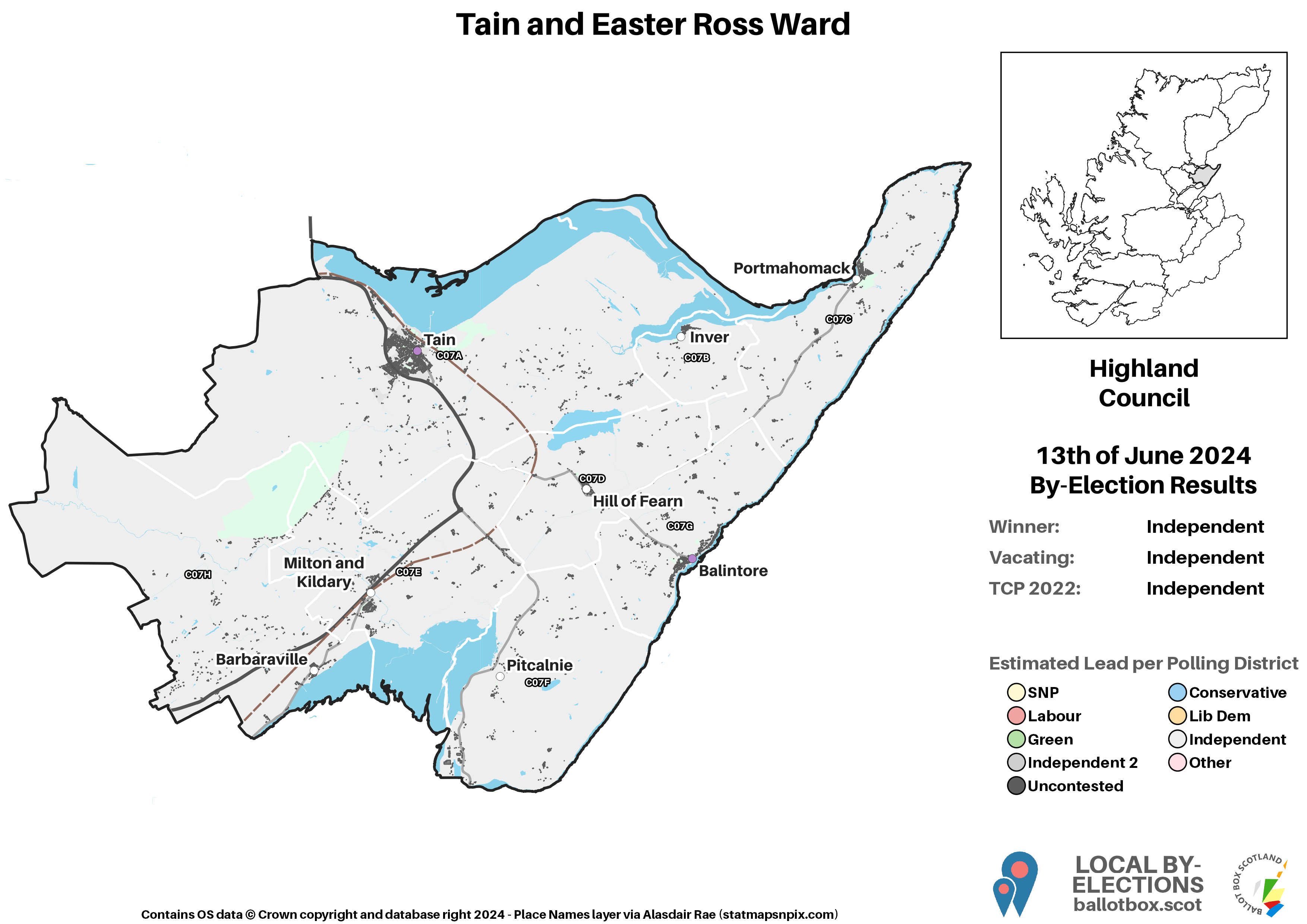
Tain and Easter Ross is one of 21 wards in the Highland council area, and elects 3 councillors at a full election. Although to my non-local eye this appears to encompass a single peninsula, it doesn’t appear to be particularly or especially named anything bar possibly the “Easter Ross Peninsula” locally. As the name would suggest, the core of the population here is found in Tain, with other settlements of note at Balintore, Portmahomack, Inver, Hill of Fearn, Barbaraville, and the twin villages of Milton and Kildary.
For elections to the Scottish Parliament, the ward is within the Caithness, Sutherland and Ross constituency, which the SNP have held (with a different MSP at every election) since gaining it from the Lib Dems in 2011. The UK Parliament equivalent is Caithness, Sutherland and Easter Ross, which has been Lib Dem consistently except for the SNP’s landslide 2015 win.
Electoral History
For the first two elections, the ward returned the same pattern of councillors: a pair of Independents, plus a Lib Dem. However only one of those Independents, Alasdair Rhind, was the same across elections. Later on in 2007 the Lib Dem councillor Richard Durham shifted to sit as an Independent whilst the other elected Independent, Alan Torrance, joined the SNP. Torrance sadly passed in 2011, prompting a by-election that brought Independent Fiona Robertson into the ward for the first time. In 2012, Rhind and Robertson were both re-elected, and former MSP Jamie Stone took up the Lib Dem seat, defeating his former party colleague running as an Independent.
Despite their national strength it took until the 2017 election for the SNP to get a look-in with a seat in the ward, which they did by knocking Rhind out. His absence was very short lived however as Jamie Stone was elected to the UK Parliament the following month, triggering a by-election that Rhind easily won. Although 2022 replicated the partisan pattern of 2017, this time it was Robertson who was the loser between the two local Independents.
When Lib Dem councillor Sarah Rawlings stood down in 2023 due to ill health, that vacancy was filled by Independent Maureen Ross. Then when when Rhind sadly passed last year it was another Independent, Laura Dundas, who emerged victorious.
This particular chart of vote shares across time can be rather difficult to follow given the fact the 2007, 2017 and now 2022 term councils had by-elections in the ward, which obviously take any sitting Independents out of play. Rhind was easily the most popular candidate in the first election, far ahead of the Lib Dems and especially the SNP. He’s not broken out individually given the circumstances, but note Torrance’s 11.2% placed him fourth, but he was able to leverage Rhind’s surplus and the votes of eliminated other Independents to claim a seat. When Torrance passed, the SNP shot up into first place with their best result yet, but only narrowly ahead of Robertson and easily overcome by transfers.
2017 is remarkable for the general turn from Independents to party-affiliated councillors, marking the first time party candidates collectively won more votes than Independents. Both the SNP and Lib Dems registered strong growth, but it was the Conservatives surging from a piddling 1.4% to 16%, nearly beating Rhind, that really stands out. He re-asserted himself by completely crushing all competition in the by-election later that year, but the full vote in 2022 continued the trend of decline as both Rhind and Robertson lost votes to further SNP and Lib Dem growth, the latter with their best share yet in the ward.
At the 2023 by-election, both the Conservatives and especially the SNP took a hit in the face of growth for the Lib Dems, the presence (albeit weak) of the Greens and Labour, and the strength of new Independent Maureen Ross. In last year’s ballot the SNP recovered slightly to place very marginally ahead of the Lib Dems in first preference terms, whilst Labour disappeared from the ballot again and the Conservatives slumped further still.
Councillors and Key Stats
1 Councillor Elected:
⚪Independent: Laura Dundas
Change vs 2023 (notional): New Independent
Change vs vacating: New Independent
Turnout: 34.9% (+0.5)
Electorate: 7179
Valid: 2483 (99.0%)
Spoiled: 24 (1.0%)
Quota: 1242
2 Continuing Councillors: SNP: Derek Louden
 Independent: Maureen Ross
Candidates
🟡SNP: Gordon Allison
🟢Green: Andrew Barnett
🟤Libertarian: Harry Christian
🟠Lib Dem: Barbara Cohen
⚪Independent: Laura Dundas
⚪Independent: John Shearer
🔵Conservative: Eva Short
First Preferences
Transfers
Two-Candidate Preferred
Two-Party Preferred
By-Election
Candidates
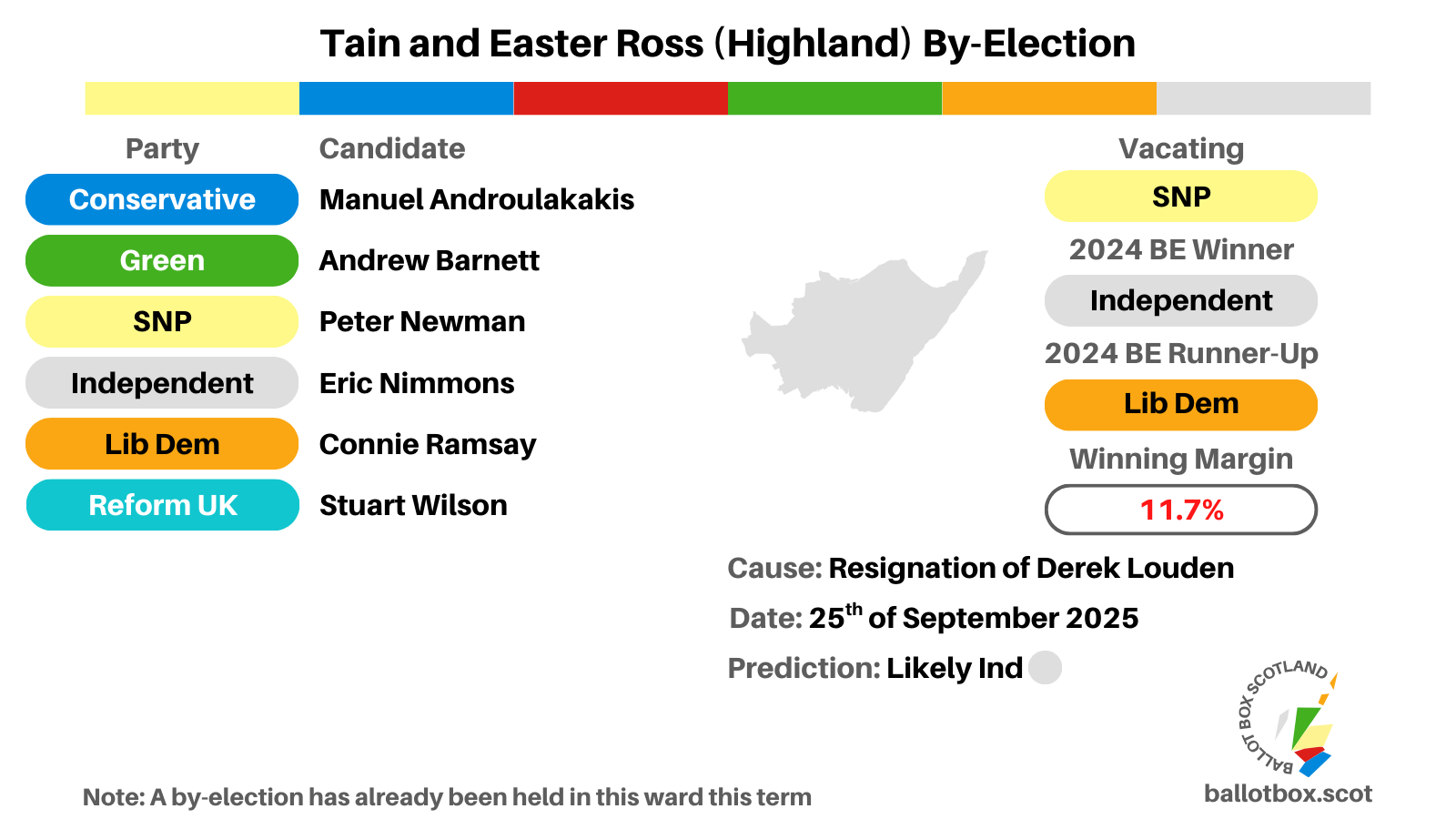
Both by-elections taking place on this date are missing one of the Holyrood 5; in this case, it’s Labour. Only two of the candidates here are returning, and the last time each stood it was for the same party. Andrew Barnett continues to be a Green and has stood for them at every by-election in this ward, as well as at the full election and another by-election in Inverness Central. Peter Newman meanwhile was the Green candidate for the Inverness, Skye and West Ross-shire constituency at last year’s UK General Election, but has since joined the SNP.
🔵Conservative: Manuel Androulakakis
🟢Green: Andrew Barnett
🟡SNP: Peter Newman
⚪Independent: Eric Nimmons
🟠Lib Dem: Connie Ramsay
🟣Reform UK: Stuart Wilson
Analysis
The past two by-elections in this ward have led to Independent victories, so the smart money would be on that outcome. However there’s only one on the paper this time and as much as Highland can, at times, reflexively vote for someone labelled Independent as if that was a party, it’s not guaranteed. As such I’m hedging slightly with a “Likely”, though I note that one of the sitting Independents is acting as his agent, which may further boost his chances.
If it’s not going Independent, you’d expect the Lib Dems to be the most likely winners. Although the SNP closed the gap on them at the last by-election, they still led by nearly 8% of the vote. Add in the fact the Lib Dems will be going hell for leather to win the overlapping Holyrood constituency next May and I fear for the amount of material some voters may end up getting through their doors!
One last little point of interest isn’t something that will determine the winner, but watch to see if the Conservatives fall behind the Greens as they did in the recent Barrhead by-election. Given they weren’t that far ahead last time when Reform weren’t on the ballot, they could be looking at another Cromarty Firth where their vote becomes truly vestigial.
Prediction
Likely Independent.
2024 By-Election Results (Detailed Data)
Results by Polling District
Second Preferences
If you find this or other Ballot Box Scotland output useful and/or interesting, and you can afford to do so, please consider donating to support my work. I love doing this, but it’s a one-man project and takes a lot of time and effort. All donations, no matter how small, are greatly appreciated and extremely helpful.
(About Donations)