Note: Due to the detailed nature of the topic, this piece is significantly longer than a usual BBS article!
Context
What's Happening?
Boundaries Scotland are back again with another pass at new Scottish Parliament constituencies and, for the first time in the process, regions. They published their initial proposals in May last year, which I wrote about quite extensively here, including an explanation of why it was happening and what the process was. Revised proposals were published in April, which I again took a detailed look at. At the end of September they published another set of revisions for consultation, but at this stage the general rule is if it hasn’t changed compared to the last revision, that means it’s not up for consultation. So only a subset of constituencies and the regional composition are being consulted on this time.
I won’t re-write the whole intro again, but the short version is this is a legal requirement, it hasn’t been demanded by any government or party, and the commission is non-partisan and is not engaged in gerrymandering. Many of the oddities that you see arise from a combination of First Past the Post and who shouted the loudest in earlier consultation stages. I have my own proposals in response to this consultation which I recommend you read as well, if you’re a keen bean.
Describing Changes
Geographic
I’m using a slightly different approach to describing geographic changes than Boundaries Scotland did, by outlining whether changes are minor, major, or effectively result in a new constituency entirely.
- Minor – Only a minor change to an existing seat, which may include a change of name.
- Major – Major change to an existing seat, which nonetheless remains recognisable in some form.
- New – A constituency with big enough changes it’s worth viewing as a new seat entirely.
As we are on our third version of these proposals, I will only specifically comment on changes versus the current constituencies or the previous proposals. The initial proposals are wiped from memory for the purposes of this piece.
Political
Although it’s not in any way the point of the exercise, it’s an inevitable fact that if you change electoral boundaries, that has an impact on the political balance of the changed seats. However, the fact that the Scottish Parliament is partly proportional means that boundary changes are both likely to be less consequential than under pure FPTP, and less direct.
When AMS is working to perfection, changing a constituency between parties without any difference in regional vote just triggers an equal but opposite change in list seats. So for example, the Conservatives winning an additional constituency in the South region doesn’t actually give them an additional seat, as they receive one fewer list seat, and the SNP get one more.
When AMS isn’t working to perfection, because a party has exceeded its proportional share via constituencies, it may not be the party losing another constituency which loses a seat. As another example, the SNP already had one seat more than their proportional share in the North East region in 2021, costing the Conservatives a list seat. If they’d also won the one constituency the Conservatives won, then the compensating list seat for the Conservatives would come from Labour, who had won the 7th and final list seat otherwise.
For a very small number of constituencies I have done a first pass at a “notional” 2021 vote share on the new boundaries. By the nature of the SNP’s dominance in 2021, very few boundary changes meaningfully change the outcome, but there are places it is interesting to look at. Again, I outlined some of the detail for how I do this in the piece about the initial proposals. I haven’t repeated the exercise for any constituencies unchanged since the last version.
Brief Overview
The maps below show a simple side by side comparison of current and existing constituencies and regions. Unlike previous BBS analysis of boundaries, as Boundaries Scotland have given official regional proposals this time and because I’ve decided to write about my own response in a separate piece, this is just as-proposed, no alternative options here.
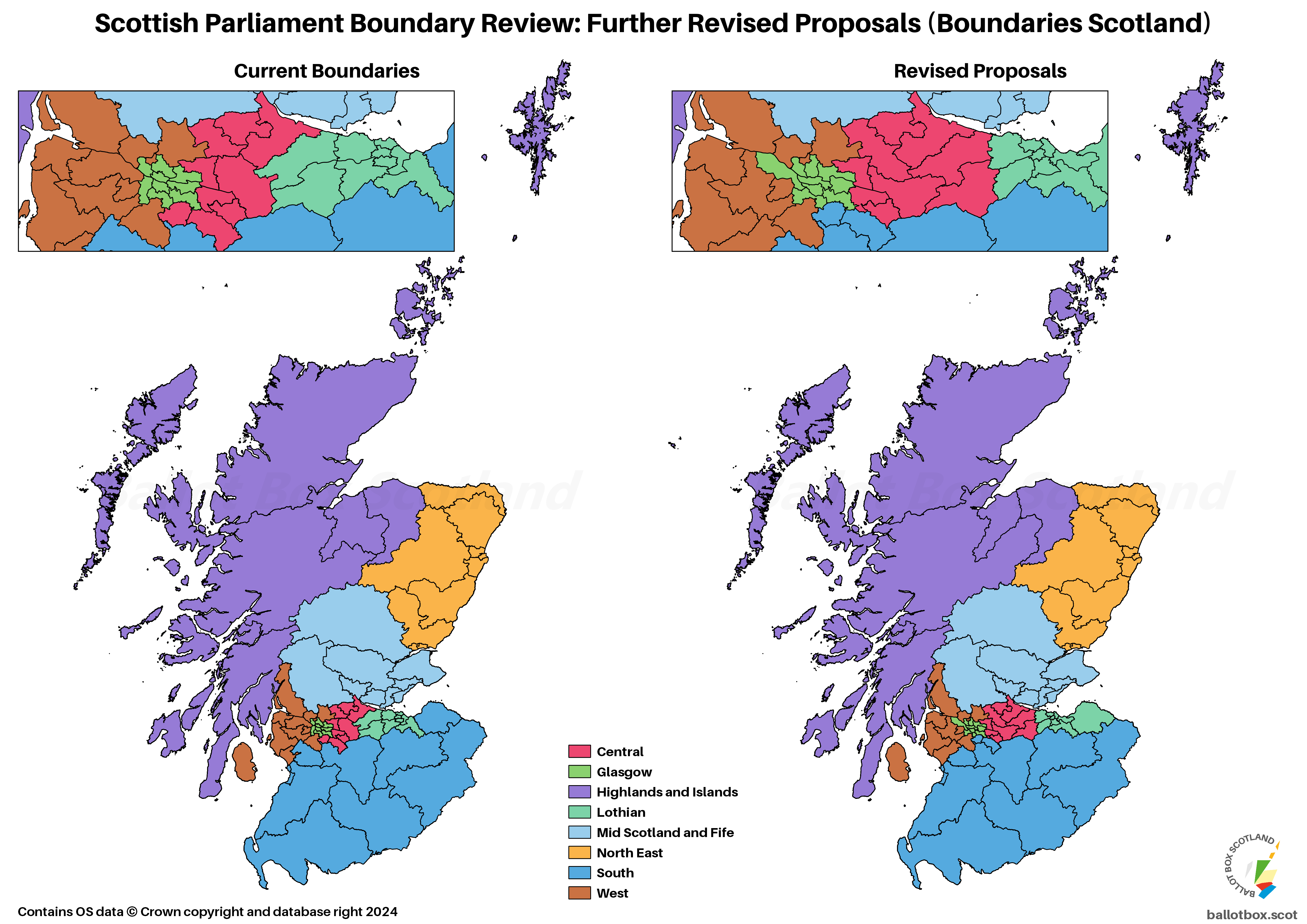
That overall picture out of the way, let’s delve right into the detail of the proposals! I’ll take each region in turn, with the grouping based on the first scenario but commentary covering both. I am not providing the map for each constituency because you can get those from Boundaries Scotland here.
Central
Central continues to experience dramatic changes, with a completely redrawn set of seats each revision. As this is the first revision to actually include indicative regions, we can see it’s even further changed, with the absolutely absurd suggestion it should lose most of urban South Lanarkshire to the South Region, whilst gaining West Lothian.
Almond Valley (Minor)
West Lothian in Central isn’t the worst thing in and of itself, but the fact it’s to balance the loss of area to South is extremely bad. This loses Fauldhouse to the Airdrie seat, but it keeps Longridge, a tiny village I’m very familiar with as the abode of a former boyfriend, and therefore I know it’s very weird that tiny village will be in Lothian region whilst the two neighbouring larger towns are in Central. Perhaps worth fixing? Also cedes Seafield to Linlithgow.
Airdrie (Major)
The previous revision had reverted back to the current boundaries of the Aidrie and Shotts seat. This one introduces significant changes, losing all villages to the north and east of Airdrie itself to Cumbernauld and Kilsyth. In compensation it gains Whitburn from the current Linlithgow and Fauldhouse from the current Almond Valley.
Coatbridge and Chryston (Unchanged)
Cumbernauld and Kilsyth (Major)
In the previous revision this had been extended to take in the Denny and Banknock areas of Falkirk. That’s been abandoned, and instead it has taken Plains, Caldercruix, Greengairs and Wattston from the current Airdrie and Shotts.
Falkirk East (Unchanged)
Falkirk had a whole local inquiry relating to its proposed changes, and the outcome was “we’re not making any changes.” The previous revision had put most of this in “Linlithgow and Falkirk South”, except the portion north of Falkirk town itself which was in “Falkirk North”.
Falkirk West (Unchanged)
This is likewise restored to the status quo, after a proposal to put most of this in a “Falkirk North” seat, whilst Denny and Banknock would have been moved to Cumbernauld and Kilsyth.
Linlithgow (Major)
Loses Whitburn (a pretty substantial town) to Airdrie, whilst gaining Seafield from Almond Valley. This is the other place Longridge could go if they wanted to make sure it followed its neighbours into the Central region.
Motherwell and Wishaw (Unchanged)
Uddingston and Bellshill (Unchanged)
Except for an industrial estate but that doesn’t count.
Regional Impact - Boundaries Scotland Scenario
The swap of West Lothian in and most of urban South Lanarkshire out is to the detriment of Labour and the benefit of the Conservatives, Greens and Lib Dems. Although West Lothian is weak Green by Lothian standards, it’s strong Green compared to the current Central. It’s not massive shifts, but it’s enough that the Greens go from winning the 7th regional seat by the skin of their teeth under the current boundaries to comfortably winning the 6th.
Glasgow
Glasgow continues to be a hot mess in terms of its overall shape, with the proposal to extend the regional boundary to include a large portion of northern Renfrewshire still alive. This is very bad and you should oppose it with ever fibre of your being. One small improvement though is the return of actually named rather than directional seats for the city.
Erskine, Renfrew and Cardonald (New)
THEY MADE IT WORSE. They decided no, actually, what they had before wasn’t vile enough and they added Bishopton from the current Renfrewshire North and West to this as well, though it loses the area around the QEUH to the proposed Central seat. So now, we have a “Glasgow” region seat which with the aid of a good gust of wind you could safely land a paper aeroplane on Dumbarton Rock from it. I have never been more affronted by a constituency boundary in my life. Every single person who reads this piece needs to go away and tell Boundaries Scotland they cannot do this.
Glasgow Anniesland (Minor)
Same as the previous revision, gains Thornwood from the current Glasgow Kelvin, loses Claythorn to the redrawn Kelvin and Maryhill.
Glasgow Baillieston and Shettleston (Major)
Unchanged versus the last revision bar the name. The bulk of this is the current Glasgow Shettleston bar the Calton and Bridgeton bits, which were removed in the initial proposals, whilst Dalmarnock and Newbank have been removed in the revised version. It also draws in areas like Riddrie, Carntyne, Cranhill and Springboig from the current Glasgow Provan.
Glasgow Cathcart and Pollok (New)
Unchanged versus the last revision bar the name. Most of this seat comes from the current Glasgow Cathcart, which is only shorn of its Battlefield and Mount Florida components. It also draws in the southern half of the current Glasgow Pollok, including Pollok itself, Crookston, Nitshill, Priesthill, Parkhouse, Darnley and Arden.
Glasgow Central (New)
None of the current Glasgow constituencies cross the river, but they are insistent on doing so in this review. This draws from three existing seats, with the bulk of Govan plus Laurieston coming from the current Southside, the city centre and the stretch from Anderston to Yorkhill from Kelvin, and the Calton and Bridgeton areas from Shettleston. Relative to the previous revision, this loses the Pollokshields ward, but gains the Calton ward, the Laurieston area, and the area adjacent to the QEUH.
Glasgow Easterhouse and Springburn (Major)
Unchanged versus the last revision bar the name. Most of this comes from the current Glasgow Provan, namely Easterhouse, Garthamlock, Robroyston, Provanmill and Dennistoun. From Glasgow Maryhill and Springburn, this has the east of Possil, Milton, and Springburn itself.
Glasgow Maryhill and Kelvin (Major)
Unchanged versus the last revision bar the name. From the current Glasgow Kelvin this only retains Hillhead, Hyndland and Dowanhill. It gains Claythorn from Glasgow Anniesland, and then areas like Maryhill, Lambhill, Ruchill (lots of -hills here, how positively Roman) and the western part of Possil from Glasgow Maryhill and Springburn. The Greens will be absolutely scunnered with this one, as they’d tried to win the current Glasgow Kelvin at the past two Holyrood elections, coming second both times.
The existing constituency consists almost entirely of strong Green areas, but being split three ways dilutes that significantly. Although the core here contains the best Green ward in the country at Hillhead, Kelvindale, Maryhill and Ruchill just cannot compare to removed areas like Thornwood, Finnieston and Garnethill. As this time I integrated my estimates for Green results in non-contested constituencies into the process, I have got a proper go at what this might look like. The Greens aren’t far off second still, but it is a good bit weaker, and I find it hard to see how they could make up the difference.
Glasgow Southside (Major)
This is a significant redrawing compared to the current seat, losing the areas of Govan around Ibrox to Plantation as well as the Laurieston area, both to the new Central proposal. Gains Craigton from the current Pollok, and the general Langside, Battlefield and Mouth Florida area from the current Cathcart. Relative to the previous “Glasgow South Eastern” proposal gains Pollokshields ward but loses the Calton ward and the Laurieston area.
Rutherglen and Cambuslang (Unchanged)
Unchanged bar an industrial estate, which doesn’t count, and the addition of Cambuslang to the name.
Regional Impact - Boundaries Scotland Scenario
Expanding the Renfrewshire component further improves the Conservative standing at the Greens’ expense, crowbarring the gap between the two a little wider still. It was 0.3% under the current boundaries but 1.3% here. Doesn’t impact the actual distribution of seats though.
Regional Impact - Boundaries Scotland Scenario
Take Erskine, Renfrew and Cardonald out back and shoot it. There are enough voters in both regions, if you accept that some degree of deviation from quota is acceptable in the name of sensible boundaries, that you can draw 8 Glasgow-only constituencies and pair them with Rutherglen and Cambuslang, as at present. As this is then just the same region as 2021, the overall regional result is the same.
Highlands and Islands
As the three Islands constituencies are not included in boundary changes, combined with only some very minor changes to the Inverness seat, Highlands and Islands would be the second least altered region overall.
Argyll and Bute (Unchanged)
Caithness, Sutherland and Ross (Unchanged)
Inverness and Nairn (Minor)
This had already lost Grantown-on-Spey and surrounds by the last revision, and has had a tiny little rural bit added which completes the Inverness South ward.
Moray (Unchanged)
Na h-Eileanan an Iar (Unchanged)
Orkney Islands (Unchanged)
Shetland Islands (Unchanged)
Skye, Lochaber and Badenoch (Minor)
What little Inverness and Nairn loses, this gains.
Regional Impact
No change to constituency winners, no change to region boundaries, no change to MSPs.
Lothian
The Lothians region continues to be really messy, due to significant population growth and also the consequences of shifting boundaries elsewhere. The current arrangement has 10 seats entirely in the area we’d think of as Lothian, plus an 11th straddling it, yet only 9 seats in the Lothian Region. The initial proposals increased that to 12 full seats without any straddling. There are now 11 full and two straddlers, which is just really awkward to work with. Remember, to all intents and purposes the maximum number of constituencies a region can have in it is 10, so that’s why this ends up at the centre of my two competing scenarios.
East Lothian Coast and Lammermuirs (Minor) - Key Seat
No (meaningful) changes except to the name compared to the previous revision, though compared to the current East Lothian it loses Tranent to the proposed Edinburgh Eastern, Musselburgh and Tranent seat. Also moves into the Lothian region for the first time, having always been in South previously. This is slightly more advantageous to the SNP than the current seat, as Tranent is very Labour.
Edinburgh Central (Major) - Key Seat
The current Edinburgh Central caused one of the biggest shocks of 2016 when then-leader of the Scottish Conservatives Ruth Davidson gained it from the SNP. It also created one of the finest examples of failing to understand the nuances of AMS, as the SNP spent five years seething at the Greens for “splitting the vote”, when had the Greens not done so then (by sheer accident of the numbers) they would have lost out on the second Lothian MSP they were proportionally entitled to in the resulting SNP overhang. It was a hard-fought battleground in 2021, with the SNP eventually prevailing quite comfortably.
This is barely that seat. From the current Central this does indeed contain the city centre, both Old and New Towns, as well as Tollcross, Canongate, most of Gorgie and what the map I’m referring to simply calls “Southside”. It also gains Merchiston and Marchmont from Southern. However, it loses the Murrayfield area to the redrawn North Western, whilst the Craigleith, Comely Bank and Stockbridge areas all go to the new Edinburgh Northern. Relative to the previous revision, it loses Morningside back to Southern but reclaims Gorgie from South Western.
These further changes benefit the SNP, taking this from an estimated 8% lead relative to pure 2021 data and making it 10.8%. However, similar to Edinburgh Northern, this is an interesting one if compared with local elections. The Greens won this area in 2022, albeit with a tight spread of 25.6% Green, 23.3% SNP and 20.9% Labour. With Glasgow Kelvin dead and buried, this would become the Greens’ best shot at a constituency win. This time around I’ve had time to incorporate my estimated Green data for a 2021 constituency run in, which due to the tacticality against them in the existing Central still has them some way off, but also reduces the SNP-Labour margin to 8.8%.
Edinburgh Eastern, Musselburgh and Tranent (New)
Same as the previous revision, but a really big change from present in the east of the city here, as we return to historic form with a pairing between the east of Edinburgh and neighbouring Musselburgh. Compared to the current Edinburgh Eastern, this loses a lot of areas including Restalrig, Craigentinny, Meadowbank, Willowbrae and Duddingston. It takes Musselburgh from the current Midlothian North and Musselburgh seat, alongside the addition of Tranent, taken from the current East Lothian.
Edinburgh North Eastern and Leith (New)
A new seat that doesn’t clearly succeed any existing seat, as it’s roughly half-n-half elements from the current Edinburgh Northern and Leith (primarily most of Leith itself) and Edinburgh Eastern (the bits described in that seat). It’s geographically unchanged versus the previous revision, but as expected the people of Leith absolutely rioted, so they got added to the name.
Edinburgh North Western (Major)
This is mostly the current Edinburgh Western seat, but it gains Ratho, Murrayfield, Balgreen and Roseburn, whilst losing Silverknowes, Muirhouse, Drylaw and Blackhall. Relative to the previous version it’s also lost an eastern portion of Barnton to the new Edinburgh Northern. As this isn’t even a whole polling district, the political impacts will be very minimal: this remains a Lib Dem seat.
Edinburgh Northern (New) - Key Seat
Another effectively new seat, as it contains so many areas of other existing seats that it’s not really a direct successor to any of them. From the current Edinburgh Northern and Leith it draws Inverleith, Newhaven, Trinity, Granton and Pilton. From Edinburgh Central, it’s got Stockbridge, Comely Bank and Dean Village. And from Edinburgh Western it takes Drylaw, Blackhall, Muirhouse and Silverknowes, plus an additional little bit of Barnton that was included in the North Western proposal last time.
As the changes versus the previous revision are so tiny, this remains a really interesting seat, because the Lib Dems won this area in the 2022 local elections by about 29.3% to the SNP’s 25.0%. I know for a fact they will be absolutely gunning for this one come 2026 if it comes to pass, so keep an eye on it.
Edinburgh Southern (Major) - Key Seat
From the current Edinburgh Southern it loses the likes of Merchiston, Marchmont, Craiglockhart and Slateford. It gains Gilmerton, Gracemount, Burdiehouse and environs from the current Edinburgh Eastern, and Fairmilehead from the current Edinburgh Pentlands. Compared to the previous revision it gets to keep Morningside rather than give it to Central, but Oxgangs goes to South Western.
That creates a boundary very close to the Edinburgh South Westminster seat, just a little wider rather than taller. Despite that similarity, voters do vote rather differently at each level, and also when there’s a clear tactical option that can win versus when there isn’t. That means that whilst the seat remains in Labour hands despite this significant reshaping, their majority is cut from 8.9% to 3.6%, though that’s more favourable than the previous proposal which took it to 1.3%.
Edinburgh South Western (Minor)
This is a redrawn and more blandly named version of the current Edinburgh Pentlands. It gains Slateford and Craiglockhart from the current Southern, but it loses Fairmilehead to redrawn Edinburgh Southern and Ratho to Edinburgh North Western. Relative to the previous revision, it has given much of Gorgie back to Central and got Oxgangs back from Southern. I personally think they should still call this Edinburgh Pentlands, it’s not like other seats with changes haven’t kept their names, and it is quite different to the Westminster South West.
Midlothian North (Major)
Unchanged versus the last revision. Compared to the existing Midlothian North and Musselburgh, this now includes almost all of Midlothian in population terms, with the only other change apart from the loss of Musselburgh compared to the current seatbeing picking up Newtongrange from the current Midlothian South, Tweeddale and Lauderdale seat. You’d think it’d require a much more significant expansion to compensate for the loss of Musselburgh, and you’d be correct – it’s just that has come from a rapidly growing population, with lots of new housebuilding at the edge of Edinburgh.
Regional Impact - Boundaries Scotland Scenario
Losing all of West Lothian but gaining all of East Lothian effectively means getting rid of two strong Labour but weaker Green constituencies in place of one strong-ish Labour constituency and one strong Green constituency with a decent Conservative share too. That’s enough to flip the ordering of Conservative and Labour on the regional vote, but not so much it impacts the seat distribution. The Greens are also significantly strengthened versus the existing region, winning the 6th rather than 7th regional seat as a result.
Mid and Fife
Mid Scotland and Fife is completely unchanged versus the previous revision, which was itself only very slightly changed compared to current boundaries.
Clackmannanshire and Dunblane (Minor)
This has effectively shifted the boundary with Stirling to the Forth, bringing in Causewayhead and Cornton.
Cowdenbeath (Unchanged)
Dunfermline (Unchanged)
Fife North East (Unchanged)
The order of the name has shifted though.
Kirkcaldy (Unchanged)
Mid Fife and Glenrothes (Unchanged)
Perthshire North (Minor)
Gains Almondbank from the southern seat.
Perthshire South and Kinross-shire (Minor)
Loses Almondbank to the northern seat.
Stirling (Minor)
Already not the full council area in one seat, it’s trimmed down by the loss of Causewayhead and Cornton to the redrawn Clackmannanshire and Dunblane.
Regional Impact
Since none of the constituencies would be any different, the SNP’s overhang isn’t rectified, and since the region doesn’t change either, it’s all the same as the actual 2021 vote.
North East
The North East wins the award for “least changes” as there is one very, very small tweak between two constituencies compared to the current boundaries. Everything else is exactly the same. Nothing has changed since the previous revision.
Aberdeen Central (Unchanged)
Aberdeen Donside (Unchanged)
Aberdeen South and North Kincardine (Unchanged)
Aberdeenshire East (Minor)
Loses Strichen, New Pitsligo, New Leeds and Fetterangus to Banff and Buchan Coast.
Aberdeenshire West (Unchanged)
Angus North and Mearns (Unchanged)
Angus South (Unchanged)
Banffshire and Buchan Coast (Minor) - Key Seat
This picks up the bits lost from Aberdeenshire East – Strichen, New Pitsligo, New Leeds, Fetterangus. As it’s unchanged compared to the previous revision, no changes to the notional vote share: still SNP.
Dundee City East (Unchanged)
Dundee City West (Unchanged)
Regional Impact
No change to constituency winners, no change to region boundaries, no change to MSPs.
South
Most of the constituencies in South are unchanged, with only a slight loss of territory from Kilmarnock and Irvine Valley to the West region. What does change here are the constituencies in the region, as it is proposed to take in a couple of urban Central Belt seats from South Lanarkshire. This is another really, really bad proposal that has put the equal sizing of region as a greater priority than sensible geographic boundaries. One of Glasgow’s largest satellite towns absolutely should not be in the same region as Berwickshire, come on!
Ayr (Unchanged)
Carrick, Cumnock and Doon Valley (Unchanged)
Clydesdale (Unchanged)
Dumfriesshire (Unchanged)
East Kilbride (Unchanged)
WHY IS THIS HERE?! Well, okay, the answer is as follows: the ridiculous rules requiring each region to be roughly the same number of voters, despite the fact that by definition two of them have to have 10 constituencies and thus are naturally over quota. Since Lothian seats in general are so jam-packed, putting West Lothian in Central eased that, and the consequence was to throw two urban South Lanarkshire seats into South.
Which is, obviously, completely and utterly absurd. This is just stupid. Utterly, irredeemably so. East Kilbride would become by far (roughly one and a half times the population of Kilmarnock) the largest settlement in the South region, which is otherwise largely rural (outside Ayr, Dumfries and Kilmarnock). No. This absolutely cannot stand. You all need to shout louder than you’ve ever shouted at Boundaries Scotland.
Ettrick, Roxburgh and Berwickshire (Unchanged)
Galloway and West Dumfries (Unchanged)
Hamilton, Larkhall and Stonehouse (Unchanged)
See East Kilbride. This shouldn’t be here. It doesn’t belong here. Nobody wants it here.
Kilmarnock and Irvine Valley (Minor)
Loses Stewarton and Dunlop to Cunninghame South, and therefore also to the West region.
Midlothian South, Tweeddale and Lauderdale (Minor)
Loses Newtongrange to a new “Midlothian North”.
Regional Impact - Boundaries Scotland Scenario
As this adds two big urban constituencies and removes a partly rural one, the share for the SNP and Labour increases compared to the existing South. By contrast, as East Lothian was very strong for the Greens and the added areas weaker, it reduces the Green share. But here’s the thing: as there are now 10 constituencies in the region, it’s very, very slightly easier to win a regional seat than it was with 9. Since the SNP now have 7 constituencies in the region they don’t need a list seat, and the Greens get it.
West
West ends up being the counterbalance to Lothian. Whereas the population across Lothian has been increasing rapidly, not so much across Renfrewshire in particular. It also ends up giving a chunk of itself over to Glasgow region, much to my chagrin, whilst nibbling just a little bit on South. That drops it to 9 constituencies overall.
Clydebank and Milngavie (Unchanged)
Cunninghame North (Unchanged)
Cunninghame South (Minor)
Gains the Stewarton and Dunlop area from the current Kilmarnock and Irvine Valley, and consequently from the South region. Doesn’t gain Kilmaurs anymore.
Dumbarton (Unchanged)
Strictly speaking it gains a little bit of the Kilpatrick hills, but that has zero consequences in voting terms.
Eastwood (Unchanged) - Key Seat
The previous revision suggested adding Neilston, but it’s been totally reverted back to the current shape.
Inverclyde (Minor)
No changes compared to the initial proposals. The name of the current Greenock and Inverclyde is a bit weird, seeing as it doesn’t cover the whole of Inverclyde council area. This version does, having added Kilmacolm and Quarrier’s Village.
Paisley (Minor)
Gains Gallowhill from the current Renfrewshire North and West. Compared to the previous revision, also gains the area by the Phoenix retail park. This is Paisley in whole and in full for the first time.
Renfrewshire West (New)
Despite the name, in population terms this is actually the successor to the current Renfrewshire South. Gains Bridge of Weir, Houston and Langbank from the current Renfrewshire North and West. Versus the previous revision, gives Neilston back to Eastwood, the area around Phoenix Retail Park to Paisley, and Bishopton to the hateful Erskine, Renfrew and Cardonald constituency in the Glasgow region.
Strathkelvin and Bearsden (Unchanged)
Regional Impact - Boundaries Scotland Scenario
A few regional changes here, namely that loss of a large chunk of Renfrewshire to the Glasgow region via the utterly abominable Erskine, Renfrew and Cardonald constituency, plus gaining Stewarton and Dunlop from South. That’s enough of a change that it allows the Conservatives to narrowly take second place in votes, though it has no impact on the overall seat distribution.
Notional National Result
Mu estimate is that these boundary changes gives the same number of seats.
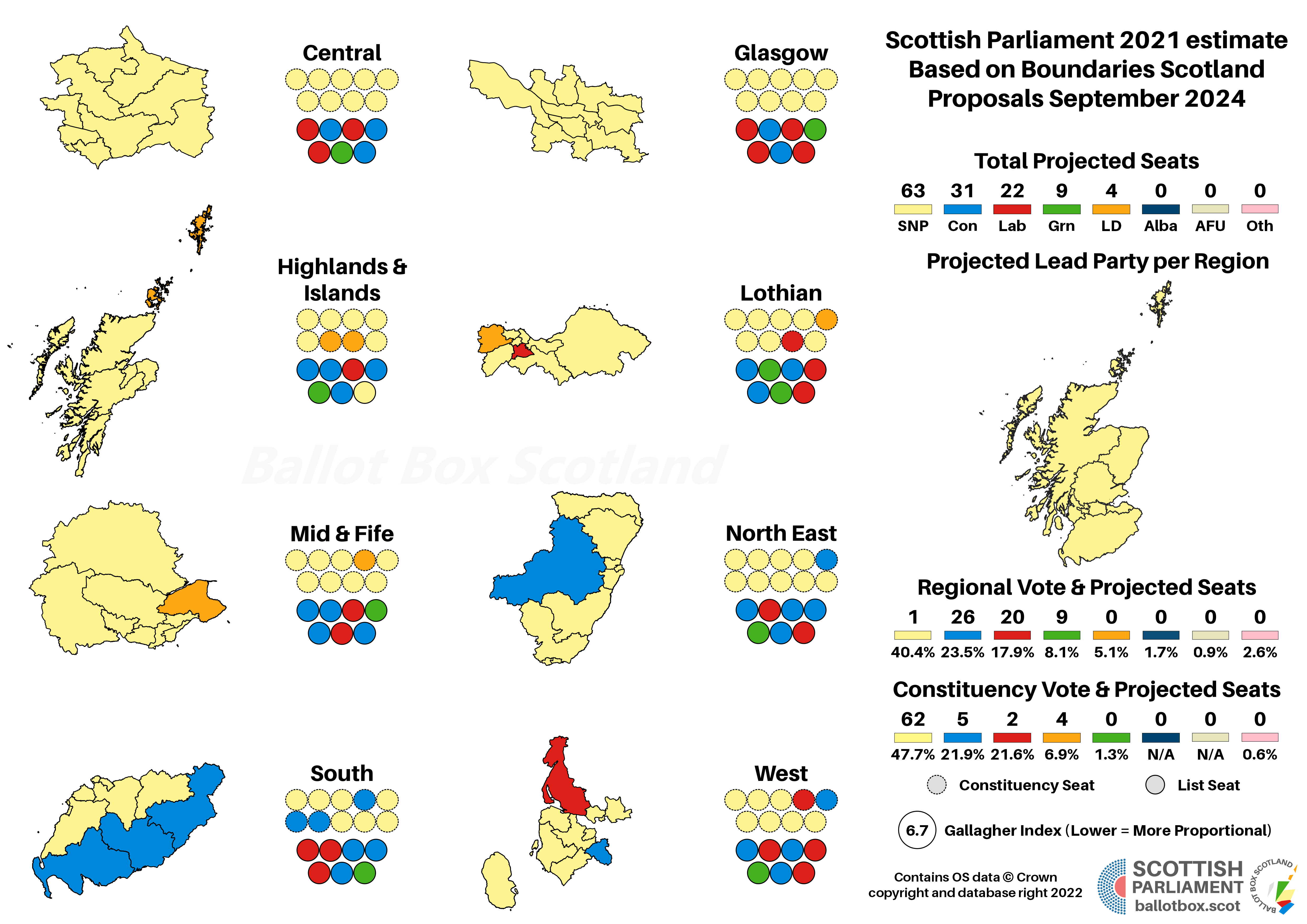
Effectively, the erasure of one of West’s constituencies and adjustment between Central, Lothian and South means that the only net change here is one seat between the SNP and Greens. Effectively, the placement of constituencies is making the difference there, as you can see in the BBS alternative proposals linked below.
Remember of course that working out notionals is not an exact art, and that parties will operate slightly differently on different boundaries! As with previous sets of proposals, I haven’t done a notional for every seat just yet as that would be incredibly time consuming and the final versions could change yet again. I will however work those out when we do have final, signed off boundaries.
Responding to the Consultation
You can respond to the consultation on Boundaries Scotland’s website here. Remember that the least useful, most absolutely pointless thing you can do is send unconstructive complaints or abuse to the commission. That helps nobody, least of all you or other people in the area you’re unhappy about. If you think there is something wrong, suggest a viable alternative – viable being the key word! Suggesting they remove a few hundred voters so they can add thousands more isn’t going to stack up. You have until the 26th of October to respond.
I have also submitted a comprehensive response to the consultation myself, which you can read here, as well as in this summary piece. If you agree with the points I’ve been making, particularly around the Glasgow region boundary plus the correct balancing of Central, South and Lothian, then that summary piece and this Twitter thread (and Bluesky equivalent) gives you some guidance on what you can tell Boundaries Scotland in your own response.
If you find this or other Ballot Box Scotland output useful and/or interesting, and you can afford to do so, please consider donating to support my work. I love doing this, but it’s a one-man project and takes a lot of time and effort. All donations, no matter how small, are greatly appreciated and extremely helpful.
(About Donations)