Background
It’s double bill central in Scotland at the moment, and this week saw two in Dundee. The vote in Lochee arose from the sad passing of Labour councillor Charlie Malone, which in one sense made it the less important of the two, as Labour winning it wouldn’t by itself change the composition of the council and impact the SNP’s bare majority.
Whereas my expectation for the concurrent Strathmartine by-election was only to “Lean” Labour, I marked this one out as “Likely”. The SNP’s win over Labour in single-seat terms in 2022 had only been 6%, a margin that should be absolutely child’s play for them to overturn. In fact, I’d even gone so far as to suggest that if the SNP were wise, they’d just ignore Lochee and focus on Strathmartine to give themselves the best shot at holding their majority.
Headline Results
Councillors and Key Stats
1 Councillor Elected: SNP: Lee Mills
Change vs 2022 (notional): SNP Hold
Change vs vacating: SNP Gain from Labour
Turnout: 21.4% (-19.0)
Electorate: 15237
Valid: 3223 (99.0%)
Spoiled: 31 (1.0%)
Quota: 1612
3 Continuing Councillors:SNP: Roisin SmithSNP: Siobhan Tolland Labour: Wendy Scullin
Candidates
 Lib Dem: Outi BourkeSNP: Lee Mills
 Workers: John Reddy
 Alba: Alan RossLabour: Marty Smith
 Green: Kate Treharne
 Conservative: Calum Walker
First Preferences
Note: The Family Party won 2.2% here in 2022.
First Preference History
I don’t think the SNP took that recommendation, and they’ll be glad they didn’t. They did lose share here, but not as sharply as they have in many other recent by-elections. Although this is their worst performance in the ward so far, and the closest Labour have come to beating them, they maintained a narrow lead. In fact, Labour even managed to lose a bit of their share, albeit only the tiniest smidge. With less than 2% between them though, and only a narrow advantage of 51.6% for the Pro-Union parties overall, this would all come down to transfers.
Compared to Strathmartine the (locally) smaller parties all did a bit better, with the weakest here still winning a greater share than the strongest in that ward. The Conservatives will again be glad that Reform UK didn’t stand, or they’d certainly have fallen below at least Alba and the Greens and probably the Lib Dems too, all of whom increased their shares. I’d have been interested to see how Galloway’s Workers Party would have done facing off against Reform UK: in theory, you’d think of the two as very distinct, but they share similarities on certain social issues and a clear “anti-establishment” vibe, and that can often lead to a degree of voter overlap.
For their part, Alba and the Greens were nearly tied, with just two votes between them. At the risk of invoking the former’s ire, some of the celebrations of this plus last week’s Perth City North may need to be reined in a bit. The two parties are taking a very different approach to by-elections. Alba are standing in hardly any of them, only 3 this year despite the fact 7 have taken place in wards they had candidates in 2022, whereas the Greens have stood in 15 out of 20.
Alba seem to only stand where they’ll actually run a campaign, whereas the Greens stand most places just to have a name on the ballot. When you are running an active campaign with a former councillor and beat a paper candidate (as I understand it) by two votes, it’s perhaps not that remarkable. Similarly, picking a tiny handful of by-elections to contest and attempting to read a national story out of them isn’t representative: it’d be like the Greens only standing in Dunblane and Bridge of Allan, Hillhead and Arran this year and then claiming the resulting vote shares as nationally indicative. Again, don’t get me wrong: running a good local campaign is what Alba need to do to win councillors in future, all I’m saying is don’t confuse a self-selecting handful of them for a national pattern.
Transfers
Two-Candidate Preferred
The gap between the SNP and Labour was eminently closable, but only if transfers went the latter’s way. They did not. Whilst the size of the SNP lead fluctuated, widening after the other Pro-Independence parties dropped out and narrowing when the Pro-Union parties did, it held throughout. This actually ends up nigh-on identical to the Strathmartine final round, at 33 votes and 1%, and even the final vote shares are only 1% different (higher).
No matter how you look at it, this is a shockingly poor result for Labour: how on earth did they fail to overturn a paltry 6% margin at this point in time? Whereas in Strathmartine I wasn’t surprised that the SNP won, but by how they won, here I am just surprised they did. The SNP started Thursday at risk of losing their majority, and ended with it reinforced. I don’t think anyone expected that, least of all Labour. There are a few possible explanations for what went wrong here for them.
One that Scottish Labour are themselves putting out there is it was the effect of the Winter Fuel Payment decision and the stramash around freebies, basically laying the blame on their still young UK Government. Another I’ve heard on the grapevine is that Dundee Labour have a generally less organised machine than the party does elsewhere. A third could be that the SNP just ran a good campaign. It could be a mix of all of the above!
In the other echo of Strathmartine, that is having a miniscule margin between two parties, Lochee went in the opposite direction: here the transfer rounds flipped the placement, and Alba crashed out before the Greens. That’s Alba’s other challenge for actually winning seats: not only do they need a higher vote and more consistent spread, they also need to be appealing enough to other voters that things like this don’t happen.
Detailed Results
Results by Polling District
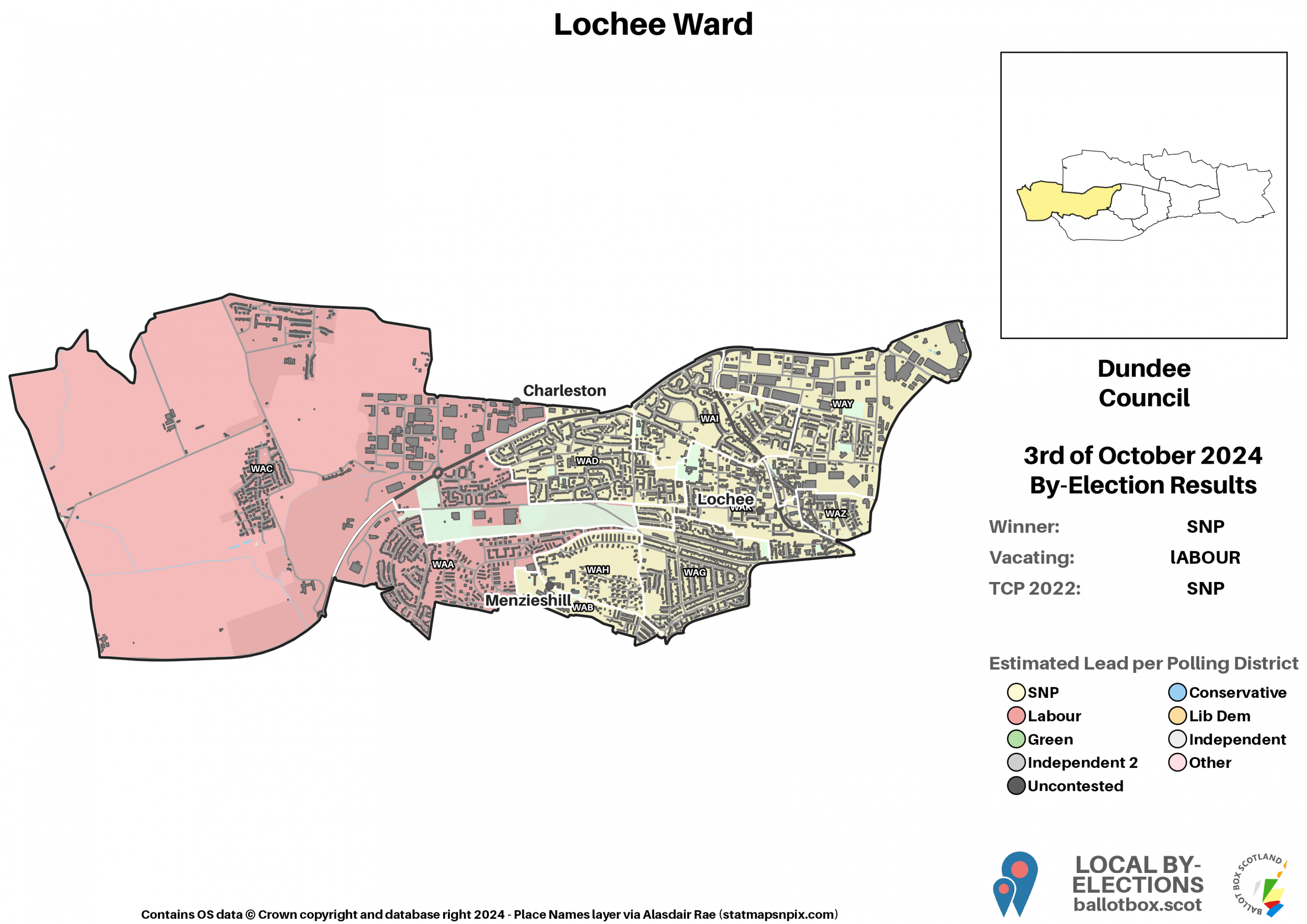
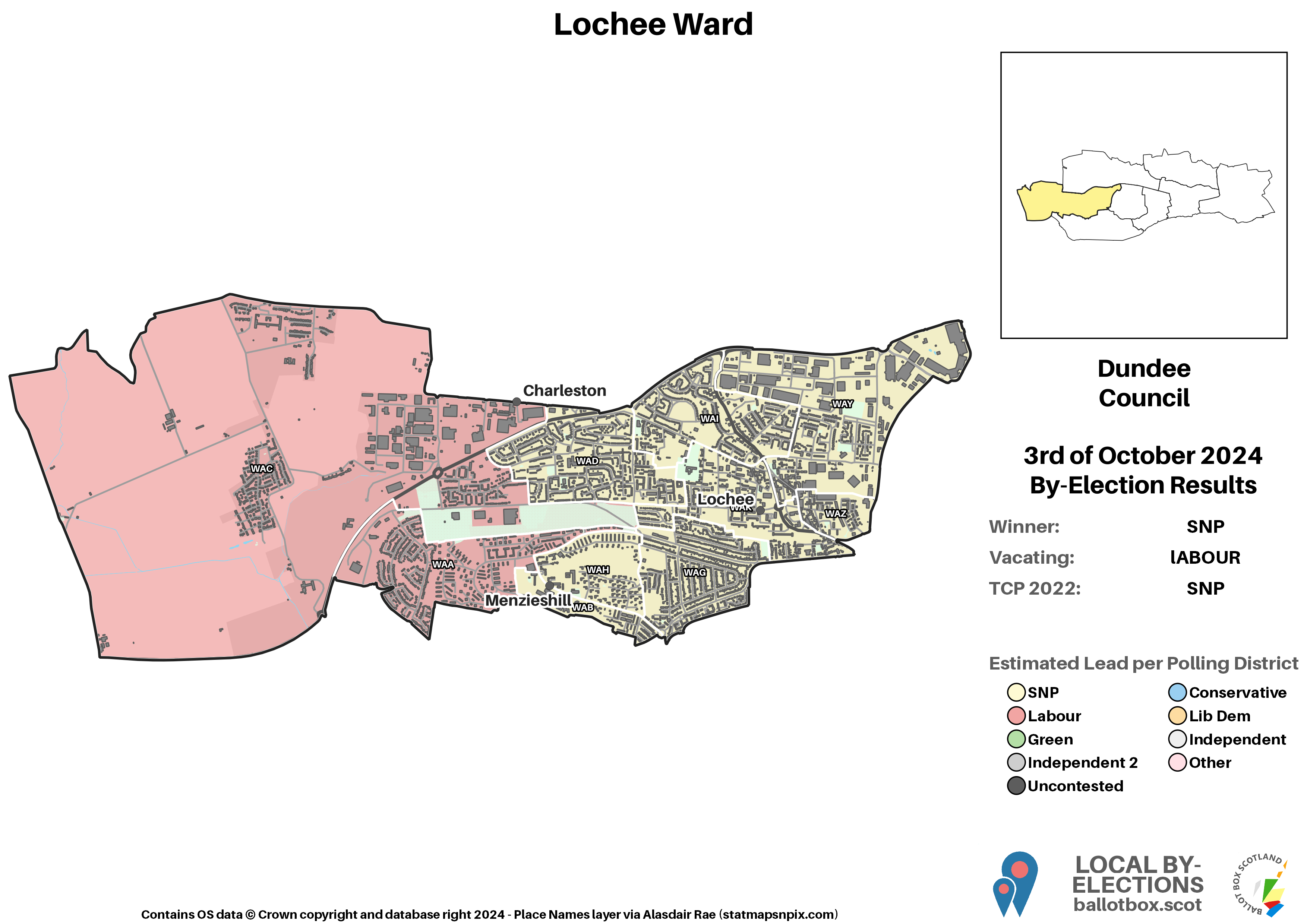
Despite the relative closeness of the top two result, most of the districts on this map remain SNP yellow. They led in Lochee itself, plus most of Menzieshill and the eastern part of Charleston. Labour meanwhile took quite a chunk lead in the western portions of Menzieshill and Charleston. For some reason, the mergers have ended up with a lot of matching geographic indicators like that.
In terms of the best spots for each party, for the SNP it’s eastern Charleston, whereas unsurprisingly Labour did best in the districts they led. The Conservatives shared their strongest area with the Lib Dems which was a southern portion of Lochee and Menzieshill, though maybe what I’m parsing as southern Lochee is eastern Menzieshill? I don’t have the local knowledge to say for sure! Alba and the Greens likewise had a shared patch in central and eastern Lochee, leaving the Workers Party with the discontiguous merger of northern Lochee and Menzieshill.
Alba fans, get ready to cry “BIAS!” as I again take an opportunity to talk about your result versus the Greens. Whilst the figures for each district individually may tell a slightly different story, the merged bloc that had the best result for both parties had the Green paper candidate ahead of Alba’s actively campaigning former councillor. My point isn’t to attempt to diminish a good improvement, but instead to point out there’s a much more nuanced story here than some are willing to concede.
Second Preferences
Turning to second preferences and we do have some slight deviations from the usual patterns, how exciting! Rather than the usual mutual SNP to Green preferencing, here the flows on the Pro-Independence side were strongest between the SNP and Alba. The Greens did still favour the SNP over everyone else, but it wasn’t returned as strongly as usual. Part of that will be the relative local strength of Alba, but Alba had the same candidate here in 2022 and the Greens got three times as many SNP second preferences back then. The feeling is pretty mutual here though: SNP to Green was down -16.7%, Green to SNP is -17.9%. For whatever reason, the bad blood between the parties is showing particularly strongly amongst their Dundee voters.
On the Pro-Union side of the equation, Labour and Conservative voters were most likely to opt for the Lib Dems, and in return the Lib Dems tended towards Labour. Somewhat oddly, the Workers Party crossed the constitutional divide with a plurality giving Alba their next preference, but as hinted earlier that strikes me more as an anti-establishment vote than any kind of clear ideological assessment, given Galloway’s vocal opposition to Independence.
We may only have three months left of 2024, but I’ve still got an absolutely staggering 22 further by-elections on my upcoming list. The first of these are coming up just this coming week on the 3rd of October in the form of another double bill. This one is in Dundee, with what should be an easy Labour win in Lochee and a harder fought one in Strathmartine that’ll make the difference between the SNP continuing their majority administration or slipping into minority, and thus risking losing control.
If you find this or other Ballot Box Scotland output useful and/or interesting, and you can afford to do so, please consider donating to support my work. I love doing this, but it’s a one-man project and takes a lot of time and effort. All donations, no matter how small, are greatly appreciated and extremely helpful.
(About Donations)