Background
Like many a west coast wean I’ve taken many a trip down to the Ayr seafront, but alas, our electoral visit is for less than happy reasons. Independent councillor for Ayr North, Mark Dixon, unfortunately died earlier this year. He’d only been elected for the first time in 2022, initially for the the SNP.
In my preview, I’d pegged this as leaning SNP. Whilst Ayr is on the whole considered quite traditionally Conservative, this ward certainly isn’t, with the SNP approaching half of the vote last time. Labour’s placing behind them was a fair bit wider than they have proven capable of overturning recently, hence, advantage to the SNP.
Headline Results
Councillors and Key Stats
1 Councillor Elected: Independent: Wullie Hogg
Change vs 2022 (notional): Independent Gain from SNP
Change vs vacating: Different Independent
Turnout: 27.8% (-12.2)
Electorate: 12653
Valid: 3385 (98.9%)
Spoiled: 37 (1.1%)
Quota: 1693
3 Continuing Councillors: SNP: Laura Brennan-Whitefield
 Labour: Ian Cavana
 Conservative: Ian Davis
Candidates
Independent: Orhan BulikjSNP: Ian DouglasLabour: John Duncan Lib Dem: Mason GrahamIndependent: Wullie HoggConservative: David PatersonIndependent: David Petrie
 Reform UK: Andrew Russell
First Preferences
Swing vs 2022
Note: the Reform candidate won 6.3% as an Independent and Alba 1.6% in 2022.
First Preference History
Well, I wasn’t counting on local fencing (and gates) mogul Wullie Hogg being such a weel-kent face! In fairness, it’s not possible for me to know every Independent that pops up, or to gauge their prospective support. Although he did top the ballot, in first preference terms he didn’t place all that far ahead of the SNP or even Labour.
Nonetheless, his presence alongside Reform UK meant that all three of the locally established parties were badly bruised, with all of them hitting their worst result in the ward’s history. The fall was furthest in absolute terms for the SNP, though in relative terms their slicing in half was less painful than the Conservatives’ slumping to barely more than a quarter of their prior performance. Labour help up comparatively well but it bodes ill for them in general terms to still be placing behind the SNP even in such circumstances.
Reform did reasonably well, though in the absence of foreknowledge about Hogg’s strength, I had wondered if they might pull ahead of Labour. They didn’t do so, though they do pick up slightly more of the various Independent transfers than Labour do, suggesting that gap would have been even narrower if this was a solely party affair. Given what we can see in later data, it’s clear Reform are continuing to devour Conservative support in particular.
Bringing up the rear, the Lib Dems were sandwiched in between the two smaller Independents as the only returning party to grow their share, albeit very modestly. Again, this speaks to the fact I reckon my model for Holyrood is slightly (and unavoidably) overcooking the Lib Dems in much of urban Scotland. I wouldn’t have expected them to do particularly well here, and they didn’t, but if they aren’t picking up a good few more scunnered voters in their rock-bottom areas like Ayr, I don’t expect them to do it in Airdrie or Anniesland either.
Transfers
Two-Candidate Preferred
Two-Party Preferred
TPP swing vs 2022
Theoretically, given he was only halfway there, Hogg could have easily been overtaken following transfer rounds. In reality, a strong Independent candidate is by definition quite appealing to most voter groups so I would have been astonished had that actually happened on these starting shares. Sure enough, Hogg’s lead over the SNP grew from just shy of 2% at the start of the process to a touch over 7% by the end.
Where I wasn’t wrong in my pre-election analysis was that Labour likely didn’t have it in them to pip the SNP. Thanks to the magic of machine counts, we can chuck Hogg out of the competition instead to see what happens if it was an SNP vs Labour head-to-head, which gives the SNP a lead of almost 4% over Labour. The non-transfer pile is bigger than either party’s share so a note of caution, but also note that the SNP got substantially more of what votes did transfer from Hogg than Labour, so I’m pretty confident overall that this would have been an SNP win in his absence.
Detailed Results
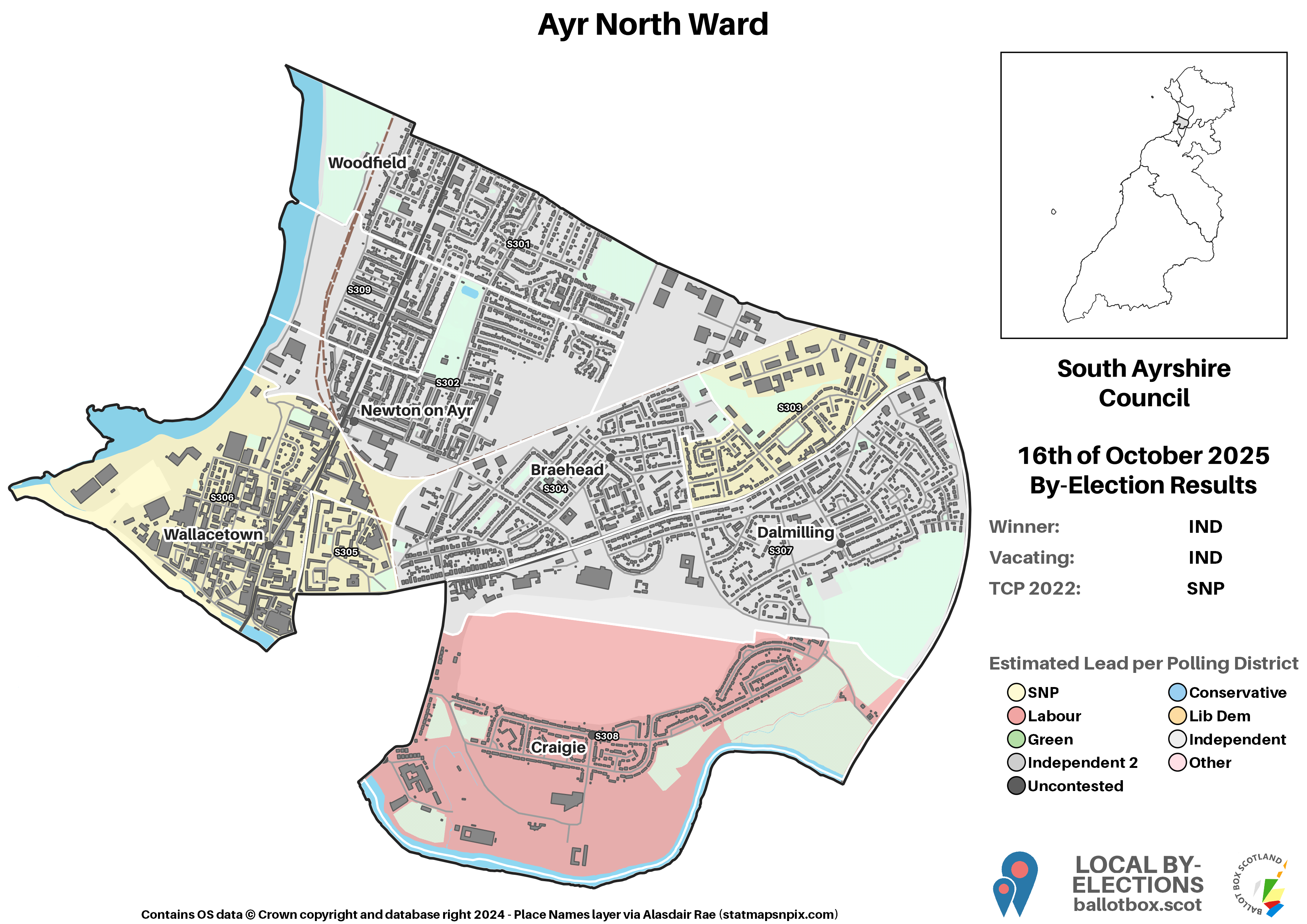
Results by Polling District
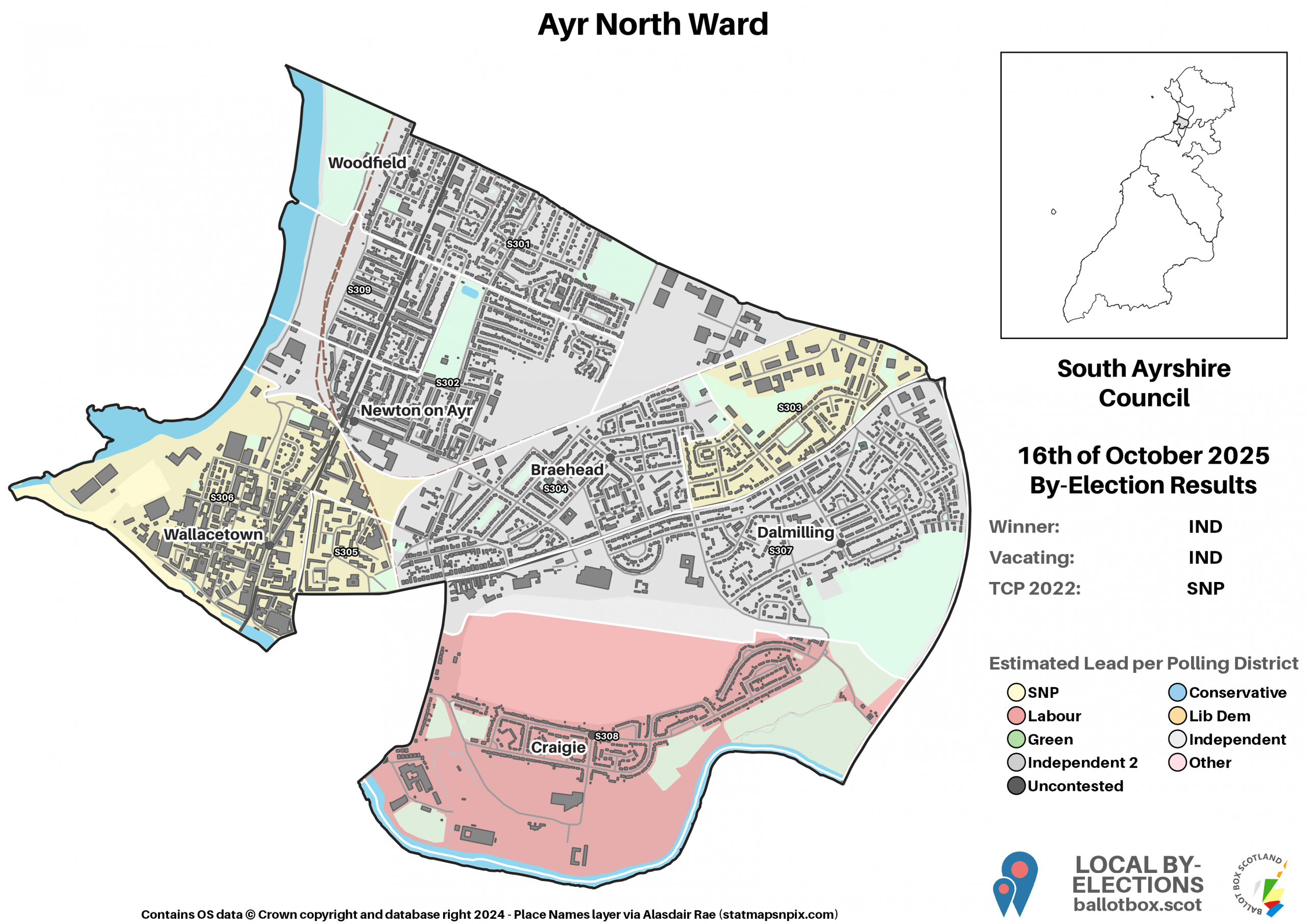
Turning now to how each candidate’s votes were distributed, and Hogg has a notably even distribution, not polling lower than 20% in any individual district (or merged set). Of those, his best was the district covering Braehead, which was also fellow Independent Bulikj’s top area. The SNP had a more notable concentration in support, as the only option on the ballot to win more than a third of the vote in any district, squeaking across that line in the districts covering Wallacetown and Whittlets. That was also the Lib Dems’ best bit, for a given value of “best”: 0.03% better than the next one.
Labour have a similarly narrow divider between their best and second best areas (0.04%), which hands that title to the Craigie district which is also the one they led in, and Reform’s peak performance. Of the candidates as-yet unmentioned, the Conservatives did best (but still not quite into double digits) in the Woodfield area, and second-ranked Independent Petrie drew his greatest support from Newton on Ayr.
Second Preferences
Direct second preferences paint a similarly fractured picture to first preferences. Of the eight candidates, only Petrie’s voters had a plurality preference for another candidate. Everyone else was most likely (and in fact for the top five candidates, almost equally likely) not to mark any later preferences at all.
Of those that did, the only candidates with a peak mutual flow were Hogg and the SNP. Labour voters very narrowly preferred the SNP over Hogg, whilst Reform, Petrie and Bulikj voters were most likely to back Hogg next. There was a straight tie between Reform and Labour for the rump Conservative voter base, and what few Lib Dems there were leaned slightly more towards Labour than they did the SNP.
Although further preferences are important when it comes to actual transfers, we can kind of see in this how the SNP beat Labour if we exclude Hogg: not only are Hogg’s voters more likely to have gone SNP, but so were Reform’s. Ultimately more votes sat with Reform went Labour before SNP, but only marginally, continuing the trend of Reform support having a substantial anti-system, rather than merely anti-Independence, flavour.
The next Scottish by-election is a return visit to Stirling East, which had already had an SNP victory in December last year. I’m therefore expecting a similar outcome this time around. One very small spanner in my works for reporting that one; although I had hoped to have the day off, if it’s a Friday morning count I may or may not find myself sat in court instead… fortunately, I hasten to add, sitting in the jury, not the dock! I’m happy to do my civic duty, sure, but isn’t it just typical they’d try have me in for it when I was taking some time off work…
If you find this or other Ballot Box Scotland output useful and/or interesting, and you can afford to do so, please consider donating to support my work. I love doing this, but it’s a one-man project and takes a lot of time and effort. All donations, no matter how small, are greatly appreciated and extremely helpful.
(About Donations)