Back in 2021, when we’d had a dramatic turn in polling on Scotland’s constitutional status, I thought it would be a great idea to add polling on that big question to my annual reviews. Recently it’s been a rather boring millstone around my neck, but once in the habit, I feel I cannot break it. Fortunately, a relatively quiet year on this side of things also makes for speedy writing!
Polling Caveats
Although these pieces always work on the basis of a Q4 polling average, in order to have some kind of consistency from year to year, which pollsters are in that average is highly variable. I won’t repeat the searing fury at the lack of Scottish polling that I wrote up in the parliamentary polling review piece, but to be clear, I’m very unhappy about how little polling we’ve had recently. I’ve only got two polls in my tracker for this quarter, one from Ipsos and one from YouGov. There was a third YouGov but that was part of the Scottish Election Study’s SCOOP project which is a slightly different approach to a standard YouGov; nothing wrong with it, but I tend to keep SCOOP separate from other polls.
As is always the case with polling on this question, this is going to look at figures both with and without Don’t Knows included. That comes with the caution that Don’t Knows are particularly important on this sort of binary question, and faced with a real referendum may not split neatly between options. In addition, the “Excluding Don’t Knows” figure may differ marginally from what you’d get using the raw “Including Don’t Knows” figure as your basis, because there’s been an additional step of rounding involved.
Independence Polling Average Through 2025 (Including Don't Know)
We began 2025 with a statistical dead heat in the form of a No advantage so minuscule as to be utterly meaningless, and we finish it with a statistical dead heat in the form of a Yes advantage so minuscule as to be utterly meaningless. The only even vaguely notable difference over the year has been an uptick in Don’t Knows, but here’s the kicker: that’s down to the relative prevalence of YouGov and especially Survation polls in the average. Norstat for example tend to find a more decisive electorate, but they were last heard from so long ago that they’re no longer in the 5-poll mix.
Independence Polling Average Through 2024 (Excluding Don't Know)
Repeat what I said above except ignore the bit on Don’t Knows. Sure, Independence is ahead here, but not even by half a percentage point. Meaningless! Boring! Dull! Also, simultaneously, remarkable! Incredible! Bizarre! How have we gotten to the point our country is split straight down the middle on whether it should be independent or not and that’s just… normal and nobody really cares? Transport yourself back to 2014, could you have imagined then that this would become such a non-issue? What an odd scenario to have found ourselves in!
Independence Polling Average Q4 2025
Remember we’re dealing with just two polls for this quarterly average, as opposed to the five above. (Also be aware that due to rounding on the headline figures, this doesn’t sum up to exactly 100%.)
Change vs Q4 2024
Change vs 2014
Remember what I said earlier about Norstat’s more decisive findings? Well they contributed two of the three polls in last year’s Q4 average, and neither in this year’s. That’s why even more so than in the trend line, the Q4 comparison has both options losing ground to uncertainty. That actually hits Independence slightly harder than the Union, but again that’s because two of the three polls in last year’s average leaned Yes, whereas it’s one each way this time.
This gives an absolutely minute bump to Independence compared to the 5-poll tracker, but it remains in statistical tie territory. At this stage I would say that this is still probably more comforting to those who support Independence (keeping the dream alive, as it were) than for those who back the Union (who currently number fewer than in 2014), but there’s really no clear advantage to either camp here.
Council Area Projection
Please see this page for how projections work and important caveats.

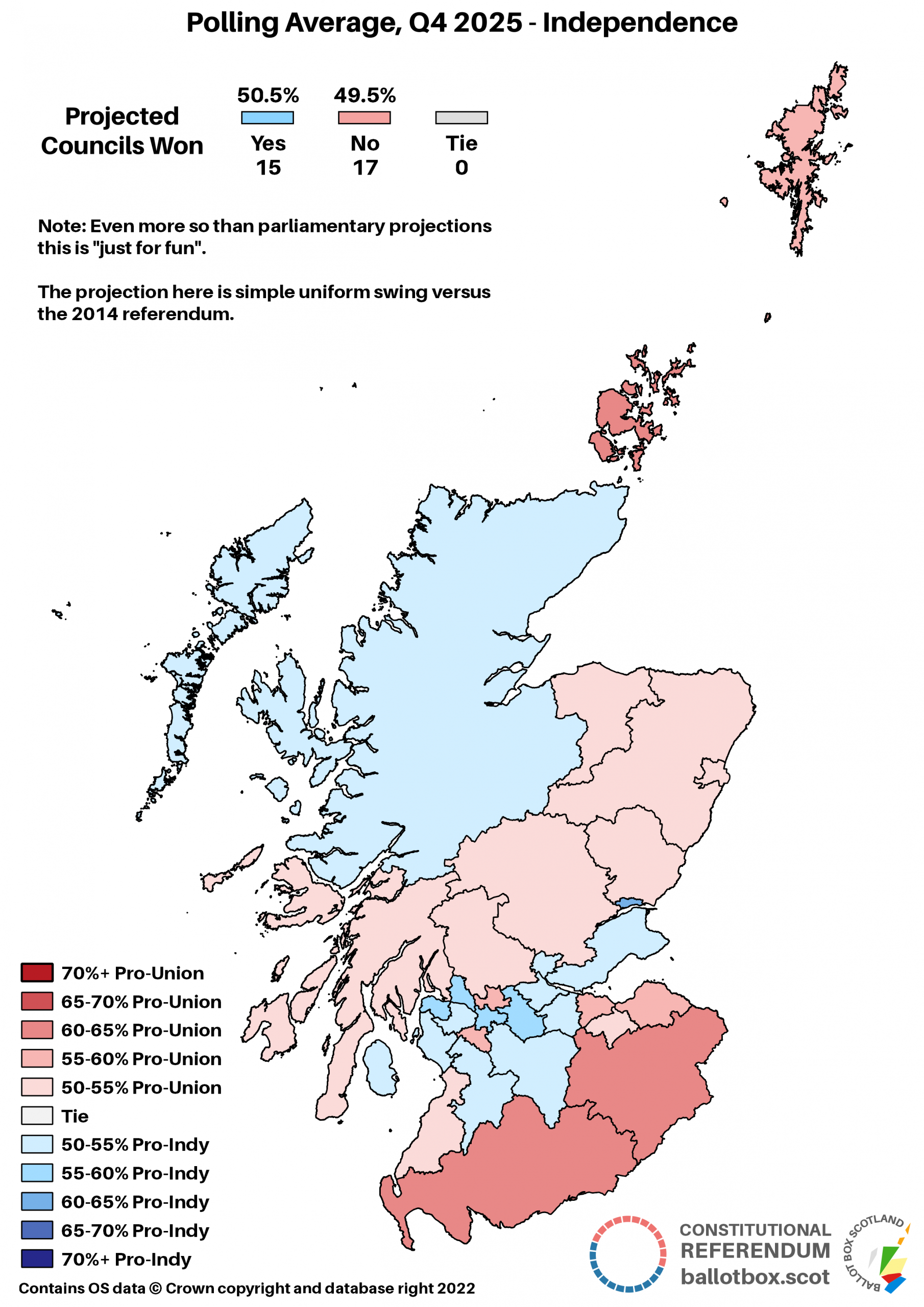
On this purely for indication, purely for fun projection versus 2014, Yes would have a lead in 15 council areas (up from 4 at the referendum, the same as last year), compared to 17 for No (correspondingly down from 28 in 2014, and again identical to last year).
This is quite literally the same map as last year, and the year before, so I’m recycling this text for a third time: the pattern is of the Central Belt (bar the most affluent bits) leaning towards Independence, with the Highlands and Western Isles as outlying areas also swinging that way, whilst the south of the country and the mostly rural sweep in between the Highlands and Central Belt remain mostly supportive of the Union. In this scenario, Independence barely squeaks ahead despite the Union being the preferred option in most council areas largely because it’s generally the more populous areas that lean towards Yes.
That said, and this is new text, we’re so far beyond the referendum that already imperfect uniform swing is even less reliable. There’s been varying amounts of demographic change across council areas which aren’t going to translate neatly like this. Something it might be worth doing, but is well beyond my capacity and capability, is a re-baselining exercise, perhaps through a large sample poll in every council area. We can dream, eh?
Looking Ahead
If you’re a long standing follower of Ballot Box Scotland my conclusions and what they mean for the future will be familiar, so I won’t overly rehash them now. The short version is that Scotland’s constitutional status is far from settled, even if there isn’t much heat in the debate at the moment. Both camps would be fools to assume that a lull works in their favour, or that a rebooted campaign will naturally go their way. More needs to be done to shift the dial in one direction or the other, because for all that it’s not causing much bother at the moment, an even split on the UK’s continued existence in its second largest member is not sustainable.
In any case, that’s the end of this year’s reviews, and therefore of 2025 on Ballot Box Scotland! Next year is going to be extremely busy, with a Holyrood election to cover, so if you haven’t already and can afford to do so (despite festive expenditures), please do consider chipping in to support this project. Your support means more than ever as whilst I had (justified) hopes of a bit more paid BBS work around that election, I’ve scaled those back. I am drawing quite a strong moral line on not giving my expertise to outlets most strongly enabling and abetting the hate campaign against trans people – the T in the LGBT community to which I belong (as the G) and which, unlike several leading politicians, I have no intention of betraying.
If you find this or other Ballot Box Scotland output useful and/or interesting, and you can afford to do so, please consider donating to support my work. I love doing this, but it’s a one-man project and takes a lot of time and effort. All donations, no matter how small, are greatly appreciated and extremely helpful.
(About Donations)