If you’ll forgive me for ending the year on a sour note, but as we turn to look at parliamentary polling over the year, I have to ask: where the hell has the polling been? It’s not that we’ve had none over the course of the year, we’ve had a bit, but notably we’ve had next to nothing from credible sources. Much to my chagrin, we did get a new pollster on the scene in the form of FindOutNow. Unfortunately, their output is such complete nonsense I have chosen to disregard them.
I explain the reasons why at length here, but suffice it to say a pollster that thinks Alba are on track to get 7% of the vote are making a mockery of the entire industry. In their current state, with their founder dead, their one defecting MSP having left them, and their only headlines about bitter infighting and expulsions, they’ll be lucky to get a whole percentage point. Notably, FindOutNow are also extremely Green-favourable, so “Ballot Box Scotland is biased towards the Greens and/or a Green front operation” conspiracists have been left in a shambles by my refusal to cover these polls.
Even allowing for my disregards, there have been notably few polls this quarter relative to the same period in the last parliament. We had 8 polls then, and nowhere near that many now. Where’s the Norstat? Where’s the Savanta? Where’s the non-SCOOP YouGov? Completely missing in action. There’s a clear reason for this: it costs money to run a poll. Whilst there’s money to be had doing Westminster polling, or it’s easy just to attach it to other polls you’re being paid for, absolutely bloody nobody in the UK-level media gives a enough of toss about what’s going on at Holyrood – or the Senedd Cymru – to pay for polling.
I don’t want to belabour the point here, but just for English folk reading this, this is such a good albeit very niche example of why Scots have such a chip on our shoulders. Oh don’t worry, this election is only going to determine our income tax rates over the next five years. It’s only going to shape the NHS that’s relied upon by five and a half million people. It’s only going to have responsibility for a nation’s education system, for its roads, for its police, for loads and loads of basic, every day essentials. It’ll only cross responsibility for £70 billion of public expenditure at some point this term but that’s chump change, eh?
Of course that’s not as important as all your breathless whataboutery concerning a potential Farage premiership come 2029! Don’t bother your pretty little heads trying to figure out what’s going on up here for a much more imminent election, which will set the playing field for 57 (and in Wales, another 32) of the seats up for grabs come 2029! Westminster is, of course, the font of all political power in these isles and it’s the only place worth paying attention to! Why, our silly little Parliament is practically a children’s plaything, no?
You can all just traipse up here for two weeks at the end of April and start of May and give us your bold pronouncements informed by what you could glean from Wikipedia on your train journey up. I’m sure we can all look forward to such phenomenally astute analysis as this (still uncorrected) piece from the literal Political Editor of the BBC, who appears to think that it’s somehow more embarrassing (and to be clear, it is still very embarrassing) to go through three First Ministers in a year than three Prime Ministers in three months. And why wouldn’t he assume that – after all, Scottish politics is so unserious, it must be our level that had the most embarrassing circumstances. Liz Truss? Never heard of her.
Sorry. Looks like I belaboured the point. I just naively assumed that a media ecosystem which is uniformly editorially supportive of the continued existence of the United Kingdom of Great Britain and Northern Ireland might do a tiny bit sodding better when it comes to bits of it that aren’t England. I mean it’s not like there’s been any real evidence of such attempts at any point in my lifetime, come to think of it, but still, it’s not unreasonable to expect is it?
Polling Caveats
Although these pieces always work on the basis of a Q4 polling average, in order to have some kind of consistency from year to year, which pollsters are in that average is highly variable. As noted in the introduction FindOutNow polling does not make it into my tracker, and although there was a YouGov for the Scottish Election Study’s SCOOP monitor, those are a bit different to normal YouGov output so I tend to pass them by for averaging purposes.
As such, there’s only two polls in my tracker covering this quarter: one from Survation, and one from Ipsos. If anything, including the Survation is a stretch as it started fieldwork in September, and given fieldwork is heavily front-loaded usually, it won’t really be from October. However, that would have left us with one measly poll, so I’ve chucked it into the mix. That also has the benefit of kind of levelling out house effects: Ipsos are notably on the highest end of Green polling for example, whereas Survation flipped a couple of years ago to consistently being on the lowest end.
Regional Polling Average Through 2025
Unlike most sources, I make a deliberate point of reporting regional (proportional) polling first, on the basis that one, First Past the Post is a democratic abomination, but more importantly, two, it’s the vote that theoretically does the most to shape the parliament. This year that’s still… mostly true, but less true than usual. Nonetheless, I persist.
On this side of things, the SNP’s support has varied by just 2% on average over the year. In other words, it’s moved within margin of error and we can be relatively confident of their relative strength. By contrast, Labour’s losses and Reform’s gains are comfortably in excess of that margin. Labour started the year with roughly twice Reform’s support, and they end it completely tied. The Conservatives too have suffered for Reform’s explosive emergence, as you would expect given their relative positions on the spectrum.
The Greens and Lib Dems meanwhile have been pretty static over the year. Although they’ve visually traded places a few times, they’re so close that it’s statistically a tie. Green shares are perhaps somewhat affected by the fact that barring the occasional Ipsos, we’ve largely heard from low-Green pollsters. If I was a gambling man I’d say add perhaps 1-2% to this to get a more reasonable current figure for them.
It’s worth a quick mention for Alba: there was a run there where we got quite a few Norstats, who after FindOutNow have the most notably Alba-friendly house effect. I’ve always had my doubts about that, and the fact they’ve gone quiet recently has also dragged Alba’s inflated figure down to something closer to likely reality.
Before we move on to the Q4 average, remember that the chart above is a 5-poll average, so the final point won’t match what’s below!
Regional Poll Average Q4 2025
Change vs Q4 2024
Change vs 2021
Looking just at the two polls in this quarter (again, why oh why have we had so little credible polling?!) gives a slightly different picture to the above. For the SNP, emphasis on “slightly”: it’s much of a muchness, and relatively to last year is only a tiny downtick. It is however still a substantial decrease relative to 2021, amounting to just over a quarter of their share. The Conservatives are also pretty in line with their average, and have lost a fair bit since last year. That means their overall losses are on a par with the SNP’s, but since they had half the votes to begin with, that means proportionally greater losses.
Labour meanwhile were already ending last year a lot worse off than they had started it, and their woes have only deepened, to the extent that they are back to roughly where they were in 2021. That means that whatever additional damage is done to them by the SNP’s First Past the Post dominance (which we’ll discuss shortly), they still aren’t actually due any improvement on their previous performance. They also place more clearly, but still marginally, behind Reform across these polls, which further bodes ill for their relative position at Holyrood.
The biggest deviation is for the Greens, where the inclusion of their best-yet poll gives them such a thumping boost that they overtake the Conservatives. If I said that the presence of low Green pollsters in the 5-poll averages should have us adding 1-2% to get to a more realistic share, I’d say we should correspondingly knock 1-2% off this figure. Nonetheless, the polls say what the polls say and that’s what I work with. Ipsos impacts the Lib Dems in the opposite direction, giving them a worse share than last year, but still comfortably above their 2021 performance.
Lastly, the absence of anyone with eyebrow-raisingly high Alba figures means they appear to be down a lot compared to last year, and indeed only just scrape a single percentage point. I feel like I say this a lot, but Alba are a busted flush by this point, and this is very likely to be the last annual review they feature in.
Constituency Polling Average Through 2025
Look, to be honest, take what I said above for each of the parties and mostly copy and paste it for this section. Although there are notable differences in relative support compared to the list vote, particularly for the SNP (higher) and Greens (lower), the direction of travel is pretty much the same. The SNP? Holding steady. Labour? In freefall. Reform? Surging. The Conservatives? Dead in the water. Lib Dems and Greens? Nothing to write home about.
Where it does differ a little is that Reform are actually ahead of Labour on this vote. It’s barely more than 1%, which is well within margin of error, so don’t read too much into it… but don’t dismiss it either. Given what happens to First Past the Post outcomes when you have this level of disparity, Reform are currently on track to be what hammers the final nails into the coffin of Anas Sarwar’s First Ministerial aspirations.
Once again, remember, this is a 5-poll average, whereas what follows is a Q4 average, so the figures following next don’t align.
Constituency Poll Average Q4 2025
Change vs Q4 2024
Change vs 2021
Again, the commentary here can replicate that for the list vote to a significant degree. Where I would draw attention though is once more to the Labour and Reform figures, with their swings of greater magnitude relative to last year. That’s what is really gubbing Labour at the moment. Although in most past elections with the SNP in front it was a slumping list vote most responsible for Labour losses, this time around they need to close the constituency gap to prevent the SNP from warping proportionality.
Seat Projection
Projecting that into seats might give us something like this (noting that the Q4 2024 projection has been re-calculated on new boundaries):
Please see this page for how projections work and important caveats.
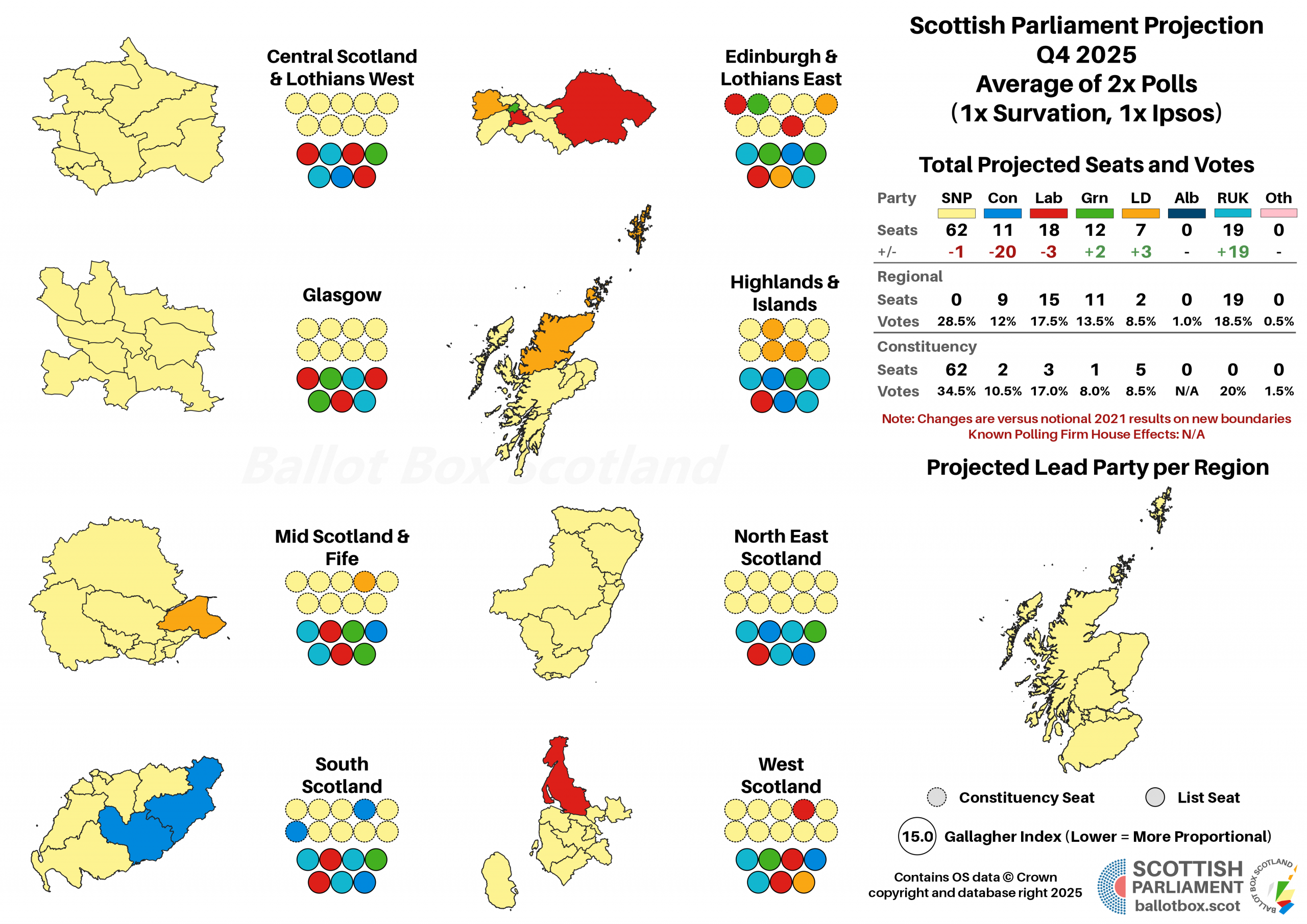
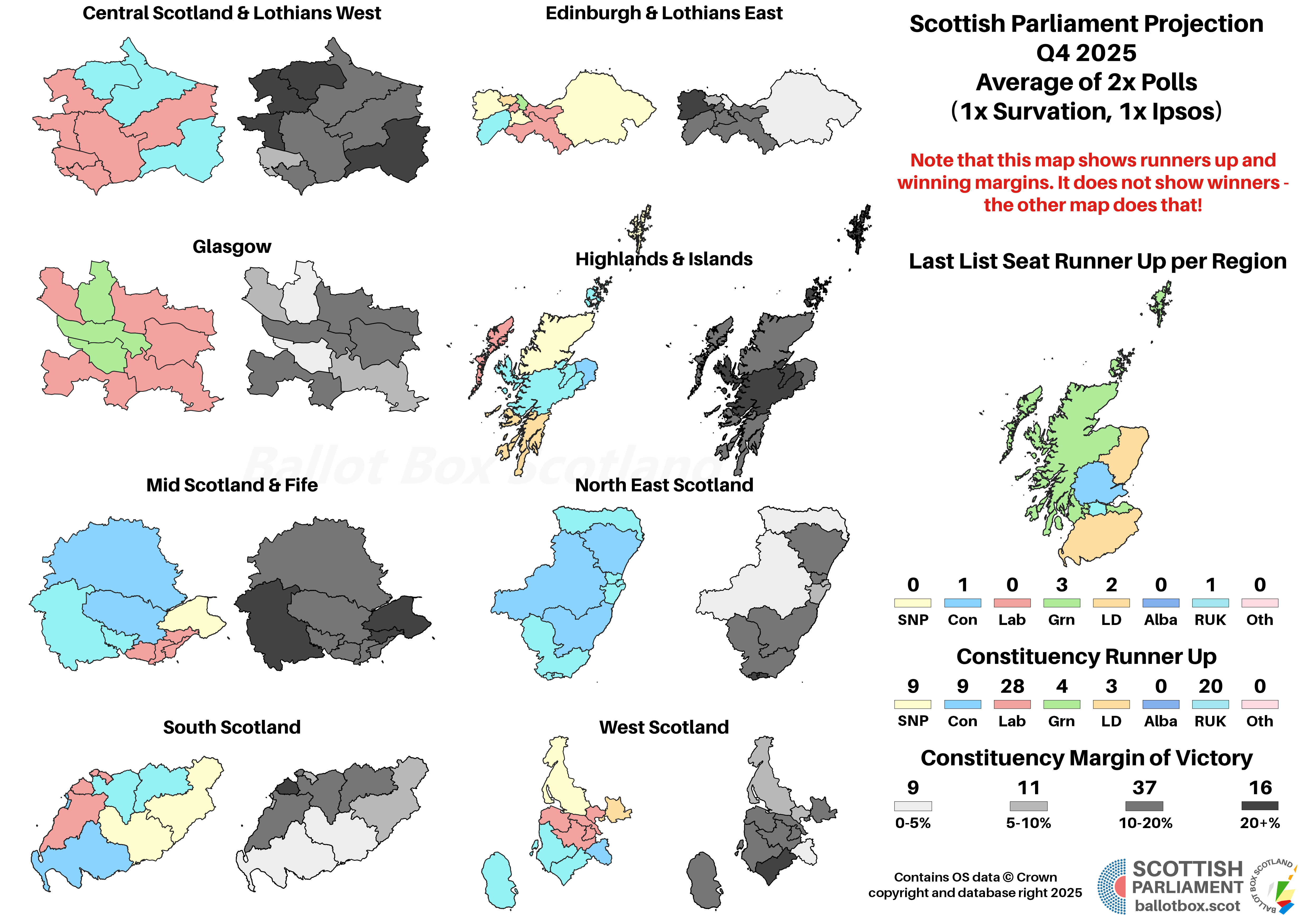
Relative to this time last year, this is an absolutely calamitous position for both Labour and the Conservatives. Alongside the Lib Dems, who can at least console themselves with making gains versus 2021, they have shed seats to all of the SNP, Reform and Greens. Despite a massive decline in their support the SNP project to a notional loss of just one MSP relative to 2021 on the new boundaries, leaving them only three short of a majority. They really shouldn’t be this strong, but this is what happens when you have such a huge First Past the Post element and such an advantage over your competitors.
In that sense, this poll is effectively a best realistic case scenario for the SNP. Of course, they’d like a majority, but I personally think that’s out of their reach: they won’t be proportionally due any list seats if they win the number of constituencies they need to get even close to a majority. They can therefore only afford to lose 8 constituencies, and I think there are more than 8 they are unlikely to win (one of which, Edinburgh Northern, my model does actually give them because it can’t account for hyper-local circumstances).
However, placing so close to a majority they can comfortably get one with any other party is a pretty good place to be. Sure, most of them won’t really want to work with the SNP, but if this is the parliament that ends up existing, their options will be to do so or achieve nothing. I can see the Conservatives and even Labour going for “nothing”, but the Lib Dems I think are cannier than that. I’ve been saying all year, not least because they did a budget deal with the SNP, that especially given Reform are pretty much anathema to them, they might be willing to work with the SNP on a case-by-case basis to score some wins.
Regardless, there’s no way that John Swinney wouldn’t continue in post with this kind of outcome. For all that Anas Sarwar and Scottish Labour have been desperately spinning winning their third easiest gain by 2% at a by-election as proof they’re on track for government, if I were Sarwar I’d be thinking about the length of my May resignation statement rather than the curtains I had picked out for Bute House. That’s certainly not to say things can’t turn around or that he should just give up, but rather that it’s looking pretty grim for him right now.
Possible Majorities
Note: these majorities relate simply to passing a vote in the Scottish Parliament. They do not imply the formation of a full coalition government.
- Traffic Light: Labour, Lib Dem and Green
- Independence Bloc: SNP, Green and Alba
- Grand Coalition: SNP and Labour
- Union Bloc: Labour, Conservative, Lib Dem and Reform UK
Turning, as I so enjoy doing, to the hypotheticals, we first look at a reformatted version of AMS. This maintains the same constituency seats as the real system does, but adds a further 16 list seats, divvied up between redrawn regions and with one per region allocated based on the national vote. This gives a more proportional outcome without massively changing the workings of the system. Although for the past few years I’ve done a map for this as a festive treat, I haven’t actually re-created the map for the new boundaries (although I have done the modelling). I’m sure you’re all gutted.
In any case, this still has the primary weakness of AMS which is the SNP massively over-performing against their fair share, but it takes the edge off slightly. It does so by weakening the Lib Dems’ hand, rendering them the only party incapable of forming a majority with the SNP
If we get rid of the FPTP element entirely, replacing it with a more fully proportional model, there would be no two-party pairing capable of delivering a majority. The closest would be the absolutely impossible SNP-Reform combo, which would still only get to 61, one more than the Grand Coalition of SNP-Labour. As this would also do away with the Pro-Independence majority, there would theoretically be the votes for a non-SNP First Minister if all of the Pro-Union parties got behind a single candidate.
I remain pretty firmly of the view that would be far too unstable to work, and that the Lib Dems in particular would blanche at the thought of being reliant on Reform to govern. Rehashing this year’s SNP-Green-Lib Dem budget deal would in this scenario just about scrape by with 66 MSPs, and would possibly be the most viable scenario, barring a damascene conversion to cooperation from Labour, who could substitute for either of the smaller parties.
Not too much wonk-y analysis for this chart, it’s just a visualisation of a range of different changes we could make to the voting system, and how those might pan out on current figures. I’d draw particular attention to the “Pure List” line, as that’s also effectively the “what if AMS was working flawlessly” one that shows, within the system’s own rules, how much of an advantage FPTP has handed the SNP.
Here, it’s an obscene 21 seats more than they’d have if every region was, as it is meant to be, proportional to the votes cast within it. Those are coming at the expense of 6 Reform MSPs, 6 Green, 4 Labour, 3 Conservative, and 2 Lib Dem. I wrote about this issue extensively in this piece, but whatever your views on the various parties, this isn’t democratically good!
Westminster Polling Average Through 2025
As goes Holyrood, so does Westminster. Again, the SNP are relatively flat but marginally better off at the end of the year than the start, whilst Labour’s vote has gone down the toilet in the face of Reform gains. Those are somewhat stronger at this level, which means Reform pulled into second in this simple average earlier than at Holyrood.
The smaller three parties (by vote share) have all followed trajectories that can be equated to the larger ones. The Lib Dems are SNP analogues, with a relatively flat line that’s a touch higher at the end than the beginning. The Conservatives are similar to Labour in having a consistent loss of support across the year. Finally, in this respect alone, the Greens are akin to Reform, with a generally steady uptick, albeit one that still leaves them as the sixth party by this measure. Again, remember that this is a five-poll average, and therefore the final point does not map to the Quarter 4 average (or rather, single poll…) just below!
Westminster Poll (one, sole, singular, only, aon, uno, ichi, kotahi) Q4 2025
Change vs Q4 2025
Change vs GE 2024
Note that there is only one Westminster poll in my tracker: the Survation in the mix didn’t have Westminster figures, which is unusual for them. We’ve therefore only got Ipsos here, which means this is subject to their house effects, of which the most notable at the moment is the strength of the Greens. I imagine in reality they’d be somewhat below this, albeit still improved on their 2024 result.
As evidenced by how little it changed the averages in the previous chart, it isn’t otherwise particularly out of kilter with other recent polling. We can take it as pretty certain that just like at Holyrood, Labour’s support has absolutely collapsed, allowing a barely recovering SNP to take a comfortable lead. It’s less certain, as it sits within margin of error, that Reform are in second place, but that is where polling is pointing at the moment.
I’m in two minds about whether this would hold up into an election. On the one hand, I do think the mid-term protest element is part of it, and that could count against Reform in the heat of a real election. On the other hand, much like Farage outfits used to do better for European elections, I do wonder if they will now do better at Westminster, especially given we can expect wall-to-wall coverage of them next time around.
Moving down the list, the Conservatives seem to have hit rock bottom, with what had looked like a very small uptick at the end of last year completely consumed by the rise of Reform. The Greens are up quite substantially but keep that “Ipsos tend to find high Green results” caveat in mind, whereas the Lib Dems are to all intents and purposes unchanged, though down a little on the election.
Seat Projection
I generally avoid doing detailed projections when we’re dealing purely with FPTP. Annual reviews are my one break with that policy, when I refer to Electoral Calculus for an indication. FPTP projections are extremely difficult to get right, and given Electoral Calculus are associated with FindOutNow I’m not mad keen on using them, but I haven’t rebuilt my own model (out of spite to both the voting system and the fact everyone else fixates on Westminster anyway), and no one else that I’m aware of has a Scotland-only predictor. Alas, it’s what we have to go on, and it’ll do for these purposes.
Regardless of exact model, given the SNP’s 13% lead over Reform and 16% lead over Labour, you’d expect them to have a commanding lead in seats. This would leave the Lib Dems, who were in sixth place in votes, second in Scottish MPs, another reminder of how ridiculous the voting system is. The lack of any Reform seats (though personally I feel like surely Aberdeenshire North and Moray East would go their way on these figures) also looks bizarre.
Scandinavian Style Westminster
Just like Holyrood though, I do always like to look at Westminster if it wasn’t mortifyingly, miserably, indefensibly undemocratic. For the 2015, 2017 and 2019 elections, the democratic distortion played to the SNP’s advantage, before flipping back to being Labour favourable in last year’s – regardless of who it benefits, it simply isn’t reflective of the electorate, a point hammered home by the FPTP projection earlier.
The scale of Labour collapse since last year is visible even under this more proportional system, as they would only just scrape into double-digit MPs. Unlike our undemocratic actual system, we’d see representation for both Reform (in second place) and the Greens, alongside a doubling of the Conservative benches relative to FPTP and an additional Lib Dem.
Looking Ahead to 2026
We’ve got a Scottish Parliament election! The seventh since Holyrood was established, we’ll see whether the SNP can win a fifth election on the trot, and whether Labour are able to finally break their habit of losing seats every time. As this piece has shown, the answer to these questions is currently on track to be “believe it or not, yes” and “wooft, absolutely not”. Make sure to keep on top of everything election related on the Holyrood Hub here!
If you find this or other Ballot Box Scotland output useful and/or interesting, and you can afford to do so, please consider donating to support my work. I love doing this, but it’s a one-man project and takes a lot of time and effort. All donations, no matter how small, are greatly appreciated and extremely helpful.
(About Donations)