Posted in

2025 in Review: Council By-Elections

We begin this year’s annual reviews, as everyone sits on their sofas groaning after their festive indulgence, with our usual run through council by-elections. Thankfully, this year was nowhere near as busy as last, though the rate was still relatively high. We had a total of 22 by-elections this year which is the joint second most since Ballot Box Scotland launched, equal to 2021 which itself had a relatively high number due to the pandemic postponing some intended 2020 votes.

By-Election Caveats

As ever, before we really start talking about by-elections, we need to get a range of caveats out of the way first. Regardless of the number and spread of by-elections, remember they always make up just a fraction of Scotland’s 355 wards. That alone means these figures aren’t representative of the whole country, with this year’s 22 by-elections being heavily skewed towards urban Scotland and the Highlands.

Also important for many by-elections, especially in the more rural wards, is the absence of popular independent councillors. Councillors that continue to serve or who have sadly passed away obviously don’t appear on the ballot for by-elections, and so that can limit the usefulness of direct comparisons with May 2022 in their wards.

Finally, remember the most important aspect of STV – that the nice simple language used for FPTP of “gain/loss/hold” isn’t as applicable here. Whoever vacated one of three or four seats is not always the same as the overall winner at the last election. It’s entirely possible for the vacating party, the party that had a first preference lead, and the party that would have won a single seat election in May 2022 to all be different!

Seat Shifts

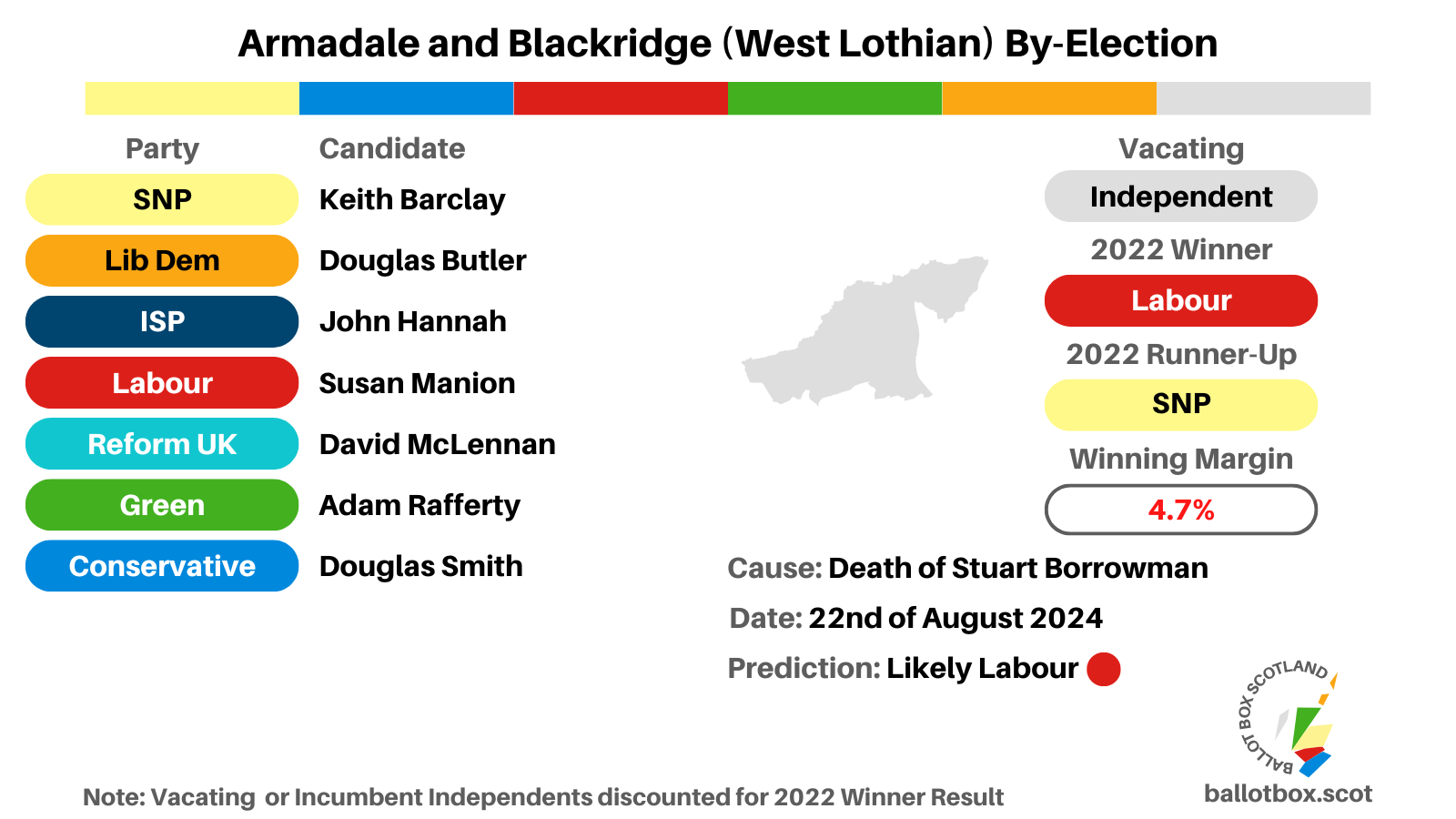
As usual, let’s start with how changes in seats, with all the complexity that involves under STV. The table below shows each of this year’s by elections with both the vacating party and 2022’s notional winner shown, alongside the eventual winner of the by-election. You can click the ward name to see the result analysis for each by-election.

And translating that table into a simpler chart format, that tells us a rather different story depending on what measure we’re looking at:

Versus Vacating

If we look first specifically at the comparison with seats vacated, which is more impactful for political control but less reflective of voter change (note Independents use slightly different terminology as they aren’t directly comparable to one another):

🟡SNP: Vacated 6, gained 6, held 3, lost 3 (net +3)
đźź Lib Dem: Vacated 2, gained 3, lost 2 (net +1)
🔵Conservative: Vacated 1, gained 1, held 1 (net +1)
🟣Reform UK: Gained 1 (net +1)
🟢Green: Vacated 1, lost 1 (net -1)
đź”´Labour: Vacated 8, gained 2, held 2, lost 7 (net -5)
⚪Independent: Vacated 5, won 5 (net no change)

Looking purely at the change in councillor numbers, this looks like a bruising year for Labour, in stark contrast to last year when they came away from both the UK General Election and a bumper crop of by-elections the big winners. Indeed, when you consider that the one Green loss was in a ward that went uncontested and thus accidentally elected a paper candidate, Labour are the the only party with a real net loss here.

That appears to have been largely to the SNP’s advantage, as they made the most gains here, as many in total as the Lib Dems, Conservatives and Reform, who each made one gain apiece. For Reform that was remarkable as their first ever win in Scotland, albeit it was by the skin of their teeth after transfers: more on that to follow later on.

Versus 2022 Winner (true Defending)

If we instead do the more electorally relevant comparison with the May 2022 single-seat winner:

đźź Lib Dem: Defending 1, gained 2, held 1 (net +2)
⚪Independent: Previously won 4, won 5 (net +1)
🟣Reform UK: Gained 1 (net +1)
🟡SNP: Defending 9, gained 2, held 7, lost 2 (net no change)
🔵Conservative: Defending 2, held 2 (net no change)
đź”´Labour: Defending 5, gained 1, held 2, lost 3 (net -2)
⚫Uncontested: 2 wards were uncontested in 2022 so have no notional defending party

This way of looking at things is somewhat less bad for Labour, especially when you consider that one of their losses under the other measure was Shetland North. Their former councillor there had stood as a paper candidate and was accidentally elected when the ward went uncontested. Nonetheless they are still the only party with any net true net losses.

Whilst the SNP don’t make any net gains, that’s still a remarkable turnaround from last year. As I pointed out throughout my preview pieces, as we entered this year Labour were starting to struggle to make gains even against relatively weak SNP leads. That just got worse for them this year, barring one fluke in Barrhead, as Reform in particular began to eat away at their support. That was especially bad for them given the largely urban nature of this year’s by-elections, and notably the three they did win were all in the Affluent E’s: Edinburgh, East Dunbartonshire and East Renfrewshire.

Labour also didn’t really deserve to win a seat in that Edinburgh one, and only did so because of the jaw-dropping insta-resignation of the Lib Dem who had won the November by-election. That naturally shattered their support, whereas had there only been the seat up from the SNP resignation, they’d have easily won the single-seat by-election again. Note also that one of the two Lib Dem net gains was in another Edinburgh ward. If I were an Edinburgh Labour councillor in a ward that didn’t elect a Lib Dem in 2022, I’d be feeling pretty worried right now.
Turnout

There’s a lot of data to track across by-elections, and a new one I painstakingly went through last year was turnout. Politicos commonly place far too much emphasis on by-elections, and that can extend to political parties themselves. I’m told that not only did Scottish Labour spend a few months briefing that Holyrood’s Hamilton, Larkhall and Stonehouse by-election had them on track for Bute House, but that their surprisingly strong win in Barrhead was further icing on the cake. This is what I believe is referred to as “cope”.

One of the many reasons you can’t simply take by-election wins as indicative in and of themselves is the vast difference in turnout. In Scotland, typically we see that SNP and Green supporters are the least likely to turn back out for a by-election, whilst Labour, Lib Dem and especially Conservative voters don’t drop off quite so sharply. With turnout down 17% versus 2022 (in the same wards), and likely to be no more than half what we’ll see in May’s Holyrood election, narrow Labour wins can be a cause for concern, not celebration.

First Preference Votes

First Preferences across 21 By-Elections

Note: As Shetland North was not contested in 2022 and only featured Independents at the by-election, I’ve not included it in this section, as it’s really not of any analytical use. Please don’t report me to Shetland Avenger, Tavish Scott.

Swing vs 2022

The three big stories from this year’s votes align relatively well with polling. One, the current top three at Holyrood are all doing pretty badly. Of those the SNP are most damaged, but since they start so far ahead of everyone else, they are somewhat insulated from serious losses. Labour have no such insulation, and especially given how many of this year’s voters were in urban areas they’d need to gain from the SNP in May, placing so far behind should have alarm bells ringing.

Two, Reform UK have well and truly exploded onto the scene. They are cannibalising the Conservative vote across the urban Central Belt, which could cost the Conservatives the vast majority of their MSPs in the relevant regions come May. However, they are also eating into the Labour vote, more so than is the case in England. That’s a big part of why Labour are doing so poorly at the moment.

Three, the Lib Dems and Greens are making up a little bit of ground. Some of that is down to standing in more of the wards that had by-elections than they did in 2022, but they’ll certainly welcome any positive movement as contrast to the other established parties. The Greens have also placed ahead of the Conservatives a few times even in weak wards, raising the possibility that allowing for turnout they could even overtake them across the Central Belt.

First Preferences across 14 By-Elections with Holyrood 5

Swing vs 2022

One of the difficulties in comparing the whole pool of by-elections is different patterns of contesting. Although contest rates for the Holyrood parties plus Reform ranged from 77% to 95% of by-elections, the distribution of absences meant just shy of two-thirds (64%) had them all on the paper. This is where things get really painful for Labour. You see how almost everyone else has a healthier looking swing here than on the raw figures? Now, do you see how Labour’s is worse?

That’s not a great sign, even more so when you remember this doesn’t include the -19.5% result in Buckhaven, Methil and Wemyss Villages, since the Greens weren’t in that one. Where directly competing with all major parties, the SNP only lost about 2% more than Labour did, and I remind you also of the earlier point about turnout differentials. Even that tiny silver lining for Labour almost certainly disappears the second we’re dealing with normal rather than by-election turnout. 

Reform's Transfer Toxicity

One topic I’ve touched upon a few times is that Reform are notably toxic to pretty much every other party’s voters, barring the Conservatives. Given the transferrable nature of local elections that’s a huge bar to them actually winning any, to the extent it did surprise me when they won Whitburn and Blackburn a couple of weeks ago. When I say “toxic” though, just how unpopular are we talking?

For each matchup of a party versus Reform, the chart below shows the average split of available transfers. Keep in mind this is the proportion of available transfers received, not the number of total votes after transfers, and it’s therefore effectively agnostic to each party’s starting total. Whether a party starts with 4% or 40% doesn’t matter, as we’re only looking at how other party’s voters felt about them.

Average Head-to-Head Transfers for Reform vs Other Parties across 12 By-Elections

Note: This is only counting the by-elections where all of the Holyrood parties were standing, and does not include the two hand counted by-elections which therefore did not gather the data necessary to calculate head-to-head results.

Once again, we’ve got a trio of key takeaways. The first is the size of the “to Neither” chunk. For every head-to-head pairing a clear majority of voters for the other parties, on average, do not preference either of the top two. That’s not necessarily surprising when you consider how few voters will rank beyond a third preference, but it’s still pretty stark. Voters just don’t really make very good use of STV – and why would they? We’ve conspired to have three different voting systems for three elections (it was four for four when we were in the EU), only one of which uses ranking! Of course voters aren’t going to develop a deep understanding of any of them given the complexity of our arrangements and dominance of the First Past the Post culture of doing nothing but screaming about your opponents.

The second is that there’s a pretty remarkable consistency across the four parties broadly (currently and/or theoretically) to the left of the political centre. For each party somewhere between 26% and 30% of voters plumped for them versus between 10% and 13% for Reform in a head-to-head. There’s enough variance there that the actual ratios span from 2.8 to 1 for the Lib Dems through 2.6 for Labour, 2.3 for the Greens and 2.1 for the SNP, but still, not a huge difference. Incidentally, what gave Reform their narrow 24-vote win in Whitburn and Blackburn was a much narrower 1.7 to 1 split; had it matched this national average, the SNP would have pipped them by 42 votes

The third is that even fewer voters are inclined to give either the Conservatives or Reform any of their preferences, fewer in total than just go to the non-Reform option in every other matchup. A whopping three-quarters of voters typically leave them out of their rankings entirely. As much as Scotland seems to have less of the bloc-politics of England in terms of where people are willing to take their first preference, voters who haven’t already jumped to Reform are broadly still bloc-y, hence few transfers to the Conservatives. Nonetheless, they still place ahead at 1.5 to 1 overall, and in an opposite case to Whitburn it was a stronger ratio of 1.9 that allowed the Conservatives to overtake and defeat Reform in Stranraer.

One thing I have been thinking a lot recently, and I’m hardly alone in this, is how particularly ill-suited the UK’s political culture is to dealing with the rise of Reform. With so many parties on the centre-left theoretically opposed to both them and the Conservatives, it should be possible to present a vaguely united front. Instead, our entrenched First Past the Post culture means that Labour in particular are deeply venomous about competing parties to their left whilst making friendly overtures to their right.

I’m not convinced that’s going to work out to their benefit in the longer term, and it’s especially unfortunate that culture carries over into proportional and transferrable votes where it’s not just unnecessary but actively unhelpful. All parties, not just Labour, really need to begin considering how on earth they’ll manage to run councils with large Reform contingents.

For my part, might I suggest a two pronged approach of not being petulant children about the need to form coalition administrations, whilst actually educating your voters about the need to transfer to other parties so as to maximise the size of workable administration blocs? Or should I start with world peace and a unicorn for every home as more realistic hopes for the future?

Looking Ahead to 2026

Thankfully, given that there’s the small matter of the Holyrood election in May, there are only a couple of by-elections currently scheduled for 2026. They include one of, if not the, most bizarre circumstances of any by-election I’ve yet covered. I’ve been waiting for quite literally years to be able to preview one of them, so don’t miss that.

The remaining parts of the Year in Review pieces, covering Parliamentary and then Constitutional polling, are due up over the next couple of days. As we’ve had very little polling (which is outrageous given how close the Holyrood election is), you’ll need to take those with a substantial pile of salt.

If you find this or other Ballot Box Scotland output useful and/or interesting, and you can afford to do so, please consider donating to support my work. I love doing this, but it’s a one-man project and takes a lot of time and effort. All donations, no matter how small, are greatly appreciated and extremely helpful.
(About Donations)