Background
As the term was approaching it’s fifth and final year, it really seemed like we might manage to make it through an entire Scottish Parliament session without a by-election. Tragically, that was not to be. In late March Christina McKelvie, SNP MSP for Hamilton, Larkhall and Stonehouse died after a long illness. Although she had previously been in remission from breast cancer, as happens all too often, that awful disease returned. She was only 57.
McKelvie had been an MSP since 2007, initially for the Central Scotland region, winning this constituency when it was created in 2011 as part of the SNP’s shock majority. She’d served in various roles in the Scottish Government since 2018, and she was clearly very well liked across the whole parliament. In the tributes paid to McKelvie by fellow MSPs, it wasn’t just her partner Keith Brown who struggled to maintain composure, but also often combative debaters like Patrick Harvie and Jackie Baillie. There’s much that divides our Parliament, and often rightly so, but in this case the grief was unifying.
Before the campaign got truly underway, my preview pointed out that this was an absolute must-win for Labour in a way it wasn’t for the SNP. The SNP lead over Labour in this constituency was half what it was nationwide in 2021, making this one that Labour couldn’t afford not to win if they wanted to get into Bute House. On the other hand, simply losing this seat in and of itself doesn’t matter to the SNP, as they can win (and have) without Hamilton seats before. Given where polling was at the time, with my model swinging from a 1% Labour lead to 1% SNP lead as polls shifted, I had it marked as a tossup between the two.
That was before Reform disrupted the campaign. Certainly I expected they’d place a strong third, but in the aftermath of England’s local elections the pace of growth really began to pick up, even in Scotland. In a bitter campaign defined by Reform’s atrociously misleading (what some parties called “blatantly racist”) adverts about Anas Sarwar, some began to talk of Labour being pushed into third place, or even a Reform win. Many activists, academics, pollsters and pundits were picking up a febrile atmosphere.
I therefore adjusted my expectations from tossup to an SNP lean. Crucially, a lean is only a very slight advantage for one party, not a prediction of certain victory. Labour remained in clear contention, but it really did seem like they might have blown their chances.
Headline Results
Winner and Key Stats
Winner:
🔴Labour: Davy Russell
Change vs 2021: Labour GAIN from SNP
Majority: 602 (2.2%)
Turnout: 44.2% (-16.8)
Electorate: 61485
Valid: 27109 (99.8%)
Spoiled: 46 (0.2%)
Continuing Regional MSPs:
🔴Labour: Richard Leonard
🔵Conservative: Stephen Kerr
🔴Labour: Monica Lennon
🔵Conservative: Graham Simpson
🔴Labour: Mark Griffin
🔵Conservative: Meghan Gallacher
🟢Green: Gillian Mackay
Candidates
🟤Scottish Socialist Party: Collette Bradley
🟤Family: Andy Brady
🟣Reform UK: Ross Lambie
🟡SNP: Katy Loudon
🟤UKIP: Janice MacKay
🟢Green: Ann McGuinness
🟠Lib Dem: Aisha Mir
🔵Conservative: Richard Nelson
🔴Labour: Davy Russell
⚪Independent: Marc Wilkinson
Votes
Electoral History (Constituency Vote)
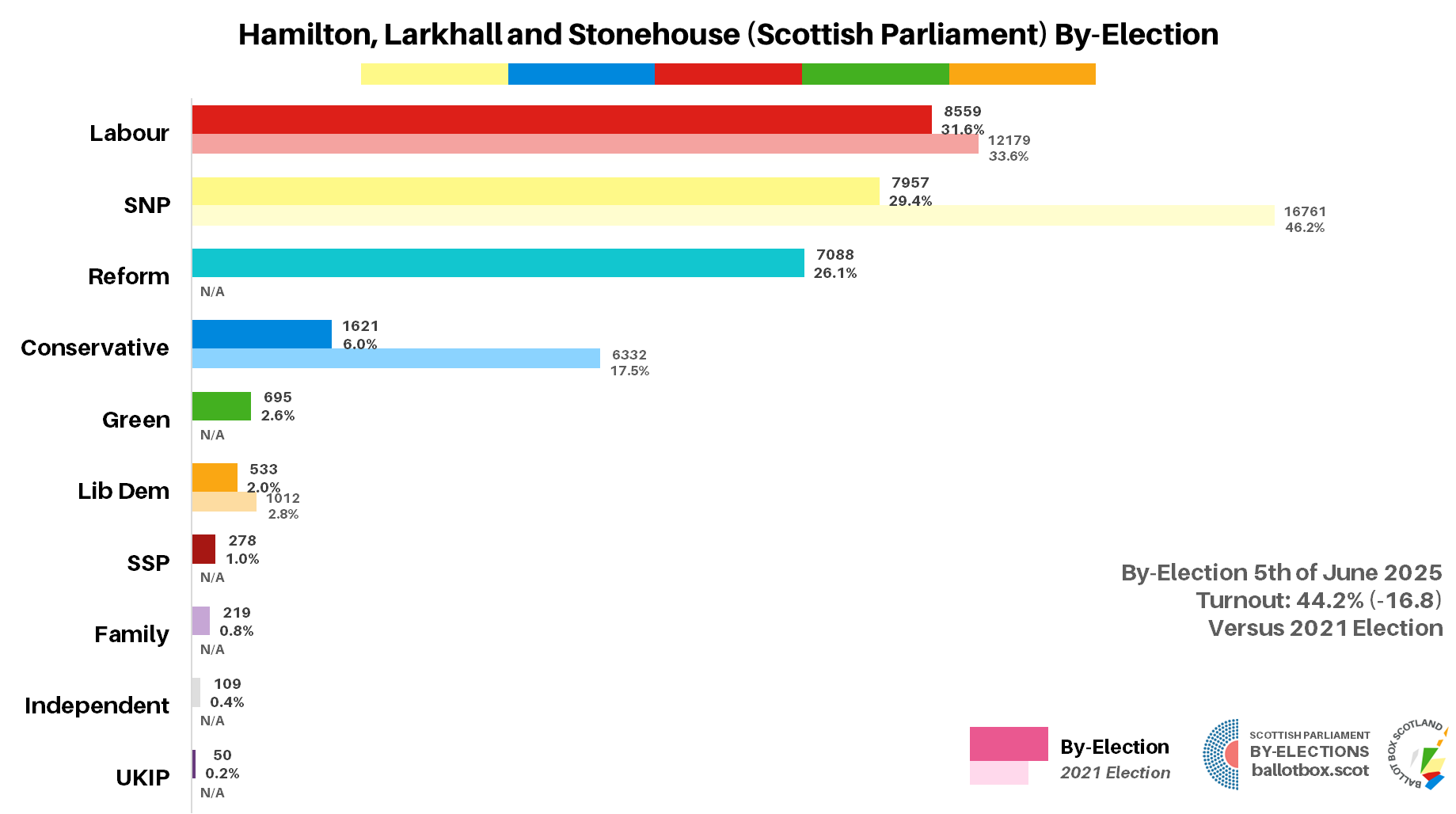
In the end, Labour managed to defy the doomsaying that had taken hold and eke out a win by the skin of their teeth. A majority of 2.2% is cause for relief, not really celebration. A Rutherglen and Hamilton West blowout of 31% this was not, and whilst Labour certainly shouldn’t be unhappy to have won, as I’ll get on to discussing later there isn’t actually that much cheer for them to take from this. It’s caveats all the way down for this one.
For the SNP’s part this was a really big blow, crashing down to their worst ever share in the seat’s history. In terms of how much of the vote they lost (nearly 17%), this looks a lot like the bruising they received in constituencies across the Central Belt in last year’s General Election. That’s where the other half of the caveat about the slender majority here comes in though: this wasn’t a full election, but a by-election. The SNP’s comparatively youthful and less affluent voter base is less likely to turn out in such scenarios. That alone could count towards them regaining the seat next year.
Reform UK meanwhile ended up in the odd scenario of doing very well in an objective sense but underperforming against the expectations set in those closing days. Rather than a strong second challenging for a possible win, they placed third. It was a close third to be sure, but you guessed it, caveat time. In an opposite case to the SNP it must be recognised that by-elections are where we’d expect Reform to do best. These are when voters often lash out at governments, safe in the knowledge a protest vote carries less risk than usual, and they had two to show their distaste for.
As we move down the rest of the ballot, no one else really registered at all. The only other party to hold their deposit were the Conservatives, and not by much. They’ll have suffered defections to both Labour, to stop the SNP, and Reform, as a natural place for dissatisfied voters on the right to turn to. This points to the accuracy of current suggestions they could lose half of their seats, and I had wondered if they might end up placing behind the Lib Dems in the sub-5% band. That turned out to be unjustified.
Instead, the Lib Dems placed sixth behind the Greens. Neither would have expected to do well in a constituency like this regardless, and I don’t think these shares will worry either of them. Their natural supporters tend to be squeezed under First Past the Post at the best of times, never mind at a hotly contested by-election. If they’d placed behind any of the fringe candidates, they’d have had cause for concern. On the other hand, if they’d held their deposits, they would have been justified in thinking they were on track for better than expected results next year. As neither of these came to pass, it’s all very “as you were.”
Speaking of fringe candidates, those fell in roughly the order we might expect. The SSP don’t really meaningfully exist anymore but this isn’t actually too bad for them, as they were the only one of the bunch to scrape it into a whole percentage point. The Family Party meanwhile have a big question mark over them I think as their kind of role as (for want of a better term) “anti-woke” headbangers is pretty well covered by Reform and, frankly, the increasingly radicalised Conservatives.
Poor Edinburgh based pizza-Independent Marc Wilkinson didn’t quite make it over the line here, but not to worry: he’s got another shot at elected office in Fountainbridge and Craiglockhart later this month. A vanity candidate, you say? I couldn’t possibly comment (yes, obviously.) Last and definitely least, the sad, lingering remnants of UKIP were the only ones not to even get into triple-digit votes. Honestly, you do have to ask why they haven’t just thrown in the towel. What’s even the point, and what constituency are they serving, when Reform UK are surging?
Further Caveats
I touched on a couple of the big caveats about this result in the earlier section, but these ones didn’t fit neatly in the flow. One thing to bear in mind is that it’s vanishingly unlikely either the Greens or SSP will contest this constituency next year. As Pro-Independence parties, most of their support will have been at the SNP’s expense. Their absence is another thing that will count in the SNP’s favour as they try to pick this seat back up.
There’s a follow-up caveat to that one though which is that alone doesn’t make the difference. Voters don’t actually all move between parties in the clear and obvious patterns political obsessives assume they should. In order for the SNP to have won this by-election, they’d have needed to get 62% of all the votes that went to the Greens and SSP, and at the same time for Labour to have gotten none. Based on what we know from local election transfers, something more like 50-60% to the SNP and 10-20% for Labour would be more realistic. That’s not enough, and also means neither truly “split the vote” in this case.
If the previous caveats were SNP-favourable in the first case, and SNP-neutralish in the second, this last one is instead Labour-favourable. As I touched on in the Reform section earlier, I expect their share was somewhat inflated in a way it won’t be next May. Unless there’s a lot of further growth in Reform support (and more on that very shortly), those votes have to go somewhere else. That’s going to be Labour more than the SNP, and therefore that may help Labour to tighten their grip.
With Reform having such a big breakthrough in this by-election, albeit one exaggerated in my view by the nature of by-elections, it’s worth investigating where that support may have come from. I’m aye complaining about how little Scottish polling we’re getting lately, but what we do have is probably good enough for a general sense. I’ve had a dive into the tables for the most recent Survation (2nd – 5th of May) and Norstat (27th – 30th of May) polls to see what they reckon.
There are two figures in the charts below. The first is the number of Reform UK’s votes in the by-election that come from a particular party, if we assume that this is in line with the second figure, which is the proportion of Reform UK constituency votes coming from that party according to polling. In reality, we obviously shouldn’t assume that.
Whilst the polling figures may be pretty accurate nationwide, they’ll vary significantly from seat to seat. In that sense, the number of votes in this constituency is just to illustrate the point, whereas the proportions are more useful to talk about.
Source of Reform UK Constituency Votes (versus 2021 Holyrood Constituency)
First things first: note the statistical tie between the SNP and Labour for contributions to the Reform voter base. This may come as a surprise but remember that the SNP had twice as many constituency votes as Labour in 2021. In other words 2021 Labour voters are twice as likely to have swung behind Reform as SNP voters, it’s just that there’s a lot more of the latter.
What is likely to explain the SNP figure here is that they’ve been the clear recipient of “anti-system” votes for well over a decade. People who are scunnered with the state of things absolutely did, and continue to, see Independence as a solution. A lot of voters are now feeling equally scunnered with both Westminster and Holyrood, which we saw through the complete collapse in SNP support and favourability after Nicola Sturgeon’s resignation and the ensuing chaos. Hence, some of those voters have moved to Reform.
What shouldn’t come as a surprise is just how much of Reform’s support is coming from 2021 Conservative voters. More of those voters than SNP, Labour and Lib Dem combined have since shifted their allegiance to Reform. That’ll be a combination of the natural ease of shifting to another right wing party, the allure for some of voting for the strongest Pro-Union option, and the massive loss of trust in the Conservatives over their last few years in power.
The size of the Others/Non-Voters bar is also worth commenting on. That’ll mostly be the latter, given there weren’t many Other constituency votes in 2021. A small portion of this will come from the fact there are four years of new voters (both newcomers to Scotland and young people reaching voting age) in the mix. It’s likely that most of this however comes from people who didn’t vote last time saying they will now, either because of natural churn in which voters feel like doing so, or because they specifically only want to vote for Reform.
Source of Reform UK Constituency Votes (versus 2024 Westminster)
If we compare to 2024 however, things look dramatically different. Most obviously, since Reform were actually on the ballot for the General Election, the biggest chunk of their current support comes from people who voted for them then. Another huge difference is the tie between the SNP and Labour is gone, with the SNP becoming the smallest source of votes and Labour the largest after Reform themselves.
If we think back to that point about anti-system voters scunnered with the state of things, effectively the SNP already lost those voters last July, when many opted for Labour instead. That’s why the explosive growth for Reform in Scotland has been so damaging to Labour rather than the SNP. The SNP have already suffered the loss of those voters, and it’s now Labour losing them afresh. This explains the shape of the charts on the polling tracker page, which are relatively flat for the SNP but see Labour plunging and Reform skyrocketing.
The Conservatives meanwhile make up a much smaller proportion of the Reform vote. That’ll be because so many of those voters already made the switch last year, so we’re getting down to the most stubborn core of Conservative support. This is still a fair chunk of voters to lose however, and if we compare with the rough current Reform polling position amounts to about 2.5% to 3% of the total vote falling away from the Conservatives.
The proportion of Others and Non-Voters here is much smaller than on the Holyrood side of things. Again, a wee bit of that is down to only having a single year of new voters in the mix, but most of it will be freshly activated voters, both via churn and through feeling it worthwhile to vote Reform now.
The Lib Dem share is also a bit bigger compared to the Holyrood chart. It’s still not very many voters, and it’s important to remember that their 2024 vote was about 3% higher than their 2021 Constituency share, so they simply have more votes to lose in this scenario.
Conclusions on Reform Voters
So, to quickly summarise what we’ve learned here:
- Reform UK are drawing the clear majority of their Scottish support from long-standing Pro-Union voters;
- BUT they are also attracting a small proportion of those “anti-system” voters who were SNP in 2021, which amounts to a lot of voters given how strong SNP support was at the time;
- HOWEVER the SNP already lost those voters last July and very few of their remaining voters are at all Reform-favourable, meaning Labour and to a lesser extent the Conservatives have the most to lose from further Reform growth.
Reading Beyond the Headlines
I could have screamed the day after the by-election when a journalist no less senior than BBC Scotland’s Political Editor, Glenn Campbell, stated that:
“National opinion polling has them heavily trailing the SNP in Holyrood voting intentions. This by-election result runs counter to that trend, albeit that it is a localised win on a low turnout.”
You would think such an experienced journalist (and I really don’t want to have a go at Campbell, I’ve plenty of respect for him) would know that little caveat at the end means the rest of the section is such dire analysis it shouldn’t have been said in the first place. You simply can’t take the headline vote shares in a single constituency and draw conclusions about national trends from it!
It’s like looking at Edinburgh Southern in isolation in 2021 and assuming that since they won the seat Labour must have won the election, when in reality it was one of just two constituencies they held. As I noted in my preview and again at the start of this piece, the SNP’s majority of 12.6% in this seat was a bit less than half their national advantage over Labour of 26.1%, making this seat low hanging fruit. Labour winning it by a small margin absolutely does not go against recent polling.
In point of fact, at least as far as the SNP and Labour are concerned, this by-election was almost perfectly in line with polling trends, if you look at the swings. If we apply the swings from this by-election to the 2021 results and then compare with the two polls we got in May:
That’s pretty damn close! It’s just shy of 3% narrower between the two parties than polling is, but that’s neither damning to the accuracy of polling, nor particularly meaningful to overall outcome. It’s also the kind of thing that can be explained by margins of error and the previously discussed fact that SNP voters are typically less likely to turn out for by-elections than they are for the main event.
Indeed, if we adjust the current BBS tracker point to bring it in line with these figures nationally (and just dumping the excess with Reform UK), here’s what my model reckons for Hamilton, Larkhall and Stonehouse:
Again, that’s not at all bad, is it? It’s got Labour and the SNP pretty much spot on where they were in the by-election. Reform are a fair bit short of their share and the Conservatives a bit stronger, but I don’t think unreasonably so in either case given that the by-election will be somewhat different to the full election. Likewise it’s got the Lib Dems and Greens faring slightly better and the wrong way round, but again, the model is for a full election not a by-election, and Green constituency shares are hard to pin down.
This Doesn't Flip Many Seats
Having established that far from disproving polling, this by-election actually backs it up, what does that mean beyond Hamilton, Larkhall and Stonehouse? Just after the result was declared I ran a very quick uniform swing against notional 2021 results on the new boundaries. That would give a mere 8 Labour constituency wins, compared to 51 for the SNP. However, my actual model doesn’t work on (pure) uniform swing, and I also think that the 10 constituencies that hands the Conservatives is overly generous.
Using the same national figures as I did for the HLS chart above, here’s what my model spits out:
That’s a little closer than what the current output says, with the SNP on 4 seats fewer. Crucially however, none of that is really to Labour’s benefit. Only two additional constituencies (for a total of 6, the same as the Conservatives) end up in the Labour column, and the net difference in seats is actually two apiece to the Conservatives and Reform. According to my model, versus 2021 on the new boundaries, these are the constituencies that flip from SNP to Labour:
- East Lothian Coast and Lammermuirs (2021 majority: 3.8%)
- Edinburgh Central (2021 majority: 10.5%)
- Hamilton, Larkhall and Stonehouse (2021 majority: 12.6%)
- Rutherglen and Cambuslang (2021 majority: 12.9%)
The two additional seats that flipped on the uniform swing version are:
- Clydebank and Milngavie (2021 majority: 14.0%)
- Uddingston and Bellshill (2021 majority: 14.7%)
Even if we allow for stronger swings towards Labour across the Central Belt than this (I’m not sure we should, given this was already a highly favourable seat for them), just looking at the other neighbouring seats that don’t flip shows the challenge facing Labour:
- Clydesdale (2021 majority: 21.2%)
- East Kilbride (2021 majority: 21.3%)
- Motherwell and Wishaw (2021 majority: 22.9%)
These constituencies, and the many with similarly chunky majorities across areas like Glasgow, Renfrewshire and West Lothian, would need much sharper falls than the SNP experienced in this by-election to end up in the Labour column. Again, at the risk of repeating myself but it’s really important to drive this point home, this all points to current polling being pretty spot-on at least insofar as the SNP vs Labour contest is concerned.
Tell Us Something We Don't Already Know
Far from being a shock outcome that requires us all to re-assess the current state of play ahead of next year’s election, all of the above simply means that Hamilton, Larkhall and Stonehouse has done nothing more than tell us several things we already knew.
Oh, Labour have completely lost all the gains they made last year and are even doing a little worse than 2021? We already knew this.
That poor Labour performance is helping to mitigate, in seat terms, what is a much worse loss of support for the SNP? We already knew this.
Reform UK have finally managed to break through in Scotland and are headed for great success next year? We already knew this.
None of that is to say that things couldn’t still change. They already have! If you’d said this time last year that the SNP were favourites to lead the Scottish Government in 2026, you’d have sounded completely daft. Likewise, nobody would have believed Reform UK could be eying up a Scottish vote share approaching or even exceeding 20%. You’d have been a fool to float the idea that Labour would lose absolutely every little bit of support they’d clearly regained and which seemed likely to bear fruit in the looming General Election.
There is every chance that things could turn on their head once again in the 11 months left to go until the big day. We have no idea what the actual campaign period is going to look like. We have no idea what further actions both the UK and Scottish Governments will take in response to the Reform surge, and how those will be received. Maybe someone will hide in a sandwich shop, or be caught on hot mic slating a voter, or a Rennie/Davey-esque photo op campaign might set the heather alight.
All I’m saying is that if anyone wanted a big turning point ahead of 2026, this by-election isn’t it. For all the drama of the campaign and the surprise many felt at a Labour victory that they had written off, I’m afraid Hamilton, Larkhall and Stonehouse have delivered us an utterly pedestrian result. This is no repeat of Winnie Ewing’s remarkable 1967 Hamilton win, nor is it the incredible comeback of the 2023 Rutherglen and Hamilton West.
There’s a couple of weeks to go before we’ve got any more Scottish by-elections, but we’ve got a double-whammy when we do. Two Independent resignations in Highland council mean we’ll be taking a virtual trip to Eilean a’ Cheò (Skye) and returning to Cromarty Firth after we’d already had a by-election there last year. Folk desperate to get indicators for Holyrood out of those will again be disappointed given how strong Independents will be and how little presence Labour have in this part of the country.
If you find this or other Ballot Box Scotland output useful and/or interesting, and you can afford to do so, please consider donating to support my work. I love doing this, but it’s a one-man project and takes a lot of time and effort. All donations, no matter how small, are greatly appreciated and extremely helpful.
(About Donations)