Background
A sudden winter chill couldn’t stop the wheels of local democracy, as voters in Dumfries and Galloway’s Stranraer and the Rhins ward took the polls. Very long serving Independent (and, for a period in the middle, Labour) councillor Willie Scobie retired after an impressive 37 years in elected office, leaving some very big boots to fill.
Coming from the deep south of the country, this was always going to be a very different situation to what we’ve had elsewhere this year, which have largely been Highland or urban Central Belt by-elections. As a result, in my preview I discounted the possibility of an SNP or Labour win. Instead, and especially considering the characteristics of Stranraer, I reckoned this as a complete tossup between previously strong but recently wounded Conservatives and newcomers Reform UK. A Reform win here would have been a huge moment, as their first ever Scottish victory.
Headline Results
Councillors and Key Stats
🔵Conservative: Julie Currie
Change vs 2022 (notional): Conservative Hold
Change vs vacating: Conservative Gain from Independent
Turnout: 34.3% (-7.2)
Electorate: 11573
Valid: 3939 (99.3%)
Spoiled: 29 (0.7%)
Quota: 1971
3 Continuing Councillors:
⚪Independent: Andrew Giusti
🟡SNP: Ben Dashper
⚪Independent: Chrissie Hill
Candidates
🔵Conservative: Julie Currie
🟢Green: Michael Havard
🟡SNP: Simon Jones
🔴Labour: John McCutcheon
🟣Reform UK: John Roberts
⚫Heritage: Gisele Skinner
⚪Independent: Shaun Smith
🟠Lib Dem: Tracey Warman
First Preferences
Swing vs 2022
Note: Willie Scobie won 22.8% and another Independent, Tommy Sloan, 1.3% in 2022.
First Preference History
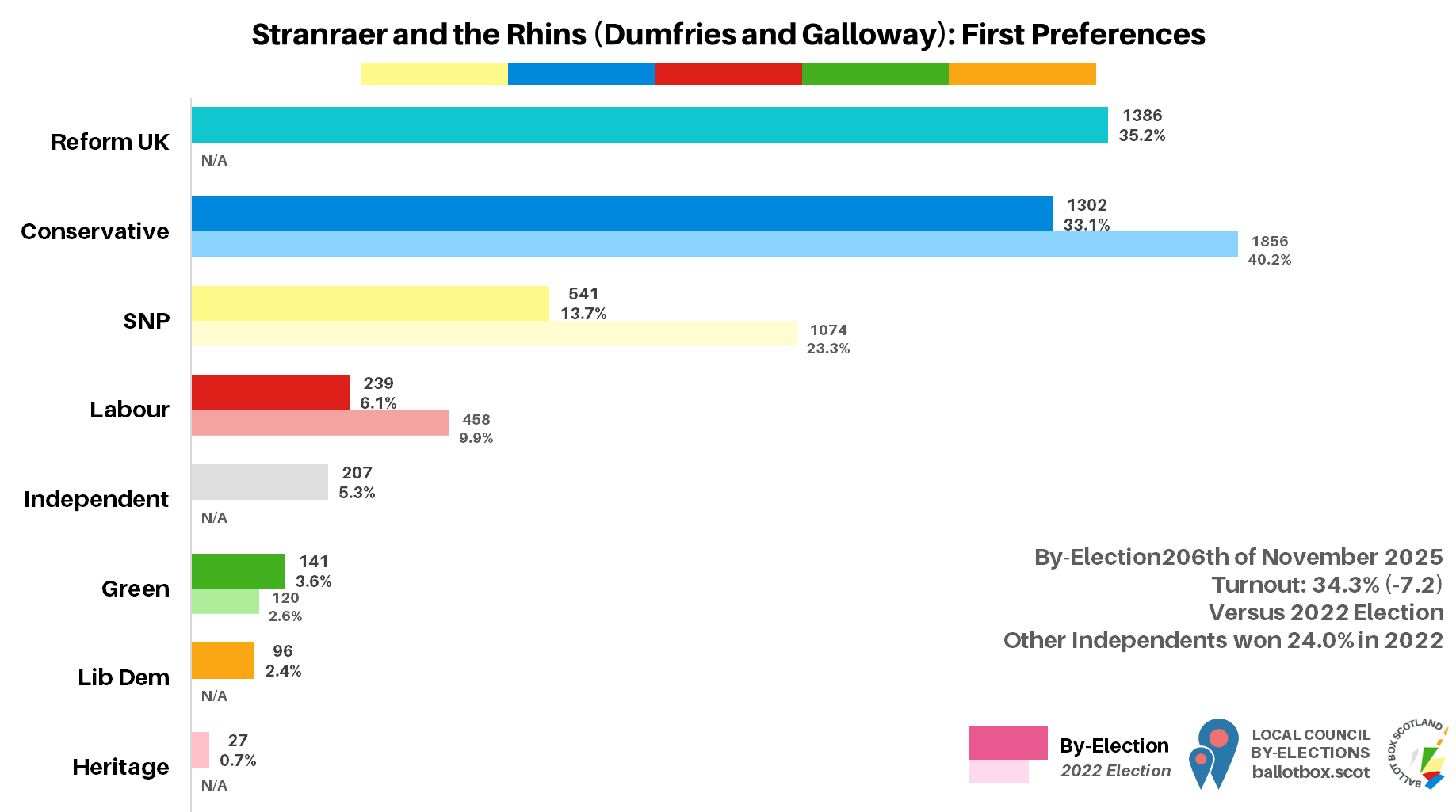
Now, I don’t always get my predictions absolutely spot on, but I have a pretty good record, so you’ll forgive me for crowing about being bang on the money here. I could not have been more spot on as first preferences showed the complete dominance of, but extreme closeness, of the right wing parties. That was so close it was impossible to guess in advance whether transfers would swing it. I had a source at the count, which as it was a hand count involved several stage-by-stage updates, and neither of us could settle on how it was going to end up.
Sticking to first preferences for now though, this is Reform’s best ever result in Scotland, the first time they’ve cracked 30%, and the first time they’ve topped the first preference count. That’s a remarkable result, but also in the direction that it’s still well below their best performances down south. A drum I feel like I’ll have to keep banging over the coming months is that it’s equally foolish to have pretended Reform were never going to take off in Scotland as it is to pretend there remains no distinction between the depth of support across the nations of the UK.
Looking at these figures in the round, it’s actually as if 2025 Reform simply substituted for 2017 Scobie. They were only 1.3% short of his tally back at the first election in this ward, and all of the Conservatives, SNP and Labour are within 1% of their shares then too. None of the latter three will have much cause to be happy about that, but it’s also not in local terms a shattering result either.
The Conservative vote held up perhaps a little better than I might have expected, even having thought they were one of the likely winners. I’d be interested how many of those voters might actually have plumped for another party but (understanding of STV not being fantastic) went Conservative to stop Reform. It won’t be an enormous proportion, but it might be enough that their “natural” vote could have just missed 30%.
On the other hand, a relatively poor SNP result was probably made all the poorer by the fact they stood a Dumfries resident for this one. Don’t let the name “Dumfries and Galloway” make you forget how huge this area is. As I quipped to one pal when discussing the result, doing the geographic equivalent of standing a Musselburgh resident in Paisley isn’t going to do you any favours, especially not when it’s a by-election to replace an extremely weel-kent local councillor.
Although they may not appear to be the biggest losers, either in absolute or relative terms, in one sense Labour did end up worst off here. Recall that Scobie was a former Labour councillor, and in theory you might have expected a fair few of his former voters to turn to his former party. Though they may have been drawn off by another Independent who placed not far behind Labour, it’s still not the best sign.
Bringing up the rear, the Greens were notably not only the sole returning party to grow their share, but they also increased their raw number of votes. This is still a very modest share, but when you consider that Green voters are least likely to turn out at by-elections and how little they need to grow their overall vote to secure a South Scotland MSP in May, it’s not a bad sign. They remained ahead of the Lib Dems, who will also have drawn off some of the Labour and Conservative support, whilst fringe outfit the Heritage Party failed to secure even a whole percentage point.
Transfers
Two-Candidate Preferred
With such a small margin between the top two, transfers were the decisive factor. As noted earlier I honestly couldn’t have told you in advance purely from first preferences who would go on to win. In theory, the Conservatives are the more transfer friendly option than Reform, but how many voters would quite simply not preference either party?
As it turns out, quite a few. Despite the SNP’s weak starting share, they picked up slightly more of the available transfers (189) before they dropped out than Reform and the Conservatives combined (184). When the SNP’s votes were transferred (remembering the 189 that didn’t start with them), those that went anywhere split just over 2:1 to the Conservatives, ultimately handing them the win by just 1% at the last stage and denying Reform that much-desired first-ever Scottish victory.
In total, around 68% of the voters who hadn’t given their first preference to the top two also didn’t give them any later preference either. A quick run back through the past 5 by-elections showed figures of around 58%, 58%, 56%, 36% and 44% (averaging roughly 50%) for available votes not transferring to either of the top two. This shouldn’t really surprise anyone but it nonetheless emphasises that when the top two comes down to parties on the same end of the political and constitutional spectra, voters from the other end don’t much fancy backing them either of them.
Regardless, this restores Conservative representation to a ward that lost it when both 2022 councillors chucked the party. That’ll be some consolation to the local group, which lost the administration as a result of its complete collapse. However, it still means that of the 9 people elected as Conservative councillors in Galloway in 2022 or since, only 4 are currently so affiliated.
Detailed Results
Unfortunately, that’s it for this by-election. Dumfries and Galloway are one of just two councils that do their by-election counts by hand rather than machine. That means we can’t re-calculate head-to-heads between other parties, nor can we see the results by polling district, nor can we see direct second preference flows. Whilst a real close look at that is the preserve of nerds like me, it is a loss of important and useful information that could further illuminate what happened in such a unique by-election.
For example, I’d be curious to see the urban-rural split of Reform’s vote. My instinct is that in this case they might have done better in Stranraer than in the rural component, but there’s no evidence to prove or disprove that hunch. It would also be useful to know how many SNP first preferences ultimately went to the top two, and how many were actually Lib Dem, Independent or Labour first preferences that passed through them. Alas, an opportunity missed!
We’ve only got two more by-elections due up this year, coming up on the 11th of December. Both of these are repeat by-elections for wards that had already had a return to the polls in November last year. Highland’s Fort William and Ardnamurchan is to replace an SNP councillor first elected at a 2021 by-election, who was subsequently re-elected at the full outing in 2022. Meanwhile West Lothian’s Whitburn and Blackburn is actually to replace the victor of last year’s by-election, a very peculiar circumstance indeed. Expect the former to be a pretty easy Lib Dem win, whilst the latter could be a messy scrap between Labour and the SNP.
If you find this or other Ballot Box Scotland output useful and/or interesting, and you can afford to do so, please consider donating to support my work. I love doing this, but it’s a one-man project and takes a lot of time and effort. All donations, no matter how small, are greatly appreciated and extremely helpful.
(About Donations)