As the 2026 Scottish Parliament approaches, keep up to date with all the latest polling and analysis on Ballot Box Scotland’s Holyrood Hub page!
It really has been a fallow period for Scottish polling, something I’ve been getting increasingly frustrated about. When you compare with the final quarter of 2020, the equivalent point ahead of the 2021 election, there was enough money behind interest in Scottish politics to fund five different polling firms to churn out eight polls. Until this point this quarter, we’d had only one credible poll, with a second from the completely unserious FindOutNow who I’ve taken the extraordinary step of not covering. Never mind though, it’s not like it’s a vitally important election or anything, to say nothing of the dearth of Welsh polling as well when that could be an even more dramatic election.
Fortunately, we’ve now got a second poll from a credible firm into the mix. This is another from usual partners Ipsos (link to tables) and STV News (link to STV’s original writeup). We could still do with for example YouGov stepping back onto the field, but at least this is something after nearly two months since my last reported poll! In addition to my coverage here, you can also catch me on the final section of last night’s Scotland Tonight offering my take on the poll alongside STV’s own Colin Mackay (episode available until the 9th of January).
The previous Ipsos covered the 12th – 18th of June 2025. Changes are shown as (vs that poll / vs last election).
Regional Vote
Change vs Last Poll
Change vs 2021
Although it’s been six months since the last Ipsos, most of the changes here are within margin of error, so keep that in mind. Even so, there’s a lot to get into, as a small gain for the SNP takes them back into a dougle-digit lead over Labour, who are experiencing the largest dip in support. They remain in second place in this poll, but only just: a single percentage point ahead of both Reform and the Greens amounts to a statistical tie.
For Reform, this is about where we’re seeing them in polling overall at the moment, but for the Greens this is their best-ever vote share. As ever with Ipsos, bear in mind they very much tend towards the upper end of Green polling, but also consider that this is up two points since the last poll, and up six since the (pre-GE24) one before that. We can reasonably read an upwards trajectory for the party from this, even if the actual number is potentially overegged.
The Conservatives are potentially at the point where they can begin to breathe a sigh of relief. Their gains here aren’t particularly notable, but I do get the sense they are no longer on a downswing, and given the rise of Reform they might actually consider roughly equalling their 2011 share as better than they feared. Apart from Labour the Lib Dems are the only party to lose support here, just one point, but that puts them on a notably low share by recent standards, which again is somewhat typical of Ipsos polls.
Note the lack of Alba here; strictly speaking they aren’t entirely absent, but they amounted to 0.51% of respondents. Although Ipsos on their website have rounded that up to 1%, I’m not even bothering with it because it’s clearly below 1%. That adds to why I’m so contemptuous of Find Out Now polling and their absurd notion Alba are on as much as 7% of the vote: it’s a dead party simply awaiting burial at this point.
Constituency Vote
Change vs Last Poll
Change vs 2021
Turning to the constituency vote is where we get to the real catastrophe for Labour, with a 7% loss well outside the margin of error. That crashes them down not just to a far worse result than in 2021, but also a couple of points behind Reform who have a substantial increase in their share. With the SNP on roughly twice the vote of their closest competitors, you’d expect them to win a huge majority of the FPTP seats.
The three other major parties offer very little to remark on, was the Lib Dems and Greens hold steady and the Conservatives are only up 1%. For the Greens this is therefore tied for their best ever constituency share with the last Ipsos, and combined that makes this their best overall poll ever.
Seat Projection
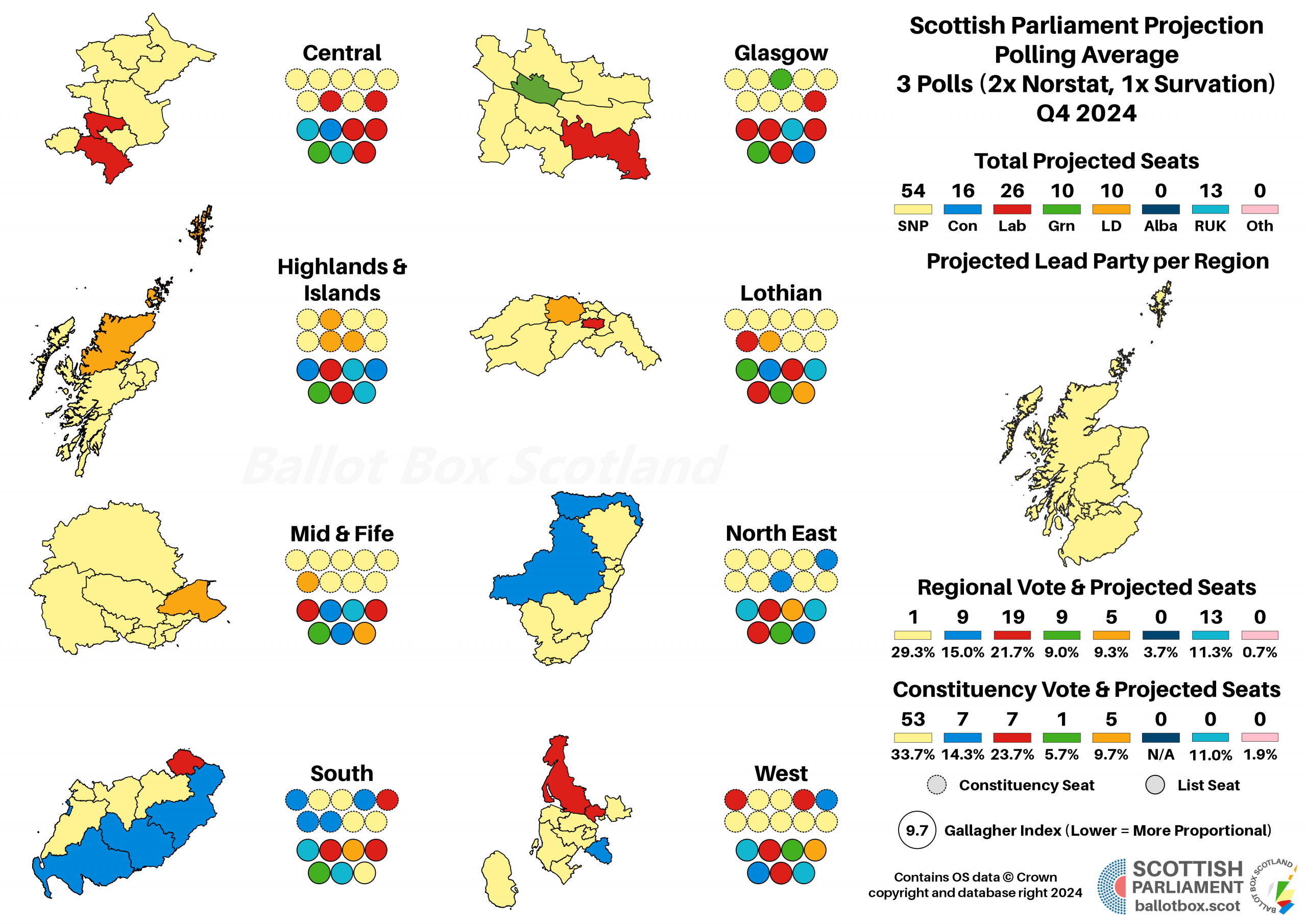
Projecting that into seats might give us something like this:
Please see this page for how projections work and important caveats.


Overall, this isn’t actually all that different to the last poll, as the SNP were already well ahead on the constituency vote in that one. Note that although this is the best overall poll for the Greens, and they are even attributed four constituency seats, it isn’t their best seat projection, because the SNP’s overhang is so intense; as you can see in the AMS ideal line, the SNP “should” be on 40 MSPs, meaning a whole third of their projected MSPs here are (in my view and in line with how the system should work) democratically unearned. First Past the Post: not a representative, fair or at all good voting system, even when only part of a whole!
What changes there are though are at Labour and the Lib Dems’ expense. With the usual caveat that individual constituency results must be understood to be highly uncertain in the case of marginal constituencies, the depths of Labour’s troubles in this poll are shown by the fact they don’t even gain East Lothian Coast and Lammermuirs from the SNP in my model. Uniform swing would hand it to them, but my model averages that out with a more proportional swing, and since that seat is relatively weak for the SNP and strong for Labour, the model thinks Labour fall pretty hard there.
The Lib Dems are kind of in an opposite case situation here because the model cannot be convinced they will win Edinburgh Northern when their vote share isn’t really increasing very much. I expect they would, which would add another to their tally. Indeed, because of the SNP’s overhang, the 5 seats that the Lib Dems are on in my model makes this their worst poll since another Ipsos all the way back in May 2023, and well below recent polling with other firms.
Possible Majorities
Note: these majorities relate simply to passing a vote in the Scottish Parliament. They do not imply the formation of a full coalition government.
- Traffic Light: Labour, Lib Dem and Green
- Independence Bloc: SNP, Green and Alba
- Grand Coalition: SNP and Labour
- Union Bloc: Labour, Conservative, Lib Dem and Reform UK
Change vs Last Poll
Change vs 2024
Labour’s misery continues into the Westminster figures, where again they’ve lost so much support since the last poll that it’s outside the margin of error. That leaves them on half of what they won at last year’s UK election, and with the SNP ticking up two points also puts them on nearly half what the SNP are on. That’s the kind of difference that would likely lead to another near-wipeout.
Another 4% gain for Reform therefore puts them in second place and scrapes them into the 20’s. That’s not quite their best score, but it fits with other pollsters who are finding Reform a little bit higher for the London parliament than its Edinburgh counterpart. At this point of support I would be looking at Aberdeenshire North and Moray East as a possible Scottish Reform MP, though it’s hard to see where else they might break through.
Again, the story of other parties is that their swings aren’t notable, though where that leaves them is perhaps still worth picking up on. The Conservatives and Greens were tied in the last poll and remain tied here, but for the Conservatives that means lifting them up from their lowest poll since the election, and for the Greens it takes them to their best-ever share for this parliament.
Change vs Last Poll
Change vs 2014
Look, there’s very little to say here: basically no change since the last poll, Yes remains very narrowly ahead, Brexit Numbers ahoy.
Hypotheticals
As ever, the last little bit of analysis concerns those hypothetical and more proportional voting systems that BBS likes to play about with. The use of pure FPTP at Westminster is an affront to democracy, and though Holyrood fares far better, AMS is still deeply imperfect. The examples here simply transpose the poll findings onto more proportional voting systems – the reality is that different systems would of course result in different voter behaviour.
Scandinavian Style Westminster
If you find this or other Ballot Box Scotland output useful and/or interesting, and you can afford to do so, please consider donating to support my work. I love doing this, but it’s a one-man project and takes a lot of time and effort. All donations, no matter how small, are greatly appreciated and extremely helpful.
(About Donations)