A poll! A poll! Is it Survation? No!
A poll! A poll! Is it Norstat? No!
A poll! A poll! Is it FindOutNow? Thank the gods, NO!
Nearly a full year after last year’s UK Election and with less than a year to go until the Scottish one, Ipsos have finally roused from their slumber to diversify our polling landscape. I’ve been begging for something that wasn’t from Survation, Norstat (both of whom I cover) or FindOutNow (which I do not) for months, and finally, my prayers have been answered. The infrequent but enduring partnership of STV News (link to original writeup) and Ipsos (link to tables) popped up with a real spicy take in mid-June.
It’s been nearly 18 months since we heard from Ipsos, at least for Holyrood, and it’s important to note that since their last poll they’ve undergone a methodology change. Previously, they were the last remaining major telephone pollster. That’s been replaced with a panel system, which you can read about here. I am not a methodology expert so don’t ask me any more about this, but just bear it in mind, especially for comparing with the previous poll.
The previous Ipsos covered the 25th – 31st of January 2024. Changes are shown as vs that poll / vs last election.
Regional Vote
Change vs Last Poll
Change vs 2021
Lots to get our teeth into here! Starting with the SNP, this is a notably low share: in terms of BBS-tracked polling, they haven’t been this low since May last year. On the other hand, it’s notably more favourable for Labour than Survation and Norstat were. Whereas they showed no advance on 2021, this is at least progress, even if it’s a huge decrease since the last poll. No prizes for guessing that the biggest increase is for Reform, who were still barely registering at the start of last year.
Nipping at Reforms heels though are… the Greens?! Get used to the following phrase in this piece: this is the best share they’ve ever had on this vote. They’ve previously peaked at 14%, at different times and with different pollsters, so this isn’t a massive record breaker. It is however a lot better than the other two pollsters I’ve been following lately. Ipsos have a tendency to highball Green support, but since the others lowball it, it’s at least helpful to get something else in the mix. What we can probably say is that regardless of exact share the Greens are up on 2021 at the moment. If you pressed me, I’d say chuck between 2-4% from the Green to SNP column for something more like a real election.
Although it’s not a big shift compared to the last poll, the biggest losers in relative terms since 2021 are the Conservatives. Although the SNP lose one percentage point more, this represents over half of the Conservative vote share. Again, get used to this phrase: this is the worst Conservative share I’ve seen. Falling bang on 10% means they are in single-digits in urban Scotland. This is absolutely catastrophic, and speaks to the fact the Conservatives are being utterly devoured by Reform and neither their UK nor Scottish leader has a clue what to do about it.
The Lib Dems are up a little bit, more so versus 2021 than the last poll. One thing that’s worth noting here is that this is lower than their constituency share, which I would consider to be “correct” based on past performance. Some of the other recent polls have had higher list than constituency and I always treat that with some scepticism. Lastly, despite the sharp decline for the SNP and accordingly huge gains for the Greens, note that Alba aren’t advancing against 2021 at all.
Constituency Vote
Change vs Last Poll
Change vs 2021
Over on this side of the ballot paper it’s a little less dramatic looking on the surface, but it tells much the same story. The SNP are down a huge chunk of their vote, but with Labour slipping more compared to the last poll they retain a decent lead. It’s only very marginal for this one, but this is again a slight increase for Labour on 2021, which is a silver lining for them. Again, no surprise that it’s Reform making the biggest gains given the timing of the previous poll.
The Conservatives are again on the weakest share I’ve seen here, though it is only a point lower than the most recent Survation. That means they are fourth on this ballot, better than their list ranking, but they’ve got both the Lib Dems and Greens right behind them. For the former this is only a slight improvement, whereas for the latter it’s again the best share they’ve ever had for this ballot: they’ve previously capped at 7%. In reality I’m doubtful the Greens will stand in many constituencies and thus won’t get anywhere near this regardless, and that’s very important for reasons I’ll explain in the seat projection section.
Seat Projection
Projecting that into seats might give us something like this (note that the Previous Poll figures have been re-projected for the new boundaries):
Please see this page for how projections work and important caveats.
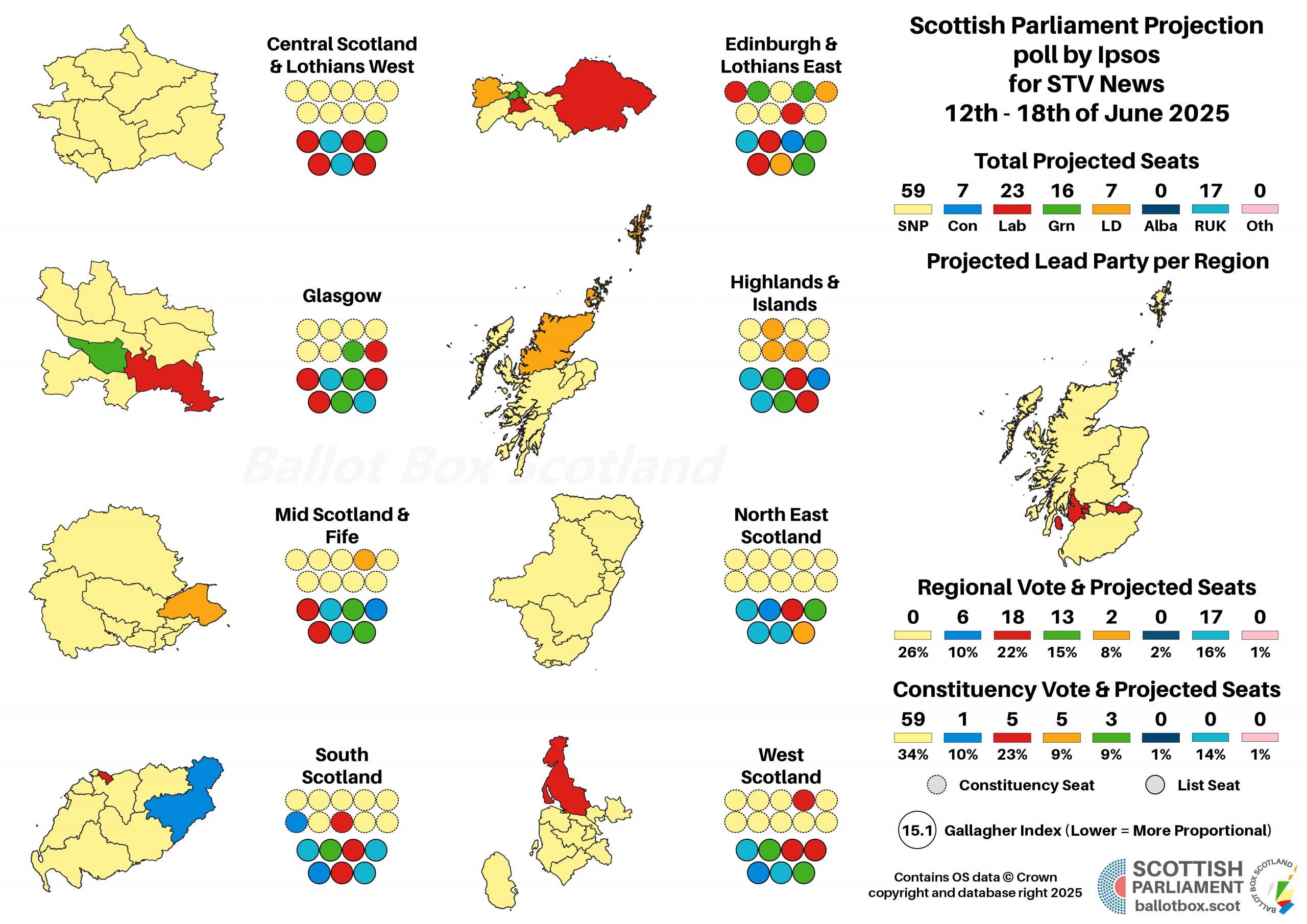
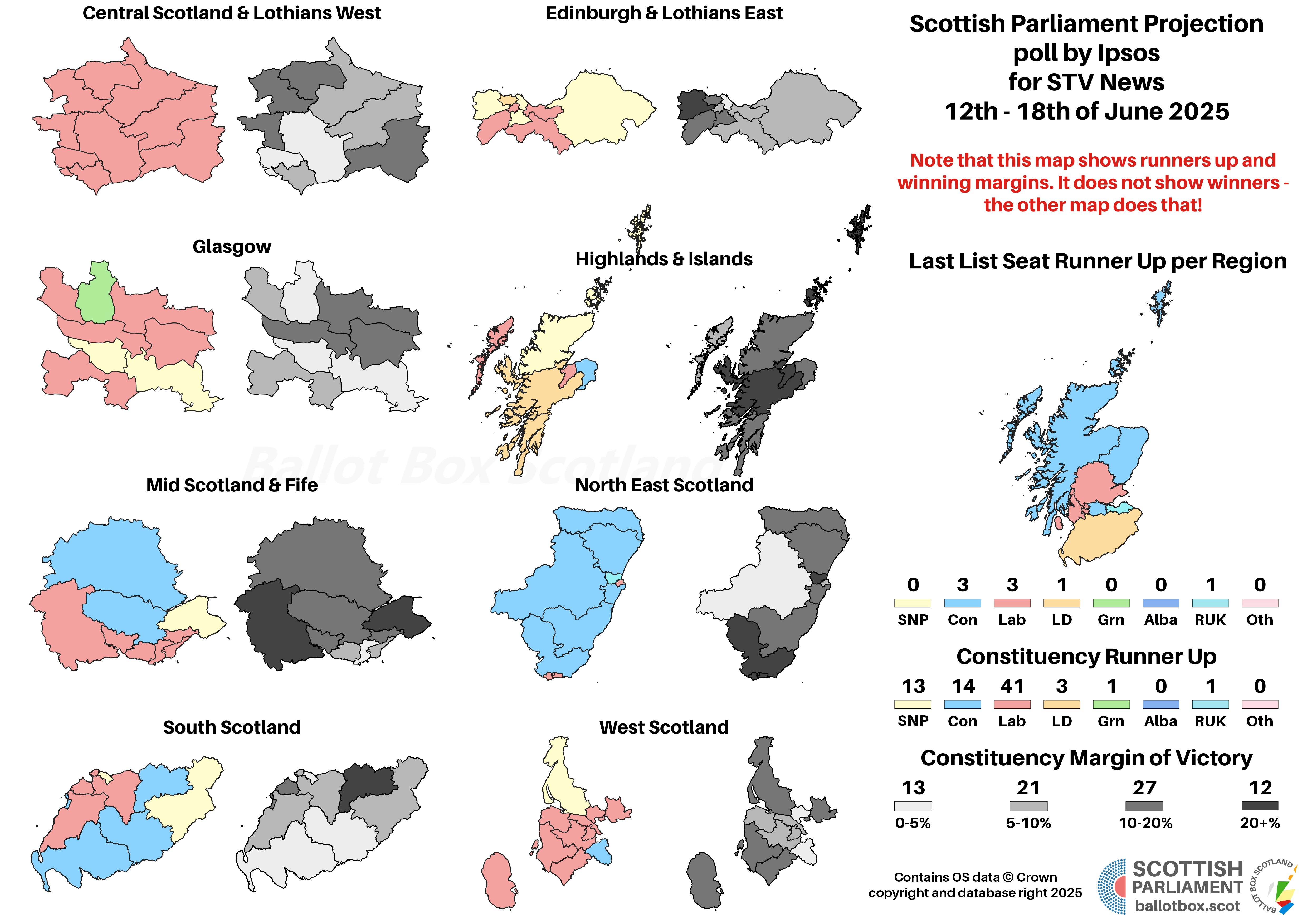
The vote shares above couldn’t help but lead to a wild outcome, and that’s exactly what we have here. In certain key respects this doesn’t actually differ too much from other recent polls: the SNP’s constituency dominance is helping to insulate them from a much worse outcome, and one that is justified by the massive slump in their support. Alongside the Greens they therefore retain a clear Pro-Independence majority, and one that increases by a total of two seats versus the notional 2021 result on the new boundaries.
Where this gets really eye-popping is the Conservative tally: a paltry 7 seats. Not only does that tie them with the Lib Dems, but that’s a loss of more than three-quarters of their previous number, and just under half of the worst result they’ve ever had prior to this (15 in 2011). Only one region has more than a single Conservative MSP, and two regions have none at all. If they had a better result than my model thinks in Eastwood, that’d be the one seat they were due in West and party leader Russell Findlay would lose his seat.
Returning to the Greens, you may also spot they project to a remarkable 3 constituencies here. I would urge a lot of caution on that front because it’s very hard for my model to get this side of things right. I would actually be confident of the Edinburgh Central win if 15% was right on the list, whereas Edinburgh Northern and Leith on the one hand and Glasgow Southside on the other are extremely marginal even in this model and I’d definitely not bet on them. You might be surprised that, given Glasgow Kelvin was regularly Green-tinted prior to the boundary changes, the new Glasgow Kelvin and Maryhill doesn’t go their way. It actually comes very close, but that’s because the Kelvin component is smaller than the Maryhill one; contrast that with the new formulation of Southside which is almost entirely on strong Green patches.
I noted earlier that there’s a further point about the Green constituency vote arising from my expectation they won’t stand in many places. My model has a toggle for whether to include the Greens in each constituency or not, and I only have that on for five seats: the four mentioned above plus Aberdeen Central. That means the vast majority of the Green constituency share has to go somewhere else. Using 2022 transfer patterns, around 60% of the expected Green share flows to the SNP in their absence, versus about 20% to Labour. In this particular poll the cumulative effect of that is to give the following “real” constituency shares:
In other words, it takes what was an 11% lead for the SNP over Labour on the raw figures and turns it into a 13.6% lead. That means that compared to models which are expecting the Greens to contest every seat, mine is more favourable to the SNP and is contributing to their over-representation. This is one of the permutations I capture in my hypotheticals at the bottom, on the “Full Green Slate” line of the Various Other Systems chart. For this poll that would tip 5 seats away from the SNP with the net effect being two extra MSPs apiece for the Conservatives and Lib Dems plus one for Labour.
Possible Majorities
Note: these majorities relate simply to passing a vote in the Scottish Parliament. They do not imply the formation of a full coalition government.
- Traffic Light: Labour, Lib Dem and Green
- Independence Bloc: SNP, Green and Alba
- Grand Coalition: SNP and Labour
- Union Bloc: Labour, Conservative, Lib Dem and Reform UK
Change vs Last Poll
Change vs 2024
What’s happening on the Westminster vote is pretty similar, though since the comparator is purely with 2024, it looks positive for the SNP and dire for Labour. Reform are performing strongly but notably less so than with the other two pollsters, who both said 21%.
Once again we’ve got a record-breaking Green share here: I think their previous best for Westminster in Scotland has been 7%. That ties them with the Conservatives who are, you guessed it, on the worst share I’ve ever seen them on for this vote. It was very neat of them to be at 10% in all three votes, I have to say. That leaves the Lib Dems very close behind with only a single point dip compared to the election.
One thing worth picking up is that not only is this a slightly narrower SNP over Labour lead than the Holyrood constituency, but unlike that ballot I would expect the Greens to contest most seats. The reason they would try to do so at Westminster but not Holyrood is that obviously, constituencies are the only game in town for the former, whereas for the latter they are a drain on resource that can otherwise be spent trying to actually win list votes. I’ve written about this before, noting that deposits not put forward in 2021 amounted to about 13% of their entire campaign spend. In any case, that would mean the SNP don’t benefit from their absence and would take the hit in a few seats as a result.
Change vs Last Poll
Change vs 2014
Ipsos have typically been the most Independence-favourable regular pollster, and that has held up here despite their change in methodology. That said, the Yes share is down a fair chunk versus the previous poll, with a corresponding rise in Don’t Knows. It’s still a lead, giving the cursed numbers after we exclude those uncertain, but not a very big one. Overall, this continues to feed into the sense that the constitutional question is far from settled, but not a major part of the current landscape either.
Hypotheticals
As ever, the last little bit of analysis concerns those hypothetical and more proportional voting systems that BBS likes to play about with. The use of pure FPTP at Westminster is an affront to democracy, and though Holyrood fares far better, AMS is still deeply imperfect. The examples here simply transpose the poll findings onto more proportional voting systems – the reality is that different systems would of course result in different voter behaviour.
Scandinavian Style Westminster
If you find this or other Ballot Box Scotland output useful and/or interesting, and you can afford to do so, please consider donating to support my work. I love doing this, but it’s a one-man project and takes a lot of time and effort. All donations, no matter how small, are greatly appreciated and extremely helpful.
(About Donations)