As the 2026 Scottish Parliament approaches, keep up to date with all the latest polling and analysis on Ballot Box Scotland’s Holyrood Hub page!
For many years, even as English and Welsh voters turned to them in increasing numbers, Scots had very little interest in Farage-led outfits. Whether UKIP, Brexit or Reform UK, they only ever found anything approaching success at European Elections, even though almost every election in Scotland uses a form of proportional representation. UKIP peaked at just 2% of the Holyrood vote in 2016, and at the last Scottish Parliament election in 2021 Reform won a derisory 0.2%.
That all changed last year when, although still substantially weaker than down south, Reform scored a respectable 7% of the Westminster vote. Since then, they have been gaining momentum through big shares (but as yet, no wins) in council by-elections, and polling for next year’s Holyrood election has them breathing down Labour’s neck for second place. On the occasional night where his forced optimism gives way to gentle weeping, I imagine Anas Sarwar has nightmarish visions of Nigel Farage joining Keir Starmer in barring the doorway to Bute House.
It’s clear that Scottish Labour’s current woes are down in large part to Reform’s surging support, but just how much of that is a direct transfer between parties? Polling at UK level broadly suggests Labour losing more support to parties of the centre-to-left than to Reform, for example. You’d be an absolute fool though to simply assume Scottish trends neatly follow those in England: leave that to the court jesters who barely ever engage with politics outwith Westminster’s crumbling walls. With a sudden spate of Scottish polling through September, we can dig into the data to get a clearer sense of exactly what’s going on.
How have past voters' intentions shifted?
To start piecing together the shape of Reform’s support, we need to start with how opinion has shifted amongst past voters for other parties. Note that as poll tracking and reporting is typically done on the basis of decided voters only, all figures in this article are similarly taken from poll tables after excluding undecideds/don’t knows. This may therefore differ slightly from analysis that includes past voters who are currently unsure of how they will vote. The change in the shape of the electorate between elections (past voters or non-voters switching, eligible voters moving to or from Scotland, younger voters attaining the vote, older voters dying) will also impact some of these numbers.
The 2024 figures are an average from the constituency vote portion of the most recent polls by More in Common, Survation and Norstat. Reform’s support is pretty much identical in both votes, and I’m just using the constituency vote both as it’s most directly comparable with 2024 and because most pollsters don’t break their tables down for 2021 regional vote (a major flaw, in my view). As More in Common did not have a comparator for 2021 vote, those averages are purely between Survation and Norstat. Averaging may therefore be affected by the relative dearth of Scottish polling over short, comparable periods, and the house effects and methodologies of different pollsters.
Shift in Polled Constituency Vote vs 2021 Constituency Vote
Relative to the last Holyrood election, most parties that contest constituencies nationwide have retained the majority of their vote. The Conservatives are the exception, as they are expected to lose around half of their vote on average. Unsurprisingly, most of this has gone to Reform, which keeps about 9 in 10 of their 2021 vote on the right hand side of the political spectrum. Retention rates then rise from just shy of two-thirds for Labour to just below three-quarters for the Lib Dems and just above for the SNP.
Whilst all parties show a statistically significant loss to Reform, the likelihood of their voters doing so shows a marked constitutional split. On average, SNP voters are proving substantially less likely to swing to Reform than people who backed any of the Pro-Union parties. Even Lib Dem voters, the least likely amongst the Pro-Union parties, shift at a ratio of 2-to-1 versus the SNP’s. That grows to 2.5-to-1 if you compare with Labour, and 5.6-to-1 for the Conservatives.
Shift in Polled Constituency Vote vs 2024 General Election Vote
Whilst in general we want to compare elections of the same type, we cannot ignore the fact that last year was the first election Labour won in Scotland since 2010. That represented a radical departure from the SNP’s near-decade-and-a-half dominance of Scottish politics, as well as the first non-European (qualified) success for a Farage led outfit north of the border. It would be simply incorrect to treat voters as if they were all still in 2021. As such, we should compare with 2024 votes as well.
This is absolutely damning for Labour: of the five parties in the chart (not enough votes for Greens to get their own line), they are the only party to retain less than half of their 2024 vote. The SNP are at the front of the pack, holding on to around 90% of those (decided) voters who backed them last year, and their gains from Labour alone would make up the difference. Reform aren’t far behind, whilst Lib Dems and Conservatives sit a few percentage points either side of two-thirds. Labour? 49%.
Although the proportions look smaller overall, this broadly replicates what we see in the 2021 chart of SNP voters being much less likely than those who backed Pro-Union parties to swing behind Reform. What differs here is the relative propensity: it’s now about 3.8-to-1 for Lib Dems vs SNP, 5.5-to-1 for Labour, and 7.4-to-1 for the Conservatives. Long story short is that regardless of whether you compare 2021 or 2024, relatively few SNP voters have moved their support to Reform compared to the Pro-Union parties.
How are past voters contributing to Reform's current support?
All of the above said, it’s very well looking at the proportion of each party’s past vote going to Reform, but that’s only part of the picture. The Lib Dems’ 2021 voters may be twice as likely as the SNP’s to shift to Reform, but those voting SNP outnumbered Lib Dems 7-to-1. What the earlier section told us was the new composition of each party’s 2021 and 2024 voters: we also need to understand the composition of Reform’s current voters.
Source of Polled Reform Votes vs 2021 Holyrood Constituency Vote
Relative to 2021 it shouldn’t be a surprise that the biggest chunk of Reform’s vote is coming from Conservative voters. When two in five of the second placed party’s voters are making the leap, that’s obviously going to be a huge proportion of Reform’s support. Likewise, given Labour were roughly tied with the Conservatives on the constituency vote in 2021, being half as likely to make the move means contributing about half as many voters.
The SNP aren’t a million miles behind Labour though, as although their voters have the lowest propensity to turn to Reform of the Westminster parties, there were so many of them in 2021 that they still make up about one seventh of Reform’s support. That leaves the Lib Dems as by far the smallest individually tracked component of the vote (Greens will be smaller yet, but there were so few Green constituency votes in 2021 that it’s basically impossible to meaningfully estimate).
Source of Polled Reform Votes vs 2024 General Election Vote
When we compare versus 2024 however things look very different. Obviously, since Reform actually had a substantial presence last year, a large proportion of their polled Holyrood support is effectively carryover from that election. Correspondingly, you’d have expected the Conservative contribution to be much smaller seeing as so many of them already made the switch last year anyway.
The biggest chunk however is coming from those who voted Labour. It’s not massively more than Reform’s own carried over vote, so let’s not get carried away, but let’s not underplay this either. Roughly one third of the people intending on voting Reform at Holyrood are recent Labour supporters. That’s the thought keeping Anas Sarwar awake at night. On the other hand, note how 2024 SNP voters amount to a marginally smaller proportion than Lib Dems.
I know some people have gotten quite cross with me for drawing the distinction between 2021 and 2024 voter flows. A lot of them, it seems clear to me, really want to be able to say “the SNP are losing support to Reform” by making their comparison with 2021. What this data shows is that this is, broadly speaking, untrue. Instead, the SNP have already lost most of that support to Reform. They lost it last year: either directly or via Labour as a stopping off point.
That distinction matters because it plays into how parties perceive and respond to the threat of Reform. A feeling of “losing” support adds to a sense you can reverse the losses by making concessions to the polices you think they are leaving you for. We can see this from Labour at UK level, where for the past six months almost the entire political machinery of government and party communications has been repurposed into a “make overtures to Reform voters” machine.
By contrast if you consider those voters already lost and unlikely to return, you might think about how to shore up your existing base, if not potentially grow it. The SNP have accordingly taken a much harder line against Reform and their policies, speaking out for example against increasing restrictions on immigration. Whatever your views on the parties and policies involved, it’s pretty clear that one of these strategies is working a lot better than the other, and it’s not Labour’s. I’ve said it before and I’ll say it again: “our opponents are right, but for the gods’ sakes don’t vote for them!” is a fool’s campaign.
Which way is Labour swinging?
Given the contribution Labour’s 2024 voters are making to Reform’s current support, it’s worth a brief diversion to talk about Labour’s seeming collapse in more detail. Earlier on we could see how their votes were going on a party-by-party basis, but how are they shifting in left-right terms?
Shift in Labour's Polled Constituency Vote vs 2024 General Election
What’s really fascinating about this is that it differs quite strongly from the overall picture across Britain. Recent polls and studies have tended to suggest that the net total of 2024 Labour voters swinging to parties broadly on the left and/or liberal end of the political spectrum (the Lib Dems, Greens, SNP and Plaid Cymru) is about twice as high as those swinging for right-wing and/or reactionary parties (to Reform and the Conservatives). Yet here in Scotland the two destinations are roughly equally sized, at just shy of a quarter of Labour’s 2024 support each, with a small but statistically meaningless advantage to the right.
At a guess, I’d suggest there are two notable contributors to this effect. The first is that whilst the constitution is no longer all-consuming, it remains important to lots of people, many of whom will now vote for whoever they perceive to be the strongest anti-Independence force. I guarantee you there will be a fair few voters who have taken the following path: Labour from the 90’s up to 2015, the Conservatives from 2016 up to roughly 2021, back to Labour in 2024, and now Reform. “Strongest” here doesn’t necessarily imply numerically, but instead in terms of policy, narrative, and feeling of sending a message.
The second may be smaller but I think, given the state of polarisation and the deeply toxified nature of the UK’s political discourse, it shouldn’t be handwaved away: radicalisation. There’s a portion of the Scottish electorate that has absolutely been radicalised into a quite unhealthy hatred of the SNP. That goes beyond the simple, ordinary, legitimate, essential democratic disagreement with the SNP into obsessive territory, particularly on the basis of the them being “woke”. These are the folk who’ll accuse the SNP of “Cultural Marxism”, who peddle creepy and invasive conspiracy theories about Nicola Sturgeon’s personal life on Twitter, and who are convinced some sort of Stonewall Gender Ideology Mafia have captured the Scottish Government.
Reform UK’s inherently and fundamentally “anti-woke” agenda is highly appealing to that kind of voter. They could have been worked up into voting Labour last year to strike a blow against the hated Nats, but with Reform now on the rise they’ve got a better outlet for their views. Do I think there are huge numbers of these voters? No. Do I think they could account for, say, 2-3% of the total voting electorate, which becomes substantial when measuring flows in the way this section does? Absolutely.
How does Reform's support vary across Scotland?
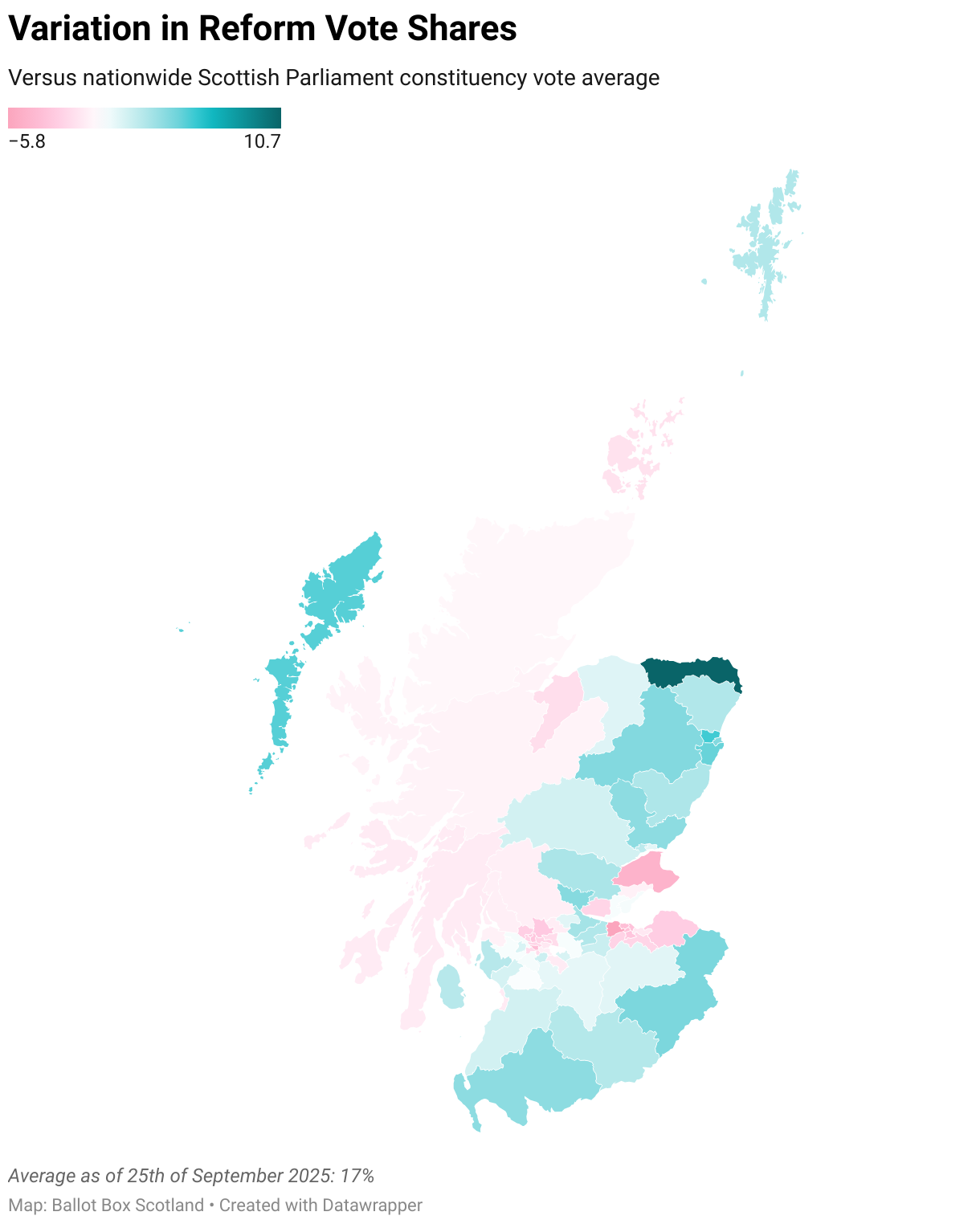
Now that we’ve had a good look at where Reform votes are coming from in party terms, it’s worth finishing with a look at where they might be coming from geographically. As they had a strong result and stood in every constituency in 2024, we can take that data as authoritative. Since their 2021 regional shares were so anaemic, they aren’t brilliantly illuminating by themselves, so we can instead look at their projected shares in the BBS average at time of publication.
Note that there is therefore a little bit of a methodological difference here. My projections for constituency shares for Reform take the combined vote for Reform and UKIP in 2021 as a starting point to estimate how their support might be distributed, which won’t necessarily map perfectly to the current reality.
Distribution of Reform UK Vote
Caveat above in mind, these two maps aren’t actually that different. There are a few clear deviations that just come down to imperfections in the process; for example if anything, Eastwood (shown for Holyrood as nearly identical to their national share) should be even weaker for Reform than East Renfrewshire was at UK level: Eastwood doesn’t have the Barrhead and Neilston areas I’d expect Reform to do best in. You can also spot how Na h-Eileanan an Iar plus Perthshire and the lower North East, as it were, lean more Reform in my model than they did at Westminster.
Otherwise though, we can see some pretty clear similarities. The Banff and Buchan area shows up as easily the strongest patch, with solid support in nearby seats. Galloway, southern Angus, Clackmannanshire, Falkirk and West Lothian also stand out as relative hotspots in both maps. On the flip side, Edinburgh, Glasgow, North East Fife, and East Dunbartonshire-inclusive seats would be expected to be below par. You can still see gradations within the two big cities though, with the eastern portions of both coming closer to Reform’s national share the central and western parts.
That’s why if you look at the regional projection on the Holyrood Hub page, you’ll see that the North East, South, and Central Scotland and Lothians West regions are the top three strongest for Reform. The North East in particular is important for Reform: my model doesn’t yet expect that they will win Banffshire and Buchan Coast, but the SNP’s lockdown on North East constituencies is costing Reform at least one MSP at present. It’s not guaranteed they’d make a net gain if they did win that constituency (the freed-up list seat might have someone else ahead of them in the queue), but it wouldn’t hurt.
Conclusions
So, in summary:
- Reform have absolutely devoured the Conservative’s 2021 support. This makes up by far the biggest portion of their voter base with reference to 2021, and combined with specific local reasons leads to especially strong backing in Banffshire, Buchan and Galloway.
- Having effectively lost their entire gain in support compared to 2019 (and 2021), Labour’s voters are narrowly the biggest portion of Reform’s voter base with reference to 2024. This will reflect some 2021 Conservative to 2024 Labour to 2026 Reform movement. This is being seen most strongly in the mid-Central Belt, where Labour were historically highly successful.
- Compared to the rest of the UK, where Labour’s losses are seemingly going 2-to-1 to broadly left wing parties versus right wing parties, in Scotland the two destinations are statistically tied. This is likely to reflect ongoing constitutional polarisation with a side helping of radicalisation, which isn’t unique to Scotland but has unique Scottish dimensions.
- The SNP have lost relatively few of their 2021 voters base to Reform, but given how many voters they had at that election, they make up a sizeable chunk of Reform’s support. However, the past tense there is crucial. They are losing almost none of their 2024 support in that direction. That is made up for by 2024 Labour voters turning (or returning) to the SNP.
- In general, the Lib Dems are not contributing much of the Reform vote regardless of what election you compare with. However, as a proportion of their own voter base, past Lib Dem voters are more likely than past SNP voters to vote for Reform. Overall, Reform support can therefore be said to be drawn overwhelmingly from the Pro-Union camp.
With seven months still to go until the big day, nobody should be counting their chickens just yet. It’s unclear whether Reform’s current surge will survive contact with an actual campaign, especially given the almost complete absence of any notable Scottish spokespeople or any devolved policies. On the other hand, they could further consolidate the anti-SNP vote if both the Conservatives and Labour continue to struggle. Whatever happens though, we can say with certainty by this point that the “threat” of Reform is overwhelmingly to the other Pro-Union parties.
The only way Reform become a threat to the SNP is by failure or absence; any votes they lose are most likely to flow back to Labour or the Conservatives, shoring those parties up in key constituencies. Should they choose not to contest many, or any, constituencies, that massively reduces the SNP’s current advantage. My estimate on current polling is that Reform UK choosing to contest the list only would narrow the SNP’s constituency vote advantage over Labour from 16% to 10%, costing them 9 MSPs and leaving them just short of a Pro-Independence majority with the Greens.
It can reasonably said that even with absolutely zero prospect of entering government themselves, Reform could yet be the biggest deciding factor in who does, or at least how easy it is for them to govern. That may be a far cry from current UK polling which suggests a potential Reform majority government, but it’ll still be the biggest disruption to Scottish politics since the SNP’s jaw-dropping majority in 2011.
If you find this or other Ballot Box Scotland output useful and/or interesting, and you can afford to do so, please consider donating to support my work. I love doing this, but it’s a one-man project and takes a lot of time and effort. All donations, no matter how small, are greatly appreciated and extremely helpful.
(About Donations)