Once again, my wishing for a poll was apparently done on a monkey’s paw. Very shortly after I personally expressed my annoyance there hadn’t been a Scottish poll in over two months (when there had been over 40 for Westminster), we got a new one from More in Common. This is the first ever full Scottish voting intention poll from More in Common (link to tables), and it’s another… interesting read, to say the least.
Bear with me here, but a decade ago I was off work for two straight weeks with a shocking case of tonsillitis. I have never been sicker in my life. When I was back at work I was still finishing my course of antibiotics. As I was duly taking my medicine in the office kitchen, the work experience student we had in for the summer walked in and exclaimed “are you on drugs?!” Anyway, whenever I see a Scottish poll that’s not by Survation or Norstat at the moment, I find myself thinking exactly that. You’ll soon find out why…
For reasons stated above there is no previous More in Common poll to compare and thus changes are only versus the last relevant election.
Regional Vote
Change vs Last Poll
Change vs 2021
To begin with, this is a relatively strong share for the SNP by recent standards. They’ve only hit this level in one other poll since last year’s General Election. With Labour seemingly collapsing again and Reform on the up, those parties are tied with one another and combined only just equal the SNP’s share. They are followed closely by the Lib Dems which is where my eyebrow hit the roof.
If the last poll BBS covered by Ipsos clearly overestimated the Greens (by around 2-4%) in my view, More in Common are doing the same for the Lib Dems. 14% is their best figure since 2021 and it’s well in excess of what other pollsters have been finding lately. Labour have had a rough summer but I’m simply not convinced that the outcome of that has been to bring the Lib Dems’ historically weaker list vote in Scotland to the level of their current GB-wide Westminster polling, and indeed to what would be a record share. When I asked for pollsters beyond Survation and Norstat, did they all have to come with some bizarrely strong house effect for a small party?
Speaking of house effects, More in Common have also tended towards the lower end of Green polling at GB level, and I’m inclined to say that’s carried over to Scotland. This leaves the Greens unchanged versus 2021, which is hardly unparalleled and in fact fits margin of error of most recent polling, but it’s a stark contrast to the Ipsos. Truth lies in the middle, perhaps. Skipping back up the rankings, the Conservatives have what is again a truly abysmal share, only blunted by the fact that a halving of their vote is no longer the worst thing a poll has suggested for them.
Constituency Vote
Change vs Last Poll
Change vs 2021
The SNP’s share on the constituency ballot is less notably out of kilter with other pollsters; certainly it’s the highest in the past few months, but we’ve had a couple of 36-37% in the past year so it’s not totally out there. For Labour though, this is the worst constituency share of the term. Given that an overly-wide gap in the constituency vote translates to an absolute hammering given our deeply imperfect proportionality, which Labour themselves introduced, this is extremely bad news for them. Placing ahead of Reform on this one ballot is only a small comfort in such a scenario.
The Conservatives continue to do badly on this side of things, though here they are tied with rather than behind the Lib Dems. Again, and I say this on most occasions, the Lib Dems have never in six Holyrood elections won a higher list than constituency share (because they excel at a “vote for us to stop the baddies” approach which doesn’t apply as well under PR), which adds to my sense of caution about having such a high list share. I’m certainly not saying this is definitely wrong, it’s just a notable outlier compared to what we’ve had earlier in the year and we need more polls to compare with.
Seat Projection
Projecting that into seats might give us something like this:
Please see this page for how projections work and important caveats.
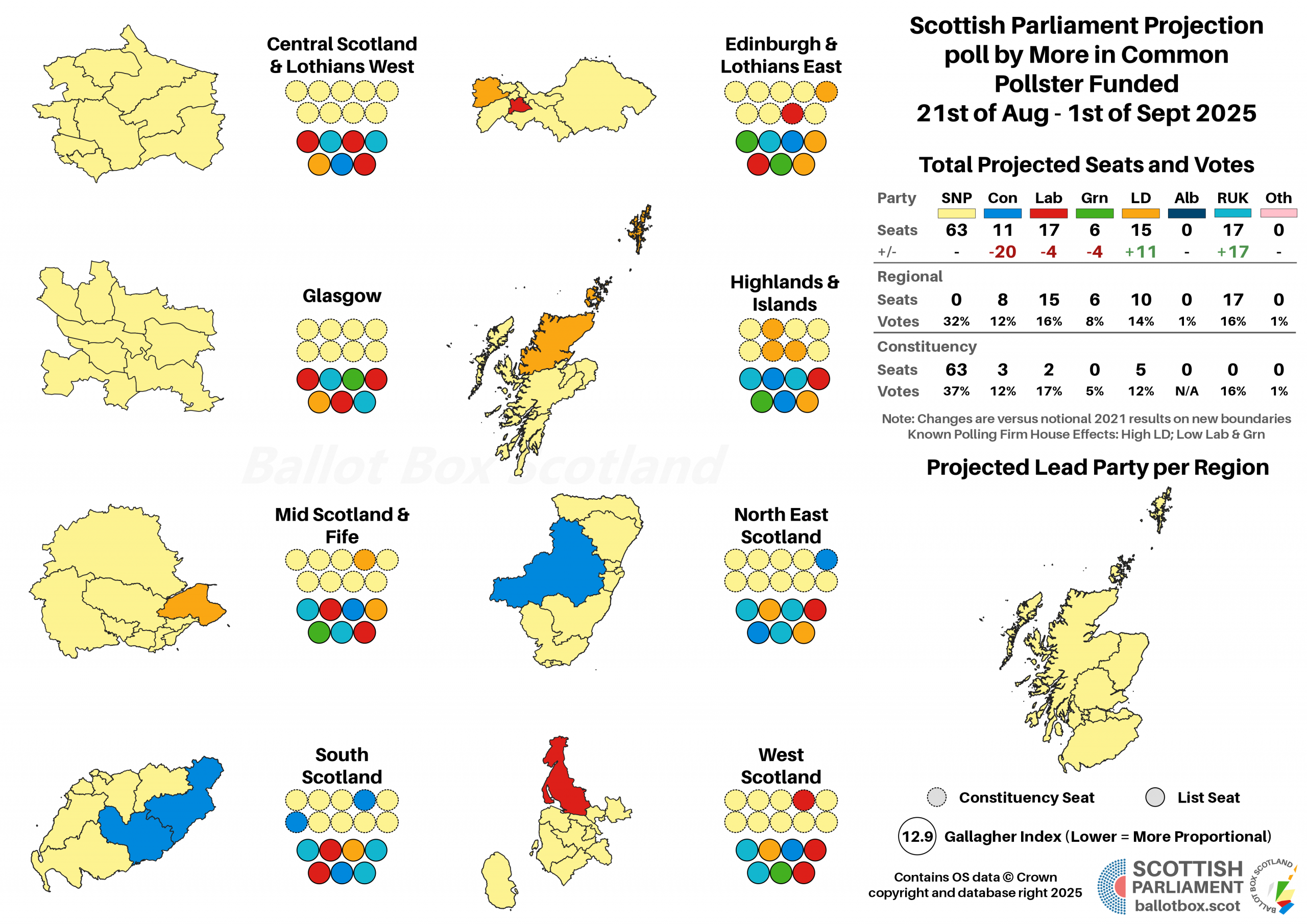

This is an absolutely ridiculous outcome, it has to be said. For the SNP to be down a quarter of their constituency vote and a fifth of their list share and lose not a single seat would be a democratic outrage. That’s only happening because they are massively exceeding their fair share of constituency seats, which is what happens when they have more than twice Labour’s share of that vote. It also preserves an easy majority for the Pro-Independence bloc, though the SNP’s straining of proportionality means it’s a joint-lowest seat projection for the Greens of the term; as ever, consult the “Pure List” line in the hypotheticals down the bottom for what the “correct” outcome should be.
The timing of this couldn’t, really, have been worse for Labour. Just an hour before this poll dropped, at the first First Minister’s Questions after the summer recess, Anas Sarwar had deployed an overly-bold jibe about John Swinney having eight months left in the job. I’d thought it overly bold in the moment as it was. With the worst Labour seat projection of any poll this term following minutes afterwards, Sarwar might want to consider the wisdom of such lines in the future.
It’s also not a great start for the new Green co-leaders that the first poll out of the gates has one of them losing her seat. That requires the double caveat that More in Common are on the low end of Green polling and that they actually have the votes for it but the SNP’s massive constituency excess locks them out. It’s also, objectively, daft to suggest the Lib Dems will win a seat in Central Scotland and Lothians West but the Greens won’t! Model says what model says though.
On which subject, note that although it’s got the Lib Dems on easily their best seat projection of the term, effectively returning them to pre-Coalition levels, they don’t quite take Edinburgh Northern. In reality I expect that to happen regardless, though since they’ve got one of the list seats in the Edinburgh and Lothians East region in this scenario they just swap those over rather than make any real gains. I also continue to struggle to see a reality in which the Lib Dems regain a Glasgow seat, but again, the model can only work with what the poll tells it.
I know that some people bristle when I caveat things like this, but there’s a reason these are “analysis” pieces. I’m not just regurgitating what calculators say and taking it as gospel, I’m here to interpret within the wider context. I’ve said a few times but the dearth of Scottish polling is a real problem because if we had more regular polls, we’d could be more confident that huge gains for certain parties (Lib Dems in this case, but equally the Greens from the earlier Ipsos) were questionable outliers or reasonable expectations. Instead, we keep getting these big, dramatic figures without any real comparability in the moment. With 8 months left to go, I hope that the pace picks up, a lot, and soon.
Possible Majorities
Note: these majorities relate simply to passing a vote in the Scottish Parliament. They do not imply the formation of a full coalition government.
- Traffic Light: Labour, Lib Dem and Green
- Independence Bloc: SNP, Green and Alba
- Grand Coalition: SNP and Labour
- Union Bloc: Labour, Conservative, Lib Dem and Reform UK
Change vs Last Poll
Change vs 2024
Unlike Holyrood, this isn’t More in Common’s first foray into Scotland for Westminster figures, but since the last time was before the 2024 election it’s not relevant for comparative purposes. It’s further absolutely disastrous news for Labour here, as whilst the SNP are effectively unchanged (up just a point) compared to last year, Labour have lost half of their vote. That puts them on their worst share since the election and behind Reform UK, who’ve trebled theirs, and also taken a treble for poll leads over Labour. Those come from three different pollsters, suggesting it’s not a mere house effect.
This is the weakest part of the poll for all of the Conservatives, Lib Dems (tied with one another) and the Greens, though for the latter two it’s progress compared to July last year. The Conservatives may take some cold comfort here that since they were so close to rock bottom back then anyway, further losses to the SNP would be relatively limited on these figures.
However, one thing that adds to my dubiety about the exact figures in this poll is how much lower this is than the SNP’s Holyrood shares. Indeed, there hasn’t been a poll since the General Election that has had the SNP on a lower Westminster figure than on the Holyrood list. Yes, it’s within margin of error, but the 6% gap between Westminster and Holyrood constituency is also unusually large; only a Norstat in December last year had a similar gap. If the general shape of this poll is right, I would expect that this figure should either be a little higher or their Holyrood a little lower.
Change vs Last Poll
Change vs 2014
As is so often the case at the moment, this is the least interesting part of the poll. Ah yes, there remains a near tie between constitutional camps, how riveting. That’s what most polling tells us. It’s closer than 2014, but not an Independence lead. Plus ça change, plus c’est la même chose.
Hypotheticals
As ever, the last little bit of analysis concerns those hypothetical and more proportional voting systems that BBS likes to play about with. The use of pure FPTP at Westminster is an affront to democracy, and though Holyrood fares far better, AMS is still deeply imperfect. The examples here simply transpose the poll findings onto more proportional voting systems – the reality is that different systems would of course result in different voter behaviour.
Scandinavian Style Westminster
If you find this or other Ballot Box Scotland output useful and/or interesting, and you can afford to do so, please consider donating to support my work. I love doing this, but it’s a one-man project and takes a lot of time and effort. All donations, no matter how small, are greatly appreciated and extremely helpful.
(About Donations)