As the 2026 Scottish Parliament approaches, keep up to date with all the latest polling and analysis on Ballot Box Scotland’s Holyrood Hub page!
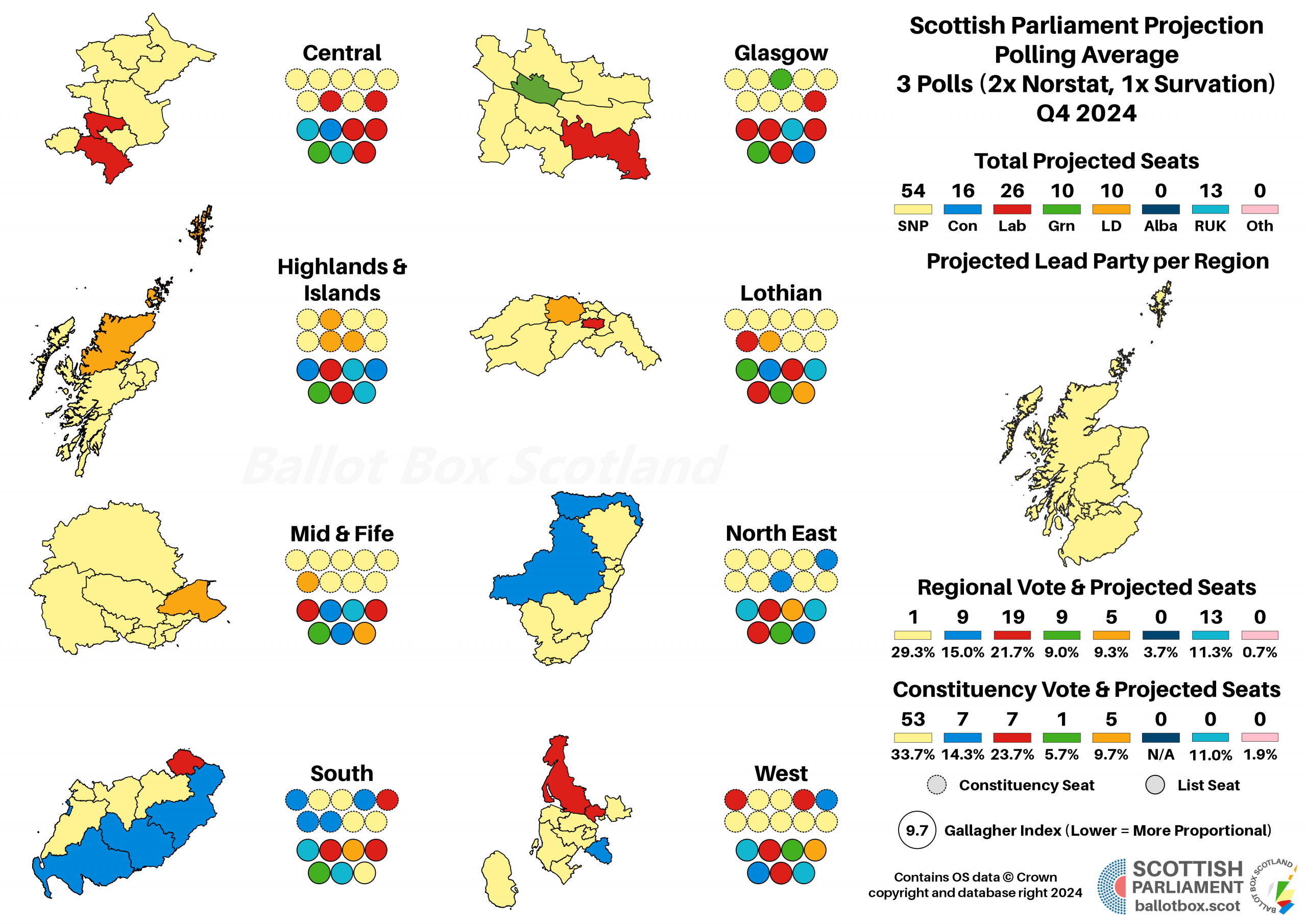
Hot on the heels of one of our regular polling sources, the usual pairing of the Sunday Times (link to original writeup) and Norstat (link to tables) are back after their own summer break with a new batch of polling. That rounds out a neat three new polls (from BBS-acknowledged sources; not you, FindOutNow) over September which helps bring averaging more up to date.
The previous Norstat covered the 27th – 30th of May 2025. Changes are shown as (vs that poll / vs last election).
Regional Vote
Change vs Last Poll
Change vs 2021
So, there’s absolutely nothing here that’s outwith margin of error, which means this poll could be picking up continued movements, or it could just be statistical wobbliness. What those wobbles show though is a slight re-adjustment within each camp. On the Pro-Independence side, the SNP are up a point whilst the Greens are down one; as much as Norstat, Survation and More in Common are all low-Green pollsters, the new Co-Leaders are unlikely to be buoyed by seeing three 8%ers in a row. Alba for their part are up one, Norstat continuing their trend of finding higher support than any other credible pollsters.
For the Pro-Union column, the Conservatives have dropped a couple of points and Reform UK have gained the same amount. That means that although Labour are unchanged, Reform draw level with them on this vote, adding to sense they are really nipping at their heels for second place.
Constituency Vote
Change vs Last Poll
Change vs 2021
Movements are slightly larger on the constituency vote, but still mostly within margin of error. These are almost entirely between the Pro-Union parties, as the SNP are only up one point and the Greens unchanged. I’ll get onto it at the Westminster section, but I’ve a notion crystallising about what might be happening with some of this Low Green polling.
For the two traditional big Pro-Union parties, their losses here put them on joint-worst shares for this vote of this whole term. A relatively chunk gain for the Lib Dems pulls this vote back up above their list vote, which I tend to think is more reasonable, and the bump for Reform combines with Labour’s slump to put them in clear second for this vote.
Seat Projection
Projecting that into seats might give us something like this:
Please see this page for how projections work and important caveats.
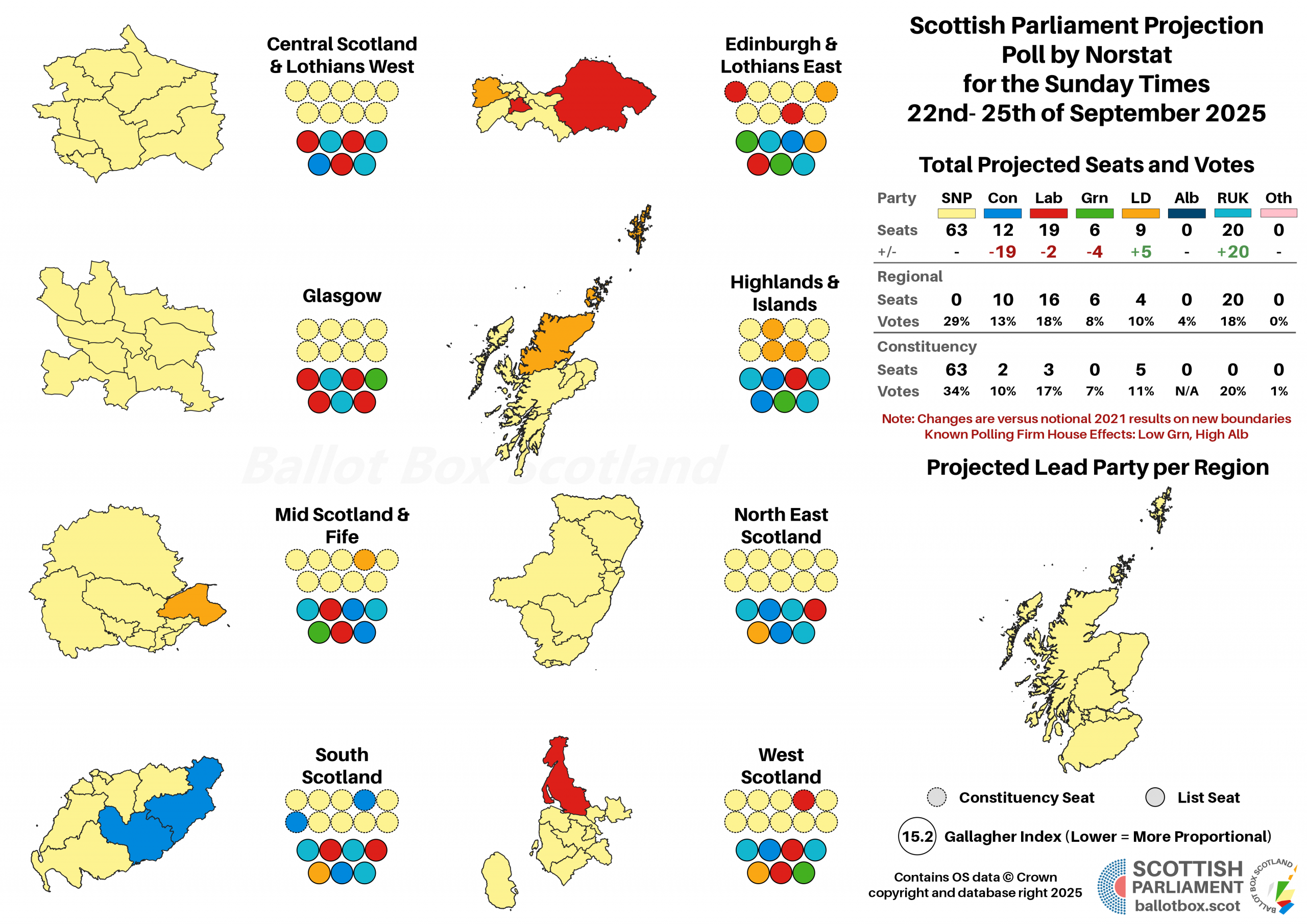
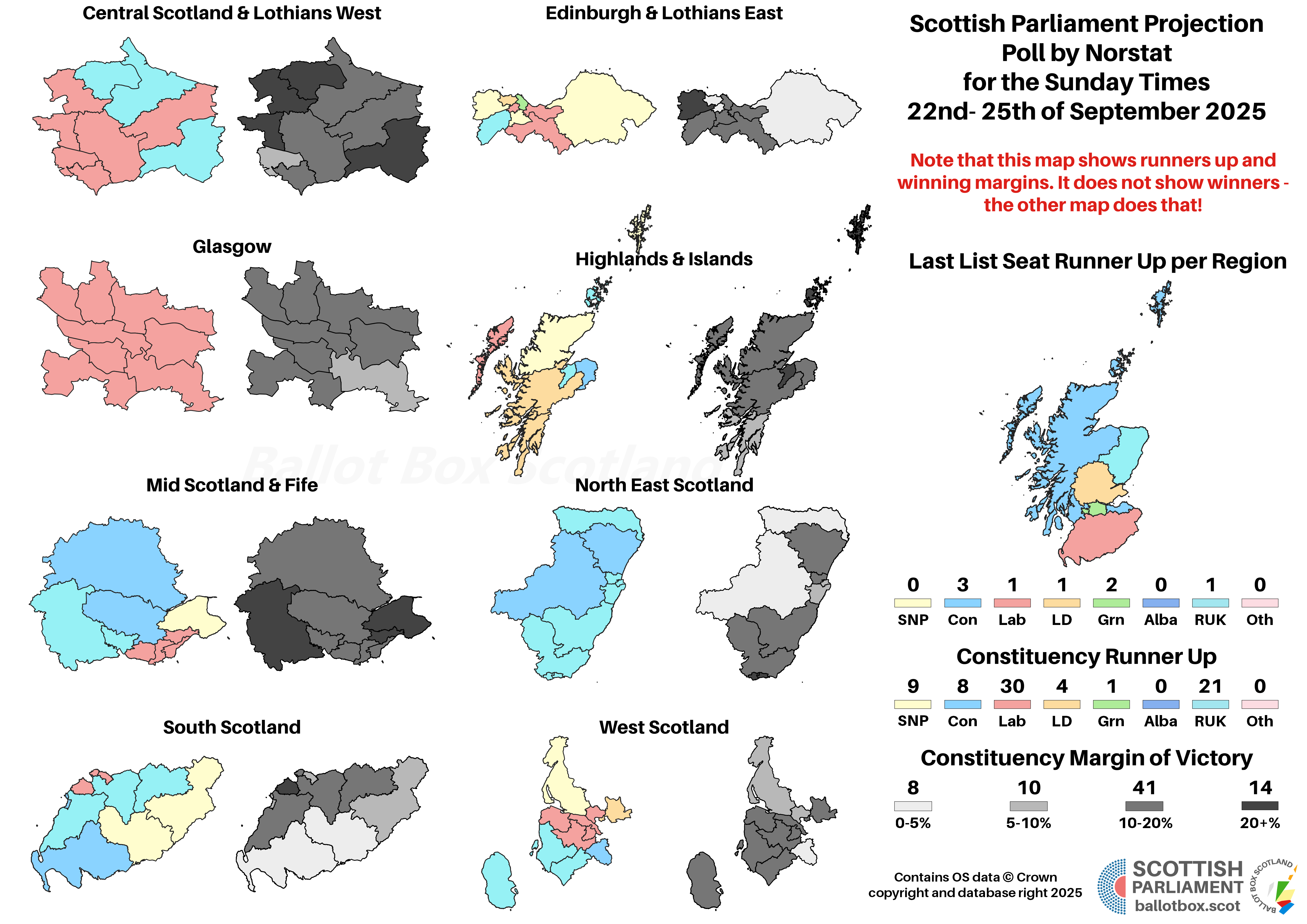
Given their stonking Constituency vote lead over Labour, the SNP continue to absolutely sweep the map, contributing to a constituency haul 21 seats in excess of their ideal, fair, proportional AMS share. This time around that’s 6 at Labour’s expense, 4 each off Reform, the Conservatives and Greens, and 3 from the Lib Dems. That leaves them just two short of a majority, and thus with the depleted Green bench of 6 MSPs still a Pro-Independence majority overall.
Although Labour were tied in the list vote, the distribution of votes and constituency wins by different parties actually leaves them one seat shy of Reform in my model. It’s important to remember that unlike Westminster, Holyrood does not have a formal “Leader of the Opposition” post as that would be a stupid concept in a proportional parliament, but placing second still has a major psychological impact.
Possible Majorities
Note: these majorities relate simply to passing a vote in the Scottish Parliament. They do not imply the formation of a full coalition government.
- Traffic Light: Labour, Lib Dem and Green
- Independence Bloc: SNP, Green and Alba
- Grand Coalition: SNP and Labour
- Union Bloc: Labour, Conservative, Lib Dem and Reform UK
Change vs Last Poll
Change vs 2024
As with Holyrood, the changes at Westminster are pretty minor, all fitting within margin of error. This time though it’s all between the Pro-Union parties. There’s a point down for the Conservatives and up for the Lib Dems, compared to a likewise mirrored plus minus two for Labour and plus two for Reform. That’s the best Reform have yet polled in Scotland. At this point, Reform have been ahead of Labour in three of the past five polls and tied in another. That means for Westminster they’ve achieved something they haven’t yet at Holyrood: they’ve pulled into second place, however narrowly, in the tracker average.
As I mentioned earlier, I’m starting to ponder about the Green findings amongst Low Green pollsters, though Norstat are the strongest example of this possible effect (Survation the weakest, More in Common in the middle). Note how close both the constituency and this Westminster share are to their List share, despite the fact the Greens have consistently done much better on the proportional vote. For example, Green shares of 2.7% in Glasgow and 4.3% in Edinburgh in the 2015 election were followed a year later at Holyrood by 10.2% (city only, not including Rutherglen) and 12.9%, respectively.
The Greens got roughly 9.6% in Glasgow and 8.3% in Edinburgh (both impacted by the fact new constituency boundaries don’t perfectly align with the cities) in 2024, and their polling with Norstat (and Survation) hasn’t meaningfully changed since then, wobbling between 8-10%. Past experience would suggest they should be in line for much bigger shares than this at Holyrood given that level of Westminster support, which would be reflected with national polling spiking above 10%. This is making me think there’s something going on here. There are a few possibilities, some of which lie with voters, some with the pollsters.
On the voter side, perhaps what we’re seeing at the moment (and what would contribute a bit to the SNP’s net loss in support since their peak) is natural Greens who were previously willing to tactically vote SNP no longer doing so and going Green even under FPTP. If so, that would mean a narrow gap between different votes, and suggest this polling is accurate. On the pollster side though, it could be that how they are building their sample is catching either too few or too many genuine Green voters, and a substantial gap between votes remains. In which case, either the constituency and Westminster shares are too high, or the list vote is too low, or potentially a little bit of both.
As ever, watch as I draw my shield against “you would say that because YOU’RE a Green!” Look, my role on BBS is to analyse stuff, and I think this is worth analysing! It looks a little odd! And, to be clear, I don’t know for certain in which direction it is odd: I’ve given scenarios where it could be to the Greens’ detriment! It’s genuinely interesting and I’m looking forward to figuring out what might have happened once we actually have election results in hand to compare.
Change vs Last Poll
Change vs 2014
What a surprise: hee-haw real movement on the constitution. The one change is a single point gain for No which carries over to the Excluding Don’t Knows measurement. This still leaves Yes with a bit of an advantage, as has typically been the case in recent Norstat polling, and means three of the five polls in the current average are Yes-leaning. Don’t read too much into that, especially given how small the advantage is, but do take it as a reminder this question isn’t settled yet, not really.
Hypotheticals
As ever, the last little bit of analysis concerns those hypothetical and more proportional voting systems that BBS likes to play about with. The use of pure FPTP at Westminster is an affront to democracy, and though Holyrood fares far better, AMS is still deeply imperfect. The examples here simply transpose the poll findings onto more proportional voting systems – the reality is that different systems would of course result in different voter behaviour.
Scandinavian Style Westminster
If you find this or other Ballot Box Scotland output useful and/or interesting, and you can afford to do so, please consider donating to support my work. I love doing this, but it’s a one-man project and takes a lot of time and effort. All donations, no matter how small, are greatly appreciated and extremely helpful.
(About Donations)