Background
It’s double bill central in Scotland at the moment, and this week saw two in Dundee. Strathmartine wasn’t a by-election I’d have anticipated arising, at least not from the specific councillor involved. In fact the SNP’s John Alexander wasn’t simply a councillor, but the Council Leader, and someone I’d thought was likely to be a bit of a rising star in the SNP given his relative youth and prominent role. Yet, perhaps reflecting somewhat on the reality of the SNP as a party on a downward swing, he was off for pastures new and a better family-work balance.
Previewing this, I’d noted the vital importance of this one for the SNP to retain their majority on the council – the only single-party majority currently existing in Scotland thanks to the combination of STV and the collapse of the Labour administration in West Dunbartonshire. With the SNP’s lead in 2022 being much wider than Lochee on the same day, but still well within the massive swing that took the Dundee Central seat from a roughly 33% to just a 2% SNP lead in July, I thought this might be leaning Labour.
Headline Results
Councillors and Key Stats
1 Councillor Elected: SNP: Jimmy Black
Change vs 2022 (notional): SNP Hold
Change vs vacating: SNP Hold
Turnout: 22.3% (-17.8)
Electorate: 15403
Valid: 3391 (98.8%)
Spoiled: 41 (1.2%)
Quota: 1696
3 Continuing Councillors: Labour: Kevin KeenanSNP: Stewart Hunter
 Lib Dem: Daniel Coleman
Candidates
 Conservative: Naveed Ali
 Green: Callum BairdSNP: Jimmy BlackLib Dem: Jenny Blain
 TUSC: Donald MacLeodLabour: Richard McCready
First Preferences
Note: In 2022, Alba won 1.8% and the Scottish Family Party 1.4% of the vote.
First Preference History
Well, Dundee proved quite the surprise overall, but we’ll get onto that. Looking purely at first preferences, the SNP did indeed lose a big chunk of their vote, slipping to their second worst result yet. However, the biggest beneficiaries weren’t Labour, but the Lib Dems, who won easily their best share in the ward thus far. I’m not surprised at all to see the Lib Dems doing well here, but I thought Labour would see a lot more growth than they did, and certainly didn’t expect to see them pipped for second place by just one vote. Yet with barely more than 8% between the SNP and their closest competitors and a bunch of transfers from smaller parties, there was no way to be sure of the winner based purely on these figures, though I’d have expected it to come from the Pro-Union side…
That put those who voted for the smaller parties in a real kingmaker position, despite the sub-5% shares for all of them. For the Conservatives that made them the only other returning party to lose vote share, and they’ll be glad that Reform UK didn’t stand in this one or I guarantee you they’d have fallen below both the Greens and TUSC. The former had only a very modest increase in share indeed, whilst the latter experienced substantial growth, in relative terms.
Transfers
Two-Candidate Preferred
Now, the thing about a “lean” prediction is that I am not surprised if another party I identified as competitive wins, and the SNP did indeed win, securing their majority. What does surprise me is that they won starting well short of quota, only 8% ahead, and with a solid 58% spread amongst the Pro-Union parties. On that split of first preferences I would broadly expect either the Lib Dems or Labour to win, depending on who was in second after the bottom three were eliminated. Yet although the Lib Dems ran the SNP close (32 votes and just 1% of the vote; Lochee was almost identically close but for Labour), it wasn’t enough.
They were still rightly chuffed with themselves giving Labour a bit of a fright, mind you, but it’s odd it wasn’t an overall win. It was still a pretty big swing relative to 2022 though, which if you reset the calculation to SNP vs Lib Dem was a 17% SNP lead, marginally wider than the actual SNP vs Labour lead of 15.9%. Here’s the real kicker though: the Lib Dems may have only had a one vote lead over Labour on first preferences, but the lead they accumulated over transfer rounds was so substantial that if you reset this by-election to SNP vs Labour, that’s a bigger loss of 5.1% (or 172 votes). So the Lib Dems fully displaced Labour as the primary challengers here.
Detailed Results

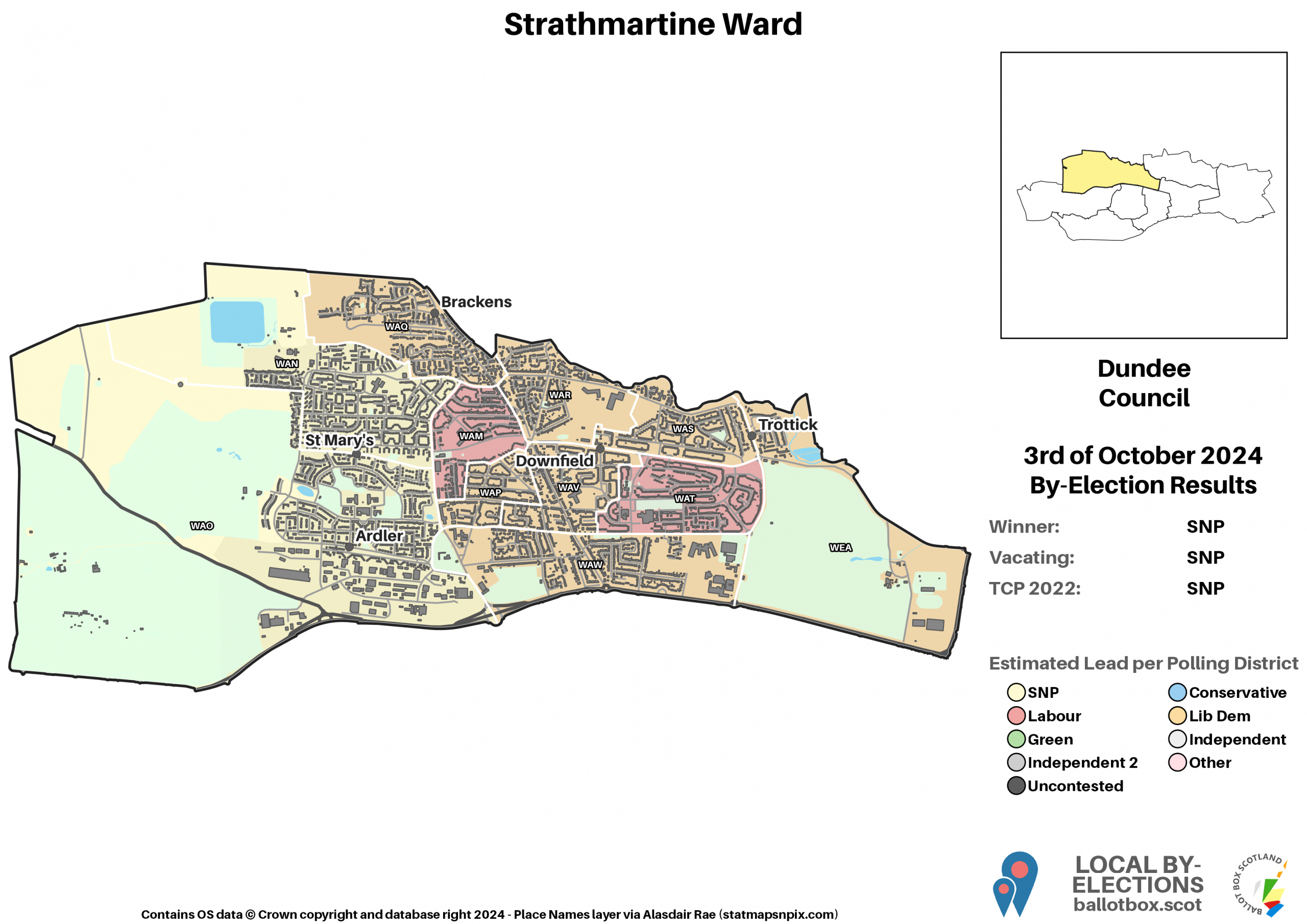
Results by Polling District
Box mergers are very slightly awkward here in that the districts Labour led in, which I’d parse as the eastern and western portions of Downfield, are the result of a box merger of non-contiguous areas. It’s not clear then if they actually led in both, or were just really dominant in one. Also, despite their lead in votes overall, the SNP only end up leading in two districts, covering St Mary’s and Ardler. Those had the most votes though which is why neither had to be merged, and they were the weakest Lib Dem areas, and they otherwise led in Brackens, most of Downfield and Trottick.
In terms of best bits per party, for the SNP it was St Mary’s, whilst the Lib Dems shared their brightest spot in southern Downfield with the Conservatives. The Greens and TUSC meanwhile excelled in the other yellow tinted district around Ardler.
Second Preferences
For second preferences, some of the usual stories but also some interesting bits. The SNP and Greens had their usual mutual flows, which on the surface don’t have much difference in how much they are down by: about -7% for Green to SNP, and -9% from SNP to Green. But remember, Alba were on the ballot last time as another Pro-Independence option; they got about 10% of SNP and 5% of Green second preferences. That’s makes the transfer rates particularly anaemic, especially from the SNP to Greens: whereas we’ve had one by-election so far where Green voters recoiling from the SNP cost the latter a seat, if this patter repeated across Dundee in 2027 it might really puncture the Greens chances of winning councillors for the first time.
For the other parties, everyone except the Lib Dems was most likely to go for them. That includes TUSC, albeit their transfers were quite fractured, but was honestly a bit of a surprise. TUSC are by definition proper left wingers; trade unionists; and (not by definition) Pro-Independence. Any of the Greens, Labour or SNP would be a half-decent fit for those voters. The decidedly centrist Lib Dems as the most popular single choice is a bit wild! Anyway, the Lib Dems had a much more clear flow, and that was towards Labour.
Still a whopping 20 by-elections left to go this year! Next week is another double bill (there are so many of these), with two North Lanarkshire by-elections. Both follow Labour councillors becoming MPs: one in Fortissat and one in Mossend and Holytown.
If you find this or other Ballot Box Scotland output useful and/or interesting, and you can afford to do so, please consider donating to support my work. I love doing this, but it’s a one-man project and takes a lot of time and effort. All donations, no matter how small, are greatly appreciated and extremely helpful.
(About Donations)