Lack of diversity in credible Scottish polling continues to be a serious problem, as we’ve only really got two pollsters in the mix, and less than a year until the election. That said, as much as we desperately need to get some polling out of the likes of YouGov, Ipsos, Opinium or Savanta, it has been a good while since a Norstat. After a run of three Survations on the trot, the Sunday Times (link to original writeup) doing their usual partnership with Norstat (link to tables) is tolerable, at least.
The previous Norstat covered the 11th – 14th of February 2025. Changes are shown as (vs that poll / vs last election).
Regional Vote
Almost everything here is clearly within margin of error so don’t read too much into it. Even so, with a loss of 2% the SNP take the worst hit of any party here. It might be worth reaching back to note they were on 32% with Norstat six months ago. We can say with absolute confidence the SNP have not recovered; we can say with relative confidence that they have stabilised since their lowest points; we need a bit more data before can start saying if they are back in reverse.
Labour ticking up just a single point may be arithmetically meaningless, but they’ll take anything they can get at the minute. Their previous Norstat figure had been the worst since last year’s General Election. This is merely their joint-second worst. Reform have the most substantial swing here, straining to push beyond margin of error, with a 3% uptick taking them past the Conservatives who remain steady.
That leaves all of the Lib Dems, Greens and Alba down a single digit; for the latter, recall that Norstat are somewhat favourable for them. Even so this is their worst figure with them for a few months. When you consider that the day I wrote this Ash Regan gave the most jaw-droppingly dim quote to the Herald as part of an interview, you might come to your own conclusions about why they continue to have zero hope outside of desperately begging people to pay attention to some dodgy polling.
Constituency Vote
On the constituency side of things there’s a very similar tale for the top two parties; for the SNP it’s down but still better than their lowest point, for Labour it’s a tiny improvement but still their joint-second worst figure since last year’s election. Reform definitely push on through the other side of the margin of error here with a gain of 4 points, putting them past the Conservatives here too.
Both the Conservatives and Lib Dems lose a few points here, with the latter more severely and given their low share, a smidge beyond error. I still remain dubious of any poll that has the Lib Dems higher on the list than constituency, as at every election to date the opposite has been the case, but things can always change. The Greens meanwhile are up one, which is a joint best for this vote. Norstat are basically the narrowest pollster for the Greens: they tend towards a low list share relative to other pollsters, but a higher constituency.
Seat Projection
Projecting that into seats might give us something like this (note that the Previous Poll figures have been re-projected for the new boundaries):
Please see this page for how projections work and important caveats.
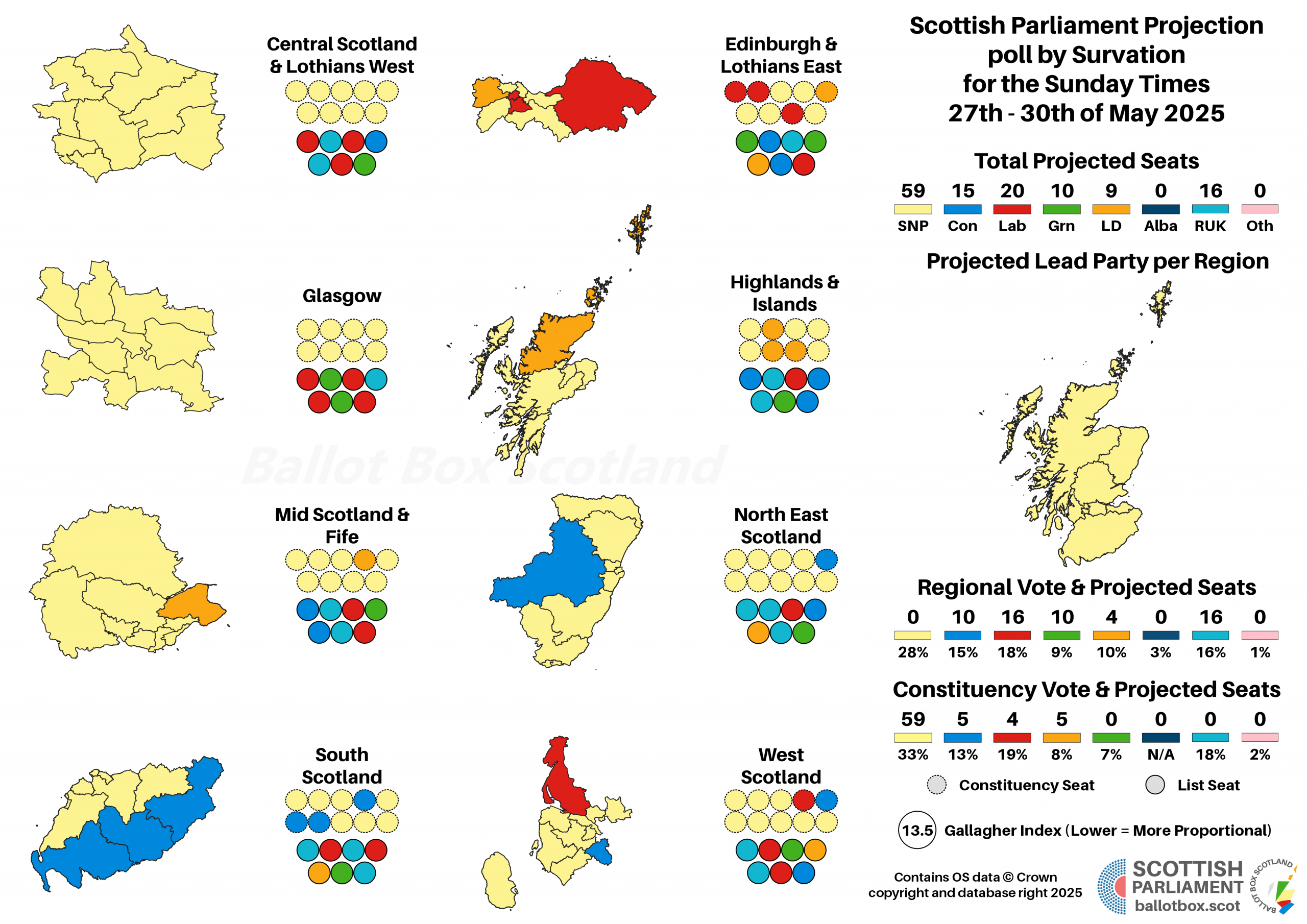
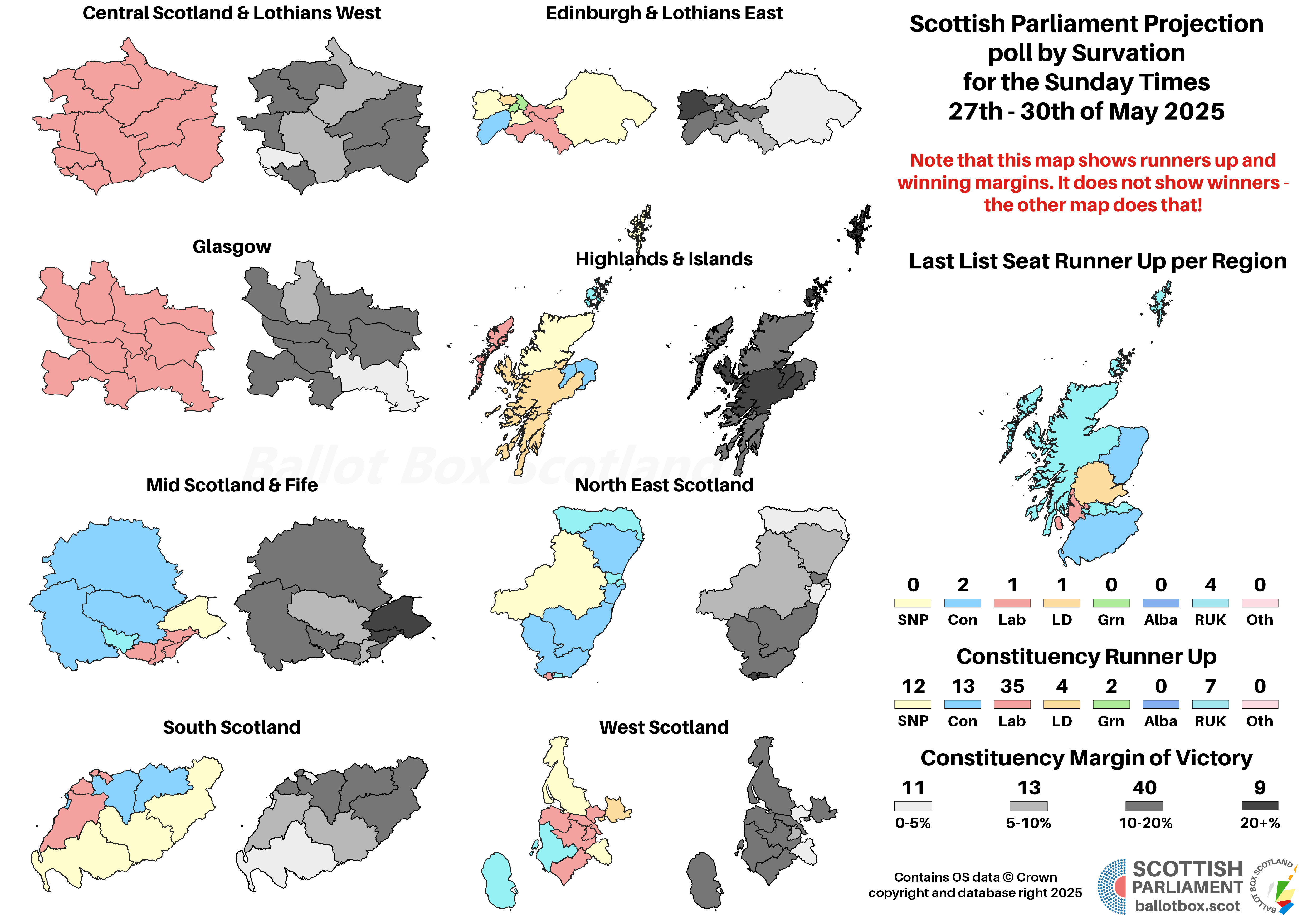
Very little that matter changes in this poll compared to the last one. The SNP continue to run completely roughshod over the proportionality intended under AMS, coming 6 seats short of a majority just by retaining such a substantial lead of the constituency vote. As ever, it is vital to remember this isn’t some stunning comeback from the brink for the SNP, it’s Labour snatching defeat from the jaws of victory.
Where there are shifts it’s from the smaller to the larger opposition parties. The Conservatives, Greens and Lib Dems all lose seats compared to the last poll, all of which go into the Labour and Reform columns. The Greens placing ahead of the Lib Dems despite coming behind them in votes is an artefact of where their votes are and how the SNP are distorting proportionality. If you peek down at the “Various Other Systems” chart in the end section and look at the Pure List line, you’ll see the Lib Dems would be ahead if the SNP weren’t winning so many constituencies.
Unfair as this outcome would be given the intended functionality of the system, this would preserve a Pro-Independence majority barely any smaller than that which currently exists at Holyrood. The SNP would be in a position to pair with any other willing party to pass legislation and budgets, though the willingness beyond the Greens and Lib Dems would likely be limited.
Possible Majorities
Note: these majorities relate simply to passing a vote in the Scottish Parliament. They do not imply the formation of a full coalition government.
- Traffic Light: Labour, Lib Dem and Green
- Independence Bloc: SNP, Green and Alba
- Grand Coalition: SNP and Labour
- Union Bloc: Labour, Conservative, Lib Dem and Reform UK
A lot of similarities between the two First Past the Post votes in this poll. Much of what I wrote about the Holyrood constituency vote applies here: SNP down but they’ve had worse; Conservatives down and Lib Dems even more so; Greens on a joint-best ever share for this vote.
The differences are since, unlike Holyrood, Labour’s starting position is “winning”, a small re-gain really doesn’t matter much when it’s still absolutely ruinous compared to last July. This also makes Norstat the second credible pollster to find Reform ahead of Labour in Scotland for Westminster, even if it’s a statistically-tied lead of just 1%. At this level of support, I’d be starting to look at Aberdeenshire North and Moray East as a possible first Scottish MP for Reform.
Probably the most dramatic bit of this poll spits out a comparatively strong lead for Independence. This is a big swing versus the last poll, but it snaps back to an almost identical position to their December poll. That might – emphasis on might! – suggest it’s oscillating around a middle ground of a smaller lead for Independence than here.
It’s pretty remarkable that even as Pro-Independence parties are only taking 40% of the vote in the Holyrood part of the poll, Independence itself would be running bang on 50% support even inclusive of Don’t Knows. There’s perhaps something to worry both sides in here: for the Pro-Union camp, any poll lead for Independence right now should be a bit of a worry, but it might suggest that the current UK Government is weakening rather than strengthening the bonds of Union.
Meanwhile the Pro-Independence side has to reckon with not just the extreme difficulty of actually securing another Independence referendum in the first place, but the fact the unpopularity of the current Scottish Government is probably the primary barrier to getting one. I’m not sure how they square that circle.
Regardless, be aware this is very different to what Survation and YouGov have found recently. That’s not to say it’s rubbish, but instead that we’re still in a very uncertain position constitutionally. There isn’t a clear, settled majority for either Independence or the Union right now, and it’s hard to see how one emerges from the current mess.
Hypotheticals
As ever, the last little bit of analysis concerns those hypothetical and more proportional voting systems that BBS likes to play about with. The use of pure FPTP at Westminster is an affront to democracy, and though Holyrood fares far better, AMS is still deeply imperfect. The examples here simply transpose the poll findings onto more proportional voting systems – the reality is that different systems would of course result in different voter behaviour.
Scandinavian Style Westminster
If you find this or other Ballot Box Scotland output useful and/or interesting, and you can afford to do so, please consider donating to support my work. I love doing this, but it’s a one-man project and takes a lot of time and effort. All donations, no matter how small, are greatly appreciated and extremely helpful.
(About Donations)