After another surprising lull in credible polling – has anyone else noticed there’s an election on next May? – we’ve finally got another one of our usual suspects. Survation continue to have most polling commissioners in Scotland on lockdown. They have True North. They have Scotland in Union. They had Quantum Communications earlier in the year. This one (link to tables) is another for the Diffley Partnership. Oddly, it’s a very bare bones one from a voting intention perspective: unless the data is being held back, there’s no Westminster or Independence figures, even though the last such poll had them.
The previous Survation covered the 4th – 16th of September 2025. Changes are shown as (vs that poll / vs last election).
Regional Vote
Change vs Last Poll
Change vs 2021
As is so often the case at the moment, although over the longer term it has added up for some parties, most of the movement here is within margin of error. We could perhaps summarise those changes nonetheless as “the current insurgent parties up, everyone else down”. We could also say they are roughly constitutionally balanced.
On the Pro-Independence side, the SNP are down two points, bringing them back into the 20’s, whilst the Greens are up by the same. Given Survation tend to be on the low side of the Greens at the moment, they’ll likely welcome a return to double digits with them. Whether that’s truly the knock-on effect of current GB-wide increase in Green support that’s followed the election of Zack Polanski as Leader of the English and Welsh party, or just statistical wobbling, we can’t say at this point. Obviously, I know, and you as a reader of this website know, that the Scottish Greens are a wholly independent party. Janey and Jimmy Public catching snippets from the London-centric media do not necessarily take that into consideration however!
Amongst the Pro-Union parties, the three traditional parties are all down a point, whilst Reform have jumped up a substantial 4%. That’s a joint-best share for them, equal to May’s Survation. At the time that was something of an outlier, whereas perhaps now this is more realistic. On the other parties, this keeps the Lib Dems a bit higher on this vote than on the constituency, and I remain dubious about that happening in reality. I can’t re-hash why every post, but TL;DR, that’s never happened, and unlikely given the Lib Dem MO is “pile up votes in a small number of constituencies playing as the tactical choice.”
Constituency Vote
Change vs Last Poll
Change vs 2021
Constituency shifts are almost identical to what we saw on the list. The SNP are down a little bit more, with the Greens up two on this vote as well. It’s also another four point bump for Reform, balanced out by slight Conservative and Labour dips. The Lib Dems are the only break in the pattern, up by a point. This is a new peak for Reform UK on this vote, and it’s one point shy of their best polling in Scotland ever; only the most recent Norstat, which had 23% on the Westminster vote, was higher. That also makes this the first poll where they have placed second in both votes.
Seat Projection
Projecting that into seats might give us something like this:
Please see this page for how projections work and important caveats.
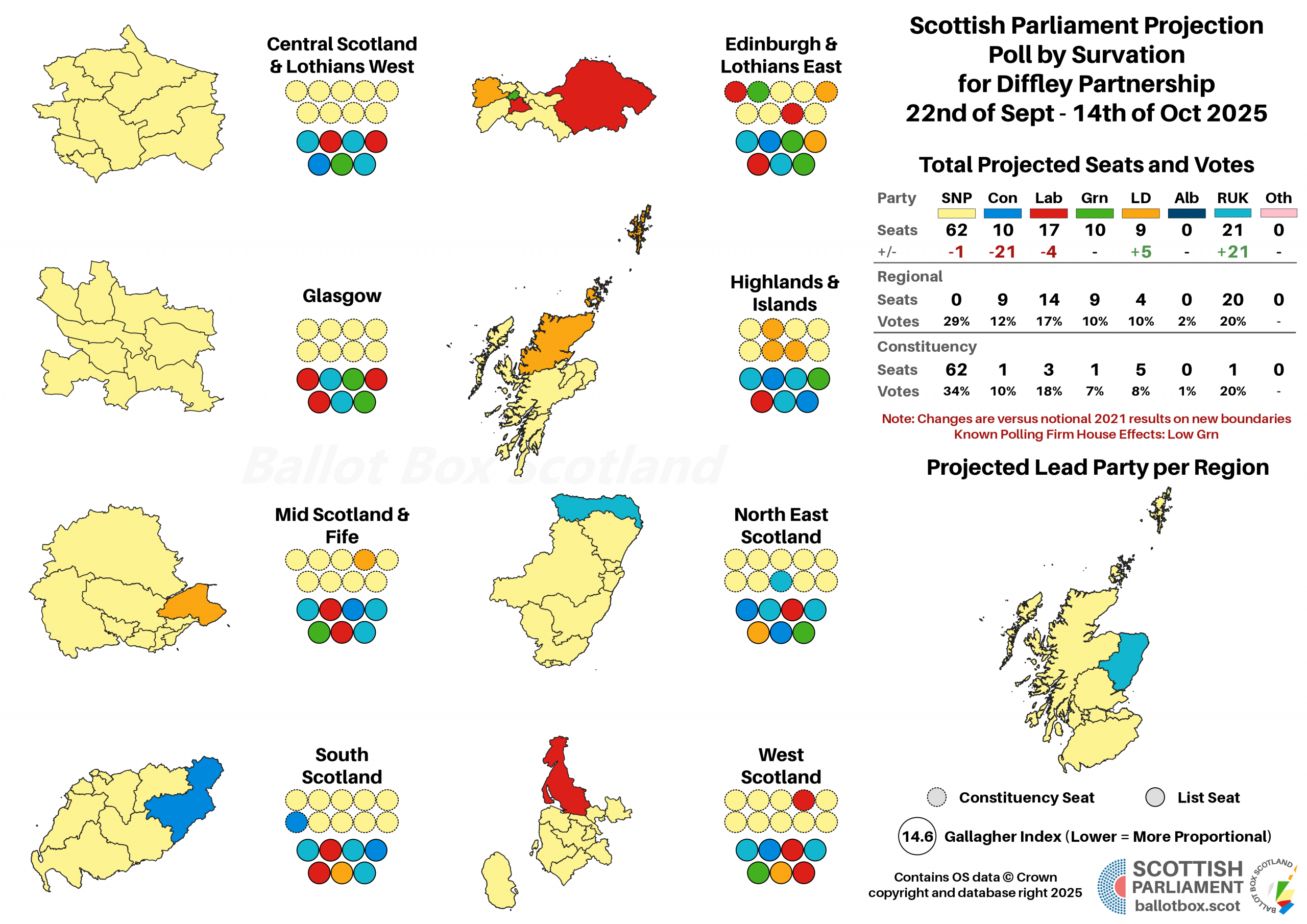
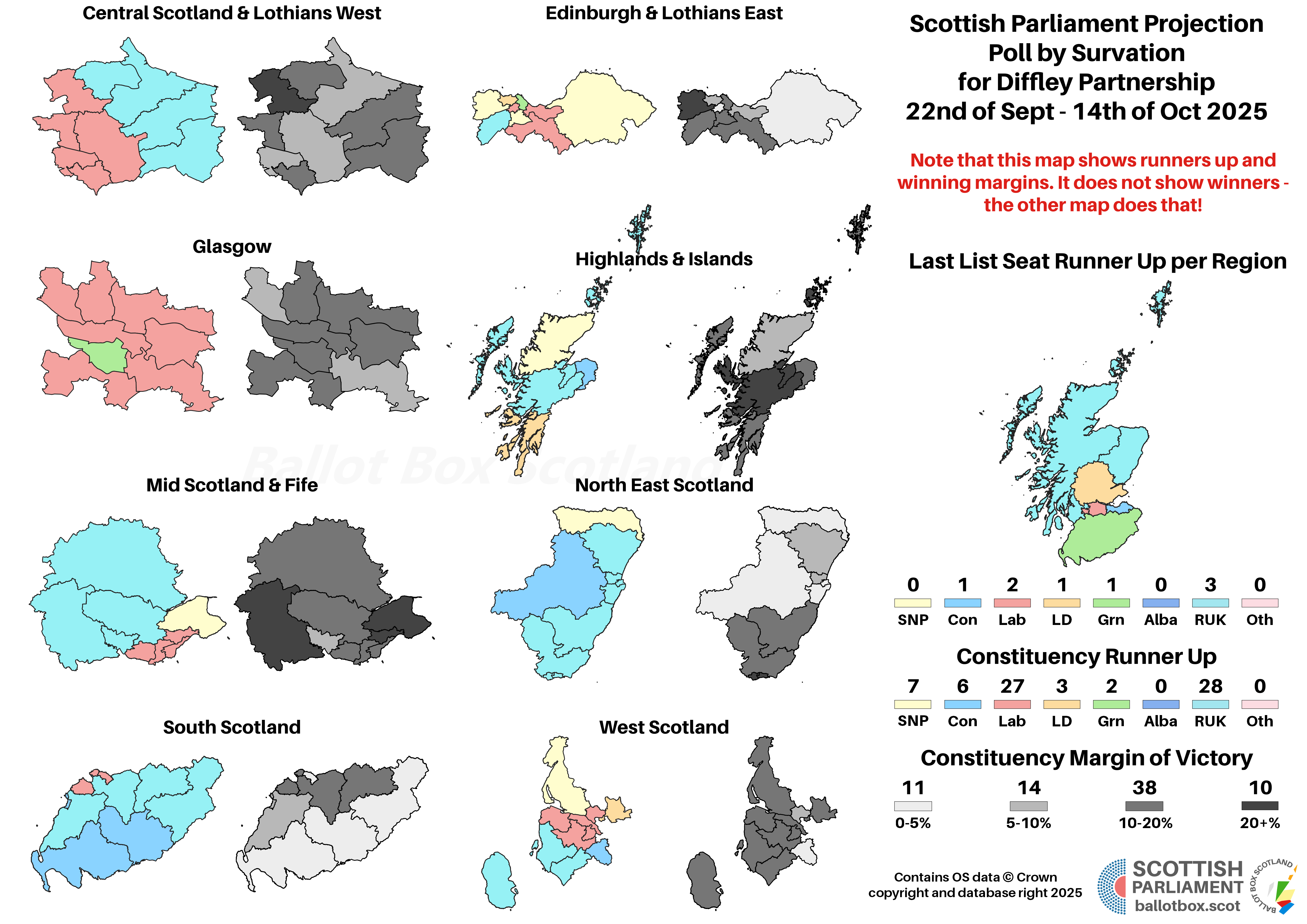
As per current norm, the SNP’s massive lead on the constituency vote translates to a much chunkier share of seats than they are fairly due. It’s 20 additional seats in excess of the AMS ideal, all bar one of which come from the Pro-Union parties; the Greens are in something of a sweet spot on these figures, where they just about squeak everything they should get. The one exception is that they miss out on a South MSP, but only by the skin of their teeth: the Conservatives lose Dumfriesshire by 0.05% of the vote, and if they held it but everything else in this scenario held up, the Greens would get that missing MSP. Regardless, this maintains the current Pro-Independence majority at Holyrood.
This is not the first poll to have Reform ahead of Labour in seats, given it’s not the first where they’ve been ahead in the list vote. It is however the first projection where I’ve had Reform winning a constituency, in this case Banffshire and Buchan Coast. That’s the Holyrood equivalent of their best Westminster seat, and hence their best prospect. I note that other projections had a few more Reform constituencies, but remember we’re both stumbling around partly in the dark without 2021 results to compare. My model is erring to a more (small-c) conservative estimate for them in constituencies for a few reasons.
Firstly, historic precedent: in 2021, both the Conservatives and Labour got roughly 22% of the constituency vote and only got 5 and 2 constituency wins, respectively. Whilst the SNP lead overall is much lower than it was then, they also had pretty massive leads in most of their constituencies. Even if Reform had a relatively concentrated vote distribution, they’d struggle to gain more than a handful of seats as the SNP’s existing advantage is chunky enough to survive the loss of over a quarter of their vote.
The second point is that very much unlike the Conservatives and Labour, I don’t expect them to have a concentrated vote distribution. Of course they aren’t going to have a totally flat share, and we know from 2024 where they will probably do comparatively well (the North East, Galloway and mid-Central Belt) and poorly (Glasgow, Edinburgh, East Dunbartonshire). Nonetheless, I expect their distribution to be flatter than the existing Pro-Union parties. Compared to the Conservatives for example, I’d expect Reform on 22% will do better in Glasgow than they did for the same share, but worse in Aberdeenshire or Perthshire.
Finally, the existing tactical base for the Pro-Union parties will likely be better able to mobilise and target resources than Reform will. Take Aberdeenshire West for example: the Conservatives have won that in the past two elections, and held the Westminster equivalent last year. Expect them to bombard voters with a tactical, anti-SNP message that might shore their vote up there, whilst they might figure it’s not worth bothering trying to actually win the Angus seats. That’s likely to both limit Reform prospects for constituency gains as well as easily explain how they win fewer constituencies than less popular parties: think how the Lib Dems won twice as many as Labour in 2021 despite only having a third of the vote.
Possible Majorities
Note: these majorities relate simply to passing a vote in the Scottish Parliament. They do not imply the formation of a full coalition government.
- Traffic Light: Labour, Lib Dem and Green
- Independence Bloc: SNP, Green and Alba
- Grand Coalition: SNP and Labour
- Union Bloc: Labour, Conservative, Lib Dem and Reform UK
No Westminster figures in this poll.
No Independence figures in this poll.
Hypotheticals
As ever, the last little bit of analysis concerns those hypothetical and more proportional voting systems that BBS likes to play about with. The use of pure FPTP at Westminster is an affront to democracy, and though Holyrood fares far better, AMS is still deeply imperfect. The examples here simply transpose the poll findings onto more proportional voting systems – the reality is that different systems would of course result in different voter behaviour.
If you find this or other Ballot Box Scotland output useful and/or interesting, and you can afford to do so, please consider donating to support my work. I love doing this, but it’s a one-man project and takes a lot of time and effort. All donations, no matter how small, are greatly appreciated and extremely helpful.
(About Donations)