Kicking off the New Year in polling, first out of the gate are the current reigning champions of vaguely regular polling, Survation (link to tables). This is part of their many regular partnerships, this time with True North. I can’t criticise too much because I’ve already have two polls from them myself and, well, there will be a third later in the campaign.
The previous Survation covered the 22nd of September – 14th of October 2025. Changes are shown as (vs that poll / vs last election). However, that poll did not include Westminster or Independence figures, and thus comparisons for Westminster are instead with the 4th – 16th of September 2025 poll and Independence with the 2nd – 5th of May (!) 2025 poll.
Regional Vote
Change vs Last Poll
Change vs 2021
Let me hear you all shout: “MARGIN OF ERROR!” Absolutely nothing in this part of the poll is of any statistically meaningful difference compared to the previous one. Given it’s been quite some time, that might indicate a relatively settled field of play at the moment. Whether the slow revving up of the actual campaign will mix things up a bit, we’ll have to wait and see.
Nonetheless, there are still a few bits and bobs it’s worth picking out of these numbers. The last poll had Reform out ahead of Labour, but they’ve fallen back to a straight tie here. It is by no means a given that Reform will overtake Labour on the day, and the contest between the two clearly remains tight.
We also see the re-opening of a gap between the Lib Dems and Greens, the latter dipping back into single digits, though Survation are very much on the weak end of their backing. Right now it is very hard to get a handle on where Green support actually lies, as we’re basically getting two extremes. Presumably, the truth is in the middle somewhere, but where exactly? Also, and as I keep pointing out, although it’s typically within margin of error, I’m dubious of any suggestion that the Lib Dems will outperform their constituency (or Westminster) vote on the list, as that has never yet been the case.
Constituency Vote
Change vs Last Poll
Change vs 2021
Shifts on the constituency vote still fit within error but they are slightly larger, in particular with a 3% increase for the Conservatives and an equally large decrease for Reform. That’s actually pretty consequential, as we’ll see below, in terms of how many constituencies the Conservatives might hold onto.
This side of the poll is very bleak for Labour though, at their joint-worst share on this vote of the whole term. Given the SNP’s constituency dominance, right now this is exactly the wrong way round for Labour, who desperately need to close the gap on this vote. I would add a similar caution to this as I do for the Lib Dems though: Labour have consistently done better on the constituency rather than the regional vote at Holyrood, and I’m not convinced that’s about to change.
In the opposite direction, note the Green share, which is very close to their list share. Again, that’s something I’m not entirely convinced by, as with the one exception of Glasgow Kelvin, the Greens typically do better on the list than constituency vote. A good example in 2021 might be Aberdeen Central, a seat the SNP were going to win easily and which therefore lacked a true tactical incentive on the constituency vote, where the Greens’ constituency vote of 6.6% was two-thirds of their list performance at 9.9%. I’m inclined therefore to say either this vote is a couple of points too high, or the list a couple of points too low.
Seat Projection
Projecting that into seats might give us something like this:
Please see this page for how projections work and important caveats.
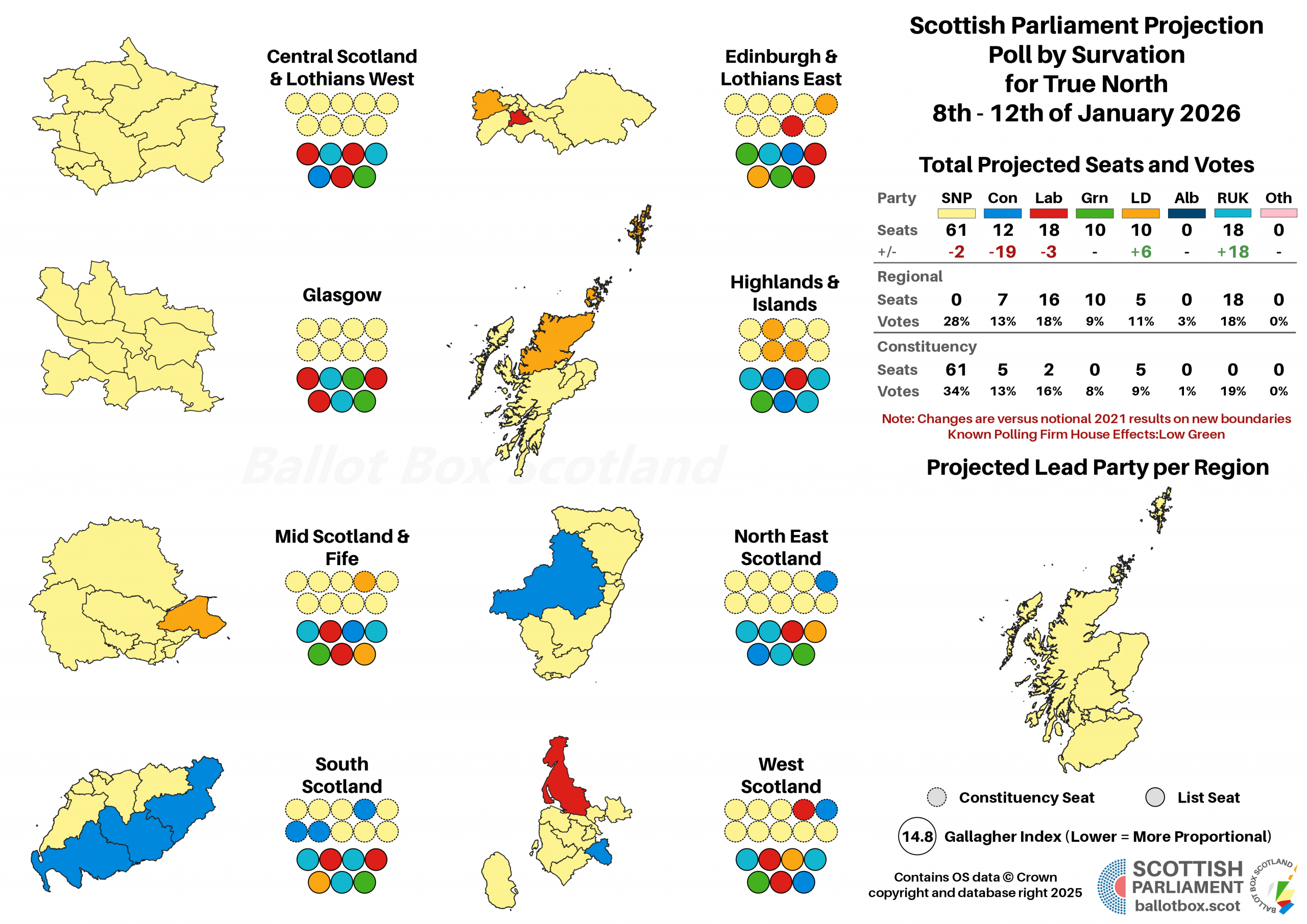
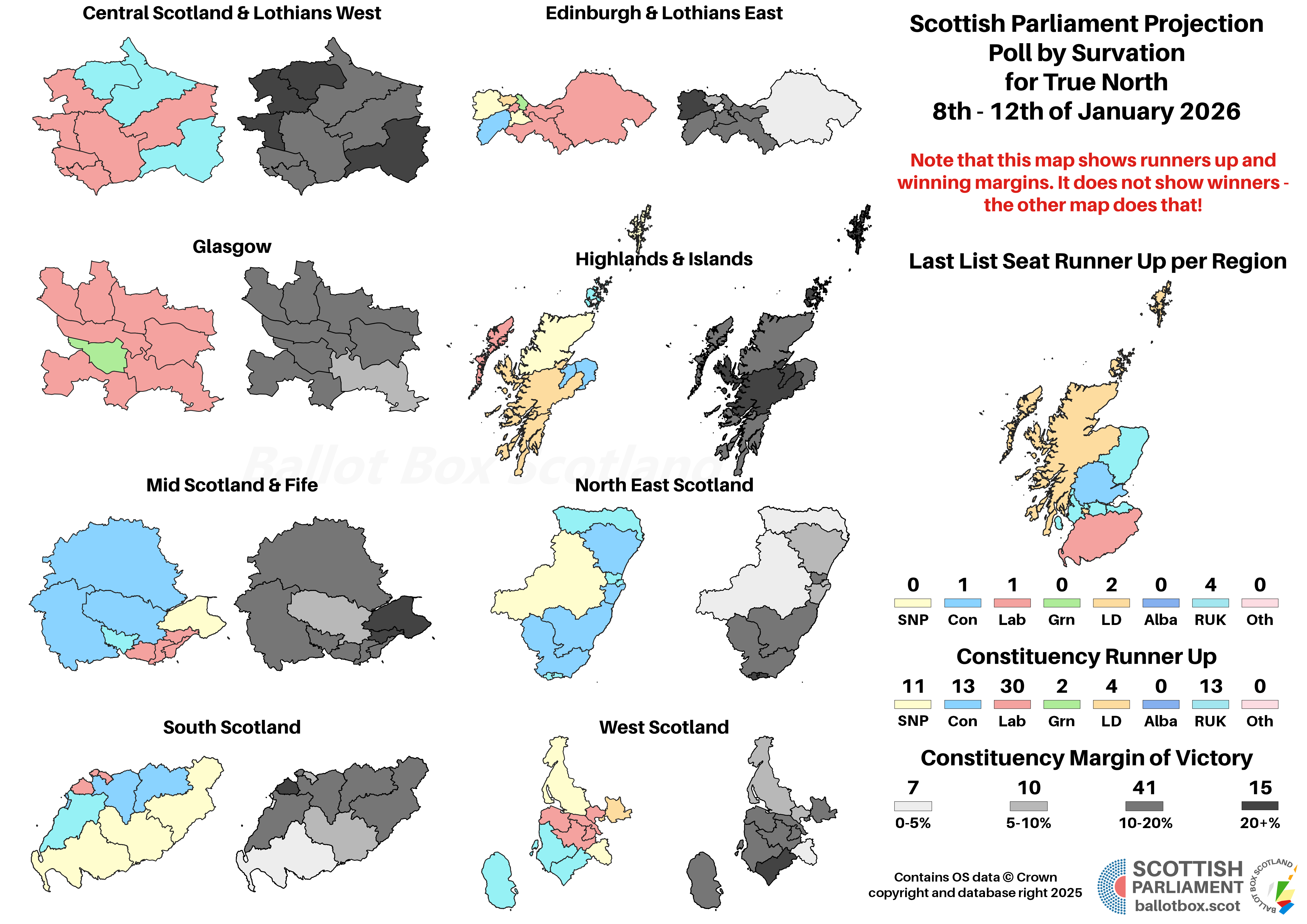
With such a big SNP lead on the constituency vote, this naturally still comes out with them nearly at a majority, and easily reaching that figure with the help of the Greens. The Greens themselves can be thankful to the Conservatives in this scenario, as their slight constituency uptick is projected to hand the latter back some key seats, easing the SNP’s pressure on proportionality enough to ensure the Greens get their due North East and South list seats. Conservative support is also distributed just well enough that although they have Eastwood here, that would narrowly not bump party leader Russell Findlay out of Holyrood.
Possible Majorities
Note: these majorities relate simply to passing a vote in the Scottish Parliament. They do not imply the formation of a full coalition government.
- Traffic Light: Labour, Lib Dem and Green
- Independence Bloc: SNP, Green and Alba
- Grand Coalition: SNP and Labour
- Union Bloc: Labour, Conservative, Lib Dem and Reform UK
Change vs Last Poll
Change vs 2024
It’s still a truly awful story for Labour in UK Parliament voting as well, with a further small dip here taking them beyond the loss of half of their vote. A small mercy for them, perhaps, that the SNP lose twice as much of their support relative to the last poll, albeit that still keeps them roughly where they were in 2024. The fact Reform are up here but down at the Holyrood side of things might interest you, but remember we’re comparing two different polls at this point.
Similar to the Holyrood constituency, the Greens have always done worse at Westminster votes than on the list vote, but here they are up substantially. Again, I believe a more accurate figure here would be a couple of points lower if the list share is right, or otherwise the list share should be a couple higher.
Change vs Last Poll
Change vs 2014
As with much of the rest of this poll, movement here is entirely within margin of error. Where that takes us though is a slight boost for Independence which brings the poll to a straight tie. Polling on average at the moment says tie on a statistical basis, so this could not be more in line with that.
Hypotheticals
As ever, the last little bit of analysis concerns those hypothetical and more proportional voting systems that BBS likes to play about with. The use of pure FPTP at Westminster is an affront to democracy, and though Holyrood fares far better, AMS is still deeply imperfect. The examples here simply transpose the poll findings onto more proportional voting systems – the reality is that different systems would of course result in different voter behaviour.
Scandinavian Style Westminster
If you find this or other Ballot Box Scotland output useful and/or interesting, and you can afford to do so, please consider donating to support my work. I love doing this, but it’s a one-man project and takes a lot of time and effort. All donations, no matter how small, are greatly appreciated and extremely helpful.
(About Donations)