Background
Our run of summer (I’m a strict “seasons follow calendar months” person) by-elections came to a close with South Lanarkshire’s Larkhall ward. Unfortunately, Labour councillor Lesley McDonald died earlier this year, necessitating a replacement to fill the last 10 months of the term. McDonald had done a total of 14 years as a councillor, split roughly half and half between representing the SNP then Labour.
In my preview, I noted that Larkhall has a particular reputation as a staunchly Pro-Union part of Scotland, which would count against the SNP winning. Instead, I saw this as a contest between Labour, who’d been the overall winner here at every election thus far, and Reform UK, for whom this would be fertile ground. As such I reckoned this as one of Reform’s very best chances thus far of winning a by-election.
Headline Results
Councillors and Key Stats
1 Councillor Elected: Reform UK: Fiona McDermott
Change vs 2022 (notional): Reform Gain from Labour
Change vs vacating: Reform Gain from Labour
Turnout: 20.9% (-21.3)
Electorate: 15764
Valid: 3266 (99.1%)
Spoiled: 31 (0.9%)
Quota: 1634
3 Continuing Councillors: Labour: Andy Carmichael
 Conservative: Richard Nelson
 SNP: Ross Clark
Candidates
 Conservative: Gary BurnsReform UK: Fiona McDermott
 SNP: Leigh Payne
 Labour: Chris Roarty
First Preferences
Swing vs 2022
Note: an Independent won 10.3%, the Lib Dems 2.4%, Libertarians 0.6% and UKIP 0.3% in 2022.
First Preference History
Sure enough, Reform did indeed do very well here, placing in first and squeaking ahead by an nigh-on invisible fraction of Stranraer and the Rhins last year for their best vote share to date. The SNP were nonetheless close enough behind that transfers could absolutely have made a difference to the final outcome, though as we’ll see I wasn’t wrong in suggesting they weren’t really in contention. For their part, the SNP actually managed to increase their vote share, a rare feat for them at the moment, giving them their best post-IndyRef performance in this ward, and the first time they’ve come ahead of Labour.
Labour’s results continue to be an absolute nightmare however. When you bear in mind that one of their former councillors had stood as an Independent in 2022 and won a solid 10% of the vote, the direct swings here don’t give the full picture of Labour’s decline. Based on transfers last time, you can add about 6% to Labour’s likely previous first preference share. In other words, that makes the swing against them roughly as bad as the Conservatives in absolute terms, at about 14.5%.
Relatively speaking however, the Conservatives came off the worst, losing almost three-fifths of their support. If overall shares like this were replicated next May, we’d expect this ward to elect two Reform councillors and then one apiece from the SNP and Labour. I don’t expect there will actually be many places Reform will have the support for a double, given the relatively even spread of their vote, but this is clearly one of them.
Transfers
Two-Candidate Preferred
Two-Party Preferred (SNP vs Labour)
TPP swing vs 2022
Transfers could have made the difference… but didn’t. Over the course of the count the SNP only gained slightly more votes than Reform did, and nowhere near sufficient to close the gap. That meant Reform now have two by-election wins under their belt, after Whitburn and Blackburn back in December. There had been less than 1% in that one, so this is a slightly more emphatic victory.
I hinted earlier that I was justified in saying the SNP weren’t in contention here, and this is where looking at the full range of preferences is vital to understand what went on. You could be forgiven for thinking that since the SNP placed second, they were the next best positioned to win. In actual fact, the only possible head-to-head they would have won would have been versus the Conservatives: the one least likely to happen.
As shown on the second chart above to help compare with 2022, if we eliminate Reform and redistribute their votes, Labour still beat the SNP by 2%. Sure, that’s much less than in 2022, and the SNP actually gain share again whereas Labour craters, but that’s still advantage Labour. At the same time, if we instead eliminate the SNP, Labour beat Reform by 2.3%, at 41.9% to 39.6%.
What this tells us, and this shouldn’t be a surprise, is that SNP voters are extremely hostile to Reform, in a way that Labour voters (especially in this ward) aren’t. Indeed, when eliminating the SNP for this re-calculation, of the 30.7% of the vote they have, only 1.4% goes to Reform, compared to 14.4% to Labour: a whopping ten times difference. This is a dynamic that could be extremely important in Central Belt wards next year.
Detailed Results
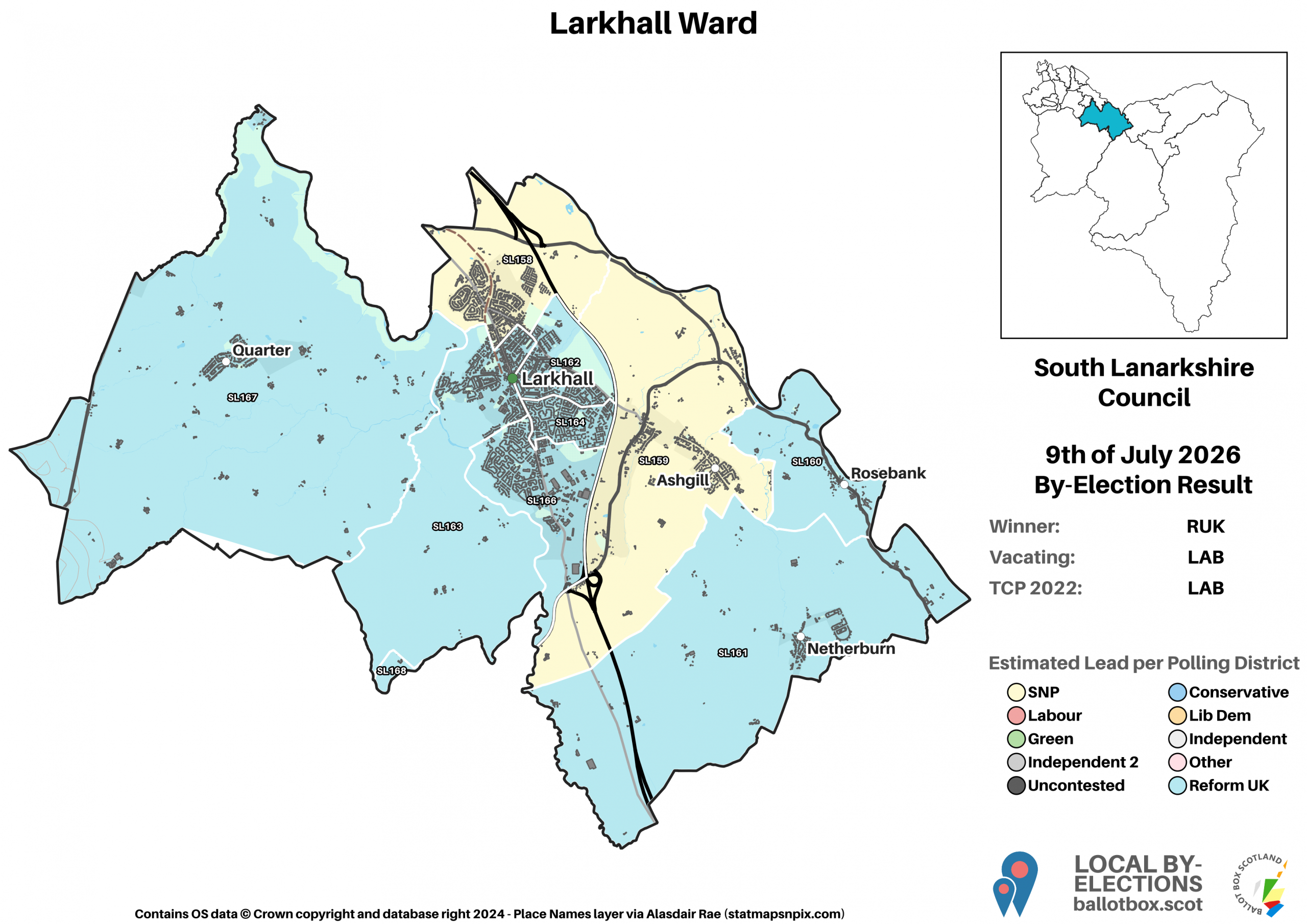
Results by Polling District
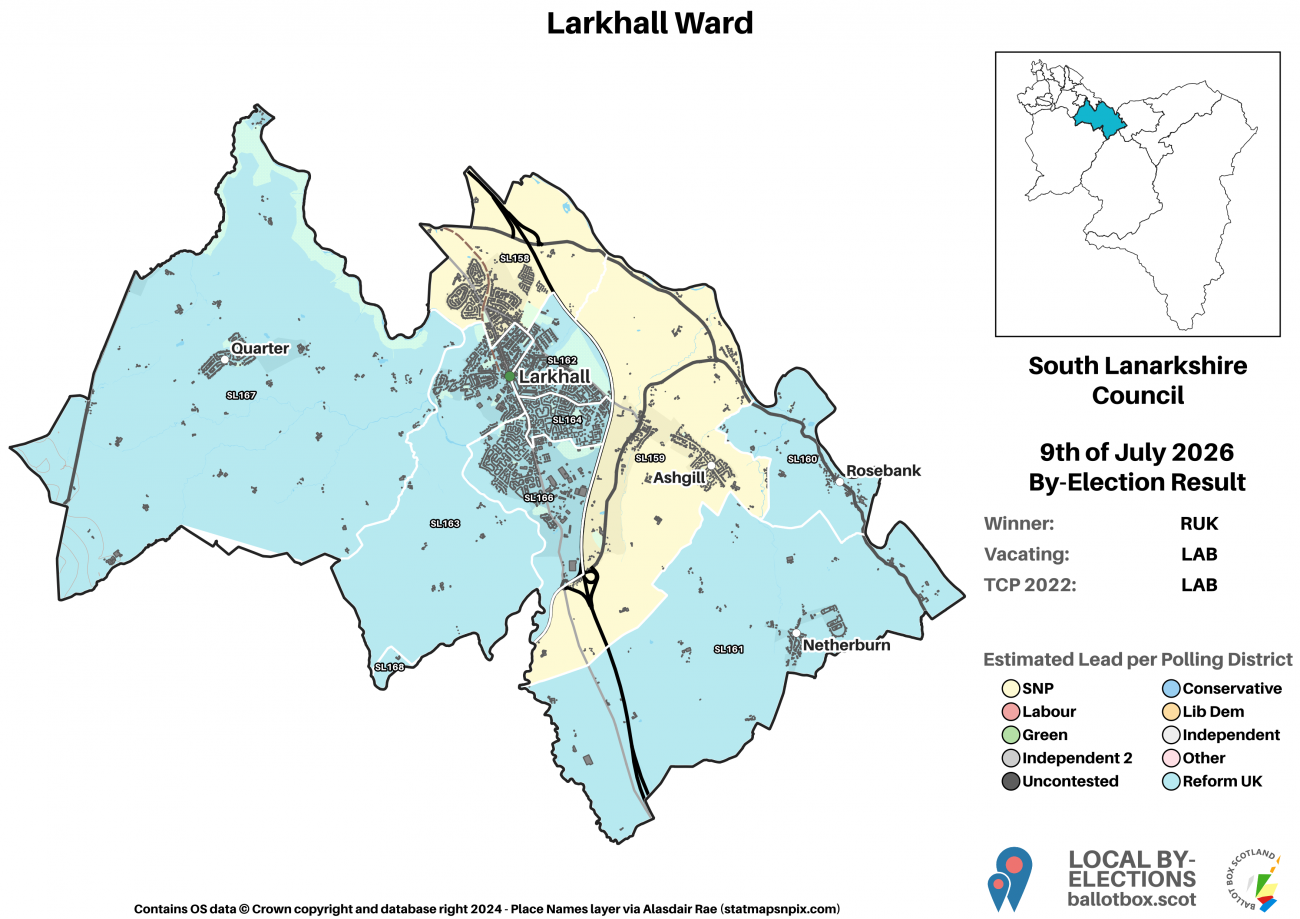
Turning now to how each candidate’s votes were distributed, and the map illustrates the almost complete replacement of Labour by Reform. All of the areas that were tinted Labour Red in 2022 are instead tinted Reform Teal, with the exception of Ashgill. Given that is merged with the SNP’s best 2022 district this time due to low turnout and how close it was, I’d guess that in reality it is also Reform-leaning, but the data can’t be unpicked to confirm that.
Of the many Reform-led districts, they did the best in the one covering the Hareleeshill area of Larkhall itself. Again, due to mergers, it might actually be neighbouring Strutherhill that’s a touch stronger, but it was merged with Quarter, so who can say! The SNP meanwhile maintained their 2022 lead in the Merryton area of northern Larkhall, plus that likely phantom lead in Ashgill. Finally, both Labour and the Conservatives had their best results in the Burnhead and Meadowhill area of Larkhall, plus Rosebank and Netherburn.
Second Preferences
Direct second preferences here really are unique to this ward, given the lack of the Greens and Lib Dems. The two largest parties also had the clearest preference flows: Reform voters overwhelmingly preferred the Conservatives, whilst the SNP’s supporters even more strongly piled in behind Labour.
Labour and the Conservatives were more split, with their strongest flows being between one another. For the Conservatives that was literally only one voter more than went to Reform, and even Labour only had about 4% difference in the proportion of their vote that went to the SNP. That explains the difference in “Reform vs SNP” and “Reform vs Labour” matchups discussed earlier.
We’ve got nearly two months until the next by-elections, a double-whammy in Edinburgh, which means previews haven’t even been written yet. That means I should get a break from Ballot Box Scotland for a month or so, though it’s not going to be totally quiet. I’ve got a couple of analysis pieces to fill the summer lull, due out later this month!
If you find this or other Ballot Box Scotland output useful and/or interesting, and you can afford to do so, please consider donating to support my work. I love doing this, but it’s a one-man project and takes a lot of time and effort. All donations, no matter how small, are greatly appreciated and extremely helpful.
(About Donations)