Background
Glasgow gave us a double bill of by-elections last week, one for sad reasons and one for ultimately quite funny reasons. This is, I’m afraid, the sad one, as Labour councillor for Southside Central James Scanlon passed away over the festive period. He’d been a councillor since the First Past the Post days, originally for Toryglen.
This is the example par excellence of a ward that not so very long ago would have been an easy win for Labour. The SNP’s winning margin for a single seat was only about 6%, a gap that would have been child’s play for Labour to close for most of last year. It is not last year. Labour’s recent woes have seen it fail to make these kinds of notionally easy gains, which is why in previewing this I opted to say it leaned towards the SNP. One other thing I suggested keeping an eye on was the Green share, which had declined in two strong wards in the city whilst going up in two weak ones last year.
Headline Results
Councillors and Key Stats
1 Councillor Elected: SNP: Mhairi Hunter
Change vs 2022 (notional): SNP Hold
Change vs vacating: SNP Gain from Labour
Turnout: 18.7% (-20.3)
Electorate: 20348
Valid: 3749 (98.3%)
Spoiled: 66 (1.7%)
Quota: 1875
3 Continuing Councillors:SNP: Alexander Belic Green: Elaine Gallagher
 Labour: Soryia Siddique
Candidates
 Lib Dem: Nicholas BudgenSNP: Mhairi Hunter
 SSP: Olivia Murphy
 Conservative: Kyle ParkUKIP: Travis Power
 Family: Danny RajaLabour: Samina RashidGreen: Laura Vroomen
First Preferences
Note: Alba won 8.1% and an Independent 0.5% here in 2022.
First Preference History
My predictive powers aren’t perfect, but they are pretty sharp overall, and proved well-founded here. Although both the SNP and Labour experienced similar decreases in their first preference share, that was marginally less bad for the SNP as it meant remaining in first place whilst dipping to only their second worst result, whilst Labour hit their lowest point in the ward so far. Placing not so very far behind in third were the Greens, who managed to buck their recent trend of poor results in core Glasgow wards with a solid swing in their favour.
That’s despite, as they would draw on a similar voter base, a surprisingly strong result from the Scottish Socialist Party. Without intending to be too cruel, that’s really not much of a party these days, but I’m told their candidate put in the work on the ground here, and that was duly rewarded with a very respectable share indeed. That also placed them ahead of not just Reform UK, but the combined total for Reform and UKIP. Don’t read too much into that though: this ward is highly unrepresentative in terms of how left it leans.
Similarly surprising was a relatively big jump in the Lib Dem vote, albeit from a very low base. That I think speaks to how scunnered a lot of people are with Labour because Glasgow as a whole simply isn’t Lib Dem friendly in the slightest these days. However, if you’re on the left of centre, supportive of the Union, bitterly disappointed with Labour, but unwilling to cross the constitutional divide, well, where else can you go?
By contrast the Conservatives managed to slump even further in what had already been their worst ward in 2022. If you can’t even manage much more than double the raw vote share of UKIP, a definitely dead and superseded party, you’re really not popular locally.
Transfers
Two-Candidate Preferred
Purely theoretically, Labour’s starting position on first preferences was close enough that they could easily overtake the SNP if they got the transfers. If. They did not. Indeed, there were more transfers available from the Greens than for any of the other five parties standing, and those voters typically favour the SNP over Labour. You would expect similar from the SSP and so it proved, with a still-small gap between the two top parties widening to a huge gulf after the Greens dropped out. That gave former councillor Mhairi Hunter an easy ride back into the City Chambers.
What’s really notable here is that despite their decrease in first preferences, after the transfers process was complete, the SNP actually had a higher share than in 2022. That is nigh-on unprecedented lately, with the only recent example being Bannockburn. However that was a ward that in 2022 terms would have been an Independent win, which means the single-seat re-calculation is slightly skewed by the fact we know lots of voters just don’t transfer much if at all. This is one half of what was a very bad result for Glasgow Labour, with the other half being an outright loss in a ward they won in single-seat terms in 2022 in the other by-election.
Detailed Results
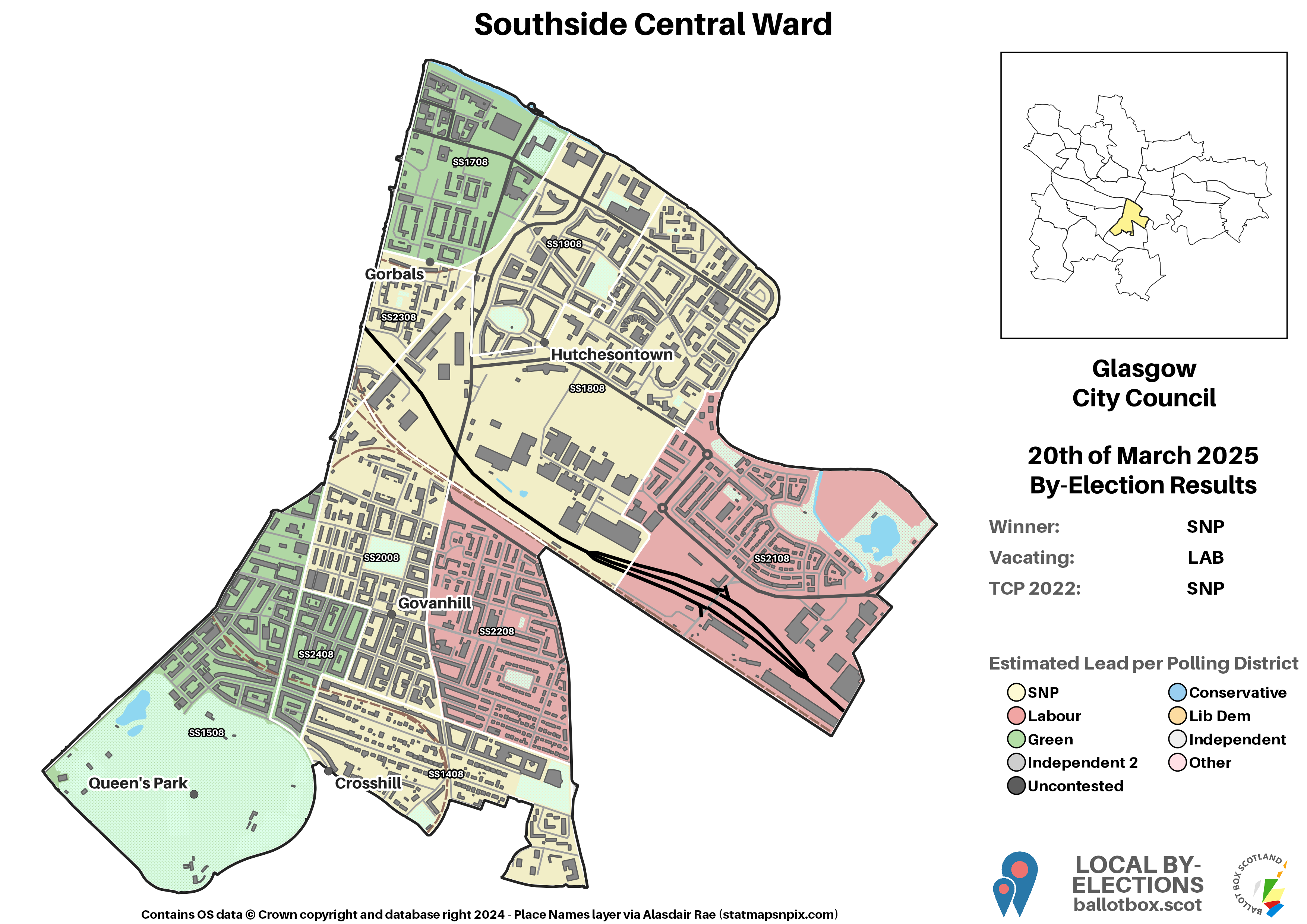
Results by Polling District
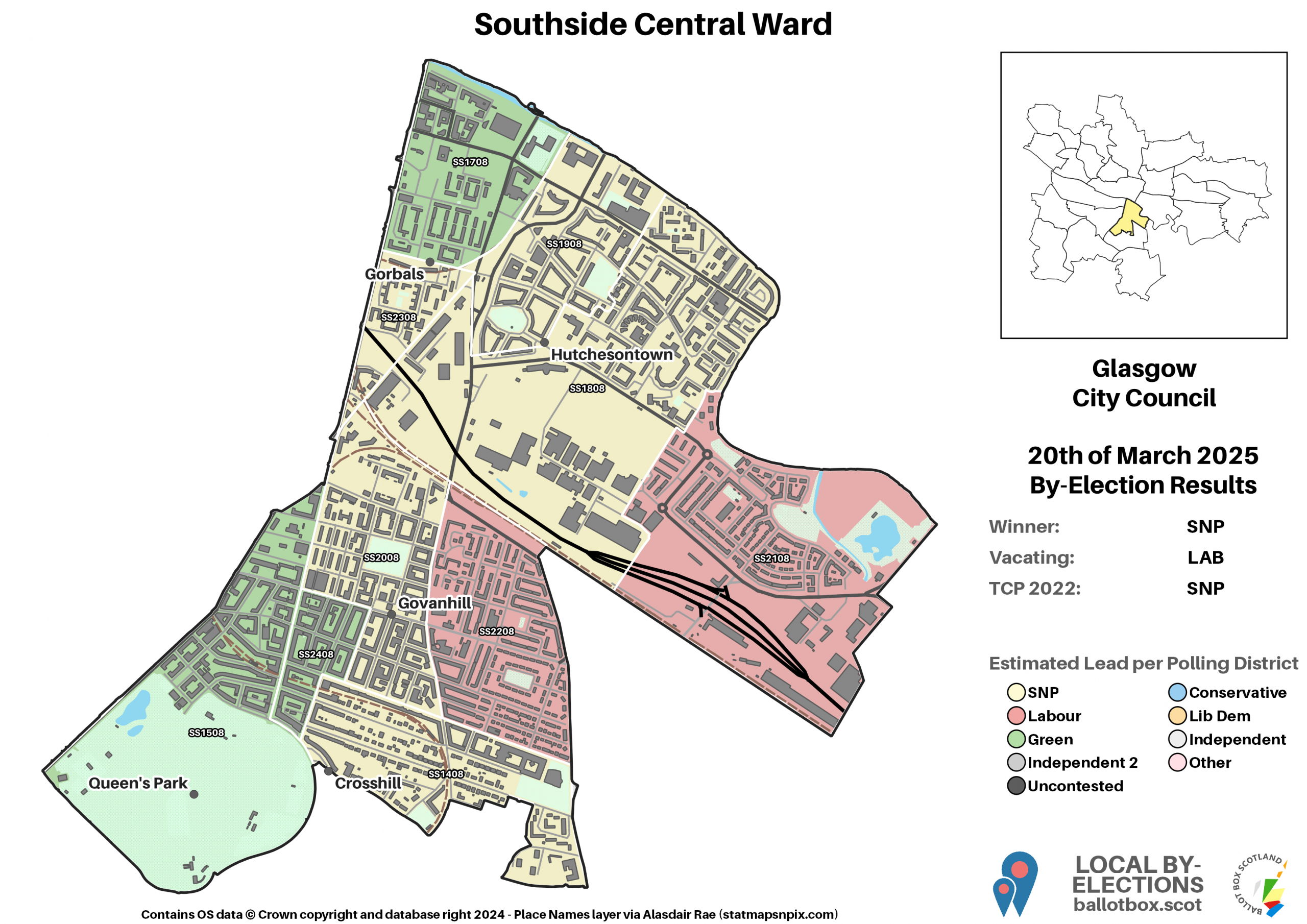
In terms of spread of support, the SNP led in most of the ward including Hutchesontown, the Gorbals, western Govanhill and northern Crosshill. Labour took the lead in Oatlands and eastern Govanhill, whilst the Greens led in the area north and west of Queen’s Park. The map also suggests they were ahead in Laurieston but that’s due to box mergers: in reality, based on 2022 results, I’d expect a Labour or SNP lead there.
In terms of where their own votes were distributed, the top three were actually pretty much evenly matched in terms of peak strength, all placing in the low-40’s. For the SNP that was in Hutchesontown, for Labour it was eastern Govanhill, and the Greens the eastern flank of Victoria Road. There was an aesthetically satisfying doubling up of best bits, with Reform in the same patch as the SNP, the Conservatives with Labour, and the SSP with the Greens. That left the Lib Dems and UKIP to excel (in relative terms) in Oatlands.
One thing really worth noting here is the difference between in person and postal votes. There’s often a notable divergence given the kinds of people who vote that way; postal votes tend to be older voters and thus lean towards Pro-Union and/or right wing parties, whilst in person tends to be younger and go towards Pro-Independence and / or left wing parties. In this case, that means Labour had a lead on postals whilst the Greens actually beat them amongst in persons. Almost half of the Labour vote came from postals, whereas only about 17% of the Green (and SSP) vote did.
That’s particularly relevant when you consider the difference in turnout as well. In a Scottish context Labour voters are more on the high turnout end, unlike in England where there isn’t another major centre-left option hoovering up the low turnout demographics. SNP and Green voters are, therefore, the low turnout voters. With fewer than half the votes cast than at the full election, and with those variations in mind, it’s not inconceivable that the “true” position in this ward would actually have the Greens in second place.
Second Preferences
Second preferences are partly what I would describe as “normal, for Glasgow”. That means there’s a standard mutual flow between the SNP and Greens, and Labour’s voters tilt towards the SNP as a next choice. Flows on the right of the spectrum are also roughly what you’d expect; the Conservatives to Reform UK, whilst they and their parent party most prefer one another.
SSP voters went massively for the Greens (again, emphasising that both parties fish in the same pool of voters), and returns were solid too. Last of all, in a sort of “standard-but-odd” scenario are Lib Dem voters. Their most popular next choice was Labour, but that wasn’t a million miles ahead of… the SSP! Or, for that matter, the Greens, though that’s a more ordinary line of transfers.
By-elections are few and far between compared to last year, thankfully, so there are only a couple on the horizon at the moment. The next is towards the end of April, when Fife’s Glenrothes Central and Thornton ward will be going to the polls to replace a late SNP councillor. That looks quite a likely bet for the SNP, as does the Clydebank one following, which may not help the mood in Scottish Labour.
If you find this or other Ballot Box Scotland output useful and/or interesting, and you can afford to do so, please consider donating to support my work. I love doing this, but it’s a one-man project and takes a lot of time and effort. All donations, no matter how small, are greatly appreciated and extremely helpful.
(About Donations)