Background
Glasgow gave us a double bill of by-elections last week, one for sad reasons and one for ultimately quite funny reasons. This is the funny one, though not so much for the councillor in question or the Labour party. Having elected local councillor Maureen Burke as MP for the similarly-titled Glasgow North East seat in July, Labour successfully put up Mary McNab in the resulting by-election.
McNab did not however act quickly enough to resign her job with the Council following her election, seeking clarity on a pre-agreed retirement settlement. Understandable though that may be, it’s the kind of thing one might have thought worth checking before standing in a by-election your party was the hot favourite to win. That failure led to her automatic disqualification as a councillor, and a rapid repeat by-election.
As Labour’s position has worsened since November, never mind the local circumstances, in my preview I had this one down as a tossup between them and the SNP. That’s quite a turnaround from having said it was Labour, absolutely no questions asked or doubt about it, last time around. I was also wondering what would happen with the already rock-bottom turnout and the already high Reform UK vote.
Headline Results
Councillors and Key Stats
1 Councillor Elected:
🟡SNP: Donna McGill
Change vs 2022 (notional): SNP Gain from Labour
Change vs vacating: SNP Gain from Labour
Turnout: 13.6% (+1.1 / -16.9)
Electorate: 14955
Valid: 1998 (98.5%)
Spoiled: 31 (1.5%)
Quota: 1000
2 Continuing Councillors: SNP: Ruairi Kelly
 Labour: Sharon Greer
Candidates
🔵Conservative: Kyle Cannon
🔴Labour: Debbie Duffy
🟤UKIP: Christopher Ho
🟣Reform UK: Rob Maddison
🟤TUSC: Anne McAllister
🟢Green: Hayley McDonald
🟡SNP: Donna McGill
🟠Lib Dem: Peter McLaughlin
First Preferences
Note: The Libertarians won 0.6% of the vote in 2022.
First Preference History
Sure enough, Labour’s suffering continued into this by-election. Although turnout was up marginally, which you would expect to favour the SNP, at only about 1% it doesn’t get anywhere close to accounting for the level of shift. With a modest upwards movement since November, the SNP were able to pull into first place in this ward for only the second time. Not only did Labour decline a fair bit since November, but their losses relative to 2022 were almost twice what the SNP’s were, leaving them on by far their worst result yet.
The biggest beneficiary in terms of votes however were Reform UK, who gained another 5% of the vote to put them only about 1.5% short of what would be a quota at a full election. In November their result translated to “probably winning a councillor due to being last candidate standing”. Here, it’s “certainly winning a councillor on the strength of their vote.”
Everyone else that was returning from November suffered by comparison. The Conservatives slumped even further, leaving them on less than half what they got in 2022 and only about a third of their peak in 2017. The Greens also ticked downwards, though they still increased share relative to their 2022 performance in what is literally their worst ward in the city. TUSC can tell a similar story, losing out compared to November but growing against 2022, whilst the Lib Dems were almost unchanged. The last remaining dregs of UKIP placed dead last here, but they add towards the near-quota for the far right overall.
Transfers
Two-Candidate Preferred
Even though the SNP started with a lead over Labour, we should all know that’s not the whole story under a transferrable system. In theory a roughly 6% lead, when only a roughly equivalent number of transfers are available from Pro-Independence parties versus around 30% from Pro-Union, shouldn’t have been sufficient for the SNP. If you’ve been following BBS over the past few months at all though you’ll also know that Reform voters simply have not been transferring to Labour in the numbers necessary. The gap did close a little but by nowhere near enough, giving the SNP a relatively easy ride to victory.
That makes this by far the worst Scottish by-election for Labour since last July’s General Election. I know some will immediately be leaping for metrics which would seem to suggest that isn’t the case. There are wards Labour got fewer votes than this! Sure, largely in places they weren’t strong in 2022 anyway. They’ve lost seemingly surefire seats to other parties! Sure, in Colinton and Fairmilehead last year to the Lib Dems, the masters at local surges (but not in selecting good candidates…). They even lost in Bannockburn to the SNP! Sure, but the notional 2022 winner there was a strong Independent which makes the single seat estimate in his absence shakier.
No, the reason this is so bad is because it’s the first time Labour have lost to the SNP in a ward they undeniably won in 2022. There are no complicating circumstances for the 2022 result, it’s not that they were a lower placed party in 2022 that were never likely to win a single seat election, they just flat-out lost this one to a party nearly two decades into office and which not so long ago felt guaranteed to lose the next Holyrood election.
That must surely be setting off further alarm bells for Scottish Labour. We’re still over a year away from Holyrood and two from the next set of locals, and a lot could change, but if it doesn’t, it’ll be grim for them. On Glasgow City Council, it’s hard to see how Labour make meaningful gains in 2027 if these sorts of results continue. For “inner” Glasgow wards like Southside Central, potential for growth is limited by the continued strength of the SNP and Greens. In three member wards, there’s no way they can win two. In four members it’s not impossible, but they already have two in a couple of them. Meanwhile for “outer” Glasgow wards like this one, a Labour double was the rule in 2022, but now the second of those seats could be gobbled up by Reform.
Detailed Results
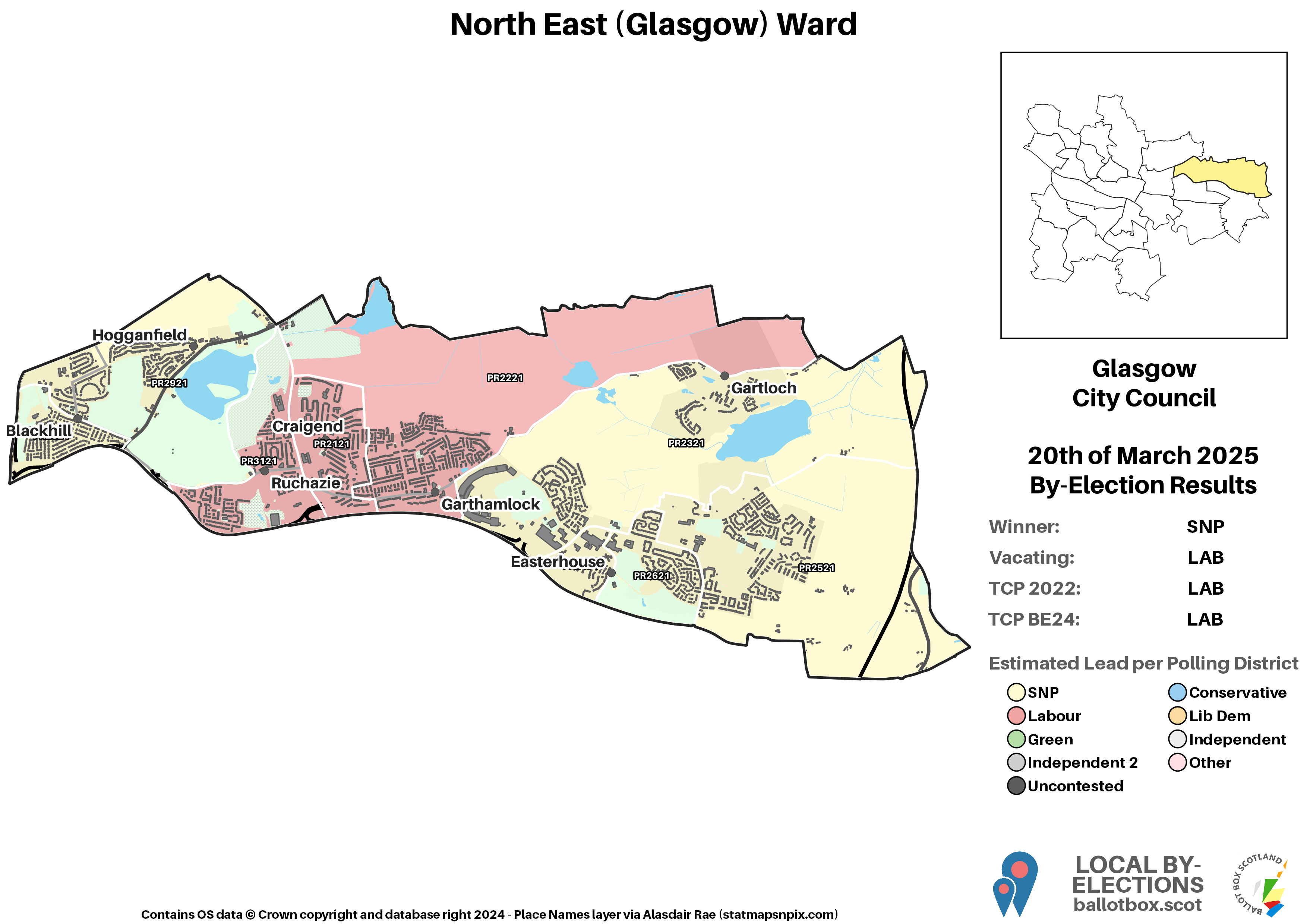
Results by Polling District
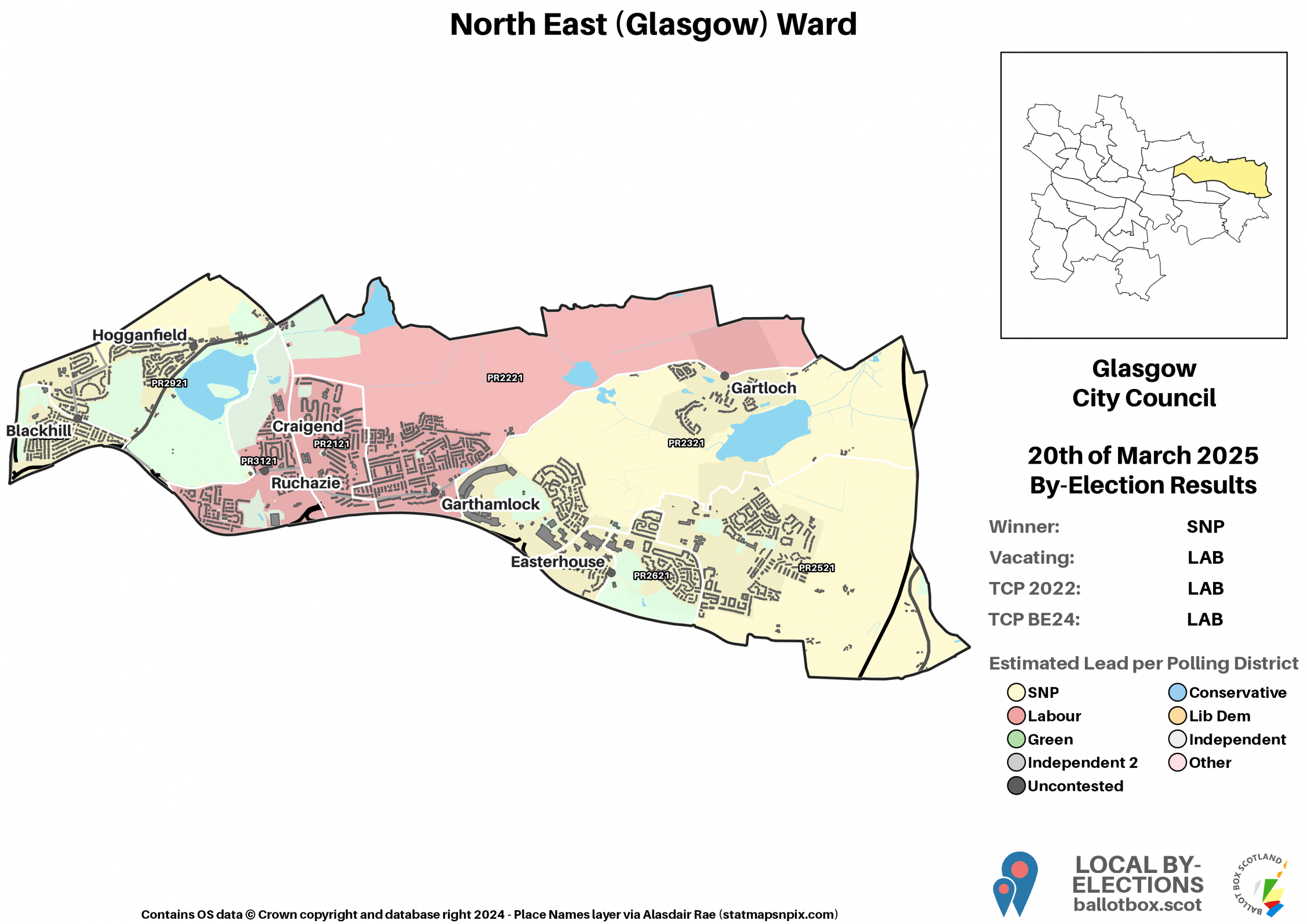
Although turnout was a mite higher in this by-election, that hasn’t helped with the task of untangling mergers. The merged boxes this time around are completely different to those in November, so I’m afraid we can’t do any meaningful comparison between the two. As merged, the SNP took a lead in most of the ward, in Blackhill, Hogganfield, Easterhouse and Gartloch. Labour were ahead in Craigend, Ruchazie and Garthamlock.
In terms of their best bits, the SNP, Reform and UKIP all proved strongest in the districts covering most of Easterhouse and Gartloch. Labour, the Conservatives, Greens and Lib Dems all had their best performances in the Craigend, Ruchazie and Garthamlock pool. Lastly, TUSC peaked in the Blackhill, Hogganfield and central-ish Easterhouse bloc.
Second Preferences
Direct second preferences are almost but not entirely what you’d expect, and also show some interesting differences compared to November. The normal mutual flow between the SNP and Greens is restored here, after the SNP’s voter marginally preferred Labour last time. There’s also no repeat of the odd but not meaningful (as it was just 15 voters) 20% Green to Reform flow, which is at a much more reasonable looking 6% (and just 4 votes) here. For their part, Labour voters remained most likely to plump for the SNP, at least those who actually marked a second preference.
Reform were most inclined towards the Conservatives still, even with a fair chunk going to UKIP, but the remaining Conservatives still narrowly favoured Labour over Reform. Two more TUSC voters went Labour than Green, after it having been two voters in the other direction in November. Visually dramatic but amounting to just 12 votes, Lib Dem voters quite strongly favoured the Greens, with a sixfold increase in numbers relative to the previous by-election. Lastly, UKIP ballot papers unsurprisingly went massively to Reform.
By-elections are few and far between compared to last year, thankfully, so there are only a couple on the horizon at the moment. The next is towards the end of April, when Fife’s Glenrothes Central and Thornton ward will be going to the polls to replace a late SNP councillor. That looks quite a likely bet for the SNP, as does the Clydebank one following, which may not help the mood in Scottish Labour.
If you find this or other Ballot Box Scotland output useful and/or interesting, and you can afford to do so, please consider donating to support my work. I love doing this, but it’s a one-man project and takes a lot of time and effort. All donations, no matter how small, are greatly appreciated and extremely helpful.
(About Donations)