Scottish polling has been a little bit Goldilocks lately. We haven’t been getting enough polling, so I have been complaining. When we were getting polling though it was far too Survation heavy, so I have been complaining. With a four month gap since the last Survation, I’m at least not unhappy to see them this time. This one (link to tables) has come from yet another one of the many commissioning sources that Survation have on lock which is Scotland in Union.
The previous Survation covered the 2nd – 5th of May 2025. Changes are shown as (vs that poll / vs last election).
Regional Vote
Change vs Last Poll
Change vs 2021
The last Survation was incredibly dramatic, with Reform in second place, but this one is much more muted. Indeed, for almost everyone the changes here are within margin of error and therefore not really work remarking on individually. It is nonetheless notable that this is another one with the SNP breaking back into the 30’s, which is adding to a sense of very modest recovery.
The flip side to that appears to be a typically low for recent Survations share for the Greens. They are now pretty consistently behind the Lib Dems, who are on one of their best shares of the term with 11%. I remain very dubious about the Lib Dem intention on the list as it has never before exceeded their constituency or Westminster shares at actual elections; more on that in the next section.
Where there is movement outwith that margin of error, it’s against Reform, who whilst still on a strong share slump back to a much less newsworthy level. That may give Labour some breathing space, but with their vote not actually changing either, they aren’t out of the woods yet.
Constituency Vote
Change vs Last Poll
Change vs 2021
Over on the constituency side of things, fewer parties are seeing changes than on the list, but for some of those that are, they are much more substantial. A single digit shift for each of Labour and Reform put the former back ahead on this vote too, having previously been tied. There’s a likewise equal-but-opposite four point shift for the SNP (up) and Lib Dems (down).
The SNP figure seems reasonable in the sense that’s the same as another recent poll by another “low Green” pollster (More in Common), so it’s not out of the ordinary. For the Lib Dems though this is the worst constituency share since before last year’s general election. I just don’t buy that when they are finding strong list shares.
As I’ve said a few times, the Lib Dems have never done better yet on the list than on the constituency or Westminster. The reason for that is pretty obvious to any real political obsessive: the famously dodgy ONLY THE LIB DEMS CAN WIN HERE bar chart campaigns only work under First Past the Post. The Lib Dems are the absolute masters at picking up and digging into small numbers of constituencies and specifically, in Scotland, by marking themselves as the best Pro-Union option for beating the SNP. That pumps their FPTP share up, but the same incentive doesn’t apply on the list, hence why the SNP actually beat them on that vote in three of their four 2021 constituencies.
Now, in fairness, there is bi-directional tacticality there: sure, some Conservative and Labour voters swung Lib Dem on the constituency vote, but some natural Lib Dem voters will have gone the opposite way on the list, reckoning they’d not be in line for PR seats themselves. And, of course, there are genuine reasons for the Lib Dems to be faring better at the moment, plus history isn’t destined to repeat. All that said, I’m still not convinced by this sort of finding. Either it should be the other way around, or both votes should be pretty close.
Seat Projection
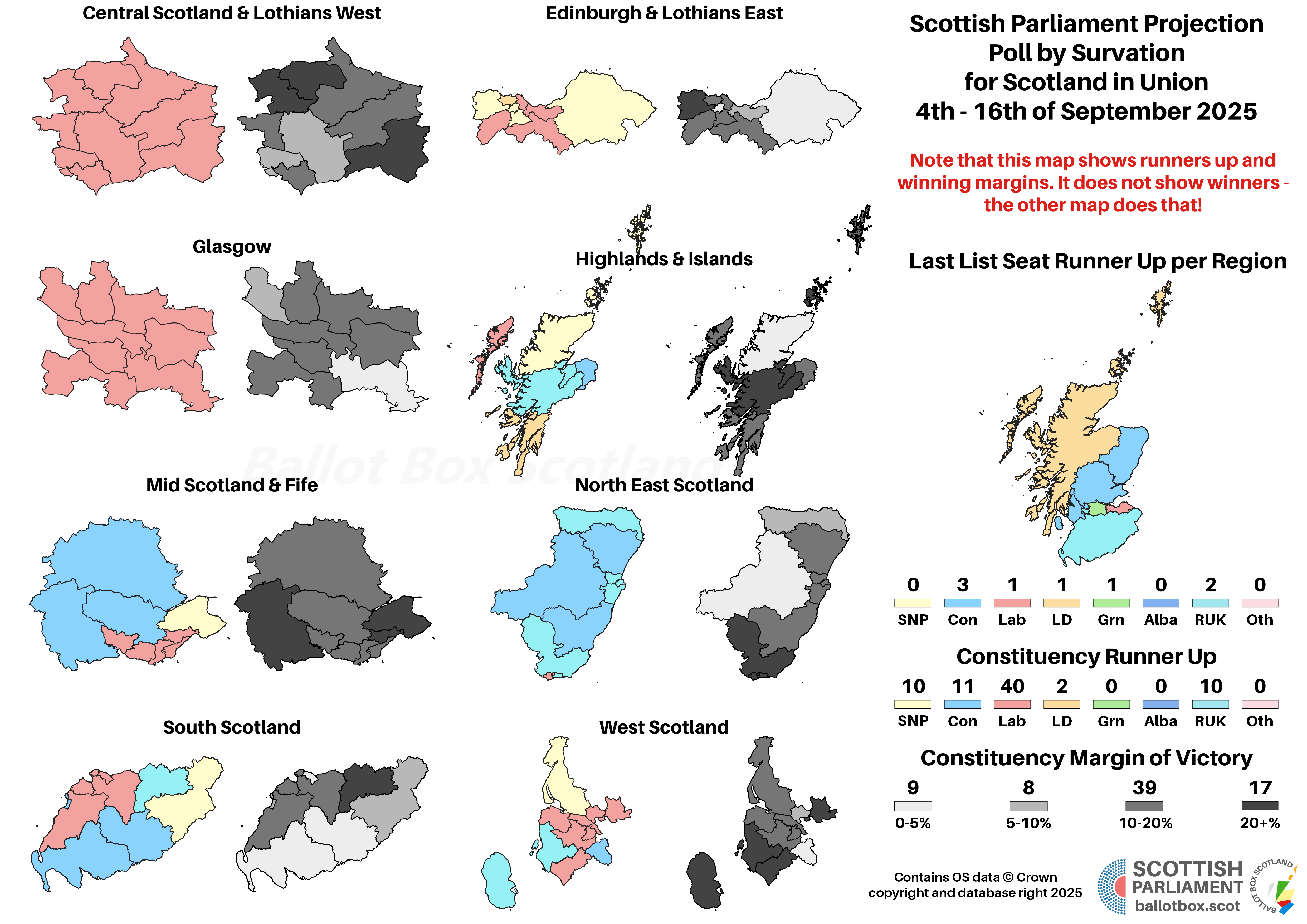
Projecting that into seats might give us something like this:
Please see this page for how projections work and important caveats.
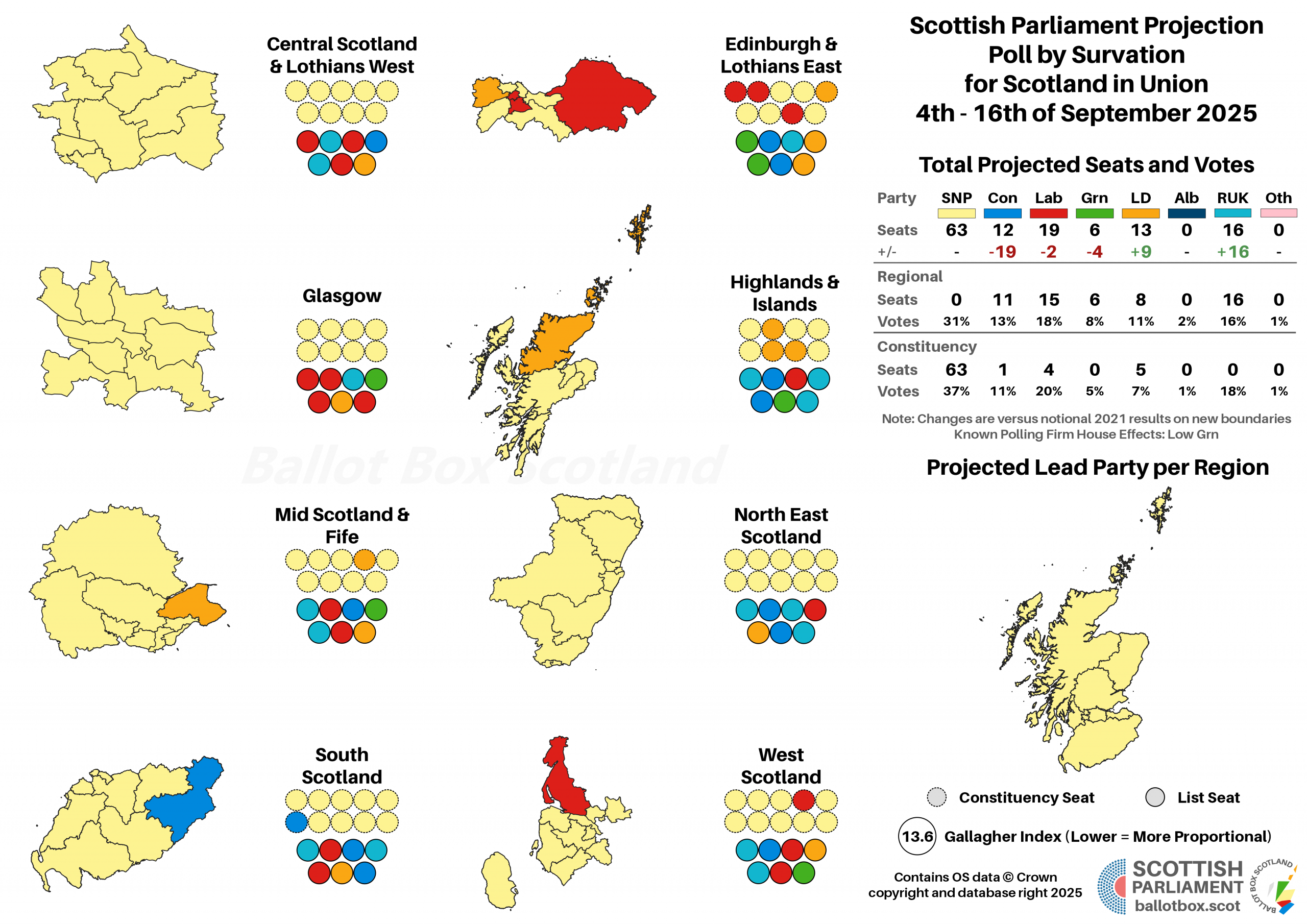
Dedicated followers may note a new line in the chart above: “Projected AMS Ideal”. The SNP have been projected to absolutely destroy the proportionality of outcome for months now, and whilst that’s hardly their fault (blame Labour for the voting system), it’s democratically concerning. I therefore want to make it absolutely clear just how much they are warping things, which in this case is a whopping 19 MSPs they are not fairly entitled to. Those come 6 from Reform, 5 from Labour, 4 from the Greens, 3 from the Conservatives, and 1 from the Lib Dems.
Nonetheless, broken or not, the system we have puts the SNP two short of a majority, meaning that even with the deflated Green benches, the Pro-Independence parties would hold onto their existing majority. It remains the case that Labour need a real miracle between now and May to have even a chance of forming a government from second place, never mind actually placing first overall.
Again, on the Lib Dems, the model says they have a Central Scotland and Lothians West seat just because it cannot fully account for how localised their support would be even at that share. There’s no way they get an MSP there but the Greens (unseating Co-Leader Gillian Mackay) don’t; indeed at last year’s UK election, the Greens managed slightly more votes than the Lib Dems in this area despite not even contesting every constituency.
Possible Majorities
Note: these majorities relate simply to passing a vote in the Scottish Parliament. They do not imply the formation of a full coalition government.
- Traffic Light: Labour, Lib Dem and Green
- Independence Bloc: SNP, Green and Alba
- Grand Coalition: SNP and Labour
- Union Bloc: Labour, Conservative, Lib Dem and Reform UK
Change vs Last Poll
Change vs 2024
Westminster polling remains a real problem for Labour; although their share isn’t out of line with Holyrood, since this is purely First Past the Post (again, entirely their own fault that appallingly undemocratic system remains in use), placing 16% behind the SNP is real goose cooking territory. Indeed, with a three-point uptick, this is the SNP’s best polled share since last year’s election.
As with other parts of this poll, Reform slip down a bit away from the eye-popping share they had last poll, but that still keeps them tied for second. The Lib Dems likewise lose share here despite their Holyrood list support, and just to really hammer this point home, I think that’s well dodgy based on past performance.
Scotland in Union continue to ask a non-standard question for this one, so I do not track it.
Hypotheticals
As ever, the last little bit of analysis concerns those hypothetical and more proportional voting systems that BBS likes to play about with. The use of pure FPTP at Westminster is an affront to democracy, and though Holyrood fares far better, AMS is still deeply imperfect. The examples here simply transpose the poll findings onto more proportional voting systems – the reality is that different systems would of course result in different voter behaviour.
Scandinavian Style Westminster
If you find this or other Ballot Box Scotland output useful and/or interesting, and you can afford to do so, please consider donating to support my work. I love doing this, but it’s a one-man project and takes a lot of time and effort. All donations, no matter how small, are greatly appreciated and extremely helpful.
(About Donations)