Ward Profile
Cause of By-Election
I’m afraid we’re in for another one of those previews where I forego any sense of fun or levity, as our electoral trip to Fife is for highly unpleasant reasons. Earlier this year, Buckhaven, Methil and Wemyss Villages councillor David Graham was convicted of and jailed for sexually assaulting and grooming a 15 year-old girl. He’s the third councillor this term to be convicted on sexual offences; one was already one too many, of course, but that’s a notably high number. That quite rightly automatically disqualified him from serving as a councillor, having continued to sit through the period after he was charged in 2023.
Graham was first elected as a councillor in 2012 as a Labour councillor. He was expelled from the party after his conviction; he’d also previously been suspended, but there’s some confusion around that from my perspective. Fife Council’s website had then re-listed him as Labour for quite a long period of time after his initial suspension (and this was duly replicated on Open Council Data), before reverting to Independent after his conviction but before sentencing disqualified him. I’m not sure whether that was an administrative error on the web team’s part or if Labour somehow weren’t paying attention to ongoing legal proceedings!
Ward Details
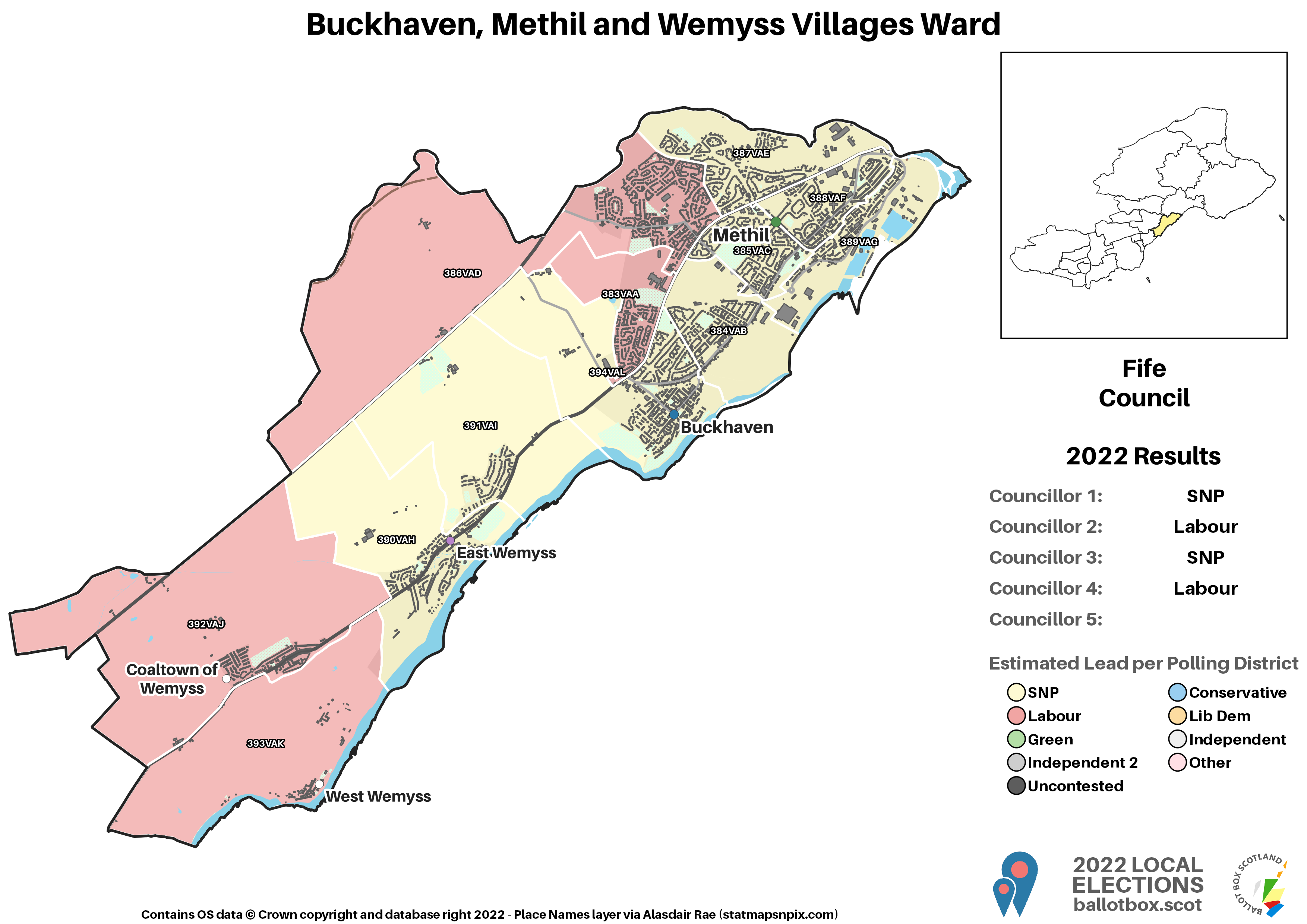
Buckhaven, Methil and Wemyss Villages is one of 22 wards in Fife, and elects 4 councillors at a full election. The bulk of this ward consists of the bulk of the wider Levenmouth conurbation, which is obviously enough bisected by the River Leven. Methil and then Buckhaven lie to the south of the river, beyond which lie the three Wemyss villages: East, West, and Coaltown of. That last one gives a hint to what this area was once known for, which was working the eastern end of the Fife Coalfield. No electorally meaningful boundary changes have taken place here since the ward was created in 2007.
For elections to the Scottish Parliament, the ward is entirely within the Kirkcaldy constituency which the SNP gained from Labour in 2011. Originally this area had been split between Central Fife, covering Methil and northern Buckhaven and won by the SNP from Labour in 2007, and the rest contained within the prior Kirkcaldy seat. At the UK Parliament it’s within the Glenrothes and Mid Fife constituency which Labour won in 2024, the previous simply Glenrothes seat having been SNP held since their 2015 landslide.
Electoral History
A nice easy pattern of representation in this ward, effectively reflecting pre-and-post retirement of local Independent Andrew Rodger. Previously councillor for the old single-member Wemyss and Muiredge ward, he easily made the transition to STV in 2007 and was joined by two Labour councillors plus one from the SNP. 2012 saw a half-changeover in councillors as the incumbent SNP councillor fell foul of the alphabet effect (Robertson placing lower down than O’Brien), whilst Labour councillor Tom Adams hopped across to the Leven-centred ward and was replaced here by Graham.
Rodger retired in 2017 and cleared the way for a simple double-double from Labour and the SNP, with original Labour councillor Jim Young replaced by a newcomer, Ryan Smart. Smart only served the one term though as whilst 2022 returned the same double-double, Labour’s Tom Adams returned to this ward after having lost his Leven seat in 2017.
Looking at the voting pattern over the period, and we can see that Rodgers started out so popular he actually placed first overall, with Labour not far behind and the SNP only winning just over a single quota. Labour vaulted into a strong lead in 2012 that easily gave them two full quotas, whilst Rodgers’ vote slipped down to meet the rising SNP share.
The first post-IndyRef and post-Rodgers vote in 2017 saw a huge concentration of the vote behind the SNP, who pulled into first place, and Labour. They won about 85% of the vote between them, with the lion’s share of the rest going to the Conservatives who nonetheless didn’t even break into double digits. Both lead parties increased their share in 2022, giving the SNP a consistently upward trajectory, and locked down about 88% of the vote. The Conservatives still held a majority of what remained, but the combined (very small) shares for Lib Dems, Greens and Alba did tick upwards.
Councillors and Key Stats
4 Councillors, in order elected:
🟡SNP: Ken Caldwell
🔴Labour: David Graham
🟡SNP: John O’Brien
🔴Labour: Thomas Adams
Change vs 2017: No change
Turnout: 38.7%
Electorate: 13540
Valid: 5105 (97.4%)
Spoiled: 136 (2.6%)
Quota: 1022
Candidates
🔴Labour: Thomas Adams
🟠Lib Dem: Celyn Ashworth
⚫Alba: Susan Blair
🟡SNP: Ken Caldwell
🔴Labour: David Graham
🔵Conservative: Brian Mills
🟡SNP: John O’Brien
🟢Green: Jeroen Van Leeuwen
First Preferences
Transfers (single winner recalculation)
Two-Candidate Preferred
By-Election
Candidates
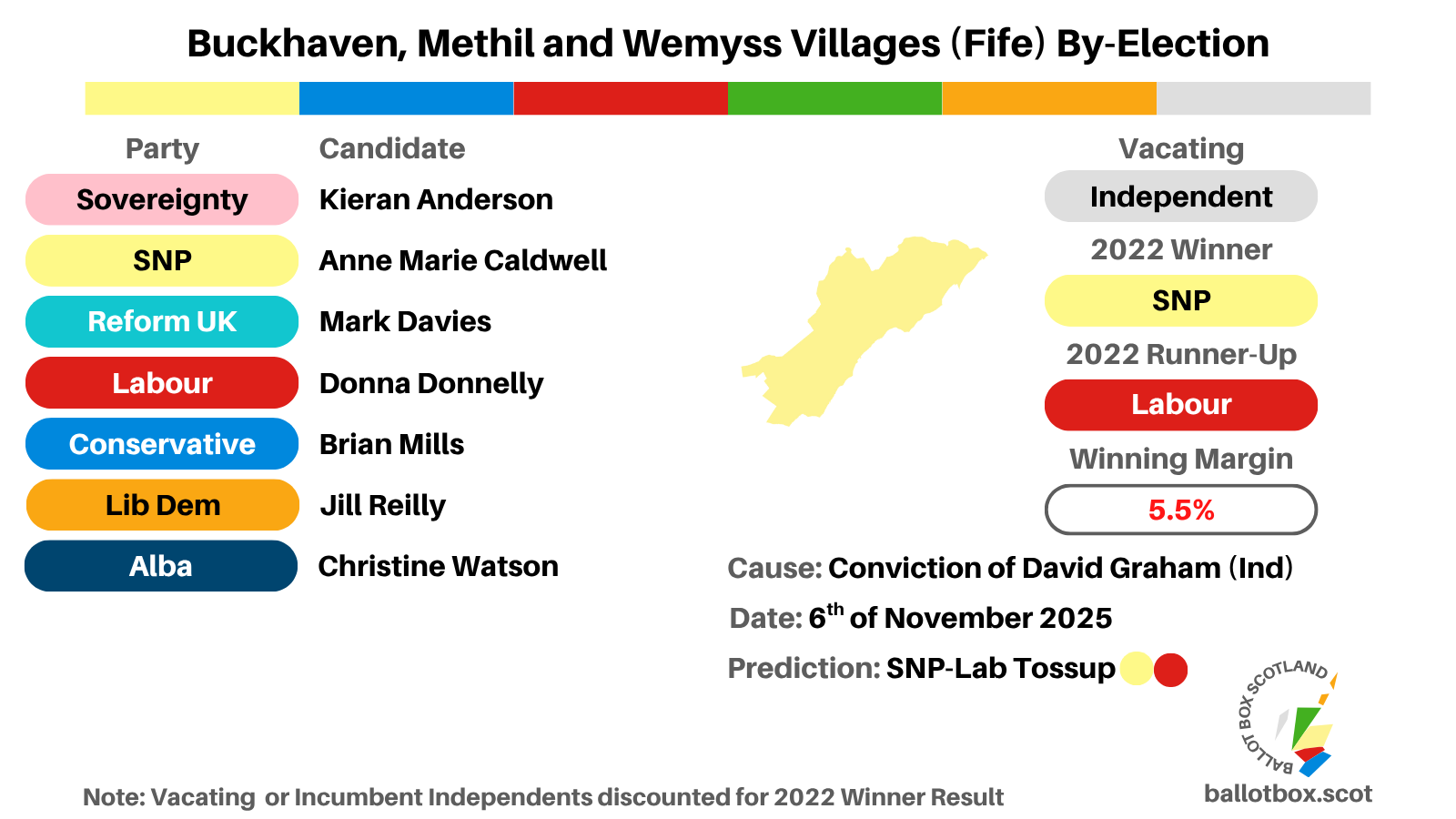
A relatively diverse ballot for this one, with the four traditional Scottish Westminster parties, Reform, plus Alba and Sovereignty. Notably, no Green despite them contesting the past two full elections in the ward; they seem to find it harder to identify paper candidates in this end of Fife than the Conservatives or Lib Dems. Almost all candidates here are fresh faces bar the Conservatives, who returns from the 2022 election.
🟤Sovereignty: Kieran Anderson
🟡SNP: Anne Marie Caldwell
🟣Reform UK: Mark Davies
🔴Labour: Donna Donnelly
🔵Conservative: Brian Mills
🟠Lib Dem: Jill Reilly
⚫Alba: Christine Watson
Analysis
Obviously, the circumstances here are pretty grim for Labour, with their third councillor of this term being removed from office following reprehensible criminal behaviour. That’s not on the party, and it didn’t stop them winning each of the other two by-elections that arose from their councillors falling foul of the law. What may be a barrier here is that they achieved those wins during the rising Labour tide just before and following last year’s General Election.
Now, they are in a pretty dire place according to polling, having effectively lost their entire gains in support in recent years. What we have seen over roughly the past year is Labour falling short of making paper-gains from the SNP, even when they only need to close a 5.5% gap as in this case. Of course the SNP are themselves significantly reduced in stature at the moment, and by-election conditions always tilt slightly against them in terms of their habitual voters being less likely to turn out than Labour’s.
The real spanner in the works here will be Reform. As we saw in Bannockburn earlier this year, “former mining heartlands” are extremely fertile territory for them, demographically speaking. I expect them to record a very strong share here, an expectation all the firmer given that they did significantly better (9.8%) in the Westminster seat covering the area last year than their national average (7%). As I recently wrote about in more detail, surging Reform support in Scotland is coming substantially at Labour’s expense.
In other recent by-elections, those voters have proven very unwilling to transfer in huge numbers to Labour, meaning if the SNP place more than a few points ahead, they may be unbeatable. That’s especially true when you consider there’s already next to no other party support available for Labour in this ward: if I were the Conservatives I’d be absolutely dreading seeing their share here, and this isn’t natural Lib Dem territory. However, typically enough have transferred that if it’s very close or Labour do pull ahead, they should win. Reform themselves are very unlikely to win regardless of share, as the SNP and remaining Labour voters are vastly more likely to preference one another.
Prediction
SNP-Labour Tossup.
2022 Results (Detailed Data)
Transfers (full election)
Results by Polling District
Second Preferences
If you find this or other Ballot Box Scotland output useful and/or interesting, and you can afford to do so, please consider donating to support my work. I love doing this, but it’s a one-man project and takes a lot of time and effort. All donations, no matter how small, are greatly appreciated and extremely helpful.
(About Donations)