As the 2026 Scottish Parliament approaches, keep up to date with all the latest polling and analysis on Ballot Box Scotland’s Holyrood Hub page!
Poll Details and Context
As part of their triannual polling, the Scottish Election Study’s Scottish Opinion Monitor (Scoop), in partnership with YouGov (link to tables), has their last poll out before the election. I’ve been a bit remiss in my coverage of Scoop polls, though that’s in part due to the fact less noise is made about their regular tracker than other polling, so it’s easy to miss. Next term I’ll try and keep a better eye out for them!
The really important thing to note about Scoop polls is that they aren’t weighted the same as YouGov’s normal series, due to the involvement of the SES team. That means these should only be compared with one another, not with other YouGov polls. It’s also why the tracker on the Holyrood Hub page has both the most recent YouGov and this in it.
The previous Scoop was from the 10th – 20th of October 2025. Changes are shown as (vs that poll / vs last election).
Note that I have recently been made aware that if you primarily consume these pieces through emails to your inbox, the charts don’t actually show up. I therefore recommend you click through to the website!
Regional Vote
Change vs Last Poll
Change vs 2021
Margin of error alert!
As with most polling at the moment, nothing here is outwith the margin of error, with the SNP, Reform and Labour all down a little compared to last time, whilst the Conservatives and Lib Dems are flat, tied as the last-placed major parties. For the Conservatives, this is a joint worst figure in my tracker, and the absolute worst for Labour.
The sharpest change is for the Greens, who look to be up a solid 3%, i.e. pushing at the very edges of the margin. That’s up from 10% two Scoops ago, suggesting a steady increase in support, and would entail a doubling of their support compared to 2021. As I don’t deal in FindOutNow polling, this is also the first poll I’ve covered (certainly in this term) that has the Greens ahead of Labour. Given this is on the very upper edge of Green polling I would take that aspect as an outlier, but still, something to worry Labour and cheer the Greens.
Constituency Vote
Change vs Last Poll
Change vs 2021
Margin of error alert!
Again, at the moment I’m having to eyeball changes versus the last poll. There aren’t actually very many, as the SNP, Reform, Lib Dems and Conservatives are all showing as flat on the SES chart. The only shift is that Labour are down a little and the Greens up by a similar amount, which translates to their best ever polled constituency share. They are likely to have very little opportunity to attain that level of support on this vote, given I expect very few constituency candidacies, but it might indicate solid prospects in those they are contesting. As with the List side of the poll, this is a joint worst poll of the term for Conservatives and absolute worst for Labour.
Seat Projection
Projecting that into seats might give us something like this:
Please see this page for how projections work and important caveats.
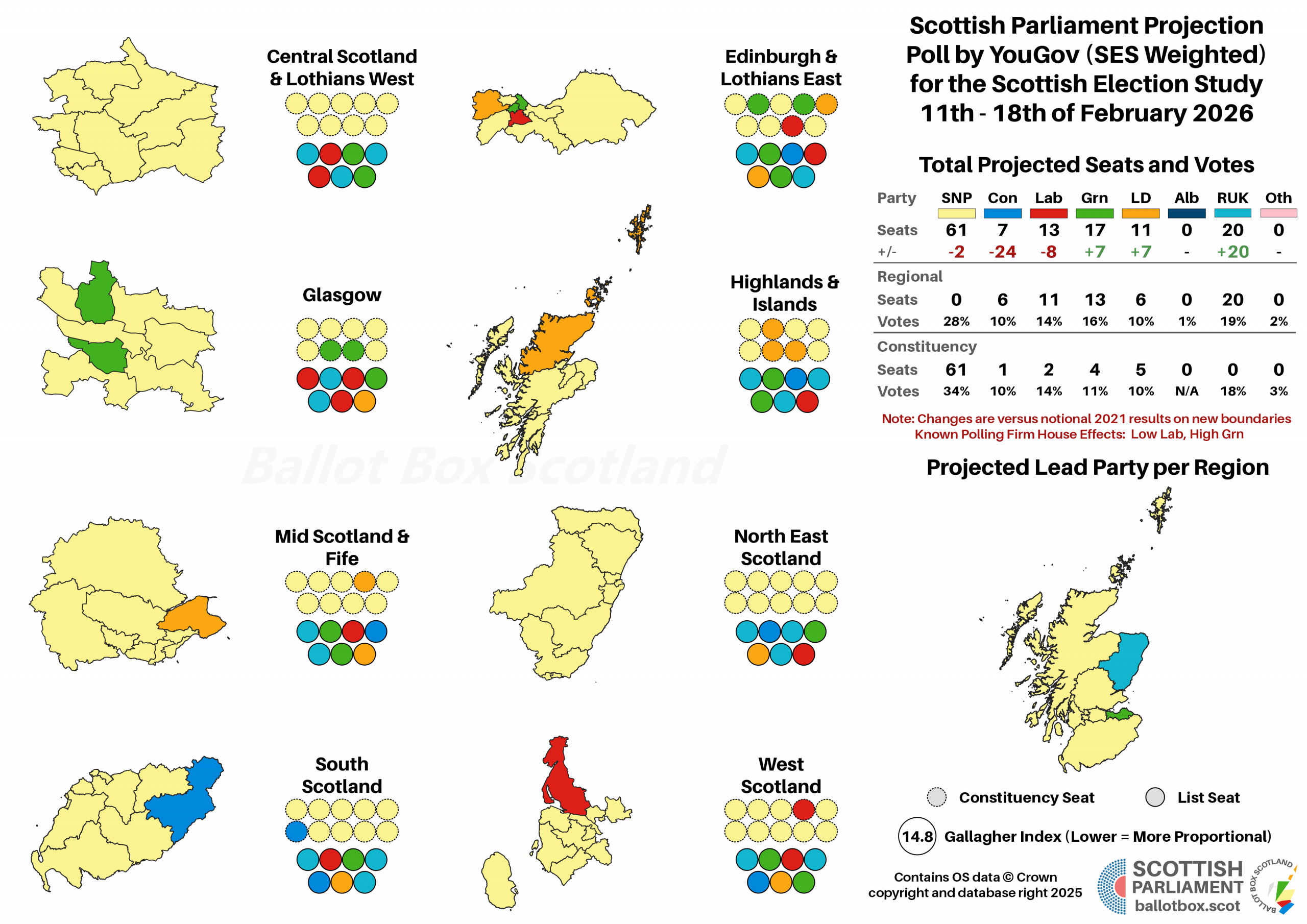

Bolstered by the weakness of their opponents and the fact that much of that Green constituency vote shifts to them in my model, the SNP continue to place miles ahead of everyone else, though still without a majority. Although short by one seat of the highest seat projection my model has had for the Greens, this would be an astonishing result for them, underpinned in part by four notional constituency wins. They even end up the largest party by regional vote share in Edinburgh and Lothians East. At this is at the upper end of their polling though, take it all with a barrel of salt.
On the other hand, naturally the worst poll of the term for both the Conservatives and Labour translates to their weakest seat projection yet. The combined total for both, of 20 MSPs, wouldn’t even match Labour’s 22 at the last election, an absolutely catastrophic scenario for the two primary parties of government at UK level. Despite a tie in votes the Lib Dems pull ahead of the Conservatives in seats because their vote is much more concentrated. As always, the model struggles not to give them a seat in Glasgow when their support gets into double digits, but in reality I find that extremely hard to believe.
Possible Majorities
Note: these majorities relate simply to passing a vote in the Scottish Parliament. They do not imply the formation of a full coalition government.
- Traffic Light: Labour, Lib Dem and Green
- Independence Bloc: SNP, Green and Alba
- Grand Coalition: SNP and Labour
- Union Bloc: Labour, Conservative, Lib Dem and Reform UK
Change vs Last Poll
Change vs 2024
Margin of error alert!
Once again, none of the movement here is statistically meaningful. That doesn’t mean the headline figures aren’t however. Although FPTP spares them the indignity of falling behind the Greens, this is the worst Labour figure in my tracker, far worse even than their 2019 low point. The Greens aren’t far behind though, and on their joint-best result for Westminster, tying with the Conservatives.
The only other decrease is for Reform, who were at their peak in the last poll, giving the SNP a double-digit lead once again. Compared to the Holyrood constituency, the SNP have tended to be a little lower and Reform a little higher on this vote, which may reflect equal parts slightly different voter behaviour between the two parliaments and a somewhat different franchise.
Change vs Last Poll
Change vs 2014
Margin of error alert!
As is typical there haven’t been much in the way of changes on the constitutional front, though those we have all favour the Union. YouGov continue their trend of finding the highest support for No, even when parsed through the Scottish Election Study.
Hypotheticals
As ever, the last little bit of analysis concerns those hypothetical and more proportional voting systems that BBS likes to play about with. The use of pure FPTP at Westminster is an affront to democracy, and though Holyrood fares far better, AMS is still deeply imperfect. The examples here simply transpose the poll findings onto more proportional voting systems – the reality is that different systems would of course result in different voter behaviour.
Scandinavian Style Westminster
If you find this or other Ballot Box Scotland output useful and/or interesting, and you can afford to do so, please consider donating to support my work. I love doing this, but it’s a one-man project and takes a lot of time and effort. All donations, no matter how small, are greatly appreciated and extremely helpful.
(About Donations)