As the 2026 Scottish Parliament approaches, keep up to date with all the latest polling and analysis on Ballot Box Scotland’s Holyrood Hub page!
With just a few weeks left to go until the big day, it’s time for the regular Ballot Box Battlegrounds series! Over this week, we’ll be taking a look at every constituency in Scotland considered marginal in 2021 terms – i.e. where the winner’s majority is below 10%. More than at any Holyrood election up until now, constituency winners really matter, because the SNP are expected to win so many more than their “ideal” proportional share if the voting system was working perfectly.
I’ve also picked out two bonus rounds worth of seats that are worth keeping an eye on even though they aren’t marginal. Each entry in the series will also look over one of the regions. Although that means three regions will go un-Battlegrounded, remember I’ve done regional previews (which also include some thoughts on every constituency) which are available here.
Note that for constituencies and regions impacted by boundary changes, I’m using my own notional calculations for 2021 results on the new boundaries. The reason we compare with 2021 rather than current projections is simple: even with boundary changes, we can be relatively sure what those results were. By contrast, projecting constituency results from national polling is always subject to substantial margins of error. Better then to compare with a known quantity than a rough and highly changeable estimate of current support.
That does however mean the first three entries in this series are surprisingly light on prospective Labour constituencies, and very heavy on marginals featuring strong Conservatives. Don’t worry though, because that’s exactly what the bonus rounds are for!
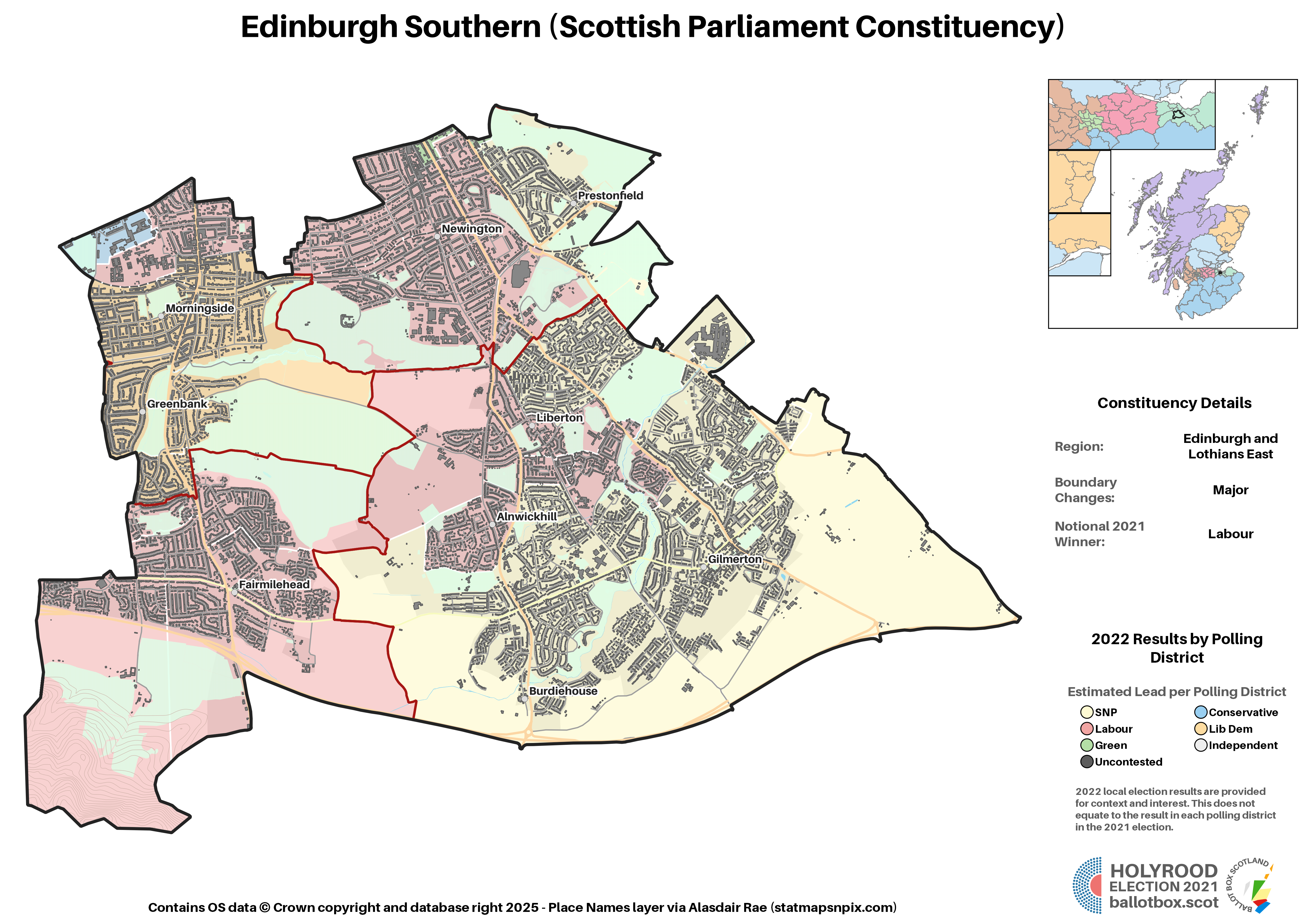
#5: Edinburgh Southern
Constituency Map
Key Information
Notional 2021 Winner: Labour
Majority: 1702 (4.0%)
Boundary Changes: Loses area around Slateford and Craiglockhart to new Edinburgh South Western; loses areas around Merchiston, Marchmont and Sciennes to new Edinburgh Central; gains area around Fairmilehead from old Edinburgh Pentlands; gains remaing bulk of Liberton and Gilmerton ward from old Edinburgh Eastern
Region: Edinburgh and Lothians East
2026 Candidates
SNP: Deidre Brock, L2
Conservative: Marie-Clair Munro, L3
Labour: Daniel Johnson (*C), L3
Lib Dem: Jane Alliston Pickard, L2
Reform UK: Charles Turner, L5
Edinburgh and East Lothian People: Marc Wilkinson, L1
Notional 2021 Constituency Vote
Notional 2021 Regional Vote
Analysis
Finally, a Labour-inclusive marginal, and one with proper boundary changes! Edinburgh has a completely transformed map following the review, and the new version of Edinburgh Southern doesn’t look tremendously like the old version, having moved to more truly cover the south of the city. What it does resemble very closely is the UK Edinburgh South seat, which you may recall has been the most solidly Labour seat in Scotland, Ian Murray twice surviving as their only MP north of the border.
Despite that close alignment with the UK seat, differential voting patterns between elections have slashed Labour MSP Daniel Johnson’s majority from 8.9% down to 4.0% by my estimate. Notably that’s a different estimate to Chris Hanretty, an academic that is much cleverer than me when it comes to this stuff, and has this come up as an SNP seat based on demographics. Even so, I will stand my ground here and say whilst that kind of stuff is a lot cleverer than what I do, sometimes it can be too clever by half. If this area is Labour at Westminster, and it’s quite heavily Labour at Council which is what informs my notional calculations, I think it’s entirely reasonable for it to come up Labour at Holyrood too.
Notional calculation quibbles aside, my expectation is Labour shouldn’t actually find it too difficult to hold this one. They’ll benefit from Ian Murray’s machinery in the area, and the fact that the SNP have lost a lot of support themselves. They may also get a small boost out of the fact the SNP had to drop their original candidate, Sally Donald, mere weeks before the nominations deadline following media reports about her social security claims. Whether or not there is actually anything wrong there, “party drops local candidate at the last minute” never helps their campaign. I reckon we can also count on a degree of further tactical voting from the 2021 Conservative vote against the SNP.
Although we can expect patches of better territory for Reform around Liberton and Gilmerton, overall Edinburgh is a weak area for the far right and their presence on the ballot is unlikely to cause Labour any great bother. If Labour do lose though, Johnson could be at risk. A defector from Alba surprisingly topped the Edinburgh and Lothian East list, and since Labour lists seem to be at least partly “zipped” (alternating between men and women), he has been ranked third. Without this constituency, the SNP could be negatively impacting on proportionality in the region, and so Labour might not get as far as being due a third list MSP.
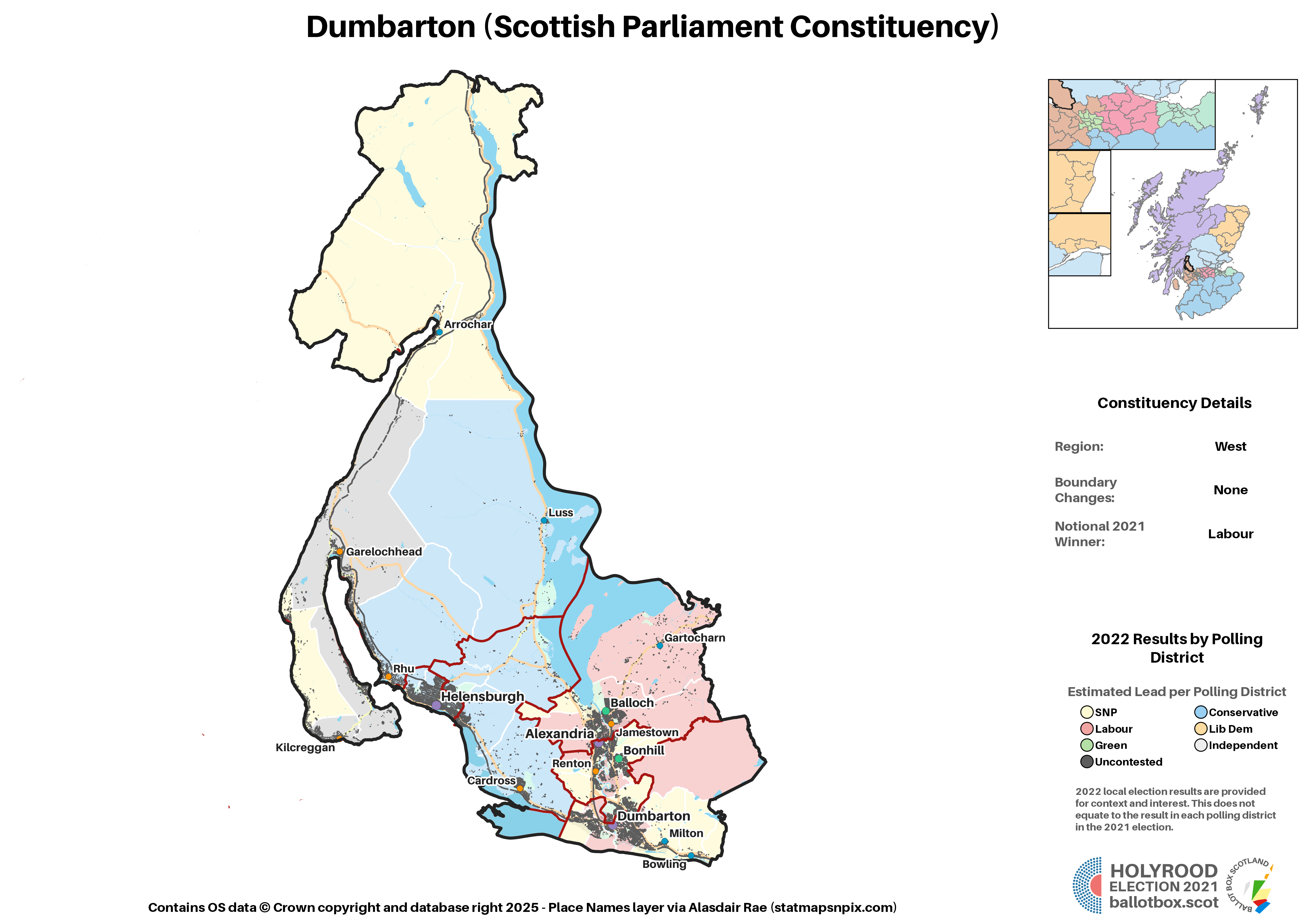
#4: Dumbarton
Constituency Map
Key Information
Notional 2021 Winner: Labour
Majority: 1483 (3.9%)
Boundary Changes: None
Region: West
2026 Candidates
SNP: Sophie Traynor, L7
Conservative: Gary Mulvaney, L5
Labour: Jackie Baillie (*C), L1
Lib Dem: Elaine Ford, L7
Reform UK: David Smith, L2
TUSC: Lynda McEwan
Independent: Andrew Muir
2021 Constituency Vote
2021 Regional Vote
Analysis
The only other constituency Labour won in 2021, Jackie Baillie has proven one of Holyrood’s great survivors. An MSP since 1999, she has three times on the trot held her seat against national swings that by rights should have thrown her out, making this the only seat the party have never lost. This was the most marginal seat after the 2016 election, when she won by just 109 votes (0.3%). By comparison her objectively slender 2021 majority of 3.9% seems positively gargantuan.
What has kept her in post so long is evident when you look at the stark difference between the constituency and list votes: a healthy dose of tactical voting from otherwise Conservative-minded voters. You’ll find a lot of such voters in the Helensburgh and Lomond area, a stretch of historic Dunbartonshire now in Argyll and Bute because the locals decided via referendum in the 90’s they were too good to be paired up with the likes of the Vale, Dumbarton and Clydebank in West Dunbartonshire. If you detect more than a hint of snippiness there, it’s because I was born and grew up in the Vale.
Regardless, the important thing about those voters is that they also went through a long period of being highly Lib Dem favourable as well. That’s a classic “affluent conservative” demographic, rather than the kind that is especially fertile for Reform. The question for Baillie is whether she can hold on to enough of those voters when the Dumbarton and Vale of Leven end of the constituency is home to the kind of post-industrial communities where Reform do perform well.
Given the SNP’s massive vote share losses it’s hard to imagine their candidate, Clydebank Central councillor Sophie Traynor, coming out on top. It would however be absolutely classically chaotic if the SNP’s worst election since 2007 was the one where the mighty Jackie Baillie was finally toppled. She needn’t fear anything but a bruised ego were that to happen though, as she remains top of Labour’s West Scotland list.
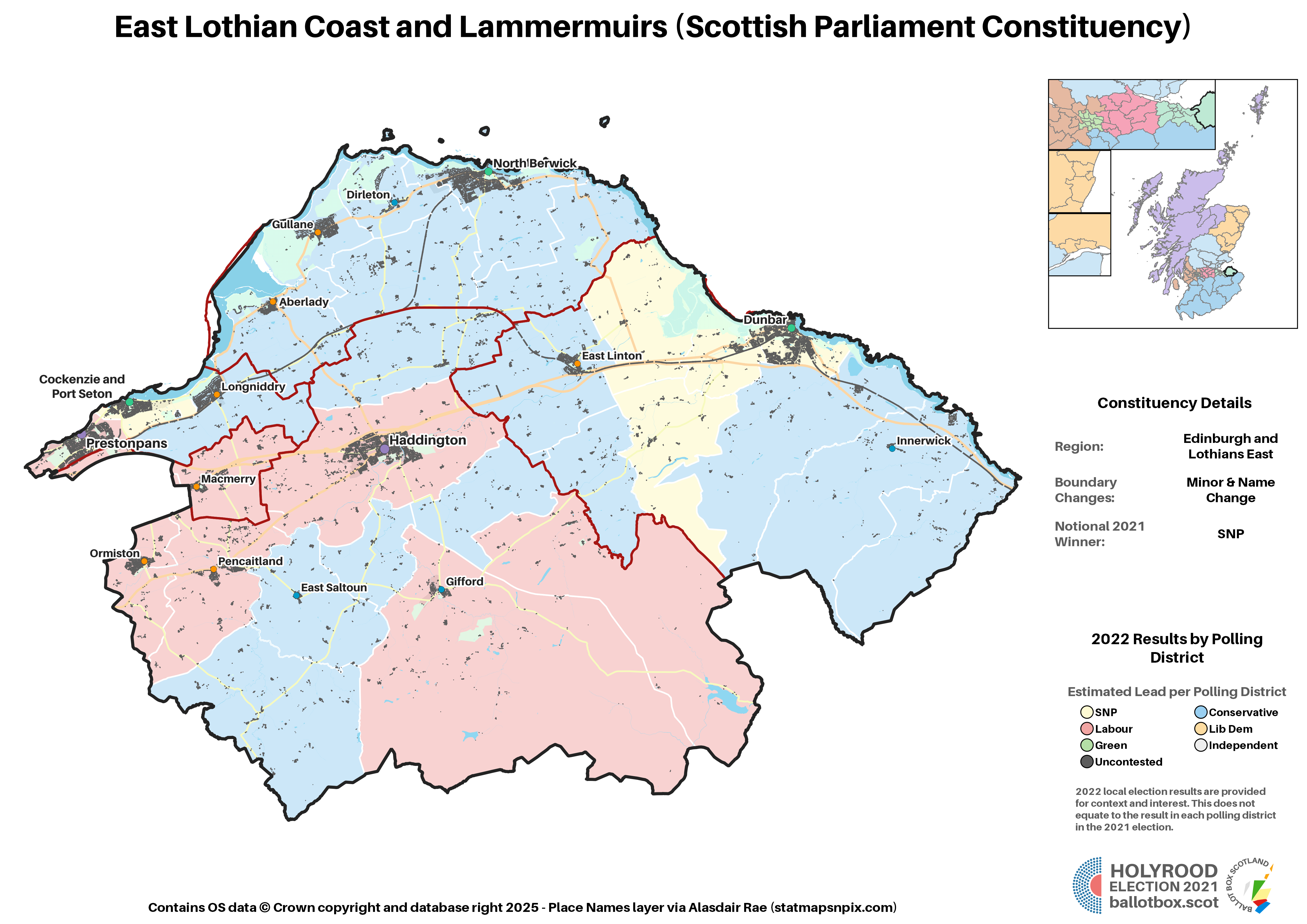
#3: East Lothian Coast and Lammermuirs
Constituency Map
Key Information
Notional 2021 Winner: SNP
Majority: 1518 (3.8%)
Boundary Changes: Loses Tranent and Elphinstone to the new Edinburgh Eastern, Musselburgh and Tranent
Region: Edinburgh and Lothians East
2026 Candidates
SNP: Paul McLennan (*C), L5
Conservative: Miles Briggs (*L), L1
Labour: Martin Whitfield (*L), L5
Lib Dem: Tim McKay
Reform UK: Nigel Douglas, L3
Independent: Morgwn Davies
Notional 2021 Constituency Vote
Notional 2021 Regional Vote
Analysis
Completing a triad of Labour seats, East Lothian Coast and Lammermuirs is in fact an ex-Labour seat at this point. They held the prior East Lothian constituency at every election up until 2021, when the SNP’s Paul McLennan finally picked it up. The addition of “Coast and Lammermuirs” seems to be an attempt to distinguish this slightly redrawn seat, which has lost the area around Tranent. Curious they’d feel the need for such a clarifying renaming here, whilst hugely redrawn Edinburgh seats (Central and Southern) keep their old names!
Anyway, minor as that change may be on the map, it takes some of the strongest Labour territory out of the constituency, hence a slight boost in the SNP’s majority from 2.6% to 3.8%. This is still the easiest seat in the country for Labour to regain from the SNP, but the fact they’ve crashed so hard since their 2024 victory means it’s still very much in play. The fact there’s a huge Conservative vote from last time that will surely be cut to ribbons may also count in Labour’s favour, particularly as East Lothian isn’t somewhere I’d expect to demonstrate Reform support much different from their average.
Who wins here is also highly consequential in the sense that it’s an effective deathmatch between two sitting MSPs. Having been shunted from the South region into the new Edinburgh and Lothians East, neither the SNP’s Paul McLennan or Labour’s Martin Whitfield ranked particularly highly on their party lists, both coincidentally placing fifth. There’s no way Labour end up due five MSPs on their current polling, and even if the SNP are due that many and come up short in constituencies, there’s already a non-constituency candidate higher up the list. Two MSPs enter this contest, but only one will leave.
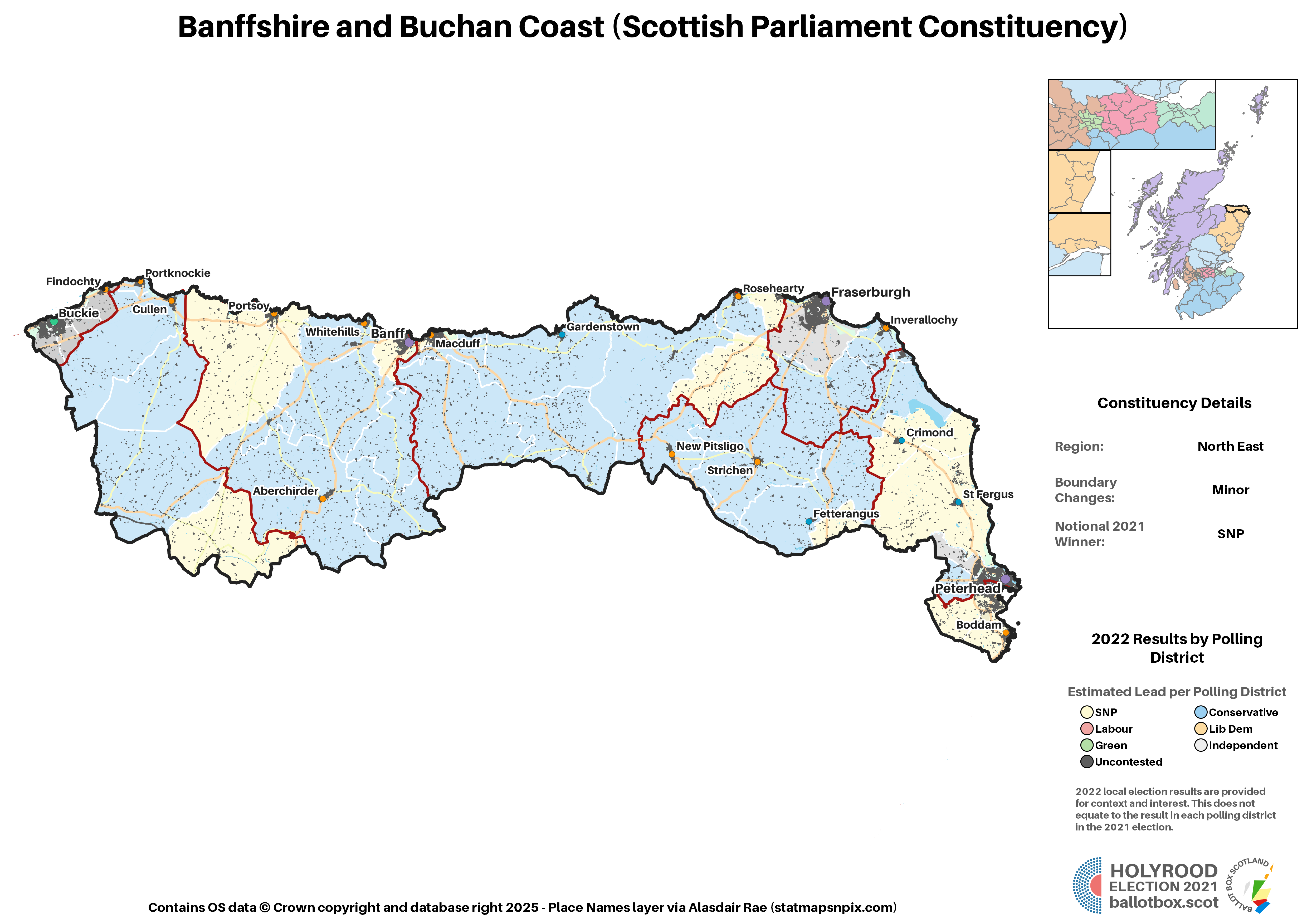
#2: Banffshire and Buchan Coast
Constituency Map
Key Information
Notional 2021 Winner: SNP
Majority: 664 (1.9%)
Boundary Changes: Gains area around New Pitsligo, Strichen, New Leeds and Fetterangus from old Aberdeenshire East
Region: North East
2026 Candidates
SNP: Karen Adam (*C)
Conservative: James Adams, L4
Labour: Brooke Ritchie, L9
Lib Dem: Ian Bailey
Reform UK: Conrad Ritchie, L5
Independent: N D R McLennan
Notional 2021 Constituency Vote
Notional 2021 Regional Vote
Analysis
After our brief Labour diversion, it’s back to SNP-Conservative marginals. A historic SNP heartland and Alex Salmond’s original stomping grounds, Banffshire and Buchan Coast has since become an extremely close contest between them and the Conservatives. New 2021 MSP Karen Adam was already facing a slender majority of 2.3% before boundary changes added a few rural villages (including the late Salmond’s home of Strichen) further eroded that to 1.9%. Her hopes of re-election now depend on just how the right wing vote is split.
For some of the other North East constituencies, I’ve poured cold water on the idea we can expect a 1:1 relationship between Conservative and Reform votes. This constituency is completely different. Much of this area was historically dependent on fishing, and to this day Peterhead is the largest fisheries port not just in Scotland or the UK but in Europe. Nearby Fraserburgh is the fourth largest in Scotland. These areas have been hard hit in recent decades, and a deep dislike of the EU’s Common Fisheries Policy is almost certainly why the UK equivalent constituency both went Conservative in 2017 and is estimated to be the only Scottish constituency to have voted Leave in 2016.
In the 2024 UK election a remarkable Reform share of 14%, twice what they achieved Scotland-wide, contributed to a split in the right wing vote that cost Douglas Ross his seat and gave the SNP their only gain in an otherwise brutal election for them. With Reform now surging and their candidate Conrad Ritchie already having done very well in a Fraserburgh by-election in 2024, I expect them to be in serious contention, and almost certainly going to hole the Conservative campaign below the waterline.
The question is exactly how the combined Conservative and Reform vote is split. Does it become a stunning victory for Reform, as former Conservatives coalesce around them hoping to stop the SNP? Or does a confused electorate being bombarded with “vote for us to stop the SNP” messages from two parties split in such a way that a much-weakened SNP manage to hold on by sitting pretty in the middle? Ironically enough, an overly split right wing vote could cost not just this constituency but an additional list MSP.
With the SNP absolutely wrecking the proportionality in the North East if they win most or all of the constituencies here, a Reform win has the potential to relieve enough pressure on the list that another Reform or Conservative MSP can take up a seat they should be fairly due. On the other hand, if the votes fall ever so slightly differently, it perhaps smooths the way for a Green or Lib Dem MSP. In an election where constituency wins are vastly more consequential than ever before, this seat is particularly impactful.
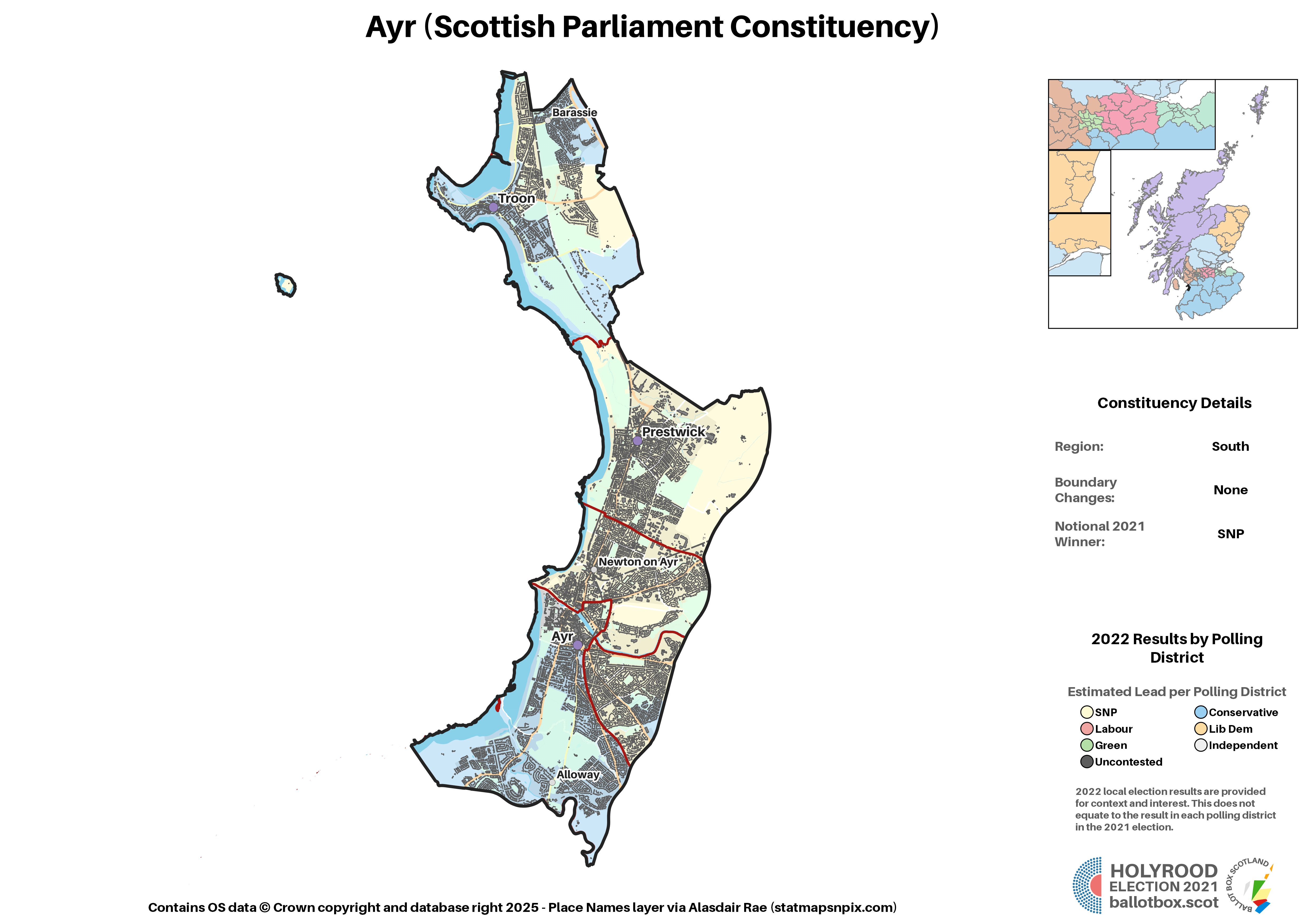
#1: Ayr
Constituency Map
Key Information
Notional 2021 Winner: SNP
Majority: 170 (0.4%)
Boundary Changes: None
Region: South
2026 Candidates
SNP: Siobhian Brown (*C), L4
Conservative: Sharon Dowey (*L), L4
Labour: Brian McGinley, L9
Lib Dem: Desmond Buchanan
Reform UK: Andrew Russell, L8
Common Party: Muhammad Tufail, L2
Independent: Denise Sommerville, L1
2021 Constituency Vote
2021 Regional Vote
Analysis
Here we have it: the most marginal constituency in Scotland. In 2021, the SNP’s Siobhian Brown sent Conservative MSP John Scott packing when she won Ayr by a wafer-thin 0.4%. In so doing, she ejected the longest serving Conservative MSP at Holyrood: they didn’t have any 1999 MSPs left, but Scott had been elected in early 2000 in the first-ever Holyrood by-election. Funnily enough Ayr had been the most marginal constituency in Scotland then too, with Labour winning by just 25 votes, making it an easy Conservative gain when Ian Welsh resigned less than a year into the job.
This has a very good chance of being another deathmatch between two sitting MSPs. On the one hand, the fact the SNP are expected to so substantially exceed their fair share of constituency seats means they are unlikely to win any list seats. If they did, Brown is placed fourth, behind sitting list MSP Emma Harper who has a theoretically harder constituency to win. Conservative MSP Sharon Dowey is likewise ranked fourth on their list, but they may struggle to win any more than three seats.
Indeed, if the Conservatives were to somehow hold all three of their existing South constituencies as well as regain this constituency, they could actually turn the tables on the SNP by being the party to win more constituencies than they are due MSPs overall in this region. This is a particularly sticky seat to try and guess how it will go however, and given the tiny margin, I’m a lot less willing to say “I favour the incumbent when both parties are doing badly” than in other seats.
Large parts of Ayr are the kind of leafy, affluent areas that vote Conservative but aren’t as fertile ground for Reform. Yet other parts are exactly the kind of working class communities that have been turning to Reform in increasing numbers lately. Much like some of the other key seats, it may depend on how much Reform split the vote as to whether the Conservatives can emerge victorious or end up seething as what could otherwise have been a fatally weakened local SNP campaign comes out on top once again.
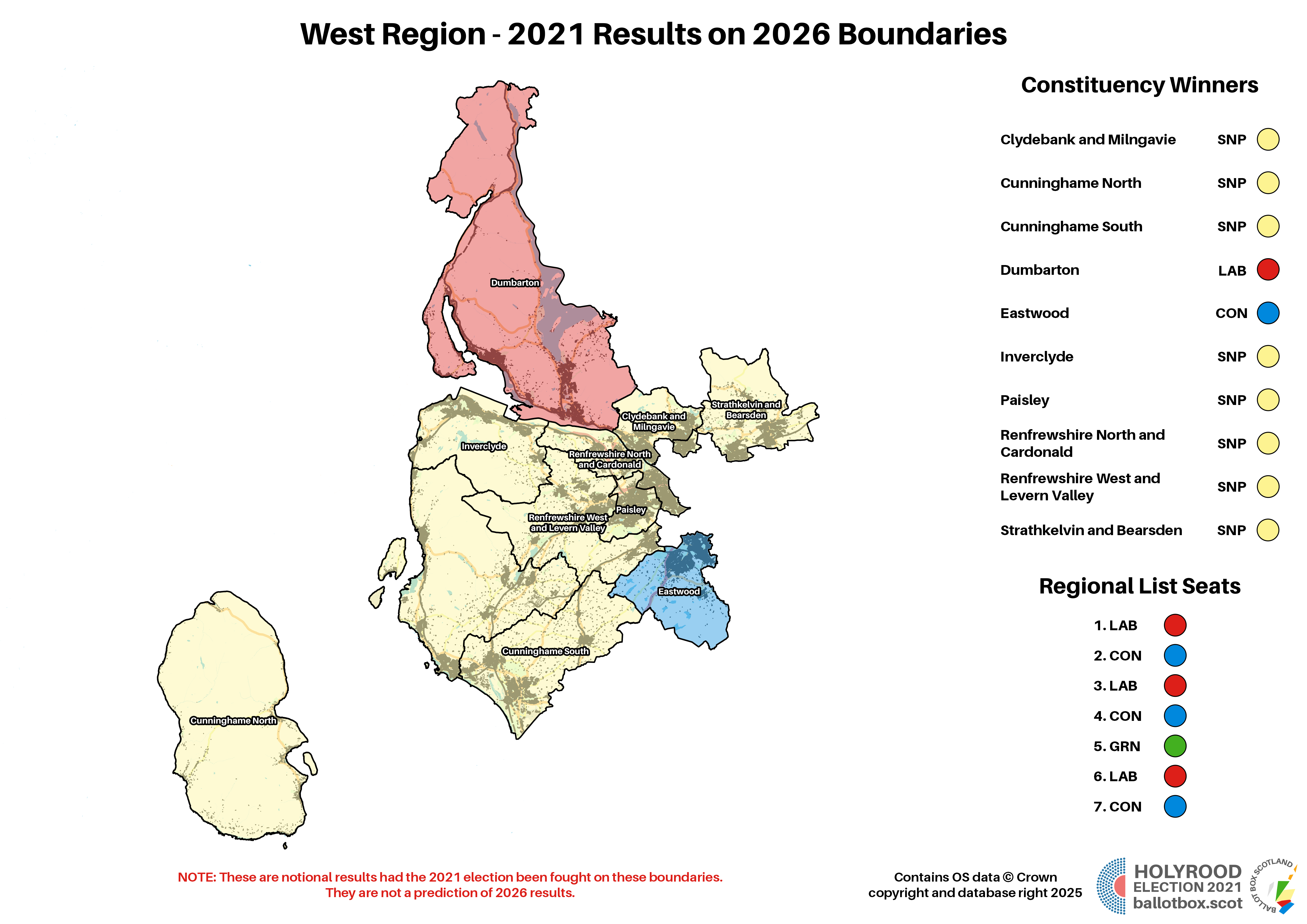
Regional Battleground: West Scotland
Region Map
Notional 2021 Constituency Vote
Notional 2021 Regional Vote
Notional 2021 List MSPs
1:Â Labour
2:Â Conservative
3:Â Labour
4:Â Conservative
5:Â Green
6:Â Labour
7:Â Conservative
Notional 2021 List Seat 7
West Scotland: 2026 Regional List Candidates
The six parties expected to win seats in the Scottish Parliament in 2026 are listed in order of national support in 2021. Remaining parties are in alphabetical order, and Independents listed last.
Candidates that are contesting both the List and Constituency ballot have their constituency noted after their name on the list.
- Stuart McMillan (*C, Inverclyde)
- Kirsten Oswald (Eastwood)
- Michelle Campbell (Renfrewshire North and Cardonald)
- Patricia Gibson (Cunninghame South)
- Kenneth Gibson (*C, Cunninghame North)
- Tom Arthur (*C, Renfrewshire West and Levern Valley)
- Sophie Traynor (Dumbarton)
- Denis Johnston (Strathkelvin and Bearsden)
- Michael Gibbons
- Andrew Steel
- Russell Findlay (*L)
- Jackson Carlaw (*C, Eastwood)
- Pam Gosal (*L, Strathkelvin and Bearsden)
- Alix Mathieson (Clydebank and Milngavie)
- Gary Mulvaney (Dumbarton)
- Maurice Corry (Cunninghame South)
- Jack Hall (Renfrewshire North and Cardonald)
- Ronnie Stalker (Cunninghame North)
- Farooq Choudhury (Renfrewshire West and Levern Valley)
- Ted Runciman (Inverclyde)
- Jackie Baillie (*C, Dumbarton)
- Neil Bibby (*L, Paisley)
- Katy Clark (*L, Cunninghame South)
- Paul O’Kane (*L, Renfrewshire West and Levern Valley)
- Francesca Brennan (Inverclyde)
- Kayleigh Quinn (Eastwood)
- Mike McKirdy (Renfrewshire North and Cardonald)
- Colette McDiarmid (Strathkelvin and Bearsden)
- Matthew McGowan (Cunninghame North)
- Ross Greer (*L)
- Cara McKee
- Karen Sharkey
- Paula Baker
- Ross Collins
- Adam Harley (Strathkelvin and Bearsden)
- Jamie Greene (Inverclyde)
- Christine Murdoch (Cunninghame North)
- Grant Toghill (Renfrewshire North and Cardonald)
- Emma Farthing (Cunninghame South)
- Ross Stalker (Renfrewshire West and Levern Valley)
- Elaine Ford (Dumbarton)
- Malcolm Offord (Inverclyde)
- David Smith (Dumbarton)
- Moira Ramage (Renfrewshire North and Cardonald)
- Mike Mann (Cunninghame North)
- Matthew McLean (Cunninghame South)
- Andy White (Clydebank and Milngavie)
- Ken Thomson
- Ian Gibson (Cunninghame North)
- Gordon Ross
- Simon McLean
- Kenneth McNeil
- Ian Vallance
- Eamon Gallagher
- Claire Gallagher (Clydebank and Milngavie)
- Liam McKechnie
- Luke Reid
- Matt Lynch
- Paul Gallacher
- Colette Walker
- Ian Inkster
Note: Independent Green Voice are a front group for a bunch of Glasgow bampots, led by someone who was expelled from UKIP for alleged Holocaust denial. They are standing purely as a spoiler party in this election, targeting the legitimate Scottish Green Party, and their simple one candidate per region slate is further evidence of this dodgy dealing.
- Allan Steele
- Andrew MacGregor
- Alan Findlay
- Cameron Milne
- James McDaid
- Louise McDaid
- Bobby Cochrane
- Bryan McLardy
- David Jacobsen
- Veronica Edgely
- Jonathan Judge
- Colin Edgely
- Ben Walker
- Mike Pursglove
- Gillian Ammoun
- Paul Mack
- Paddy McCarthy
- William Wallace
Analysis
Home to a couple of key marginals, including the Dumbarton constituency mentioned earlier in this piece, West has probably the second greatest potential for SNP constituency distortion after the North East region. Whilst I tend towards the view that Labour will hold Dumbarton, preventing the kind of clean sweep that is possible in the North East, my model still often suggests the SNP should really only be due 5 MSPs here yet they come out with 9 constituencies.
The knock-on effects on the list would therefore be significant. As mentioned in the Eastwood section of the previous post, it’s entirely possible the Conservatives only end up with one MSP in West, and if they hold Eastwood, it’s curtains for Russell Findlay. That’s despite the fact my model still sometimes puts them on just over 10%, which in a 17 MSP region should be enough for two. Labour’s Paul O’Kane may be at risk for similar reasons, as a theoretically proportionally safe fourth place and just over 20% vote has him nonetheless eliminated in the model.
The Greens too could be affected by this. Co-Leader Ross Greer doesn’t really have much to worry about as their vote share should be enough to elect one MSP, but it could proportionally entitle them to a second that they end up going without. At the time of writing, the BBS model spits out 11% Green and 10.2% Conservative, but only one Green MSP. For a tiny bit of diversity, rather than multiples of 10% and 2 MSPs, we can look at multiples of 5% and single MSPs: Reform are likely to exceed 15% but again, they are down one MSP from their fair share.
At present the party not negatively impacted by this would appear to be the Lib Dems. This region is notionally their second easiest to regain an MSP in after the North East, and my model typically thinks they should manage that. If however they don’t make quite the level of gains predicted, they could be in trouble. If they were to only get a little bit over 5%, then they could lose out to Labour, Reform or the Greens, depending on exact vote distributions.
If you find this or other Ballot Box Scotland output useful and/or interesting, and you can afford to do so, please consider donating to support my work. I love doing this, but it’s a one-man project and takes a lot of time and effort. All donations, no matter how small, are greatly appreciated and extremely helpful.
(About Donations)