As the 2026 Scottish Parliament election approaches, keep up to date with all the latest polling and analysis on Ballot Box Scotland’s Holyrood Hub page!
Poll Details and Context
With two weeks to go until the big day, it’s that most exciting (for me) time of an election campaign: a Ballot Box Scotland exclusive poll! These are only possible thanks to the incredible generosity of my supporters, for which I am immensely grateful. That is especially true this year, because for reasons of… extremely important personal principle, I chose not to renew a previous media partnership that would have split the cost of the poll.
Thankfully I had enough in reserve from past donations to cover the (over £2,000) additional cost. Whilst I crowdfund specifically for election polls, I also set aside a portion of donations received above a certain income threshold, meaning that supporting Ballot Box Scotland is effectively an investment in further content. As ever, if you can afford to do so and haven’t already, please consider chucking a few quid my way here.
Anyway, to the poll! Survation (link to tables) have once again provided this year’s BBS poll, which has actually turned out very neatly, as we’ve heard from a few pollsters since the last Survation. I’m also glad to have a normal, credible poll out there, rather than the recent run of absolutely rotten MRPs, which there is a very good chance I spend some time after the election absolutely ripping chunks out of.
The previous Survation for Holyrood covered the 16th – 23rd of March 2026. The last Survation with Westminster and Independence figures covered the 8th – 12th of January 2026. Changes are shown as (vs that poll / vs last election).
Regional Vote
Change vs Last Poll
Change vs 2021
Margin of error warning!
Even more than usual, the margin of error warning is going here. Four of the six parties are on the same share as the last poll! The only party with significant change is the SNP, who are down a margin-pushing 3%. With only a single digit uptick for Reform, you may wonder where the rest of that went: this is the magic of rounding! There’s relatively little to hang analysis on here except that SNP decrease, which I suggest you keep in mind when you look at the next section.
Perhaps worth noting though is that everyone else is on some kind of edge share in this poll. For Reform, Labour and the Conservatives, these figures are equal to their other peak figures in the current BBS average. I’m interested when a poll has both Conservatives and Reform on their peak shares because I wonder how they square that much combined support for the right-wing parties. It also differs from other polling show, and my expectations of, a weakened Reform share when the day actually arrives.
For the Greens and Lib Dems, it’s their weakest shares this poll echoes. That’s no reason for either of those parties to fear though, as it still represents solid growth versus 2021. For the Greens especially, their tendency to underperform their polling average means 11% with their weakest pollster is a positive sign.
Constituency Vote
Change vs Last Poll
Change vs 2021
Margin of error warning!
This is where the poll gets worrying for the SNP. At first glance, and with the knowledge the SNP have been sitting at 35% for nearly two years, you might be surprised to read that. They key though is that one non-margin of error swing: -7% for the Greens. With a Green presence in only 6 constituencies, they were only an option for respondents who actually live in one of those seats.
My model already discounted the Greens from the other seats, and in last month’s poll spat out 39% (+4) for the SNP, 20% (+1) for Labour, and 9% (+1) for the Lib Dems. In other words, this is an effective 4% decrease for the SNP. Whilst all other increases are within the margin of error (and indeed the Labour and Lib Dems are effectively where they were last month when excluding the Greens), combined with the list vote finding that could suggest a genuine loss of support for the SNP over the last month.
The question I have is: from and to where? I checked tables between polls and it’s not that, at least at a headline level, this represents a firming up of undecided voters: undecided figures are roughly equal in both polls. It’s unlikely SNP voters have gone to the right wing parties (especially given findings elsewhere in the poll), for one thing. However, the margin of error is a fickle mistress, and it’s not impossible that this is just a freak outlier.
If it’s not, this is effectively a joint-worst poll for the SNP alongside More in Common, which hadn’t excluded the Greens but go up to 35% in the BBS model when accounting for that. Whether it’s an outlier or not, this is the best figure for all of Labour, Reform and the Conservatives currently in my average. Given the SNP absolutely do not proportionally deserve a majority and indeed should be losing a huge number of seats, this kind of outcome is a very bad sign for them, and for John Swinney’s always perplexing fixation on a majority…
Seat Projection
Projecting that into seats might give us something like this:
Please see this page for how projections work and important caveats.
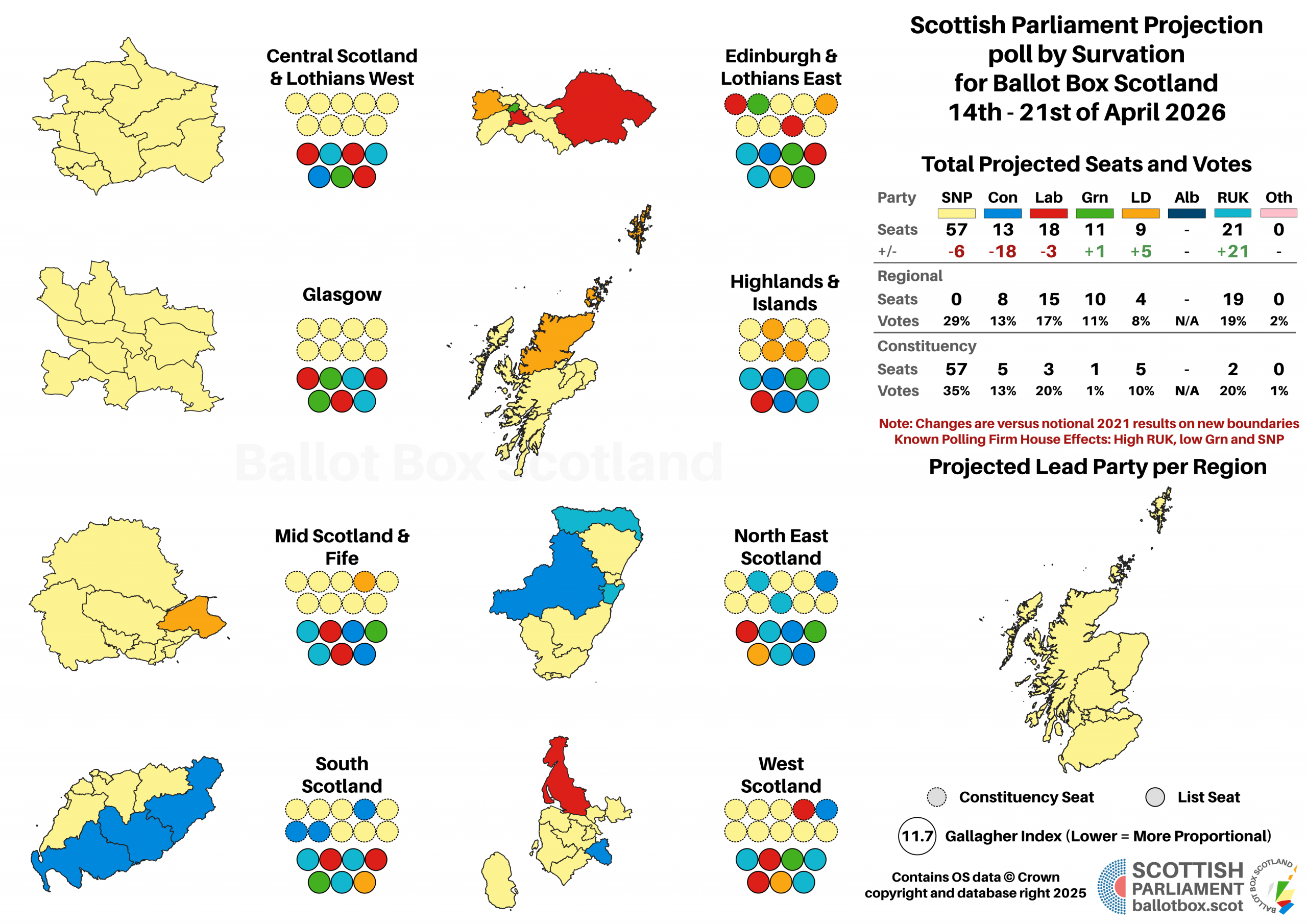
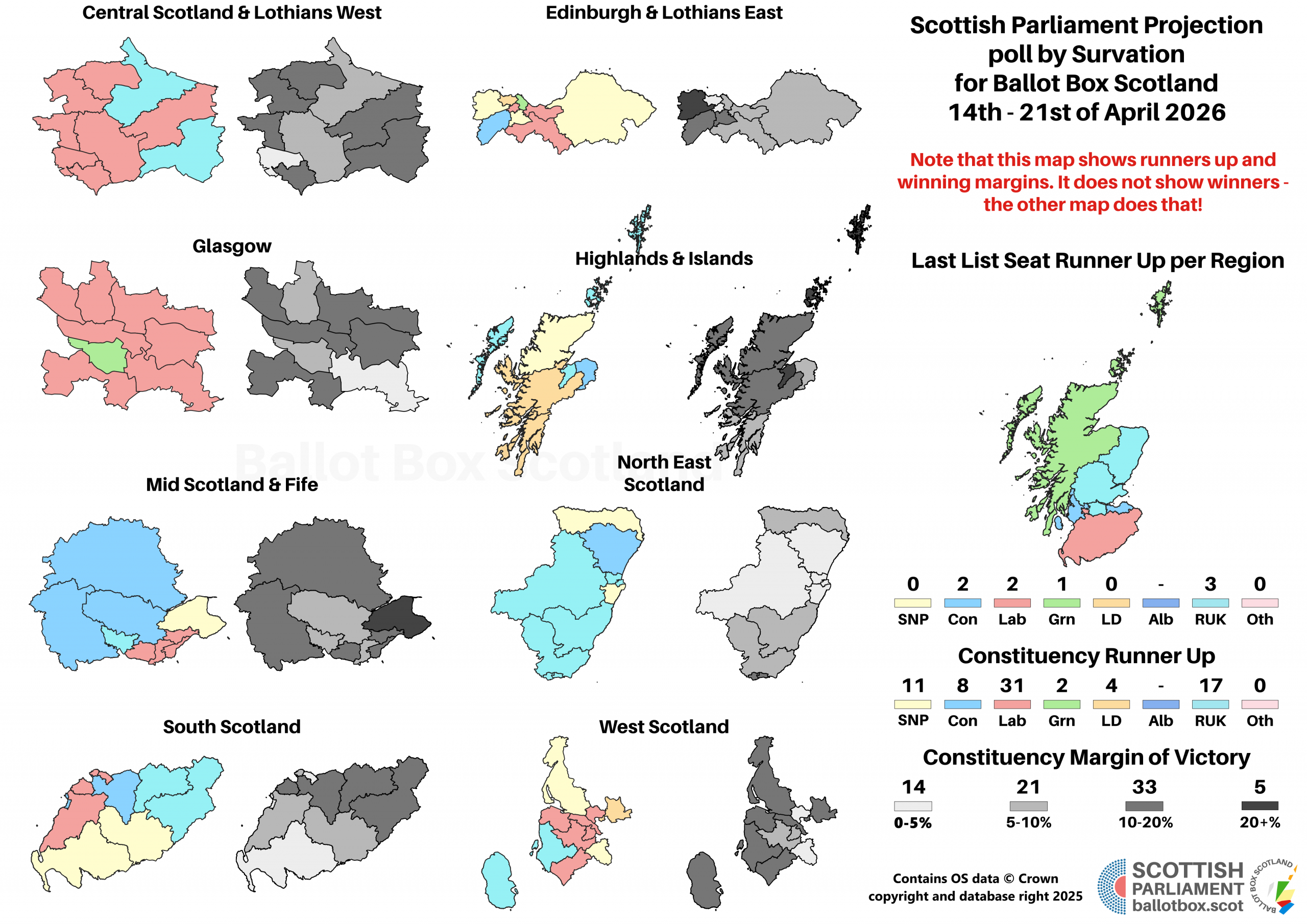
The net result of this is the joint-worst SNP seat total of any recent poll, with a jumbo crop of opposition constituency MSPs. Most notably, and this is where I put my hand up and go “my model starts to get very upset once figures start looking like this”, Aberdeen Deeside and North Kincardine falls into the Reform column. In the very unlikely event that actually happened, Stephen Flynn would have to get very comfortable as the Westminster SNP Group leader, as he’d not be making it to Holyrood. He could console himself with the knowledge that the Conservatives would lose their actual leader thanks to Jackson Carlaw’s resilience in Eastwood too.
Despite the Greens also being on their joint-weakest projection within the current average, that’s enough of a boost on their 2021 result that there would still be 68 seats for a Pro-Independence majority. Not very many seats more have to fall to tilt that towards the Pro-Union camp, which doesn’t automatically bar John Swinney from Bute House, but would certainly make it harder for him.
I have always been sceptical that the SNP could achieve a majority this year, given the headwinds against them, and if polling like this was to take real form on the day, he and his party will only have themselves to blame for a narrative that will be “well, you’ve fallen short of your goal” rather than “wow, you’ve done well to hold onto so many seats after 2024!” Of course, this poll could be an outlier, and maybe we’ll all be saying “well that was bold but jeezy peeps did it pay off!” Who can truly say?
Possible Majorities
Note: these majorities relate simply to passing a vote in the Scottish Parliament. They do not imply the formation of a full coalition government.
- Traffic Light: Labour, Lib Dem and Green
- Independence Bloc: SNP, Green and Alba
- Grand Coalition: SNP and Labour
- Union Bloc: Labour, Conservative, Lib Dem and Reform UK
Change vs Last Poll
Change vs 2024
Margin of error warning!
At Westminster level, the general vibe is a lot less interesting than Holyrood. Differences are entirely within margin of error, though they do have Labour re-gaining ground on Reform. This is the best Reform share on this vote for a few polls, something I do look a little quizzically at given their downward trend at UK-level, and it’s the joint worst for the Conservatives since the election. The SNP and Greens are also on recent but not all-term lows, which fits with the general low findings for both parties elsewhere in the poll.
Change vs Last Poll
Change vs 2014
Margin of error warning!
The constitutional question remains as it always does: pretty stuck! Independence is a smidge ahead but within what is a statistical tie, and substantially outstripping the support for Pro-Independence parties in parliamentary voting intention. Nothing exciting here for the time being.
Other Questions
It wouldn’t be a Ballot Box Scotland poll if I didn’t ask some other questions around democratic systems and so on! Some of these are quite interesting, some tell us roughly what we’d expect, and some are admittedly pretty niche.
Views on Cross-Constitutional Working
Although Scotland remains quite stuck on the constitution, it isn’t as all-consuming as it was before, and this election may result in the greatest need for cross-constitutional working. As such, it was useful to test voter’s views on such co-operation: “Regardless of your own position on Independence and the Union, which of the following statements comes closest to your views?”
- I would rather parties with similar policies in other areas work together, even if they disagree on Independence and the Union
- I would rather parties only work together when they agree on Independence and the Union, even if they have similar policies in other areas
- Don’t Know
Perhaps unsurprisingly, voters would generally prefer parties to work together across the constitutional divide, with more than twice as many people taking that view than extreme constitutional campism. A majority of every party’s supporters take the position, though with substantial variance. Those voting Lib Dem on the list are the most likely to think everyone should get along at 77%, followed by the Greens and Labour on 69%, Reform on 57%, the SNP on 55% and Conservatives on 54%.
Least preferred Government party
With the previous question in mind, it would also be helpful to know who voters are least happy with participating in government: “Which party would you least like to be part of the next Scottish Government?”
No prizes for guessing but the clear, err, losers here are Reform UK. Not only do twice as many voters mark them out as most repugnant to them than did the SNP, but the intensity of feeling is unmatched: 78% of Green list voters, 56% of Labour and 52% of SNP don’t want them anywhere near government. In genuinely one of my favourite “you can never truly fathom how utterly inconsistent voters are” findings in history, only about 31% of Lib Dems were most hostile to Reform. That was a statistical tie with the 29% who said the SNP.
Now, we need to bear in mind the small size of the samples here, but I absolutely love this. The voters who were the most “can’t everyone just work together on things they agree on?” are also the ones most bitterly divided amongst themselves as to whether the SNP (objectively closer to the Lib Dems on non-constitutional matters) or Reform (objectively hostile to the basic principles of liberalism) would be worse. Incredible stuff.
Otherwise though, the remainder of the list falls as you’d expect. Hostility to the SNP and Greens was primarily amongst the Pro-Union parties, especially Reform and the Conservatives. Reform and Conservative voters were also somewhat more hostile to Labour than the reverse. About as many SNP (19%) and Labour (16%) voters identified the other party as their least preferred option, and only 7% of Labour voters picked the Greens. In other words, though all of these parties may not be one another’s favourites, their voters are much more worried about Reform than one another.
Preferred Form of Government
We’re now into the section which I would title “ways in which voters are wrong.” I can say that because I’m a nerd and not an elected representative or someone looking to be elected, and also because I recognise this is a matter of acculturation and salience. The answers that follow, which I fully admit go against my personal democratic systems positions, are born of the fact that people are used to how our system currently works and haven’t really thought about how bad that is.
Anyway, the first of these was: “The Scottish Parliament’s proportional voting system means that it is rare for a single party to win a majority of seats. Which of the following government arrangements would you support the most, if any?”
- A majority government of one single party, who can deliver their own policy agenda
- A coalition government of two or more parties, who agree to deliver a shared policy agenda
- A minority government of one party, which delivers individual policies with support from other parties
- Don’t Know
Unsurprisingly given the UK’s embedded First Past the Post culture, single party majority government was the most popular outcome. It’s okay, you’re allowed to be wrong. Holyrood has a proportional system, that is good for voter representation, but it usually requires cross-party co-operation. My reading of this is, frankly, that our political parties have failed to make the case for working collaboratively at Holyrood, and that is one of the great disappointments of devolution. In fairness it’s hard to build a proportional, consensual culture in the majoritarian, adversarial UK, but it’s to all of our detriment that is the case.
Preferred Approach to Electoral Boundaries
A big feature of this election is of course the new boundaries. If you live in the northernmost three regions, you are almost entirely unaffected by these, with only a few hundred voters in six constituencies being shuffled about. Everywhere else you have had either massive changes to your constituencies (Glasgow, Edinburgh and Lothians East, West), your region (South), or both (Central Scotland and Lothians West): “Election boundaries in Scotland must be changed regularly to make sure each constituency has roughly the same number of voters. In other countries that have more proportional voting systems, larger constituencies are used and they change the number of seats to fit the number of voters. Which of these approaches would you most prefer?”
- A single local representative for my area, even if that means having a less proportional voting system that requires regular boundary changes
- A more proportional voting system that doesn’t require boundary changes, even if that means not having a single local representative
- Don’t Know
In fairness, voters are only wrong by a small margin on this one, and there’s a very large chunk of Don’t Knows. Statistically this is a tie between being so attached (again, due to reasons of political culture, not to objective effectiveness) of single-member constituencies they people will accept regular boundary changes, versus preferring not to have the bother though that means not having a single local person to shout at.
The thing is, voters themselves kind of know they are wrong if they think about it: they hate boundary changes! It drives them up the wall! They don’t understand them! If you want to see some of the angriest people in your life, look at the responses to boundary reviews. People will freak out about the impacts on their house prices (there aren’t any), being moved council area (you aren’t), or call it a deliberate gerrymandering exercise (it isn’t)! They also don’t understand why their constituency has to cross council boundaries, and so on.
A good voting system (not you, STV) avoids the complexities and inadvertent warping of electoral outcomes by aligning boundaries with other levels of government and then sticking to that. It’s silly that Ayrshire is split between two regions. It’s silly that Lanarkshire is split between three, by dint of South Lanarkshire alone being so split. It’s silly that the Glasgow region doesn’t have all of Glasgow in it, but does have Rutherglen and Cambuslang. We resolve that by aligning to council boundaries and changing seat numbers instead of boundaries.
Awareness of Boundary Changes
The last question was nice and simple, just asking voters about their awareness of boundary changes: “Which of the following statements most closely reflects the position you are in ahead of this year’s Scottish Parliament election?”
- I am aware of the boundary changes and how they affect my own constituency and region
- I am aware of the boundary changes, but not how they affect my own constituency and region
- I was not aware the boundaries had changed
- Don’t Know
Slightly surprisingly, about half of voters say they were aware boundaries had changed. I actually expected less than that because it is something that, for all people don’t like it when they are aware, they admittedly aren’t often. Nonetheless, more than a third of voters were outright unaware that boundaries had changed. 15% didn’t know what they didn’t know: positively Rumsfeldian!
I did check this against the regional breakdown, but there’s nothing statistically significant in there. It could have been that voters in areas with substantial changes might have been more aware, and those in areas without understandably less so, but not really. Some of the most changed regions were slightly above average for any awareness, but not all of them, and likewise the least changed regions were a bit less aware, but not all of them.
Hypotheticals
As ever, the last little bit of analysis concerns those hypothetical and more proportional voting systems that BBS likes to play about with. The use of pure FPTP at Westminster is an affront to democracy, and though Holyrood fares far better, AMS is still deeply imperfect. The examples here simply transpose the poll findings onto more proportional voting systems – the reality is that different systems would of course result in different voter behaviour.
Scandinavian Style Westminster
If you find this or other Ballot Box Scotland output useful and/or interesting, and you can afford to do so, please consider donating to support my work. I love doing this, but it’s a one-man project and takes a lot of time and effort. All donations, no matter how small, are greatly appreciated and extremely helpful.
(About Donations)